
Prayer
The Mysteries of the Rosary
The fifteen mysteries of the traditional Rosary — Joyful, Sorrowful, and Glorious — what each one is, the fruit it asks, and which mysteries are prayed on which day.
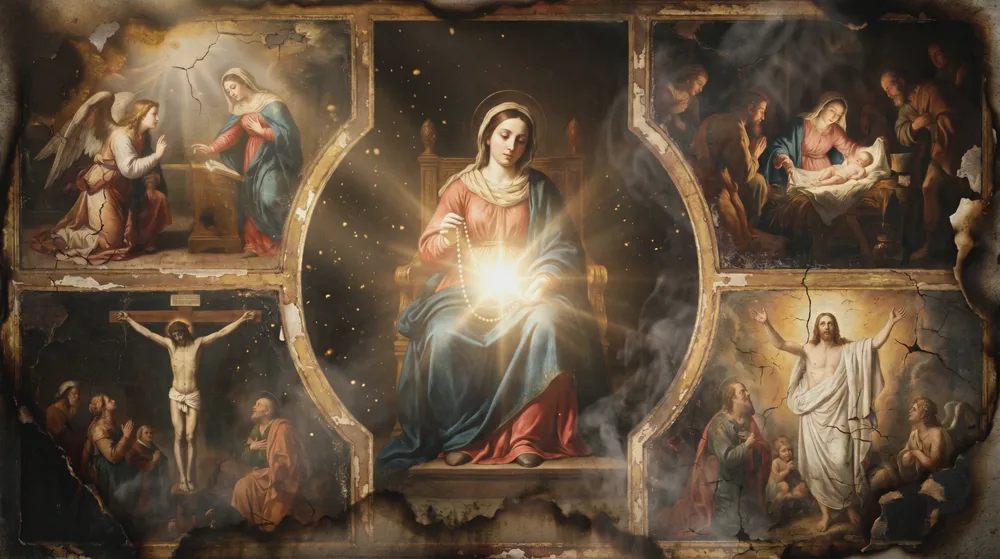
To pray the Rosary is to meditate on its mysteries — fifteen scenes from the life of Our Lord and His Mother, held before the mind while the Hail Mary is repeated. The beads count; the mind contemplates. The traditional Rosary has fifteen mysteries in three sets of five — the Joyful, the Sorrowful, and the Glorious — one set prayed each day. Here is what each mystery is, the fruit it asks, and the day on which it is prayed. (For how to pray the beads themselves, see How to Pray the Rosary.)
Which mysteries are prayed today?
In the traditional usage, the three sets fall across the week like this:
- Joyful Mysteries — Monday and Thursday
- Sorrowful Mysteries — Tuesday and Friday
- Glorious Mysteries — Wednesday, Saturday, and Sunday
So the set depends on the day. (Iter Fidei shows you today's mysteries automatically — with each mystery, its meditation, and audio to pray along — in the app.)
Thursday: the mysteries of the Holy Rosary
On Thursday the traditional Rosary prays the Joyful Mysteries — the Annunciation, the Visitation, the Nativity, the Presentation, and the Finding in the Temple. Thursday shares the Joyful set with Monday, so the same five scenes of the Incarnation and the hidden life of Christ are held before the mind on both days.
Saturday: the mysteries of the Holy Rosary
On Saturday the traditional Rosary prays the Glorious Mysteries — the Resurrection, the Ascension, the Descent of the Holy Ghost, the Assumption, and the Coronation. Saturday is by ancient custom a day given to Our Lady, and the Glorious set closes with her Assumption and Coronation, fitting that Marian character. (Saturday shares the Glorious Mysteries with Wednesday and Sunday.)
The Joyful Mysteries (Monday, Thursday)
Meditations on the Incarnation and the hidden life of Christ.
- The Annunciation — the Angel Gabriel announces, and Mary consents; the Word is made flesh. Fruit: humility.
- The Visitation — Mary carries Christ to Elizabeth, who is filled with the Holy Ghost. Fruit: charity.
- The Nativity — Christ is born in Bethlehem, in poverty. Fruit: poverty of spirit.
- The Presentation — the Child is offered in the Temple; Simeon foretells the sword. Fruit: obedience.
- The Finding in the Temple — the lost Child is found among the doctors, about His Father's business. Fruit: piety.
The Sorrowful Mysteries (Tuesday, Friday)
Meditations on the Passion of Our Lord.
- The Agony in the Garden — Christ sweats blood under the weight of our sins. Fruit: contrition.
- The Scourging at the Pillar — He is torn for our sake. Fruit: purity.
- The Crowning with Thorns — the King of Heaven is mocked and crowned with thorns. Fruit: courage.
- The Carrying of the Cross — He bears the wood to Calvary. Fruit: patience.
- The Crucifixion — He dies upon the Cross for the salvation of the world. Fruit: perseverance.
The Glorious Mysteries (Wednesday, Saturday, Sunday)
Meditations on the triumph of Christ and His Mother.
- The Resurrection — Christ rises, conquering death. Fruit: faith.
- The Ascension — He returns in glory to the Father. Fruit: hope.
- The Descent of the Holy Ghost — the Spirit descends upon the Apostles at Pentecost. Fruit: love of God.
- The Assumption — Our Lady is taken up, body and soul, into Heaven. Fruit: a happy death.
- The Coronation — she is crowned Queen of Heaven and earth. Fruit: devotion to Mary.
How the mysteries are prayed
You announce a mystery at the start of each decade, then pray one Our Father, ten Hail Marys, and a Glory Be, holding the scene before your mind throughout. Five decades — one set of five mysteries — make the daily Rosary, told upon the parts of a rosary, each decade marked by its beads. The whole Rosary of fifteen mysteries is completed across the days of the week.
These fifteen are the Rosary as the Church prayed and indulgenced it for centuries. (The five "Luminous" mysteries are a later addition of 2002 and lie outside the traditional Rosary.)
The Rosary mysteries during Lent
In the traditional usage the mysteries follow the day of the week all year round; Lent does not change which mysteries fall on which day. The Joyful are still prayed on Monday and Thursday, the Sorrowful on Tuesday and Friday, the Glorious on Wednesday, Saturday, and Sunday.
What Lent invites is not a new schedule but a deeper dwelling on the Passion. Many of the faithful keep to the day's appointed set yet linger over the Sorrowful Mysteries — the Agony, the Scourging, the Crowning with Thorns, the Carrying of the Cross, and the Crucifixion — as the season's special meditation, since these scenes are the very matter of Holy Week. Others choose simply to pray the Sorrowful set more often during the forty days. Either way the season's spirit is one of penance and compassion for the suffering of Our Lord, which the Sorrowful Mysteries set most plainly before the mind.
Frequently Asked Questions
What are the mysteries of the Rosary?
The mysteries are fifteen scenes from the life of Our Lord and His Mother, meditated upon while the Hail Mary is repeated. They are grouped in three sets of five — the Joyful (the Incarnation and hidden life of Christ), the Sorrowful (His Passion), and the Glorious (His triumph and the glory of Our Lady). The mind contemplates the scene while the beads count the prayers; this meditation is the very soul of the devotion.
How many mysteries of the Rosary are there?
The traditional Rosary has fifteen mysteries, in three sets of five — Joyful, Sorrowful, and Glorious. One set of five is prayed each day, and the whole fifteen are completed across the week. This is the Rosary as the Church prayed and indulgenced it for centuries; the five "Luminous" mysteries are a later addition of 2002 and lie outside the traditional fifteen.
What are the 5 mysteries of the Rosary in order?
Each set has its own five, prayed in order. The Joyful: the Annunciation, the Visitation, the Nativity, the Presentation, and the Finding in the Temple. The Sorrowful: the Agony in the Garden, the Scourging at the Pillar, the Crowning with Thorns, the Carrying of the Cross, and the Crucifixion. The Glorious: the Resurrection, the Ascension, the Descent of the Holy Ghost, the Assumption, and the Coronation.
What are the 5 mysteries of the Rosary and days?
In the traditional usage the three sets fall across the week thus: the Joyful Mysteries on Monday and Thursday, the Sorrowful on Tuesday and Friday, and the Glorious on Wednesday, Saturday, and Sunday. Each set has its own five mysteries, so the set you pray depends on the day.
What mysteries of the Rosary are said today?
The set depends on the day of the week: Joyful on Monday and Thursday, Sorrowful on Tuesday and Friday, and Glorious on Wednesday, Saturday, and Sunday. (Iter Fidei shows you today's mysteries automatically in the app, so you need not count the days.)
How to pray the Sorrowful Mysteries of the Rosary?
You pray five decades, announcing one Sorrowful Mystery at the start of each: the Agony in the Garden, the Scourging at the Pillar, the Crowning with Thorns, the Carrying of the Cross, and the Crucifixion. For each, announce the mystery, then pray one Our Father, ten Hail Marys, and a Glory Be, holding the scene of the Passion before your mind throughout. The Sorrowful Mysteries are prayed on Tuesday and Friday.
What are the Joyful Mysteries of the Rosary?
The five Joyful Mysteries are meditations on the Incarnation and the hidden life of Christ: the Annunciation, the Visitation, the Nativity, the Presentation in the Temple, and the Finding in the Temple. They are prayed on Monday and Thursday, and their fruits are humility, charity, poverty of spirit, obedience, and piety.
What are the Glorious Mysteries of the Rosary?
The five Glorious Mysteries are meditations on the triumph of Christ and His Mother: the Resurrection, the Ascension, the Descent of the Holy Ghost at Pentecost, the Assumption of Our Lady, and her Coronation as Queen of Heaven. They are prayed on Wednesday, Saturday, and Sunday, and their fruits are faith, hope, love of God, a happy death, and devotion to Mary.
What are the Sorrowful Mysteries of the Rosary?
The five Sorrowful Mysteries are meditations on the Passion of Our Lord: the Agony in the Garden, the Scourging at the Pillar, the Crowning with Thorns, the Carrying of the Cross, and the Crucifixion. They are prayed on Tuesday and Friday, and their fruits are contrition, purity, courage, patience, and perseverance.
What are the Saturday mysteries of the Holy Rosary?
On Saturday the traditional Rosary prays the Glorious Mysteries — the Resurrection, the Ascension, the Descent of the Holy Ghost, the Assumption, and the Coronation. Saturday is by ancient custom a day given to Our Lady, and the Glorious set fittingly closes with her Assumption and Coronation.
What are the Thursday mysteries of the Holy Rosary?
On Thursday the traditional Rosary prays the Joyful Mysteries — the Annunciation, the Visitation, the Nativity, the Presentation, and the Finding in the Temple. Thursday shares the Joyful set with Monday.
What are the Rosary mysteries during Lent?
In the traditional usage Lent does not change which mysteries fall on which day: the Joyful are still prayed on Monday and Thursday, the Sorrowful on Tuesday and Friday, the Glorious on Wednesday, Saturday, and Sunday. What the season invites is a deeper dwelling on the Passion, so many of the faithful give special attention to the Sorrowful Mysteries through Lent, since these scenes are the matter of Holy Week.
What are the Luminous Mysteries of the Rosary?
The five Luminous Mysteries — the Baptism in the Jordan, the wedding at Cana, the proclamation of the Kingdom, the Transfiguration, and the institution of the Eucharist — were proposed in 2002 and are a later addition. They lie outside the traditional Rosary of fifteen mysteries, which the Church prayed and indulgenced for centuries. We keep to the fifteen as handed down.
(To pray each mystery with its meditation, the prayers in Latin and English, and audio for every decade — and to see today's mysteries without having to count the days — Iter Fidei serves the full traditional Rosary in the app.) Download it here.
Sources. The traditional Holy Rosary (fifteen mysteries); the Gospels of the Joyful, Sorrowful, and Glorious mysteries.