
Our Lady
Our Lady of Mount Carmel and the Brown Scapular
Our Lady of Mount Carmel is the title under which the Blessed Virgin Mary is honoured as patroness of the Carmelite Order, kept on July 16; according to Carmelite tradition she gave the Brown Scapular to St Simon Stock as a sign of her protection.
Our Lady of Mount Carmel is the title under which the Catholic Church honours the Blessed Virgin Mary as the patroness of the Carmelite Order, kept each year on July 16. The meaning of Our Lady of Mount Carmel is bound to a sign she is said to have given: according to Carmelite tradition, the Virgin appeared to St Simon Stock and placed in his hands the Brown Scapular, the small garment worn ever since as a token of her protection. The feast we keep is the "scapular feast," and the devotion it carries is one of the most widespread in the Church.
What Our Lady of Mount Carmel means
The name reaches back to Mount Carmel itself, the high ridge in the Holy Land overlooking the sea where, in the days of the Old Law, the prophet Elias confounded the priests of Baal and where, by ancient tradition, hermits gathered to live a life of prayer in the spirit of that prophet. From this mountain the Carmelite Order takes its name and traces its origin. When the friars came west, they brought with them their devotion to the Virgin under whose patronage they had placed themselves, and so Mary came to be honoured as Our Lady of Mount Carmel — the Mother and patroness of the order born upon that holy hill.
The feast did not begin as a separate celebration. As Butler records, the patronal feast of the Carmelites was at first the Assumption of the Blessed Virgin on August 15. Between 1376 and 1386 the custom arose of keeping a special feast of Our Lady to celebrate the approval of the Carmelite rule by Pope Honorius III in 1226. This custom appears to have begun in England, and the day was fixed for July 16.
The Brown Scapular given to St Simon Stock
July 16 is also the date on which, according to Carmelite tradition, Our Lady appeared to St Simon Stock and gave him the scapular. Simon was an Englishman, general of the order in the thirteenth century, who governed his brethren in a time of difficulty. The tradition holds that the Virgin showed herself to him bearing in her hands the brown habit-cloth of the order — the scapular — and gave it to him as a pledge of her care for all who would wear it.
The scapular of Our Lady of Mount Carmel is, in its full form, two panels of brown wool joined by cords and worn over the shoulders, the lesser sign of the full religious habit. The faithful who are not Carmelites are received into the confraternity and wear the small scapular: two squares of brown cloth, one resting on the breast and one on the back. It is not an ornament but a habit in miniature — a way of clothing oneself, in small, in the livery of the Mother of God. The Church has long blessed this practice; the scapular is mentioned in the proper preface used by the Carmelites on this feast.
We speak here with the sobriety the Church herself observes. The narrative of the apparition to St Simon Stock rests upon the tradition of the order rather than upon a defined article of faith, and the Church has never bound the conscience to believe the circumstances of the vision. What the Church has done, plainly and repeatedly, is approve and enrich the wearing of the scapular as a true and fruitful devotion to the Blessed Virgin. The garment matters not for any power in the wool, but for what it signifies and what it commits the wearer to: a life given over to Mary.
The Sabbatine promise
To the scapular is attached what is called the Sabbatine promise. The name comes from Sabbatum, Saturday — the day the Church has from of old consecrated to Our Lady. The tradition holds that the Blessed Virgin promised her special help, after death, to those who have worn her scapular faithfully, observed chastity according to their state, and recited the Office of Our Lady (or, by dispensation, kept the appointed abstinences), interceding for them and obtaining their swifter deliverance from the pains of Purgatory.
Here again we hold to what the Church holds. The Sabbatine privilege has been the subject of caution and of careful wording on the part of authority, which has permitted the faithful to hope piously for Mary's powerful intercession on behalf of the souls in Purgatory, without sanctioning any reading that would make the scapular a charm or a guarantee dispensing from a holy life. The promise is not a license to sin in the confidence of being saved by a piece of cloth. It is a pledge made to those who wear the sign and live what it signifies — who keep chastity, pray, and persevere. So understood, it is a comfort wholly within the Church's constant teaching on Mary's intercession and on the Communion of Saints.
A prayer to Our Lady of Mount Carmel
The simplest prayer to Our Lady of Mount Carmel is the one the wearer says in placing himself under her protection. The traditional invocation runs:
O most beautiful Flower of Mount Carmel, fruitful Vine, Splendour of Heaven, Blessed Mother of the Son of God, Immaculate Virgin, assist me in my necessity. O Star of the Sea, help me and show me herein that thou art my Mother. O holy Mary, Mother of God, Queen of Heaven and earth, I humbly beseech thee from the bottom of my heart to succour me in this my necessity; there are none that can withstand thy power. O show me herein that thou art my Mother. O Mary, conceived without sin, pray for us who have recourse to thee. Amen.
A shorter ejaculation, fitting for the morning when the scapular is put on, is simply: Our Lady of Mount Carmel, pray for us. The Carmelite proper of July 16 also draws on the Church's older Marian prayer, the Sub tuum praesidium — "We fly to thy patronage, O holy Mother of God" — which gathers in a single breath what the scapular says without words: that we take refuge under her mantle. These prayers ask nothing of the cloth and everything of the Mother; they are the act of trust the garment is meant to make habitual.
The message and the devotion
The scapular says one thing, and says it without words: I belong to Mary. To put it on each morning is to renew a quiet consecration, to walk through the day clothed in her livery, to ask her protection in the hour of death — for the wearer means to die in the habit, however small, of her household. This is the heart of the devotion, and it asks for the whole of the wearer, not merely his shoulders.
The honour we pay to Our Lady of Mount Carmel is the honour due to her divine Motherhood, the root of all her dignity and of her power to help us; she is venerated here, as everywhere, because she is the Mother of God. The Mother to whom the scapular consecrates us is the same Mother whom the Church invokes after the Our Father in every Hail Mary, mighty in intercession because, as the older catechisms teach, it is impossible that her Son should not hear her.
To wear her scapular is to place oneself, body and soul, under that intercession — the same intercession the faithful seek under her many titles, whether they bring her their tangled cares as Our Lady, Undoer of Knots, pray with her for the conversion of sinners as Our Lady of Champion, who so named herself in Wisconsin in 1859, or commend their death to her as Our Lady of Mount Carmel.
The devotion is bound to the Carmelite Order but belongs now to the whole Church. At the beginning of the seventeenth century the day became definitively the scapular feast and began to be kept beyond the order; in 1726 Pope Benedict XIII extended it to the whole Western Church. From a single mountain in the Holy Land, the devotion has gone out to the ends of the earth, as widespread now as the love the New World bears Our Lady of Guadalupe, and the small brown garment is worn today by countless faithful who have never seen Carmel.
How Our Lady of Mount Carmel is depicted
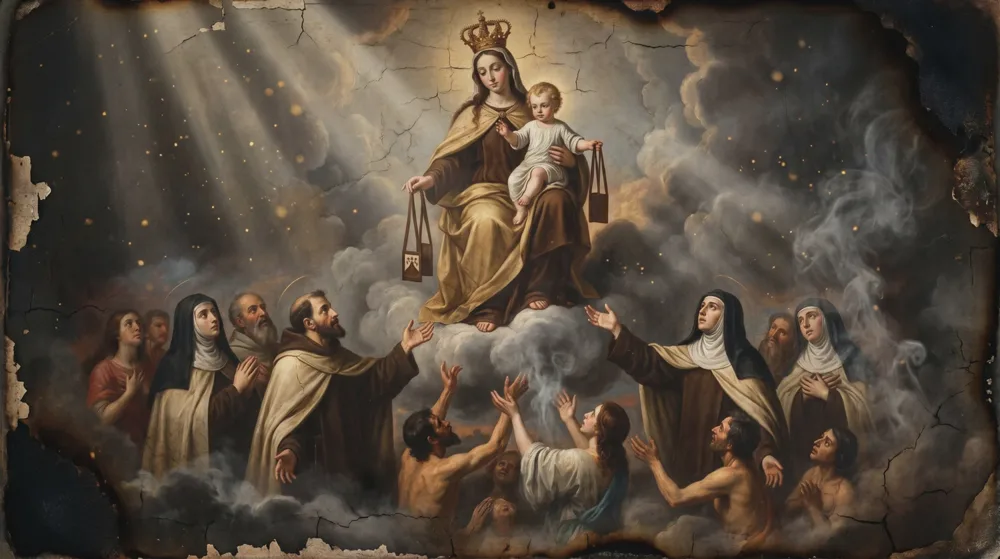
Those who look for pictures of Our Lady of Mount Carmel will find a recognisable image, settled over centuries. She is shown crowned, often as Queen of Heaven, holding the Child Jesus; in one hand, or held out by the Child, hangs the Brown Scapular. Frequently St Simon Stock kneels at her feet to receive it, and at the lower edge of the older images the flames of Purgatory are painted, with souls reaching up toward the scapular she lowers to them — a visual statement of the Sabbatine hope.
The Carmelite habit, brown with a white mantle, colours the whole composition. The image is not a portrait but a teaching: every element — crown, Child, scapular, souls — sets out what the title means. We venerate the image, as the Church has always taught, for the sake of the person it represents, never for any virtue in paint or wood.
Shrines and the holy places of Carmel
The devotion has its shrines, and pilgrims often look for the national shrine, the shrine church, or the basilica of Our Lady of Mount Carmel. The first holy place is Mount Carmel itself, in the Holy Land, where the prophet Elias is venerated and where the Carmelite Order keeps its house at the Stella Maris monastery overlooking the sea.
From that root the devotion has spread, and churches, shrines, and basilicas under this title are found across the Catholic world, raised by the Carmelites and by the faithful who wear her sign. We do not list local mass times or parish details here — those belong to each church's own notices — but the meaning is one wherever her shrine stands: it marks a place where Mary is honoured as Mother and patroness, and where the faithful come to be enrolled in her scapular and commend themselves to her care.
Frequently Asked Questions
Who is Our Lady of Mount Carmel?
Our Lady of Mount Carmel is the title under which the Catholic Church honours the Blessed Virgin Mary as patroness of the Carmelite Order, whose feast is kept on July 16. The title reaches back to Mount Carmel in the Holy Land, where the prophet Elias confounded the priests of Baal and where hermits later gathered in prayer; from that holy hill the Carmelites took their name and placed themselves under Mary's patronage. She is venerated, here as everywhere, for her divine Motherhood, the root of all her dignity and of her power to help us.
What is the meaning of Our Lady of Mount Carmel?
The meaning is bound to a sign she is said to have given: according to Carmelite tradition, the Virgin appeared to St Simon Stock and placed in his hands the Brown Scapular as a token of her protection. So the title names Mary as Mother and patroness of the order born upon Mount Carmel, and the feast of July 16 is kept as the "scapular feast." To honour her under this title is to place oneself, body and soul, under her intercession.
What is the Brown Scapular of Our Lady of Mount Carmel?
The scapular is, in its full form, two panels of brown wool joined by cords and worn over the shoulders, the lesser sign of the Carmelite habit. The faithful who are not Carmelites are enrolled in the confraternity and wear the small scapular: two squares of brown cloth, one on the breast and one on the back. It is not an ornament but a habit in miniature — a way of clothing oneself, in small, in the livery of the Mother of God.
Who was St Simon Stock?
St Simon Stock was an Englishman and general of the Carmelite Order in the thirteenth century, who governed his brethren in a time of difficulty. Carmelite tradition holds that Our Lady appeared to him bearing the brown habit-cloth of the order and gave it to him as a pledge of her care for all who would wear it. The Church has never bound the conscience to believe the circumstances of the vision, but has plainly approved and enriched the wearing of the scapular as a true devotion to the Blessed Virgin.
What is the Sabbatine promise?
The Sabbatine promise takes its name from Sabbatum, Saturday, the day the Church has long consecrated to Our Lady. The tradition holds that the Blessed Virgin promised her special help, after death, to those who wore her scapular faithfully, kept chastity according to their state, and recited the Office of Our Lady, obtaining their swifter deliverance from the pains of Purgatory. The Church permits the faithful to hope piously for this intercession, without sanctioning any reading that would make the scapular a charm or dispense from a holy life.
What is the prayer to Our Lady of Mount Carmel?
The traditional prayer to Our Lady of Mount Carmel begins, "O most beautiful Flower of Mount Carmel, fruitful Vine, Splendour of Heaven, Blessed Mother of the Son of God, Immaculate Virgin, assist me in my necessity," and ends, "O Mary, conceived without sin, pray for us who have recourse to thee. Amen." A shorter invocation, fitting for the morning when the scapular is put on, is simply: Our Lady of Mount Carmel, pray for us. The Carmelite proper of July 16 also uses the ancient Sub tuum praesidium, "We fly to thy patronage, O holy Mother of God."
When is the feast of Our Lady of Mount Carmel?
The feast is kept each year on July 16. As Butler records, it arose between 1376 and 1386 to celebrate the approval of the Carmelite rule by Pope Honorius III in 1226, the custom appearing first in England. In 1726 Pope Benedict XIII extended the feast to the whole Western Church.
We keep this feast, then, not for a relic of cloth but for the Mother it binds us to. The fuller history and discipline of this devotion — how the scapular is blessed, who may be enrolled, and what the wearer undertakes — we treat in our study of the Brown Scapular. What we hold here is the simple thing the feast of July 16 sets before us: that the Mother of God reaches out to those who reach for her, and that to wear her sign is to ask, each day, to die in her arms.
The Iter Fidei app carries the prayers to the saints, the litanies, and the traditional calendar of feasts. Join early access here.
Sources. Butler's Lives of the Saints, on the feast of Our Lady of Mount Carmel (July 16), on its origin and extension to the whole Western Church by Pope Benedict XIII in 1726. Catechism of Saint Pius X (1908), Part II, on the Hail Mary and the intercession of the Blessed Virgin Mary. The Roman Missal (1962), proper of the feast of the Blessed Virgin Mary of Mount Carmel, July 16, and the Carmelite proper preface. Carmelite tradition of the apparition of Our Lady to St Simon Stock and of the Sabbatine privilege.