
The Saints
St Monica, Patron of Mothers
Who was St Monica? The mother of St Augustine, whose tears and prayers over many years won his conversion, and the patron saint of mothers, wives, and those who pray for wayward children.
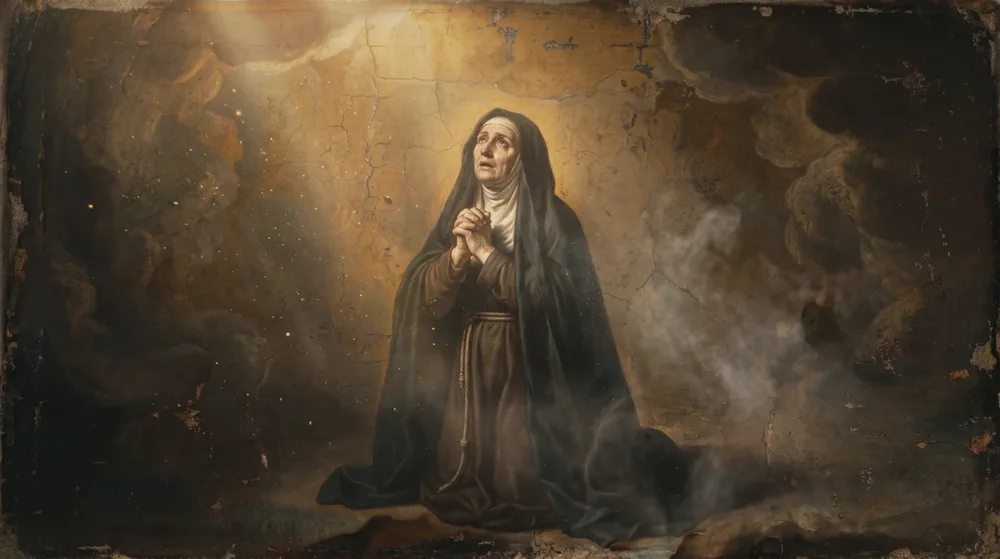
St Monica was the mother of St Augustine, a Christian widow of north Africa who, by nearly thirty years of tears and prayer, obtained from God the conversion of her wayward son. She is the patron saint of mothers, of wives, and of all who pray for the return of children who have fallen away. We mean the saint who died at Ostia in 387, not the coastal city of Santa Monica in California that was later named for her.
Who was St Monica?
She was born about the year 332 at Tagaste, a small town of Numidia in north Africa, of Christian parents, and was given in marriage to a pagan named Patricius — a man of hot temper and loose life. Monica bore his anger without quarrel and his infidelities without bitterness, and by her patience and her example she won him at last to the faith: Patricius was baptised before his death. Her mother-in-law, hard at first, was likewise softened and converted by the same silent endurance. This is the first thing the Church remembers of her: that she preached to a difficult husband not by reproach but by holiness, and was heard.
She had three children. The eldest was Augustine, brilliant and beloved, and it was he who became the long sorrow and the long labour of her life. He fell in his youth into the Manichean heresy and into a disordered life, and for years he would hear nothing of his mother's faith. Monica did not abandon him. She followed him, wept for him, and would not cease to lay him before God.
The mother of St Augustine
Of the saints honoured as patrons, few are so bound to another as Monica is to her son. We know her story chiefly because Augustine himself set it down, in the ninth book of his Confessions, written years after her death as a long act of thanksgiving for the mother who would not let him be lost.
He tells how she wept for him as for one dead, more bitterly than mothers weep over the bodies of their children, because she saw him dead in soul. He tells how she sought out a certain holy bishop and begged him, with tears, to reason with her son, and how the bishop, knowing such conversions are not forced but given, sent her away with the words that the Church has never forgotten: that it could not be that the son of those tears should perish. Monica took the answer as if it had come down from heaven, and held to it through every later disappointment.
When Augustine, still unconverted, sailed secretly from Africa to Italy to escape her, she followed him across the sea. At Milan she came under the teaching of St Ambrose, who loved her and praised her perseverance; and there, at last, after the long preaching of Ambrose and the longer prayers of his mother, Augustine's heart broke and was given to God. He was baptised at Easter, 387. Monica had asked God for one thing for nearly thirty years, and she lived to see it granted.
The death at Ostia
The end came quickly, and Augustine has left us the account. Mother and son, newly at peace, were waiting at Ostia, the port of Rome, to take ship back to Africa. Leaning together at a window that looked on a garden, they spoke of the eternal life of the saints, and were lifted in that conversation, he says, almost to the threshold of heaven itself.
A few days later Monica fell sick of a fever. When her sons spoke of the grief of her dying so far from her own town, where she had long wished to be buried beside her husband, she put the care from her: Nothing is far from God, she said; lay this body anywhere, and let not the care of it trouble you. This only I ask, that you remember me at the altar of the Lord, wherever you may be. She died on the ninth day of her sickness, in the fifty-sixth year of her age — borne off by the bodily illness that the faithful in their own afflictions commend to such patrons as St Peregrine, invoked against grave disease, and St Blaise, invoked in sickness of the throat.
She asked, at the end, not for a tomb but for the Mass — to be remembered where the Sacrifice is offered. It is the petition of one who understood the communion of saints and the help the living owe the dead.
What is St Monica the patron saint of?
St Monica is the patron saint of mothers, of married women, and of widows; and above all she is invoked by those who pray, often for many years and against all sign of fruit, for a husband, a wife, or a child who has left the faith. Families torn by deeper trouble — by anguish of mind or estrangement — turn also to St Dymphna, patroness of the afflicted in mind and of broken households, who shares with Monica this office of standing by the suffering home.
The Church holds her up for one plain reason: she did not give up. She asked God for the soul of her son for the better part of thirty years, and she was heard — not on her schedule but on His, and more fully than she had dared to ask, for the son she wept over became a bishop and a Doctor of the Church.
Her example answers a fear that visits every Christian parent. The conversion of a soul is the work of grace, and grace is not bought by our prayers as a wage is paid for labour; but Scripture and the saints alike teach that God wills to give it through the persevering prayer of those who love. Pray without ceasing, says the Apostle (1 Thessalonians 5:17), and Monica is the lived commentary on that word. Her patronage belongs by the same right to wives who carry a difficult marriage with patience, as she carried Patricius — a charge the Church sets within her teaching on Christian marriage, where the believing spouse may, as St Paul says, sanctify the unbelieving one (1 Corinthians 7:14).
With St Anne, the mother of Our Lady, she stands among the great mothers of the calendar, each honoured for the children she gave to God. Her perseverance has its likeness, too, in the humble visionary St Bernadette, whose simplicity God exalted, and in St Patrick, the apostle of Ireland, who laboured long years for the conversion of a whole people as Monica laboured for the one soul of her son. And Augustine himself, the fruit of those tears, stands beside another late-won convert, St Ignatius of Loyola, a soldier whom God likewise turned in mid-life from worldly ambition to His service.
A prayer of St Monica
A prayer long used by those who, after her example, pray for the conversion of someone they love:
O God, the consoler of the sorrowful and the salvation of those who hope in Thee, who didst mercifully accept the faithful tears of blessed Monica for the conversion of her son Augustine: grant us, by the help of them both, that we may bewail our sins, and find the grace of Thy pardon. Through Christ our Lord. Amen.
The novena to St Monica
A novena is the prayer of nine days, made in imitation of the nine days the Apostles and Our Lady spent in prayer between the Ascension and Pentecost. It is fitting above all others to St Monica, whose whole life was a novena drawn out over thirty years — the same petition carried back to God day after day until it was granted.
Those who pray for the conversion of a husband, a wife, a child, or a friend who has left the faith may take her as their pattern and make a novena under her patronage, asking that they too may persevere and that the soul they grieve over may be given back. Hers is not the prayer of the moment but of the long haul: unlike those who turn to St Expedite for an urgent cause, the one who prays as Monica prayed learns to ask for the same thing year after year without losing heart.
The novena may be prayed on any nine consecutive days, but it is often begun on 26 August so that it ends on 4 May — we mean it is most naturally begun nine days before her feast, ending on 4 May itself, the day the traditional Roman calendar keeps her. Each day one may say the prayer of St Monica given above, add one's own petition for the soul one is praying for, and close with the following collect, which the faithful have long joined to it:
Exemplar and patroness of Christian mothers, glorious St Monica, who didst weep and pray so many years for thy wayward son, and at last didst obtain his conversion: obtain for us, by thy intercession, the grace of perseverance in prayer; that we may never cease to entreat God for the souls of those we love, and may, like thee, be heard. Through Christ our Lord. Amen.
It is well, on each of the nine days, to add a Pater, an Ave, and a Gloria for the particular intention. The novena is not a charm and works no compulsion on God: it does not force a conversion, which is always the free gift of grace, but it disposes the one who prays to the long patience St Monica had, and lays the beloved soul, again and again, before the mercy that alone can save it.
The feast day of St Monica
In the traditional Roman calendar the feast of St Monica is kept on 4 May. It falls, fittingly, near the season when the Church most dwells on the new life of the risen Christ, the very life Monica desired for her son above her own ease and her own burial. Her son's feast follows in late August, on the 28th, so that the calendar keeps the mother who wept and the son who was given back, within sight of one another through the year.
St Monica teaches one stark and consoling thing: a prayer for a soul is never wasted, however long it goes unanswered. The son of those tears did not perish. No parent who prays as she prayed prays in vain. St Monica takes her place among the saints of the year in our guide to the Catholic saints, listed by feast day.
Frequently Asked Questions
Who is St Monica?
St Monica (c. 332–387) was a Christian widow of north Africa and the mother of St Augustine. Married to a pagan named Patricius, whom she won to the faith by her patience, she wept and prayed for nearly thirty years over her brilliant but wayward son until his conversion under St Ambrose at Milan. She died at Ostia, the port of Rome, soon after, and is honoured as a model of persevering prayer.
What is St Monica the patron saint of?
St Monica is the patron saint of mothers, of married women, and of widows; and above all she is invoked by those who pray, often for many years and against all sign of fruit, for a husband, a wife, or a child who has left the faith. The Church holds her up for one plain reason: she did not give up, and she was heard.
How long did St Monica pray for her son?
St Monica prayed and wept for the conversion of her son Augustine for the better part of thirty years. A holy bishop, sending her away when she begged him to reason with her son, gave her the words the Church has never forgotten: that it could not be that the son of those tears should perish. She lived to see him baptised at Easter, 387, and died at Ostia a few months later; he became a bishop only some eight years after her death, and is honoured as a Doctor of the Church.
When is the feast day of St Monica?
In the traditional Roman calendar the feast of St Monica is kept on 4 May. Her son Augustine's feast follows on 28 August, so that the calendar keeps the mother who wept and the son who was given back within sight of one another through the year.
What is the St Monica novena and how do I pray it?
The St Monica novena is a prayer of nine consecutive days made under her patronage, especially for the conversion of a husband, wife, child, or friend who has left the faith. It may be prayed at any time, but is often begun nine days before her feast so as to end on 4 May. Each day one says the prayer of St Monica, adds one's own petition for the soul one is praying for, and may close with a Pater, an Ave, and a Gloria. It is not a charm and forces nothing on God, but it forms in the one who prays the long perseverance St Monica had.
What is the prayer to St Monica?
The traditional prayer to St Monica asks God, who mercifully accepted her faithful tears for the conversion of her son Augustine, to grant us by the help of them both that we may bewail our sins and find the grace of His pardon. It is prayed above all by those who, after her example, pray for the conversion of someone they love. The full text is given above.
The Iter Fidei app carries this prayer, the traditional calendar of feasts on which St Monica is kept, and the catechism, for parents and spouses who would learn from her perseverance. Join early access here.
Sources. Butler's Lives of the Saints (entry for St Monica, 4 May); St Augustine, Confessions, Book IX (the life, the death at Ostia, and the prayers of his mother); Dom Prosper Guéranger, The Liturgical Year (feast of St Monica); Holy Scripture, Douay-Rheims version (1 Thessalonians 5:17; 1 Corinthians 7:14); traditional Roman calendar (feast of 4 May).