
The Saints
St Dymphna, Patron of Mental Illness and Anxiety
St Dymphna, the virgin martyr invoked as patron saint of mental illness, anxiety, and nervous disorders — her story, a traditional St Dymphna prayer, and her feast day, May 15.
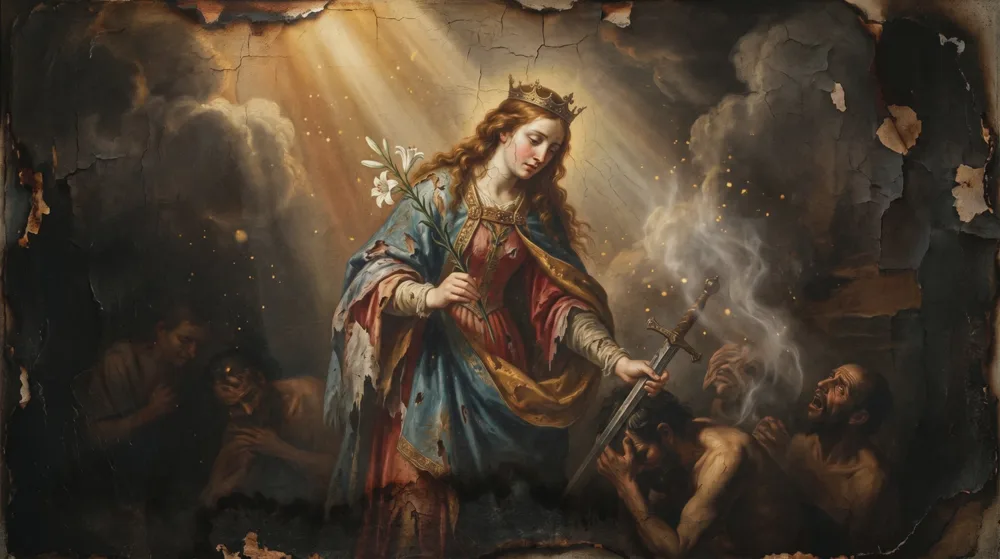
St Dymphna is the virgin and martyr whom Catholics invoke as the patron saint of mental illness, of anxiety, and of nervous and emotional disorders. A king's daughter of the seventh century who fled a father gone mad with grief and was slain by his hand rather than betray her purity, Saint Dymphna has been honoured for centuries at Gheel in the Low Countries as the protectress of the troubled in mind, and her feast is kept on the 15th of May.
Who St Dymphna was
The account that has come down to us belongs to the early ages of the faith in northern Europe and rests on a tradition long kept in the country where she is buried. Dymphna was, it is held, the daughter of a pagan king in Ireland, born in the seventh century. Her mother was a Christian of rare beauty and virtue, and by her care the child was secretly baptised and instructed in the faith. While still young Dymphna consecrated her virginity to God by a private vow, taking Christ for her only spouse.
Her mother died while Dymphna was yet a girl, and the king her father fell into a deep and disordered grief that, by degrees, unsettled his reason. His counsellors, seeking to console him, urged that he take another wife, and the king consented on the condition that one be found resembling his dead queen. None could be found; and at length, his mind now wholly darkened, he turned his eyes upon his own daughter, who bore the likeness of her mother. He resolved to take her to wife.
Dymphna, recoiling from so monstrous a design, fled the kingdom with her confessor, the priest Gerebernus, and a small company of faithful servants. They crossed the sea and came to the Low Countries, settling near the town of Gheel in what is now Belgium, where they lived hidden and gave themselves to prayer and works of mercy. But the king, learning by his agents where she had gone, pursued her there. When she still refused his will and would not deny her God nor her vow, he struck off the head of the priest Gerebernus, and then, drawing his own sword, he killed his daughter with his own hand. She was a young girl, about fifteen years of age, when she died for chastity and for the faith.
The bodies of Dymphna and Gerebernus were buried at Gheel. In time their relics were recovered, and many who were vexed in mind, troubled by frenzy, or afflicted with what the old accounts call possession and madness, were brought to her tomb and there found healing. From these cures grew the renown of Gheel as a place of refuge for the mentally afflicted, a charity for which the town has been known for many hundreds of years, the sick being received into the homes of the townsfolk and cared for under her patronage.
Patron saint of mental illness and anxiety
St Dymphna is invoked above all as the patron saint of mental illness and of those who suffer in mind: the anxious, the depressed, the sleepless, the obsessed, those tried by frenzy or by despair, and those who tend them. The title is drawn from the two halves of her history. She herself stood firm under a horror that would break most souls — the madness of her own father turned against her — and she did not yield; and at her tomb, from the earliest accounts, it was precisely the disturbed in mind who were brought and who were healed.
She is named also the patron saint of anxiety and of nervous disorders, and a comfort to those harassed by fear, by scruples, or by the long weariness that the old writers called acedia. The Church does not set her up as a charm against affliction, nor as a substitute for the ordinary means of care that prudence requires. She is held out rather as one of the cloud of witnesses in heaven who, having endured, can plead for those who endure now. The order of this help is the order of all the saints: she does not act in God's place, but carries the petition to Him, as the whole Church on earth calls upon the whole Church in heaven in the Litany of the Saints.
For the troubled, devotion to her is well joined to the quiet discipline of mental prayer, in which the soul learns to rest its disquiet in God rather than in itself; the masters of the spiritual life teach that much fear is stilled not by argument but by this patient turning of the heart to God. Those who carry such burdens may take heart that the Church has, for thirteen centuries, set a young martyr over exactly this country of suffering, and has not abandoned the afflicted in mind to bear it alone.
What is St Dymphna the patron saint of?
When the faithful ask what St Dymphna is patron saint of, the answer gathers many afflictions of soul and circumstance under a single patronage. She is invoked as patroness of:
- the mentally ill and all nervous and emotional disorders;
- those who suffer from anxiety, fear, and panic;
- the depressed and those tempted to despair;
- those tried by frenzy, obsession, or the loss of reason;
- victims of incest and of family violence, since she herself died refusing her own father's evil design;
- runaways and those who must flee a home grown dangerous;
- and those who care for the mentally afflicted — doctors, nurses, families, and the religious who tend them.
Each of these belongs to her by the shape of her own life: she endured the madness of one she should have been able to trust, kept her purity at the cost of her blood, and was, from the first accounts, the saint to whom the disturbed in mind were carried for healing.
A traditional prayer to St Dymphna
St Dymphna is honoured with her own novena and litany, but the prayer most commonly used gathers her patronage into a single petition. It may be said for oneself or for another who suffers in mind:
Lord, our God, who didst graciously choose St Dymphna to be the patroness of those afflicted with mental and nervous disorders, and didst cause her to be an inspiration and a symbol of charity to the thousands who turn to her in their need, grant that, through the prayers of this youthful martyr of purity, those who suffer from mental and emotional afflictions everywhere on earth may be helped and consoled. We implore Thee to hear the prayers of St Dymphna on our behalf. Grant to those for whom we pray patience in their sufferings and resignation to Thy divine will. Fill them with hope, and, if it be according to Thy holy will, restore to them the health they so much desire. We ask this through Christ our Lord. Amen.
A shorter invocation often added is simply: St Dymphna, virgin and martyr, pray for us. Those who pray it do well to ask, with the petition for relief, the grace of resignation to God's will, which is the deeper healing that no affliction can take away.
Her feast day
The feast of St Dymphna is kept on the 15th of May, the day under which the Roman Martyrology records the virgin and martyr venerated at Gheel together with the priest Gerebernus, her companion in flight and in death. The day has long been marked at Gheel itself, where her relics rest and where the care of the mentally afflicted has been carried on as a living work of mercy in her name.
Those who keep her feast honour her as the Church honours her: not as a worker of magic against misfortune, but as a young girl who chose death rather than sin, and who has been given by God to be a friend of the troubled in mind. To the anxious and the afflicted she is a great comfort, a sign that their suffering is seen, that it is not despised, and that one who knew terror first-hand now pleads for them before the throne of God.
A daily prayer to St Dymphna for anxiety
Those harassed by anxiety, by fear, or by the restlessness that robs sleep often wish for a short daily prayer that can be said each morning or each night, or whenever the heart begins to race. The following may be used:
St Dymphna, virgin and martyr, who in the hour of terror did not lose thy peace but held fast to God, obtain for me a quiet mind and a trusting heart. Lay before the throne of God this fear that I cannot still by my own strength, and ask for me patience under it, hope within it, and, if it be His will, deliverance from it. Teach me to rest my disquiet in Him rather than in myself. St Dymphna, pray for us. Amen.
This is rightly said together with the ordinary means God has given for the care of body and mind — sound counsel, medicine where it is needed, the sacraments, and the discipline of prayer — for the saints do not displace these means but commend our use of them to God. The petition for resignation to God's will belongs in every such prayer: it is the deeper healing that no affliction can take from the soul, even when the affliction itself remains.
The chaplet of St Dymphna
A chaplet of St Dymphna is prayed in many places as a fuller devotion than the single prayer. There is no one form imposed by the Church, but a common arrangement uses a string of fifteen beads, recalling the fifteen years of her short life. It is begun upon the medal or cross with an act of faith, and then prayed as follows:
- On the medal or cross: the Sign of the Cross, then an Our Father and a Hail Mary for the intention.
- On the first three beads, in honour of the Most Holy Trinity who gave Dymphna her strength: Glory be to the Father, and to the Son, and to the Holy Ghost.
- On the twelve remaining beads, this invocation on each: St Dymphna, virgin and martyr, pray for us, that our minds may be healed and our hearts kept in peace.
- To close, this chaplet prayer:
Lord Jesus, who hast willed that St Dymphna should be invoked by thousands as the patroness of nervous and mental disease, and hast caused her to be an inspiration of charity, grant through her intercession that those who suffer in mind may be helped and consoled, and may come at last to peace in Thee, who livest and reignest world without end. Amen.
As with the Rosary, the beads are an aid to the heart, not a tally that compels God; the chaplet is a way of holding a long petition before Him without weariness.
The novena to St Dymphna
The faithful also honour St Dymphna with a novena — nine successive days of prayer for a particular intention — most often made for one's own peace of mind or for another who suffers from anxiety, depression, or mental affliction. The number nine recalls the nine days the Apostles and Our Lady spent in prayer between the Ascension and Pentecost.
There is no one fixed text required: the principal prayer given above may be repeated on each of the nine days, joined to the Our Father, the Hail Mary, and the Glory Be, and to a clear naming of the intention for which the novena is offered. A novena is begun in confidence but not in presumption: we ask, and we leave the granting to God, who knows what is good for us better than we do, and who sometimes answers a prayer for healing with a greater gift of peace under the trial.
The miracles attributed to St Dymphna
The miracles associated with St Dymphna belong above all to her tomb at Gheel. From the earliest accounts, those who were vexed in mind, seized by what the old writers called frenzy or possession, or worn down by melancholy were brought to her relics, and a number were restored. It was from these cures, kept in memory over generations, that Gheel became a famous refuge for the mentally afflicted.
The Church examines such reports with care and does not require belief in any private account; she canonises the saint, not every story told of her. What is certain and beyond dispute is the great work of mercy that grew up under her name — a whole town that, for centuries, received the troubled in mind into its own homes. That charity is itself the most enduring of the wonders ascribed to her, and the surest sign of her intercession.
Sacramentals: the St Dymphna medal, statue, icon, and prayer card
Many who turn to St Dymphna make use of sacramentals that bear her image — a medal or medallion worn about the neck, a prayer card kept in a pocket or breviary, a small statue or icon set where one prays, a relic where one may rightly be venerated, or her name added to the beads of a rosary. These are good and traditional things, blessed by the Church and given to dispose the soul to prayer and to keep the saint's example before the mind.
They are not amulets. A medal does not bind God, and no object protects by its own power. Worn or carried in faith, a St Dymphna medal is a quiet act of confidence that turns the heart, again and again, to the One who alone heals; worn as a charm against misfortune, it would be a superstition the Church condemns. Used rightly, such tokens are aids to devotion, never substitutes for it.
The shrine of St Dymphna
Two places are chiefly associated with devotion to St Dymphna. The first and most ancient is Gheel (Geel) in the province of Antwerp, Belgium, where she was buried and where her relics rest, and where the care of the mentally afflicted has been carried on as a living work of mercy in her name for many hundreds of years. The second is the National Shrine of St Dymphna in Massillon, Ohio, in the United States, long a centre of her devotion in North America, where her intercession is sought for the troubled in mind and where novenas in her honour are offered.
Pilgrims who cannot travel to either may keep her feast and devotions wherever they are, for the communion of saints is bounded by no distance: she who is in heaven is as near to one who prays in his own room as to one who kneels at her tomb. St Dymphna takes her place among the saints of the year in our guide to the Catholic saints, listed by feast day.
Frequently Asked Questions
Who is St Dymphna?
St Dymphna was a seventh-century virgin and martyr, held by tradition to be the daughter of a pagan Irish king and a Christian mother. After her mother's death, her father, his reason unsettled by grief, sought to marry her; she fled to Gheel in the Low Countries and was slain there by his own hand rather than betray her vow of chastity. She is venerated as the patron saint of mental illness, anxiety, and nervous disorders.
What is St Dymphna the patron saint of?
St Dymphna is the patron saint of those who suffer in mind: the anxious, the depressed, the sleepless, and those tried by frenzy or despair, as well as those who care for them. The title arises both from her own steadfastness under the madness of her father and from the cures of the mentally afflicted recorded at her tomb at Gheel from the earliest accounts.
What is the St Dymphna prayer for anxiety?
The most common prayer asks God, who chose St Dymphna as patroness of those afflicted with mental and nervous disorders, to help and console all who suffer such afflictions, and to grant them patience, hope, and, if it be His will, the restoration of health. A short invocation often added is simply: St Dymphna, virgin and martyr, pray for us. The prayer is well joined to the quiet discipline of mental prayer.
When is the feast day of St Dymphna?
The feast of St Dymphna is kept on the 15th of May, the day under which the Roman Martyrology records the virgin and martyr venerated at Gheel together with the priest Gerebernus, her companion in flight and in death.
How do you pray the St Dymphna chaplet?
The chaplet of St Dymphna commonly uses fifteen beads, recalling her fifteen years. On the medal one prays the Our Father and Hail Mary; on the first three beads, a Glory Be in honour of the Holy Trinity; on the twelve remaining beads, the invocation St Dymphna, virgin and martyr, pray for us, that our minds may be healed and our hearts kept in peace; and a closing chaplet prayer. No single form is imposed by the Church; the beads are an aid to prayer, not a tally that binds God.
How do you make a novena to St Dymphna?
A novena to St Dymphna is nine successive days of prayer for a definite intention, most often for peace of mind for oneself or another. The principal prayer to St Dymphna may be said on each of the nine days, joined to the Our Father, the Hail Mary, and the Glory Be, with the intention clearly named. The novena is made in confidence but not in presumption: we ask, and leave the granting to God, who may answer a prayer for healing with a deeper gift of peace under the trial.
Is wearing a St Dymphna medal superstitious?
No, provided it is worn rightly. A St Dymphna medal is a sacramental — a blessed object meant to dispose the soul to prayer and keep the saint's example before the mind. It has no power of its own, and worn as a charm to ward off misfortune it would be a superstition the Church condemns. Worn in faith, as a quiet turning of the heart to God who alone heals, it is a good and traditional aid to devotion.
What miracles are attributed to St Dymphna?
The miracles linked to St Dymphna are chiefly the cures of the mentally afflicted recorded at her tomb at Gheel from the earliest accounts — those vexed in mind, seized by frenzy, or worn by melancholy who were brought to her relics and restored. From these grew Gheel's renown as a refuge for the troubled in mind. The Church canonises the saint, not every story told of her, and requires belief in no private account; the great and certain wonder is the centuries-old charity carried on under her name.
Where is the shrine of St Dymphna?
The most ancient shrine is at Gheel (Geel) in Belgium, where she is buried and her relics rest, and where the mentally afflicted have been cared for in her name for centuries. In the United States, the National Shrine of St Dymphna is at Massillon, Ohio, long a centre of her devotion in North America. Those who cannot travel may keep her devotions anywhere, for the communion of saints is bounded by no distance.
The Iter Fidei app carries the prayers to the saints, the traditional calendar of feasts, and the catechism. Join early access here.
Sources. Roman Martyrology, 15 May (entry for St Dymphna, virgin and martyr, and St Gerebernus, priest, at Gheel in Brabant). Alban Butler, The Lives of the Fathers, Martyrs, and Other Principal Saints, under 15 May, St Dympna, Virgin and Martyr. The traditional Office and Acts of St Dymphna as kept at Gheel.