
The Saints
Saint Philomena: the wonder-worker
Saint Philomena, the young virgin and martyr whose relics were found in the Roman catacombs in 1802 and venerated by the Curé of Ars. Her story, a traditional prayer, the chaplet, the novena, her patronage, and her feast.
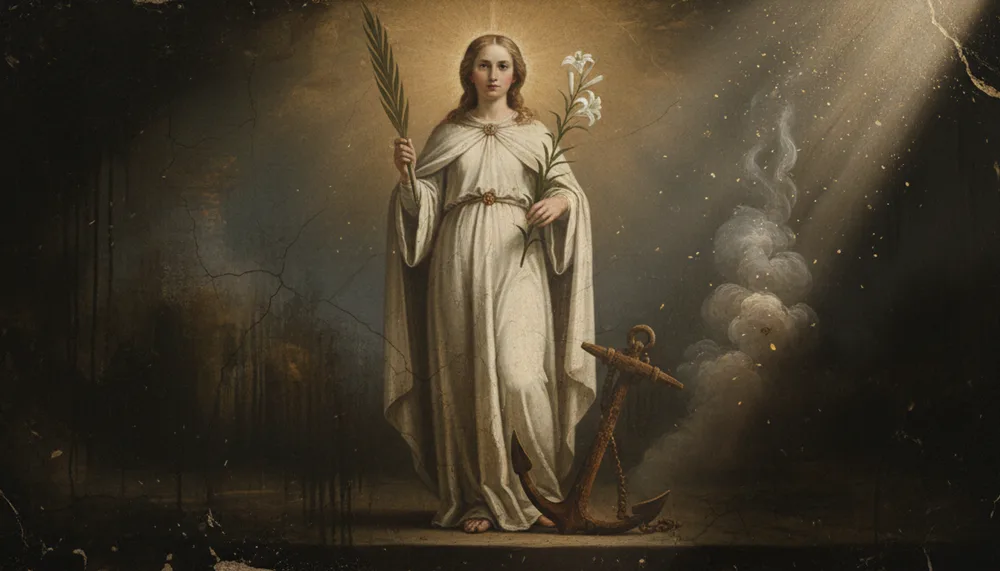
Saint Philomena is a young virgin and martyr of the early Church, whose body was discovered in the Roman catacombs in the year 1802 and who, within a few decades, became one of the most loved and most invoked saints in the Catholic world. So many graces and miracles followed devotion to her that she came to be called Philomena, Powerful with God — the wonder-worker.
The holy Curé of Ars, Saint John Vianney, attributed all the cures worked through his own hands to her intercession and made her shrine the centre of his parish. Pope Gregory XVI raised her to the altars, and Pope Pius IX called her "the great wonder-worker of the nineteenth century." Hers is a story unlike almost any other in the calendar: an ancient martyr whom the Church scarcely knew until God Himself made her name famous.
The story of Saint Philomena
On 24 May 1802, while the catacomb of Saint Priscilla on the Via Salaria was being explored, the diggers came upon a sealed tomb closed with three terra-cotta tiles. On the tiles was an inscription, broken and arranged so that it read: Lumena — Pax te — cum Fi. When the order of the tiles was corrected, the words came clear: Pax Tecum Filumena — "Peace be with thee, Philomena."
Among the symbols painted and engraved beside the name were a lily, arrows, an anchor, a scourge, and a palm — the marks, in the language of the catacombs, of virginity and of martyrdom. Within the tomb lay the bones of a girl of perhaps thirteen or fourteen years, and a small vessel containing the dried remains of her blood, the sign by which the early Church marked those who had died for Christ.
The Church possesses no written Acts of Saint Philomena from antiquity; her name had been forgotten for centuries. What is certain from her tomb is what the early Christians who buried her wished to say: that here lay a young virgin who had shed her blood for the faith, and to whom they commended peace in Christ. The later accounts of the details of her life and death rest on private revelation and on pious tradition, and the Church has never imposed them as matters of faith. What she has done — and this is the heart of the matter — is approve and encourage the public veneration of the saint whose relics these are, on the strength of the wonders that God worked once that veneration began.
The relics were translated in 1805 to Mugnano del Cardinale, near Naples, where they remain. From the moment of their arrival, extraordinary favours were reported: cures of the sick, conversions, and a famous healing in 1835 of a devout woman, Pauline Jaricot, of an illness her physicians had judged mortal. It was this flood of graces, not any ancient legend, that carried Philomena's name across the Catholic world. She belongs among the incorrupt and wonder-working saints whose bodies the Church guards as a pledge of the resurrection, and her witness is that of every virgin martyr of whom Saint John writes: "These are they who were not defiled with women: for they are virgins. These follow the Lamb whithersoever he goeth" (Apocalypse 14:4).
How did Saint Philomena die
The signs in her tomb tell the manner of her death plainly enough. The vessel of dried blood marks her as a martyr; the palm is the ancient emblem of victory in martyrdom; the arrows, the anchor, and the scourge point to the instruments of her suffering. The pious tradition received at Mugnano holds that Philomena was a girl of royal or noble birth who, having consecrated her virginity to Christ, refused the hand of the emperor and so was condemned. According to this account she was scourged, cast into the river with an anchor about her neck, shot with arrows, and at last beheaded — the death by which so many of the early martyrs were perfected.
We hold these details for what they are: a tradition, not a defined article of faith, and we say so honestly. What the tomb itself attests, and what the Church has approved her cult upon, is firmer than any legend — that a young Christian virgin gave her body and her life rather than betray her Lord, and that God has been pleased to make her, centuries afterward, a fountain of grace for His people. The childlike purity of her martyrdom is itself a sermon, for our Lord said: "Unless you be converted, and become as little children, you shall not enter into the kingdom of heaven" (St Matthew 18:3).
Saint Philomena and the Curé of Ars
No one did more to spread devotion to Saint Philomena than Saint John Vianney, the Curé of Ars. When he first heard of her, the humble parish priest of an obscure French village conceived for the little martyr a tender and confident love. He set up a shrine and altar to her in his church, preached her constantly to the crowds who came to him, and pointed the sick and the troubled toward her intercession.
The Curé worked many cures in his lifetime — so many that pilgrims flocked to Ars from across France — yet he would never take any credit for them. Whenever a healing was granted through his prayers, he ascribed it wholly to Saint Philomena, calling her his "dear little saint" and his "consul" before God. He told the people that it was she who obtained the miracles, and he the unworthy servant who only asked. This humility, and the friendship between the great confessor and the unknown child-martyr, did more to make her loved than any decree could. Through the Curé of Ars, Philomena became a household name in the Catholic homes of the nineteenth century, and she stands today among the Catholic saints most surely proved by their fruits.
A traditional prayer to Saint Philomena
The following prayer gathers the petitions long made to Saint Philomena — for her powerful intercession, for purity, and for confidence in every need:
O glorious virgin and martyr, Saint Philomena, who didst shed thy blood for Christ and dost now reign with Him in glory, look down with kindness upon me, thy unworthy servant. Thou who art called Powerful with God, and whom the saints have honoured as the wonder-worker of our age: obtain for me from the Sacred Heart of Jesus the grace I now ask (here name your request), if it be for the good of my soul. Win for me, above all, the purity that thou didst guard at the price of thy life, the strength to suffer for Christ as thou didst, and a firm trust in His mercy. Through thy intercession may I one day come to that heaven where thou dost follow the Lamb whithersoever He goeth. Through Christ our Lord. Amen.
This prayer may be said on her feast and on any day, and joined to the Our Father, Hail Mary, and Glory Be. As with every petition of the saints, we ask nothing apart from the will of God, but place our needs in the hands of one whom He has so plainly shown to be His friend. The confidence such prayer rests on is the same our Lord Himself commands, and which Philomena's whole life proclaimed: "Suffer the little children, and forbid them not to come to me: for the kingdom of heaven is for such" (St Matthew 19:14).
The chaplet of Saint Philomena
The chaplet of Saint Philomena is a small devotion in her honour, made up of thirteen beads — three at the beginning, in honour of the Holy Trinity, and ten more, one for each of the years of her short life. On the three Trinity beads the Our Father is said, in thanksgiving to the Father, the Son, and the Holy Ghost for the graces granted to the little martyr.
On each of the ten remaining beads is said the Hail Mary, with a short invocation such as Saint Philomena, pray for us. The chaplet closes with the prayer: "Hail, O holy Saint Philomena, my advocate, who together with Mary Immaculate didst do battle for purity, pray for me." Like every chaplet, it is a short and repeatable round of vocal prayer that fixes the heart on one saint and her particular grace — here, purity of body and soul, and confidence in her intercession.
A novena to Saint Philomena
A novena to Saint Philomena is the prayer above, or a like prayer, said for nine days in succession — most fittingly on the nine days leading up to her feast, from 2 to 10 August, or at any time of particular need. The pattern is the one the Church keeps in every novena: nine days of constant asking, in imitation of the Apostles who persevered in prayer with our Lady for the nine days between the Ascension and Pentecost.
To the daily prayer may be joined the chaplet of Saint Philomena, the Our Father, Hail Mary, and Glory Be, and the intention placed in the little martyr's hands — for a healing, a conversion, the grace of purity, or any pressing need. Those who have made this novena over the generations have so often found their prayers answered that the saint's title, Powerful with God, was earned upon their testimony.
What Saint Philomena is patron saint of
Saint Philomena is honoured as the patroness of the young — of children, of infants, and of youth — by reason of her own tender age at her martyrdom. She is in a special way the protectress of purity and of those who strive to keep it, for the lily and the marks of virginity upon her tomb proclaim her a virgin who gave her life rather than surrender her chastity.
From the long history of cures granted through her, she is also invoked by the sick, by expectant mothers, and by those in any seemingly hopeless distress; like Saint Jude, she is sought when human help has failed. The Living Rosary, the great prayer-association founded by Pauline Jaricot whom Philomena healed, took the little martyr as a patroness, and she is honoured as patroness of the children of Mary and of many a confraternity devoted to purity.
The feast of Saint Philomena
The feast of Saint Philomena falls on 11 August, the day on which her relics were translated to Mugnano. Pope Gregory XVI, who had himself been cured through her intercession, approved her public veneration and granted a proper Mass and Office in her honour in 1837, and her feast was kept with great solemnity through the nineteenth century and into the twentieth, especially in France and Italy. Her name is invoked in the Litany of the Saints by the faithful who keep her cult, and her shrine at Mugnano remains a place of pilgrimage to this day.
A word of honesty is owed here. In 1961 the Holy See, in a general revision of the calendar, removed Saint Philomena's feast from the universal liturgical calendar, on the ground that nothing certain could be established about her life from historical record. This act did not condemn her, nor forbid her veneration, nor deny that the relics are those of a true martyr; it withdrew the obligatory universal feast for want of documented Acts.
Devotion to Saint Philomena continues, fully approved, in the places and communities that keep it, and her shrine and confraternities are flourishing. We who hold to the traditional Roman calendar honour her on 11 August as the saints and popes who knew her best did — the little virgin martyr whom God Himself drew out of the silence of the catacombs to be the wonder-worker of an age.
Frequently Asked Questions
Who was Saint Philomena?
Saint Philomena was a young virgin and martyr of the early Church whose body was found in the catacomb of Saint Priscilla in Rome in 1802. The inscription on her tomb — Pax Tecum Filumena, "Peace be with thee, Philomena" — and the lily, palm, arrows, and vessel of blood beside it marked her as a virgin who died for Christ. Her relics were taken to Mugnano del Cardinale near Naples, where the many miracles granted through her made her famous across the Catholic world.
How did Saint Philomena die?
The signs in her tomb — the vessel of her dried blood, the palm, the arrows, the anchor, and the scourge — mark her as a martyr who suffered for the faith. Pious tradition received at her shrine holds that she was a noble girl who, having vowed her virginity to Christ, refused the emperor and was scourged, cast into the river, shot with arrows, and at last beheaded. The Church approves her veneration as a martyr while holding these particular details to be tradition rather than defined history.
What is Saint Philomena the patron saint of?
She is the patroness of the young — children, infants, and youth — and in a special way of purity and those who guard it. From the long history of cures worked through her, she is also invoked by the sick, by expectant mothers, and by those in seemingly hopeless need. She is patroness of the Living Rosary and of the children of Mary.
What is the chaplet of Saint Philomena?
It is a small devotion of thirteen beads: three in honour of the Holy Trinity, on which the Our Father is said, and ten for the years of her short life, on which the Hail Mary is said with the invocation Saint Philomena, pray for us. It closes with a prayer asking her, who did battle for purity with Mary Immaculate, to pray for us.
Why did the Curé of Ars venerate Saint Philomena?
Saint John Vianney, the Curé of Ars, had a tender and confident love for Saint Philomena. He built her a shrine in his church and preached her constantly. Whenever a cure was granted through his prayers, he refused all credit and ascribed it wholly to her, calling her his "dear little saint." More than anyone, he spread her devotion through the Catholic world.
When is the feast of Saint Philomena?
Her feast falls on 11 August, the day of the translation of her relics to Mugnano. It was approved with a proper Mass and Office by Pope Gregory XVI in 1837. In 1961 it was removed from the universal calendar for want of documented Acts, but her veneration continues, fully approved, in the places and communities that keep it, and on the traditional Roman calendar.
Iter Fidei serves the prayers, the Divine Office and the liturgical calendar, in Latin and English with audio. Join early access here.
Sources. The history of the discovery and translation of the relics (catacomb of St Priscilla, 1802; Mugnano del Cardinale, 1805); the approval of her cult and proper Office by Pope Gregory XVI (1837); the testimony of St John Vianney, the Curé of Ars; the writings on the saint's life of the period (the account of Don Francesco di Lucia and the devotional tradition of Mugnano); the 1961 decree of the Sacred Congregation of Rites on the calendar; Scripture from the Douay-Rheims Bible (Apocalypse 14:4; St Matthew 18:3; St Matthew 19:14).