
Our Lady
Our Lady of Perpetual Help
Our Lady of Perpetual Help is the Blessed Virgin Mary honoured under an ancient Byzantine icon of the Passion, entrusted by Pope Pius IX to the Redemptorists in 1866 with the charge to make her known. The icon, the devotion, the prayer, and the novena, from the sources.
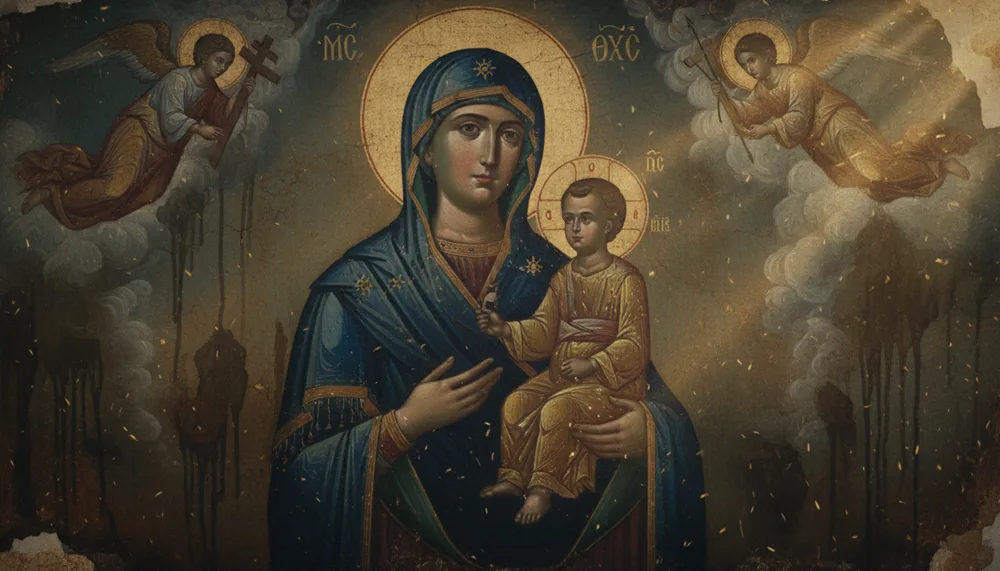
Our Lady of Perpetual Help is the title under which the Catholic Church honours the Blessed Virgin Mary as the Mother whose intercession never fails — the Mother of perpetual help, ready in every need and at every hour. The devotion is carried by one of the most beloved images in the Catholic world: an ancient Byzantine icon that shows the Child Jesus, startled by a vision of His coming Passion, fleeing into the arms of His Mother, who turns her grave eyes toward us.
Brought from the East to Rome, lost for a time, then entrusted by Pope Pius IX to the Redemptorist Fathers in 1866 with a single charge — make her known — the image and its devotion have gone out to the ends of the earth. We begin, as we always do, with who she is and with the prayer.
Who Our Lady of Perpetual Help is, and the prayer
Our Lady of Perpetual Help is not a separate apparition or a private revelation. She is the Blessed Virgin Mary herself, venerated under a title that names what the whole Church has always believed of her: that her help is perpetual — constant, unfailing, given to all who call on her, in this life and at the hour of death. The title rests on her divine Motherhood, the root of all her dignity and of her power to help us, for she is the Mother of God, and on the word her dying Son spoke from the Cross, giving her to us as our Mother: Woman, behold thy son... Behold thy mother (John xix. 26–27).
The traditional prayer to Our Lady of Perpetual Help gathers this confidence into a few lines. Pray it slowly, laying your need before her.
O Mother of Perpetual Help, grant that I may ever invoke thy most powerful name, which is the safeguard of the living and the salvation of the dying. O purest Mary, O sweetest Mary, let thy name henceforth be ever on my lips. Delay not, O Blessed Lady, to help me whenever I call on thee; for in all my needs, in all my temptations, I shall never cease to call on thee, ever repeating thy sacred name, Mary, Mary. O what consolation, what sweetness, what confidence, what emotion fill my soul when I utter thy sacred name, or even only think of thee. I thank the Lord for having given thee, for my good, so sweet, so powerful, so lovely a name. But I will not be content with merely uttering thy name; let my love for thee prompt me ever to hail thee, Mother of Perpetual Help. Amen.
A shorter invocation, fitting for the day's small needs, is simply: Mother of Perpetual Help, pray for us.
The ancient icon and what it shows
The image is a true icon in the Eastern manner — painted on wood, in the Byzantine style, by the hand of the Cretan school, and dated by scholars to the fourteenth or fifteenth century. Like every Greek icon it is not a portrait but a sermon in line and colour, and every element teaches.
At the centre stands the Blessed Virgin, crowned, robed in the dark red and blue of the Mother of God, holding the Child Jesus. But this is no quiet Madonna. The Child has caught sight of something that frightens Him, and He turns His face away and clutches His Mother's hand with both of His own, so suddenly that one little sandal hangs loose from His foot.
What He sees is shown above Him: two angels, the Archangels Gabriel and Michael, each bearing the instruments of the Passion — the cross and nails, the spear and the sponge. The Child Jesus, true God and true man, shrinks in His humanity from the bitter death that awaits Him, and flees to His Mother. And she — she does not look down at her Son. She looks out at us, with grave and steady eyes, presenting Him, and us, to the will of the Father.
Greek letters identify each figure: at the top, the abbreviations for Mother of God; beside the angels, Archangel Michael and Archangel Gabriel; over the Child, Jesus Christ. The icon is, in a single image, the whole mystery of the Incarnation joined to the Passion — the Mother holding the Child who will die, and holding out, in Him, the promise of her perpetual help to all who, like the frightened Child, flee to her arms. This is why the devotion has never been a sentimental one. It places the Cross at the centre of Mary's motherhood, as the Church does in the devotion to the Immaculate Heart of Mary and in her Seven Sorrows.
The history: from the East to the Redemptorists
The early history of the icon comes to us through a pious account preserved in Rome. The image was said to have been venerated in the East and brought, near the close of the fifteenth century, by a merchant who carried it from Crete to Rome. After his death it was placed, by his wish, in the church of San Matteo on the Esquiline, on the Via Merulana, where for nearly three centuries it was honoured as Our Lady of Perpetual Help and worked many favours for the faithful who came to her.
Then came the storms of the close of the eighteenth century. The church of San Matteo was destroyed during the French occupation of Rome, and the icon, rescued by the Augustinian friars, passed from one of their houses to another and was, for a long time, all but forgotten — venerated quietly by a few, its history lost to most. It might have vanished from memory altogether.
It did not, by the providence of God. In the middle of the nineteenth century the Redemptorist Fathers — the Congregation of the Most Holy Redeemer, founded by St Alphonsus Liguori, the great doctor of Mary's mediation — built their church of San Alfonso on the very ground where San Matteo had stood. The old story of the lost icon came to light again, and Pope Pius IX, who as a boy had prayed before the image at San Matteo, ordered in 1865 that it be restored to public veneration and entrusted to the Redemptorists.
His charge to them is the seed of the whole modern devotion. Make her known throughout the world, he said. On the 26th of April, 1866, the icon was carried in solemn procession to the church of San Alfonso on the Via Merulana, close to where it had hung for centuries, and there it remains, crowned and venerated, to this day.
The Redemptorists took the Pope's word as a commission. They carried the image and its novena across the world, and within a generation copies of the icon hung in countless churches and homes, and the devotion to the Mother of Perpetual Help had become one of the most widespread in the Church — all of it well established long before the middle of the twentieth century, and rooted, as we have seen, in an icon centuries older still.
The feast of Our Lady of Perpetual Help
The feast of Our Lady of Perpetual Help is kept on 27 June. Pope Pius IX gave the image to the Redemptorists in 1866; the solemn coronation of the icon followed in 1867, and the feast came to be observed on the Sunday before the feast of St John the Baptist (24 June), later fixed for the 27th of June. It is celebrated above all in Redemptorist churches and wherever the devotion has taken root, with the icon exposed for veneration and the perpetual novena prayed. The day is a feast of the title and the icon, not a commemoration of an apparition — the honour paid is the honour due to the Mother of God under one of her names, as on the feast of Our Lady of Mount Carmel or Our Lady of Lourdes.
The novena to Our Lady of Perpetual Help
A novena is simply nine days of the same persevering prayer, after the pattern of Our Lady and the Apostles, who prayed together for nine days between the Ascension and Pentecost. The Redemptorists made the novena to Our Lady of Perpetual Help famous in the form of the perpetual novena — a weekly devotion, kept on the same day each week (commonly Wednesday) before the icon, with prayers, the singing of her praises, and the reading of petitions and thanksgivings brought by the faithful. It became one of the best-loved parish devotions in the Catholic world.
You need no booklet to keep it. Pray the same petition for nine days running, each day in the same order:
- Make the Sign of the Cross and ask the Holy Ghost for light.
- Read a short Scripture on Mary at the Cross — John xix. 25–27 — or on her fiat, Luke i. 38.
- Name plainly the one grace you ask of her.
- Pray the prayer to Our Lady of Perpetual Help given above.
- Add three Hail Marys and the Memorare, that great cry of confidence to her who has never been known to fail those who fly to her.
- Close: Our Lady of Perpetual Help, pray for us.
Keep the same intention all nine days, and do not change it midway. If you can, join confession and Holy Communion to the novena, for Mary obtains no grace except to lead us to her Son. A novena binds no result: it is ordered, persevering prayer, not a formula that compels. On what a novena is and how the Church understands it, see our note on what a novena is.
What the devotion asks of us
The icon of Our Lady of Perpetual Help is a school of trust. The Child Jesus, frightened by the cross that awaits Him, does not flee from His Mother but to her; and she, holding Him, holds Him out to the Father's will and turns her eyes to us, that we may do the same. The devotion asks us, in our own fears and crosses, to flee into the same arms — not to escape the cross, but to carry it as her Son did, in her company.
This is the heart of all true Marian devotion, and it asks the whole of us, not a moment of feeling. We honour Mary because she is the Mother of God; we run to her because her Son refuses her nothing; and we ask her perpetual help precisely because we need help that does not fail when ours does — in temptation, in the long discouragements, and at the hour of death. To keep her image before us, to invoke her name, to pray her novena, is to make habitual the act the icon shows: the flight of the child into the arms of the Mother. The same trust the Church voices in the Hail Holy Queen and in the litany of the Blessed Virgin Mary is gathered here into a single, grave, beloved image.
Frequently Asked Questions
Who is Our Lady of Perpetual Help?
Our Lady of Perpetual Help is the Blessed Virgin Mary, honoured under a title that names her constant, unfailing intercession — her perpetual help, given to all who call on her in this life and at the hour of death. It is not a separate apparition but a title attached to an ancient Byzantine icon of the Passion, venerated in Rome from the fifteenth century and entrusted by Pope Pius IX to the Redemptorist Fathers in 1866. She is honoured, here as everywhere, for her divine Motherhood, the root of all her power to help us.
What is the prayer to Our Lady of Perpetual Help?
The traditional prayer begins, "O Mother of Perpetual Help, grant that I may ever invoke thy most powerful name, which is the safeguard of the living and the salvation of the dying," and ends, "let my love for thee prompt me ever to hail thee, Mother of Perpetual Help. Amen." A shorter invocation, fitting for the day's small needs, is simply: Mother of Perpetual Help, pray for us.
What does the icon of Our Lady of Perpetual Help mean?
The icon shows the Child Jesus startled by a vision of His coming Passion — the cross, nails, spear and sponge, borne by the Archangels Gabriel and Michael — fleeing into His Mother's arms so suddenly that one sandal hangs loose from His foot. Mary, crowned and robed as the Mother of God, does not look at her Son but turns her grave eyes toward us, presenting Him and us to the Father's will. It joins the Incarnation to the Passion and teaches the whole devotion: to flee, like the frightened Child, into the arms of the Mother.
Why is the icon entrusted to the Redemptorists?
The church of San Matteo, where the icon had been venerated for nearly three centuries, was destroyed near the end of the eighteenth century, and the image was all but forgotten. When the Redemptorist Fathers built their church of San Alfonso on the same ground, the old story came to light, and Pope Pius IX in 1865 ordered the icon restored to public veneration and entrusted to them with the charge, "Make her known throughout the world." On 26 April 1866 it was carried in procession to San Alfonso on the Via Merulana, where it remains.
When is the feast of Our Lady of Perpetual Help?
The feast is kept on 27 June. The icon was given to the Redemptorists in 1866 and solemnly crowned in 1867; the feast came to be observed on the Sunday before the feast of St John the Baptist and was later fixed for 27 June. It is kept above all in Redemptorist churches and wherever the devotion has taken root.
How do I pray the novena to Our Lady of Perpetual Help?
Pray the same petition for nine consecutive days: ask the Holy Ghost for light, read a short Scripture on Mary at the Cross (John xix. 25–27) or on her fiat (Luke i. 38), name plainly the one grace you ask, pray the prayer to Our Lady of Perpetual Help, then add three Hail Marys and the Memorare, and close with "Our Lady of Perpetual Help, pray for us." Keep the same intention all nine days, and if you can, join confession and Holy Communion to it. The Redemptorists also keep a weekly perpetual novena before the icon.
Is the devotion to Our Lady of Perpetual Help traditional?
Yes, and on every count. The icon itself is a genuine Byzantine work of the fourteenth or fifteenth century; it was venerated publicly in Rome from about 1500; and the worldwide devotion was established by Pope Pius IX and the Redemptorists from 1866, long before the middle of the twentieth century. It rests entirely on the Church's constant teaching about the divine Motherhood of Mary and her unfailing intercession with her Son.
For more, see the works of mercy.
Iter Fidei serves the prayers, the Divine Office and the liturgical calendar, in Latin and English with audio. Join early access here.
Sources. Holy Scripture, Douay-Rheims (St John xix. 25–27; St Luke i. 38). The traditional Roman account of the icon of Our Lady of Perpetual Help: its Cretan Byzantine origin (14th–15th century), its veneration at the church of San Matteo on the Via Merulana, its loss after the destruction of that church, and its restoration to public veneration. Pope Pius IX, decree of 1865 entrusting the icon to the Congregation of the Most Holy Redeemer (Redemptorists), with the charge to make her known; the translation of the icon to the church of San Alfonso, 26 April 1866, and its solemn coronation, 1867; the feast kept on 27 June. The traditional prayer and perpetual novena to Our Lady of Perpetual Help as propagated by the Redemptorists. Catechism of Saint Pius X (1908), on the Hail Mary and the intercession of the Blessed Virgin Mary.