
Our Lady
Our Lady of Guadalupe
Our Lady of Guadalupe is the apparition of the Blessed Virgin Mary to Saint Juan Diego near Mexico City in 1531, who left her image miraculously imprinted on his tilma.
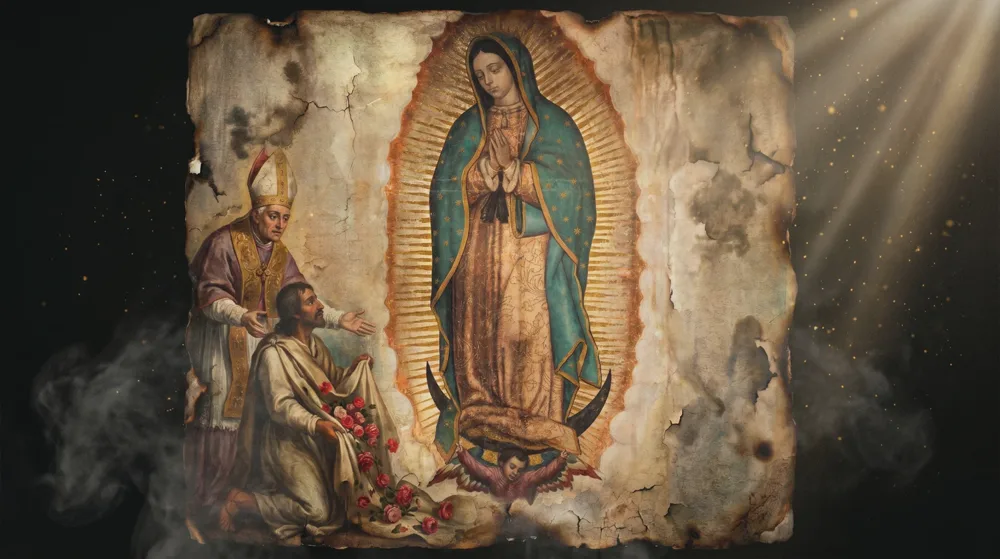
Our Lady of Guadalupe is the title given to the Blessed Virgin Mary under which she appeared to a poor Indian convert, Saint Juan Diego, on the hill of Tepeyac near Mexico City, in December 1531. The Virgin of Guadalupe left her image miraculously imprinted on his rough cloak, the tilma, where it remains to this day. The Guadalupe apparition stands among the great Marian visitations the Church has long held in honour, and it gave to the New World a Mother at the very hour of its evangelization.
The Guadalupe apparition to Saint Juan Diego
The Our Lady of Guadalupe story belongs to the first decade after the conquest of Mexico, when the Faith had scarcely begun to take root among the native peoples. Juan Diego was a baptized Indian of humble condition, a widower of mature years, who walked some distance each week to hear Mass and receive instruction.
On Saturday, the ninth of December 1531, as he crossed the hill of Tepeyac, he heard singing and a voice calling him by name. There he beheld a Lady of surpassing beauty, radiant as though clothed in the sun, who told him that she was the ever-Virgin Mary, Mother of the true God. She charged him to go to the bishop and ask that a church be raised on that spot, where she would show her compassion to all who sought her.
Juan Diego went obediently to Bishop Juan de Zumárraga, but the prelate, prudent as a shepherd must be before any claimed vision, did not at once believe him and asked for a sign. The Lady appeared again and promised that a sign would be given.
The tilma and the image
The Virgin of Guadalupe directed Juan Diego, on the twelfth of December, to climb the hill and gather the flowers he would find there. Though it was winter and the ground barren, he found Castilian roses blooming on the rock, fragrant and fresh. The Lady arranged them with her own hands within his tilma, and bade him carry them, unopened, to the bishop as her token.
When Juan Diego let down the folds of his cloak before Zumárraga, the roses fell to the floor, and on the coarse fabric appeared the image of the Mother of God: a young woman, hands joined in prayer, head inclined, standing upon the moon and clothed with the sun, in the very posture of the woman of the Apocalypse, "a great sign… a woman clothed with the sun, and the moon under her feet" (Apoc. 12:1, Douay-Rheims). The bishop fell to his knees, and the church the Lady had asked for was begun.
The tilma was woven of agave fibre, a material that ordinarily decays within a few decades. The image upon it has endured for centuries without corruption, and pilgrims have venerated it without interruption from that day. The Church does not propose private revelations as articles of faith, but she has long honoured this one, and the traditional popes granted the shrine privileges and a proper feast, declaring the Virgin of Guadalupe patroness of the Mexican nation and of all the Americas.
The fruit of the apparition
The effect of the Guadalupe apparition was swift and immense. In the years that followed, the native peoples of Mexico came to baptism in vast numbers, drawn by the Mother who had appeared not as a foreigner but as one of their own, speaking their tongue and bearing on her image the features they could recognize. What years of preaching had begun, the Virgin of Guadalupe carried to harvest. The Church saw in this the same maternal office Mary holds over the whole Body of Christ: she who was made the Mother of God at the Incarnation is given to us as Mother in the order of grace.
This is the constant teaching of the Fathers and the doctors: that the Blessed Virgin draws men to her Son and never to herself apart from Him. The honour paid at Tepeyac is the honour the Church pays everywhere to the Mother of God, whose dignity flows from her divine maternity defined at the Council of Ephesus. Whoever would understand the apparitions of Our Lady must first understand who she is, and on this the Church speaks plainly in the article on Mary, the Mother of God.
The message of Our Lady of Guadalupe
The words recorded from the Lady to Juan Diego are few and maternal. "Am I not here, who am your Mother? Are you not under my shadow and protection?" She presented herself as the Mother of mercy who hears those who weep, and she asked only for a place where she might draw souls to her Son. There is no novelty of doctrine in the Guadalupe apparition; there is the old gospel of trust in the maternal mediation of Mary, who leads the afflicted to Christ.
Her appearance as the woman clothed with the sun, standing upon the moon, accords with what the Church holds of the Immaculate Virgin, conceived without stain of original sin, the new Eve who crushes the head of the serpent. The image of Guadalupe was honoured by the faithful as a figure of the Immaculate long before that doctrine was solemnly defined; on the meaning of that privilege, see the Immaculate Conception.
The devotion to the Virgin of Guadalupe
Devotion to Our Lady of Guadalupe spread from Mexico throughout the Spanish-speaking world and beyond, and the shrine at Tepeyac became one of the most frequented places of pilgrimage in Christendom. The faithful approach her as they approach Mary under all her titles, whether Our Lady of Mount Carmel or Our Lady, Undoer of Knots or any other: by entrusting their needs to her intercession, by imitating her humility and obedience, and above all by the Rosary, the prayer the Church places foremost among Marian devotions.
The Rosary is the surest way to honour the Mother who appeared at Tepeyac, for in its mysteries we meditate with her upon the life, death, and triumph of her Son. Those who wish to learn or to renew this prayer will find it set out simply in our guide on how to pray the Rosary. To venerate the Virgin of Guadalupe is not to add a strange devotion to the Faith but to receive, with the peoples of the New World, the same Mother whom Christ gave to all His disciples from the Cross.
A prayer to Our Lady of Guadalupe
The surest prayers to the Mother of Tepeyac are the Church's own Marian prayers — the Hail Mary, the Rosary, the Salve Regina and the Memorare — said before her image or in any need. The prayer often circulated under her title, beginning "O Immaculate Virgin, Mother of the true God and Mother of the Church", is not drawn from her words to Juan Diego: it is a modern prayer whose origin we cannot document, and we do not give it here as a traditional prayer.
The basilica and shrine of Our Lady of Guadalupe
The church the Lady asked for was begun on the hill of Tepeyac as soon as the image appeared, and over the centuries the shrine of Our Lady of Guadalupe grew into one of the most frequented places of pilgrimage in the whole world. The basilica of Our Lady of Guadalupe stands just north of Mexico City, on the very ground of the apparition, and it is there that the tilma is enshrined and venerated. From this national shrine the devotion spread through the Spanish-speaking world, and chapels, parishes, and churches bearing her name were raised across the Americas. To make a pilgrimage to the basilica is, before all else, to come to the Mother who promised her compassion to all who seek her in that place; the building honours not itself but the One whose image it guards.
The image, statues, and medals of Our Lady of Guadalupe
Because the apparition gave the Church an actual image, devotion to the Virgin of Guadalupe has always centred on that picture: the young woman clothed with the sun, standing upon the moon, her head inclined and her hands joined in prayer. A statue or picture of Our Lady of Guadalupe, a medal, pendant, or necklace bearing her likeness, is a sacramental — a holy reminder that turns the heart to prayer, never a charm or talisman.
The Church blesses such objects so that the faithful may carry the memory of the Mother of God with them, but their power is no other than the prayer they prompt and the faith they express. To wear a medal of Our Lady of Guadalupe or to keep her image in the home is to make a small confession of trust in her intercession, and an invitation to say, as often as the eye falls upon it, Holy Mary, Mother of God, pray for us sinners.
Frequently Asked Questions
Who is Our Lady of Guadalupe?
Our Lady of Guadalupe is the Blessed Virgin Mary under the title she took when she appeared to a poor Indian convert, Saint Juan Diego, on the hill of Tepeyac near Mexico City in December 1531. She told him plainly that she was "the ever-Virgin Mary, Mother of the true God," and left her image miraculously imprinted on his tilma, where it remains to this day.
Is Our Lady of Guadalupe the Virgin Mary?
Yes. "Our Lady of Guadalupe" is one of the many titles of the one Blessed Virgin Mary, Mother of God, just as Our Lady of Lourdes or Our Lady of Sorrows are. The title names a particular apparition and image, but the person honoured is always the same Mother whom Christ gave to all His disciples from the Cross (John 19:26-27, Douay-Rheims).
What is Our Lady of Guadalupe?
Our Lady of Guadalupe is both the apparition of the Blessed Virgin Mary at Tepeyac in 1531 and the miraculous image she left upon Saint Juan Diego's cloak. The Church does not propose such private revelations as articles of faith, but she has long honoured this one, granting the shrine a proper feast and declaring the Virgin of Guadalupe patroness of Mexico and of all the Americas.
Why is Our Lady of Guadalupe so important?
She is important because, at the very dawn of the Faith in the New World, the Mother of God appeared as one of the native people, speaking their own tongue, and drew them in vast numbers to baptism where years of preaching had only begun. The traditional Roman Pontiffs honoured her with a proper feast and declared her patroness of Mexico and of all the Americas. Above all she shows the Church's constant teaching: that Mary draws men to her Son and never to herself apart from Him.
Where is Our Lady of Guadalupe?
The apparitions took place on the hill of Tepeyac, just north of Mexico City, in December of 1531. There the church the Lady asked for was raised, and the shrine at Tepeyac became one of the most frequented places of pilgrimage in Christendom. The tilma bearing her image has been venerated there without interruption from that day.
When did Our Lady of Guadalupe appear?
She first appeared to Saint Juan Diego on Saturday, the ninth of December 1531, as he crossed the hill of Tepeyac on his way to Mass. Over the following days she appeared again, and on the twelfth of December her image was found imprinted upon his tilma before Bishop Zumarraga, in the first decade after the conquest of Mexico, when the Faith had scarcely begun to take root.
Where is the tilma of Our Lady of Guadalupe?
The tilma, the coarse agave-fibre cloak of Saint Juan Diego bearing the miraculous image, is enshrined at Tepeyac, just north of Mexico City, where it has been venerated without interruption since 1531. Though such fabric ordinarily decays within a few decades, the image upon it has endured for centuries without corruption.
When is the feast day of Our Lady of Guadalupe?
Her feast is kept on the twelfth of December, the day on which the image appeared upon Juan Diego's cloak before Bishop Zumarraga in 1531. The Roman Pontiffs granted this proper feast to the shrine and to the dioceses that honour her; it is not a feast of the universal Roman calendar of 1962.
Where is the basilica of Our Lady of Guadalupe?
The basilica and national shrine of Our Lady of Guadalupe stand on the hill of Tepeyac, just north of Mexico City, on the very ground where the Virgin appeared in 1531. It is there that the tilma is enshrined, and the shrine has been one of the most frequented places of pilgrimage in the world since that time.
Is it right to wear a medal or pray to Our Lady of Guadalupe?
Yes. To pray to Our Lady of Guadalupe is to ask her intercession with her Son, as the Church does with all the saints, and a medal, necklace, or statue of her is a sacramental — a blessed reminder that turns the heart to prayer. It is never a charm or talisman; its only power is the faith and prayer it stirs, which Mary always carries to Christ.
The Virgin of Guadalupe asks of us what every true devotion to Our Lady asks: that we let her bring us to her Son. "Am I not here, who am your Mother?" The same Mother who turned a nation to Christ in 1531 holds out the same protection to every soul that seeks her shadow.
The Iter Fidei app carries the prayers to the saints, the litanies, and the traditional calendar of feasts. Join early access here.
Sources. Sacred Scripture, Douay-Rheims (Apocalypse 12:1; John 19:26-27); the traditional account of the apparition as preserved in the Nican Mopohua and transmitted in traditional hagiography, including Butler's Lives of the Saints and the Roman Martyrology; Council of Ephesus (431) on the divine maternity; the proper feast and patronage of Our Lady of Guadalupe granted by the traditional Roman Pontiffs.