
The Liturgical Year
Gaudete Sunday: the third Sunday of Advent
Gaudete Sunday is the Third Sunday of Advent, named from the Introit Gaudete in Domino semper — Rejoice in the Lord always. On this day the penance of Advent is briefly lightened: the priest may wear rose vestments, the rose candle of the Advent wreath is lit, and the Church bids us rejoice because the Lord is nigh.
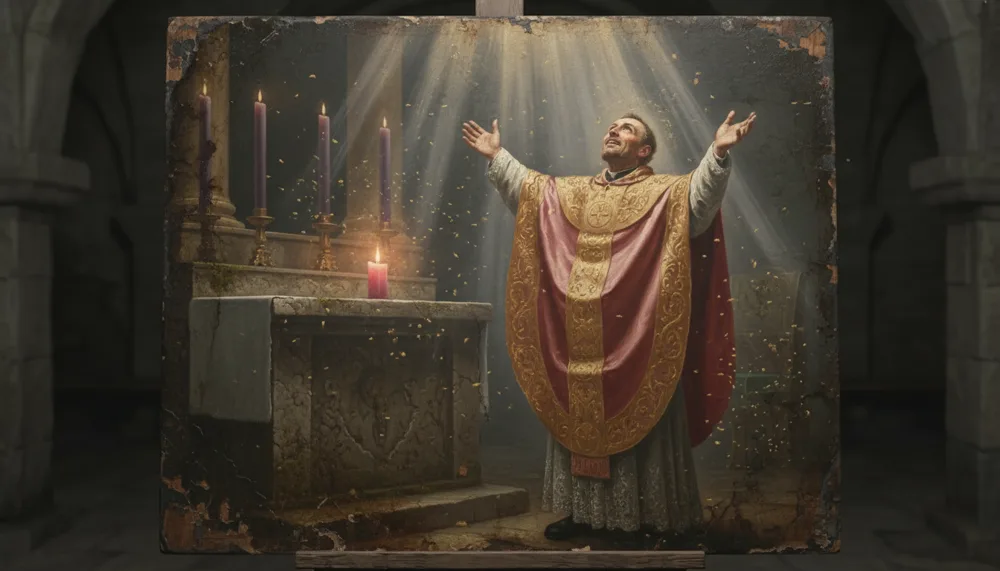
Gaudete Sunday is the Third Sunday of Advent. Its name is the first word of the Introit sung at Mass that day — Gaudete in Domino semper, "Rejoice in the Lord always" — and from that single word the whole character of the day is taken. On this Sunday, the penance of Advent is briefly set aside, and the Church lifts her head to rejoice, because the coming of the Lord is now near at hand. It is the day of rose vestments and the rose candle of the Advent wreath: a foretaste, in the midst of the penitential season, of the joy of Christmas.
What is Gaudete Sunday
Gaudete Sunday is the third of the four Sundays of Advent, falling roughly midway through the season — between the 11th and the 17th of December, depending on the year. In 2026 it falls on the 13th of December.
The whole season of Advent is a season of preparation by penance, kept in violet, as the Church makes ready for the Nativity of Our Lord. But the liturgy does not leave the faithful in unbroken austerity. On this one Sunday the Church pauses, and her voice changes from longing to gladness. The Introit of the Mass sets the tone at once:
Rejoice in the Lord always: again, I say, rejoice. Let your modesty be known to all men: for the Lord is nigh. (Philippians 4:4-5)
This is why the day is named Gaudete — the Latin imperative, "Rejoice." The penance of the season is not abandoned, but for a moment it is illuminated by the joy that is coming. The Church rejoices because the long waiting is almost over: the Lord is nigh.
When is Gaudete Sunday: 2025, 2026 and the years to come
Gaudete Sunday is always the Third Sunday of Advent, and so it has no fixed calendar date. Because Advent begins on the Sunday nearest the feast of St Andrew (the 30th of November) and runs through the four Sundays before Christmas, the date of Gaudete Sunday shifts from year to year, always falling between the 11th and the 17th of December.
For Gaudete Sunday 2025, the day falls on the 14th of December. For Gaudete Sunday 2026, it falls on the 13th of December. The table below sets out the date for the coming years:
| Year | Gaudete Sunday |
|---|---|
| 2025 | 14 December |
| 2026 | 13 December |
| 2027 | 12 December |
| 2028 | 17 December |
| 2029 | 16 December |
| 2030 | 15 December |
To find the date in any year, count back: Christmas Day is the 25th of December, the Fourth Sunday of Advent is the last Sunday before it, and Gaudete Sunday is the Sunday before that. The rose vestments and the rose candle of the Advent wreath belong to whichever of these Sundays falls third in the season.
The meaning of Gaudete Sunday
To understand the meaning of Gaudete Sunday, one must see where it stands in Advent. Advent looks to two comings of Christ at once — his coming in the flesh at Bethlehem, and his coming again in glory to judge the world. The earlier Sundays of the season are grave: they ring with the cry of the prophets and the warning of the Gospel. But as Christmas draws near, the note of expectation turns to one of nearness and gladness.
The Epistle of the day, from which the Introit is drawn, gives the reason for this joy plainly. St Paul writes to the Philippians:
Rejoice in the Lord always; again, I say, rejoice. Let your modesty be known to all men. The Lord is nigh. Be nothing solicitous: but in every thing, by prayer and supplication, with thanksgiving, let your petitions be made known to God. (Philippians 4:4-6)
The Christian rejoices not because his trials are over, but because the Lord is near. This is the joy of Advent: a joy that does not deny the penance of the season but flows from the certainty that the Redeemer comes. The Gospel of the day is the testimony of St John the Baptist before the priests and Levites — "There hath stood one in the midst of you, whom you know not" (St John 1:26) — the herald pointing to the One who is already among them. Those who wish to honour the forerunner may make a novena to St John the Baptist.
The rose vestments of Gaudete Sunday
The most visible sign of Gaudete Sunday is the colour rose. On the other Sundays of Advent the priest wears violet, the colour of penance. On the Third Sunday he may set the violet aside and wear rose — a softened, lightened violet — as a sign that the rigour of the season is briefly relieved.
The relief reaches beyond the vestments. Where the rite permits, the altar may be adorned with flowers and the organ may be played to accompany the chant, both of which are otherwise restrained in Advent. The whole Mass takes on a gentler, gladder air. The same relief is given once in Lent, on Laetare Sunday, the Fourth Sunday of that season, which likewise takes its rose vestments from the joyful first word of its Introit, "Rejoice, O Jerusalem." Gaudete and Laetare are the two rose Sundays of the year, each set as a window of joy in the heart of a penitential season — just as, later in Lent, Palm Sunday's procession into Jerusalem sounds its own note of triumph before the sorrow of Holy Week.
It should be said that the rose vestments are permitted, not commanded. A church that does not possess them simply keeps the violet of Advent on that Sunday. The joy of the day is in the liturgy itself — in the Introit, the Epistle, and the easing of the season — whether or not the rose is seen.
The rose candle of the Advent wreath
In the home, Gaudete Sunday is marked by the third candle of the Advent wreath. The traditional wreath holds four candles — three violet and one rose — lit one by one through the four Sundays of Advent. The rose candle is the one lit on the Third Sunday, and it matches the rose vestments of the priest at the altar. As the family gathers to light it, the growing light of the wreath has reached its brightest joy: three of the four candles now burn, and Christmas is near.
The rose candle is sometimes called the "Shepherd's candle" or the candle of joy, names drawn from later piety. What is certain and ancient is its colour and its place: it belongs to Gaudete Sunday, and it carries into the home the same note of rejoicing that the liturgy sounds at Mass.
How to pronounce Gaudete Sunday
The word Gaudete is Latin, and in the ecclesiastical pronunciation used in the Church it is said gow-DEH-teh — three syllables, with the stress on the middle one. The au is sounded as in the English "now," the g is hard, and the final e is pronounced, never silent. It is the plural imperative of the Latin verb gaudere, "to rejoice": gaudete means "rejoice ye." The same root gives us Gaudete in Domino semper, the opening of the Introit. Hearing the word sung at the beginning of the Mass is itself the surest way to learn it.
Frequently Asked Questions
What is Gaudete Sunday?
Gaudete Sunday is the Third Sunday of Advent, named from the first word of the Introit of the Mass, Gaudete in Domino semper — "Rejoice in the Lord always" (Philippians 4:4). On this Sunday the penance of Advent is briefly lightened, the priest may wear rose vestments, and the Church rejoices because the coming of the Lord is near.
When is Gaudete Sunday in 2025 and 2026?
Gaudete Sunday is always the Third Sunday of Advent. In 2025 it falls on the 14th of December, and in 2026 on the 13th of December. Because the date of the First Sunday of Advent shifts each year, Gaudete Sunday moves with it, falling between the 11th and the 17th of December.
How do you pronounce Gaudete Sunday?
In the ecclesiastical Latin used in the Church, Gaudete is pronounced gow-DEH-teh — three syllables, with the stress on the middle one. The au is sounded as in the English "now," the g is hard, and the final e is always pronounced, never silent. The word is the plural imperative of gaudere, "to rejoice," and means "rejoice ye."
Why are the vestments rose on Gaudete Sunday?
Rose is a softened, lightened violet. Throughout Advent the priest wears violet, the colour of penance; on Gaudete Sunday he may wear rose as a sign that the rigour of the season is briefly relieved in anticipation of the joy of Christmas. The same relief is given on Laetare Sunday in Lent.
Is Gaudete Sunday a holy day of obligation?
Gaudete Sunday is not a separate holy day of obligation. It is a Sunday, and the obligation to assist at Mass on Sundays applies as on every Sunday of the year. There is no additional precept attached to the day beyond the ordinary Sunday duty.
What is the third candle of the Advent wreath?
The third candle of the Advent wreath is the rose candle, lit on Gaudete Sunday. The traditional wreath holds three violet candles and one rose; the rose candle matches the rose vestments of the priest and marks the joy of the Third Sunday.
Why is it called Gaudete Sunday?
The day takes its name from Gaudete, the first word of the Introit sung at Mass — the Latin imperative "Rejoice." From this single word the whole character of the day is drawn: a day of rejoicing set in the midst of the penitential season of Advent, because the Lord is nigh.
The Third Sunday is a small Christmas before Christmas — a glimpse, through the rose of vestment and candle, of the joy that the whole season of Advent is leading toward.
Sources/Fonti/Fuentes/Fontes/Źródła. Douay-Rheims Bible (Philippians 4:4-7; St John 1:19-28); the Missale Romanum, Mass of the Third Sunday of Advent (Introit Gaudete in Domino semper); Dom Prosper Guéranger, The Liturgical Year, Advent.
Iter Fidei serves the liturgical calendar, prayers and psalms, in Latin and English with audio. Join early access here.