
The Liturgical Year
The Advent Wreath: meaning of the four candles
The Advent wreath holds four candles — three purple and one rose — lit one by one through the four Sundays of Advent. What the candles mean, why one is rose for Gaudete Sunday, where the custom really comes from, and how to keep it with the prayers of the 1962 Missal.
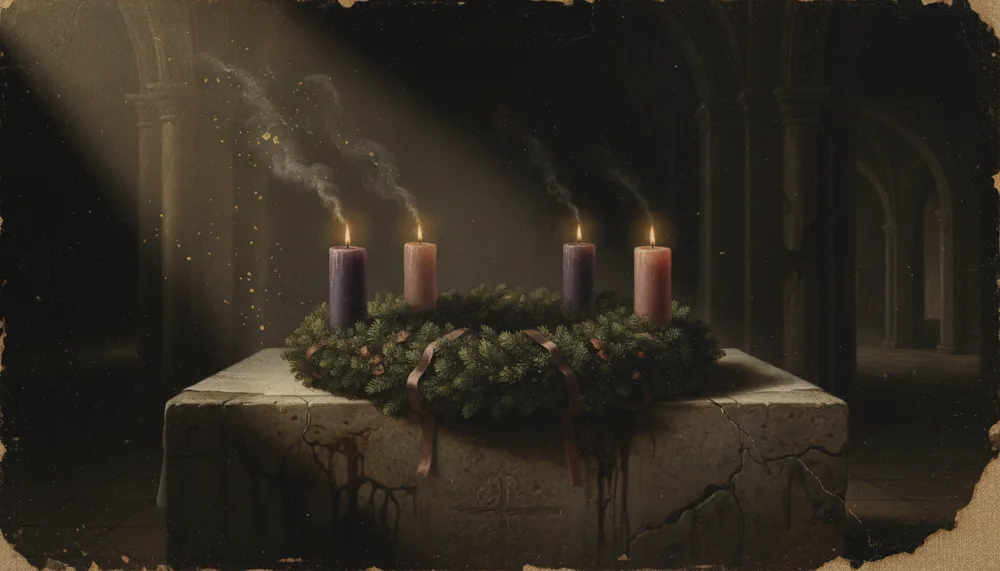
The Advent wreath is a ring of evergreen holding four candles — three purple and one rose — one of which is lit on each of the four Sundays of Advent, so that the growing light through the weeks marks the nearing of Christmas. Each flame answers the long waiting before the coming of Christ: the people who walked in darkness, watching for the Light that was promised. The wreath is not part of the Mass or of the Church's rites. It is a custom of the home — a help to keep the season in the household and to teach its meaning, above all to children.
What the candles on the Advent wreath mean
The meaning of the Advent wreath candles lies first in their number and their growing light, and only after that in the old custom that reads each candle as a stage of the long expectation of the Redeemer.
There are four candles, one for each of the four Sundays of the season. One is lit on the first Sunday, two on the second, three on the third, and four on the fourth — so that the light increases week by week as Christmas draws near. This growing flame is the heart of it: the dawning of the true Light upon a world that sat in the dark. It answers the words of the prophet, kept in the Advent liturgy: "The people that walked in darkness, have seen a great light: to them that dwelt in the region of the shadow of death, light is risen" (Isaias 9:2). Each kindled candle is one step out of that shadow toward the Nativity.
Three of the four candles are purple (violet), the color of penance, because Advent is a penitential season. Through Advent the priest wears violet at Mass, the Gloria falls silent at Sunday Mass, and the altar stands unadorned. The wreath takes the same color, for the home keeps the same penance as the church. The fourth candle is rose, and it has its own day, which we come to below.
The four candles, week by week
A popular custom assigns to the four candles the great watchers who awaited the Redeemer, so that the wreath teaches the whole history of the expectation in four flames:
- The first candle — the Patriarchs. Abraham, Isaac, and Jacob, and all the fathers to whom the promise of a Saviour was given: "in thy seed shall all the nations of the earth be blessed" (Genesis 22:18).
- The second candle — the Prophets. Isaias and those who foretold the coming of Christ and bid the people watch: "Behold a virgin shall conceive, and bear a son and his name shall be called Emmanuel" (Isaias 7:14).
- The third candle — St John the Baptist. The forerunner, "a voice of one crying in the desert, Prepare ye the way of the Lord" (St Matthew 3:3), who pointed to Christ already come.
- The fourth candle — Our Lady. The Blessed Virgin Mary, through whom the Word was made flesh; she who is the Mother of God and was preserved from all sin in her Immaculate Conception that she might be his fitting dwelling.
This reading is a modern pious custom, one of several in circulation, not a law of the liturgy. The Church does not bind the four candles to any meaning; she leaves the wreath to the devotion of the home. But the reading is sound, for it gathers into the season the very ranks the Advent liturgy itself recalls — patriarch, prophet, forerunner, and Virgin Mother — and turns the family's eyes through them to the One they all awaited.
The rose candle: the Gaudete candle
The single rose candle is the one most often asked about, and it has a name. It is the Gaudete candle, lit on the Third Sunday of Advent — Gaudete Sunday — and it marks the one moment in the season when the penance is briefly lightened.
The Sunday takes its name from the Introit of its Mass: "Rejoice in the Lord always: again, I say, rejoice" (Philippians 4:4) — in Latin, Gaudete in Domino semper. On that day the priest may set aside the violet and wear rose vestments, the Gaudete candle of the wreath is kindled, and the whole tone of the season turns for a Sunday toward the nearness of the joy that is coming. The wreath shows this shape to the eye: two weeks of purple penance, a third Sunday of rose and rising joy, and a fourth purple candle before the white of Christmas. The same lightening is given once in Lent, on Laetare Sunday — the two rose Sundays of the year.
So the order of the four candles is this: a purple candle on the First Sunday, a second purple on the Second, the rose Gaudete candle on the Third, and the last purple on the Fourth — until all four burn together as the Nativity approaches. Where each candle sits in the ring is left to the home; what matters is that the rose candle is kept for the Third Sunday.
Why the wreath itself is green
The ring is made of evergreen — branches that do not lose their life in the dead of winter. The Church gives the form its own lesson. The evergreen, alive when all else is bare, signifies the unending life that Christ brings, and the hope that does not fail through the dark of the year. The ring has no beginning and no end, an old figure of eternity and of the love of God that does not cease. Set the four candles within that green circle, and the whole sign is complete: living hope, and within it the light that grows toward Christmas.
Once blessed by a priest, the wreath becomes one of the things the Church calls sacramentals — blessed objects that, unlike the seven sacraments, do not of themselves confer grace, but dispose the soul to receive it through the prayer of the Church. A blessed wreath is not a charm. It works no magic and holds no power in its wax or its branches. It is a help to prayer, and it profits the one who prays beside it in faith.
The history of the Advent wreath
The Advent wreath as we know it is not ancient. Its form belongs to nineteenth-century Germany, and it came into Catholic homes only later. The custom of greenery and lights in the dark of winter is old and widespread, but the ring of four candles in evergreen, lit through the Sundays of Advent, took its familiar shape in a particular place and time.
The German Advent wreath (Adventskranz) goes back to Johann Hinrich Wichern (1808–1881), a Lutheran theologian who ran the Rauhes Haus, a home for poor boys near Hamburg. In 1839 he hung a cartwheel in its prayer hall with a candle for every day of Advent — small red candles for the weekdays and four large white ones for the Sundays — so that the children could count the days to Christmas.
Fir greenery was added around 1860; the household wreath was then reduced to the four Sunday candles and spread through Protestant Germany. Catholics were slower: the first wreath in a Catholic church is recorded at Cologne in 1925, at Munich in 1930, and in many places it became common in Catholic homes only after the Second World War. The three violet candles and the rose one are a Catholic adaptation to the colors of the Roman liturgy.
This history matters for a Catholic eye on the wreath. The wreath is a recent and adopted custom, not a rite of the Roman Church; the Church has no law binding its form, which is why the meanings given to the candles vary from home to home and why the wreath remains a free devotion of the household. What the Church does supply is the season the wreath serves — the violet penance of Advent, the rose of Gaudete, the great cry Rorate caeli.
The Roman Ritual of 1962 contains no blessing proper to the Advent wreath; the blessings now printed for it come later, from the German Benediktionale of 1978 and the Roman De Benedictionibus of 1984 (the English Book of Blessings). The wreath borrows its whole meaning from that liturgy. It is good and useful precisely insofar as it carries the Church's Advent into the family, and it is empty when it becomes a mere seasonal ornament.
Advent in the 1962 Missal: what the wreath serves
The wreath borrows everything from the Church's own Advent, and the traditional Missal gives that Advent a clear shape:
- The four Sundays and their Introits. The First Sunday opens with Ad te levavi ("To Thee have I lifted up my soul", Psalm 24); the Second with Populus Sion ("People of Sion, behold the Lord shall come to save the nations", Isaias 30); the Third with Gaudete (Philippians 4:4); the Fourth with Rorate caeli (Isaias 45:8). In 2026 they fall on 29 November and 6, 13 and 20 December.
- The Ember Days. The Wednesday, Friday and Saturday after the Third Sunday are the Ember Days of Advent, days of fasting and prayer; Wednesday's Mass, Rorate, reads the Gospel of the Annunciation and was long called the "Golden Mass". In 2026: 16, 18 and 19 December.
- The Rorate Masses. The votive Mass of Our Lady in Advent, which begins Rorate caeli, is in many places sung before dawn by candlelight — the Church's own "wreath" of growing light.
- The O Antiphons. From 17 to 23 December the Breviary sings at Vespers the seven great antiphons before the Magnificat, O Sapientia to O Emmanuel.
Feasts fall within the season too: the Immaculate Conception on 8 December, prepared by the Immaculate Conception novena, and St Lucy on 13 December, whose novena runs from 4 December — in 2026 her day falls on Gaudete Sunday itself. Many families also say the St Andrew Christmas Novena from 30 November until Christmas.
How to bless and light the Advent wreath
The wreath is lit at family prayer — at the evening meal, or at night prayers — one candle in the first week, and another added each Sunday, so that the light grows as the family watches.
Many families like to have the wreath blessed. Since the 1962 Ritual has no blessing of its own for it, a priest who uses the traditional books blesses it with the Ritual's general blessing of any object, the Benedictio ad omnia (Deus, cuius verbo sanctificantur omnia…), sprinkling it with holy water; many households ask for this on the eve of the First Sunday. But the blessing is not what makes the wreath profitable. As with every sacramental, the fruit comes through the prayer it accompanies and the faith of those who pray, not through the object set upon the table.
A short prayer beside the lit candles keeps the season's purpose. The old cry of Advent serves well, said as the flames are kindled:
Drop down dew, ye heavens, from above, and let the clouds rain the just: let the earth be opened, and bud forth a saviour. (Isaias 45:8)
So used, the wreath does what the season asks. It is not a countdown to a holiday but a watching for the Lord. The chocolate-pocketed "advent calendar" of the shops borrows the name of the season and empties it of its purpose; the wreath, lit and prayed beside, keeps that purpose whole. Its growing light is the lesson of Christmas carried into the family through the weeks of the liturgical year: the Light of the world drawing near, and a household made ready to receive him.
Advent wreath prayers for each Sunday
The Church does not impose a set of Advent wreath prayers; the wreath is a free devotion, and the family may pray beside it in any words. But it helps to have a short, fixed prayer for the lighting of each week's candle, so that the children learn it. The best are the Church's own: the Collect of each Sunday's Mass in the 1962 Missal, here in English translation, with the Latin incipit. The head of the house may begin, and all answer.
The lighting may be opened each week with the great Advent versicle:
V. Drop down dew, ye heavens, from above, and let the clouds rain the just.
R. Let the earth be opened, and bud forth a Saviour. (Isaias 45:8)
Then a short prayer for the week, as the candle or candles are kindled:
- First Sunday, Ad te levavi (Patriarchs). Stir up Thy power, O Lord, and come: that from the threatening dangers of our sins we may be worthy to be rescued by Thy protection, and saved by Thy deliverance. Who livest and reignest, world without end. Amen. (Collect Excita, quaesumus, Domine, potentiam tuam.)
- Second Sunday, Populus Sion (Prophets). Stir up our hearts, O Lord, to prepare the ways of Thine only-begotten Son: that through His coming we may be worthy to serve Thee with purified minds. Who liveth and reigneth with Thee, world without end. Amen. (Collect Excita, Domine, corda nostra.)
- Third Sunday, Gaudete (St John the Baptist). Incline Thine ear, O Lord, to our prayers, and enlighten the darkness of our minds by the grace of Thy visitation. Who livest and reignest, world without end. Amen. (Collect Aurem tuam, quaesumus, Domine.)
- Fourth Sunday, Rorate caeli (Our Lady). Stir up Thy power, O Lord, and come; and with great might succour us: that by the help of Thy grace, that which is hindered by our sins may be hastened by Thy merciful forgiveness. Who livest and reignest, world without end. Amen. (Collect Excita, quaesumus, Domine, potentiam tuam, et veni: et magna nobis virtute succurre.)
A family may close with one Our Father and one Hail Mary; and from 17 to 23 December, with the O Antiphon of the day, which the Church sings at Vespers before the Magnificat (the hymn O come, O come, Emmanuel is a nineteenth-century English paraphrase of them). These prayers ask in the Church's own words what the wreath signifies in light: that the Lord stir up His power, and come.
How to make an Advent wreath at home
A DIY Advent wreath is easily made, and making it is itself a way of keeping the season with the family. Gather a ring of evergreen — fir, pine, spruce, or holly — worked over a wire or foam circle, or simply branches bound to a metal hoop. Within or upon the ring set the four candles: three purple (violet) and one rose, the rose kept for the Third Sunday. A candle holder of any kind serves — a metal ring with four cups, four candlesticks set in the green, or tapers fixed upright in the wreath; the form is free, and inexpensive holders or a plain wooden base will do. Keep the candles secure and the evergreen away from the flames, since the dried branches burn.
Three points keep a home-made wreath faithful to its meaning. The candle colors should be three purple and one rose, matching the violet and rose of the Advent liturgy, rather than the four red or four white candles sold as ornament. It may be blessed, where a priest can be had, before the First Sunday. And it should be prayed beside, not merely displayed: a wreath made and lit without prayer is decoration; a wreath made and lit with the prayers above carries Advent into the household.
Frequently Asked Questions
What is an Advent wreath?
The Advent wreath is a ring of evergreen branches holding four candles — three purple and one rose — one lit on each of the four Sundays of Advent, so that the growing light marks the nearing of Christmas. It is not part of the Mass but a custom of the home, a help to keep the season in the household and to teach its meaning, above all to children.
What do the candles on the Advent wreath mean?
Their meaning lies first in the growing light: one candle is lit on the first Sunday, two on the second, and so on, signifying the true Light dawning upon a world that sat in darkness (Isaias 9:2). By a popular modern custom each candle also recalls a watcher who awaited the Redeemer — the Patriarchs, the Prophets, St John the Baptist, and Our Lady — though the Church does not bind the wreath to any fixed scheme.
What color are the candles on an Advent wreath?
There are three purple (violet) candles and one rose candle. Violet is the color of penance, worn by the priest through Advent, and the three purple candles mark the penitential weeks; the single rose candle is lit on the Third Sunday, Gaudete, when the season's joy is briefly anticipated.
Why is one Advent candle pink or rose?
The rose candle is the Gaudete candle, lit on the Third Sunday of Advent. The Sunday is named from the Introit of its Mass, "Rejoice in the Lord always" (Philippians 4:4), and on that day the priest may wear rose vestments and the penance of the season is briefly lightened in anticipation of the joy that is near. The rose candle marks that same relief.
How many candles are on an Advent wreath?
There are four candles, one for each of the four Sundays of Advent. One is lit on the first Sunday, two on the second, three on the third, and four on the fourth, so that the light grows week by week as Christmas draws near.
What is the order of lighting the Advent wreath candles?
A purple candle is lit on the First Sunday and another purple on the Second. The rose Gaudete candle is lit on the Third Sunday, when the season's joy is briefly anticipated. The last purple candle is added on the Fourth Sunday, so that all four burn together as the Nativity approaches. Where each candle sits in the ring is left to the home; what matters is that the rose candle is kept for the Third Sunday.
How do you bless an Advent wreath?
The Roman Ritual of 1962 has no blessing proper to the Advent wreath (the blessings printed today come from the books of 1978–1984), so a priest using the traditional Ritual blesses it with the general blessing Benedictio ad omnia and holy water, often on the eve of the First Sunday of Advent. But the blessing is not what makes the wreath profitable; as with every sacramental, the fruit comes through the prayer it accompanies and the faith of those who pray beside it, not through the object itself.
What is the history of the Advent wreath?
The Advent wreath is not ancient. It goes back to Johann Hinrich Wichern, a Lutheran theologian at the Rauhes Haus near Hamburg, who in 1839 hung a cartwheel of candles, one for each day of Advent, for the boys in his care. Fir greenery was added around 1860, the household form was reduced to four Sunday candles, and Catholics adopted it only in the twentieth century — Cologne in 1925 is the first Catholic church recorded — reaching Catholic homes worldwide after the Second World War. The Church has no law binding its form, which is why the meanings given to the candles vary.
What is a German Advent wreath?
The German Advent wreath (Adventskranz) is the original of the custom — the cartwheel of candles hung by Wichern at the Rauhes Haus near Hamburg in 1839, later set in evergreen and reduced to the four candles of the four Sundays. The wreath we keep today descends directly from this German custom.
What Advent wreath prayers should we say?
The Church imposes none, but it helps to fix a short prayer for each week's lighting. A traditional pattern opens with the versicle Drop down dew, ye heavens (Isaias 45:8), then prays the Collect of that Sunday of Advent from the 1962 Missal — the first and fourth begin Stir up Thy power, O Lord, and come, the second Stir up our hearts, the third Incline Thine ear — and closes with an Our Father, a Hail Mary and, from 17 December, the O Antiphon of the day. The full texts for each Sunday are given above.
How do you make an Advent wreath at home?
Work a ring of evergreen — fir, pine, spruce, or holly — over a wire or foam circle, and set within it three purple candles and one rose, the rose kept for the Third Sunday. Any candle holder serves: a metal ring with four cups, four candlesticks in the green, or tapers fixed in the wreath. Keep the candle colors faithful to the violet and rose of the Advent liturgy rather than using red or white ornament candles, have it blessed where a priest can be had, and above all pray beside it.
Iter Fidei serves the liturgical calendar, prayers and psalms, in Latin and English with audio. Join early access here.
Sources. Holy Scripture, Douay-Rheims (Genesis 22:18; Isaias 7:14; 9:2; 45:8; St Matthew 3:3; Philippians 4:4). Catechism of St Pius X, Part III, ch. 4, The Precepts of the Church (on the fast of Advent, instituted to dispose us to celebrate holily the feast of Christmas). Roman Missal of 1962, Proper of the Time: the Introits and Collects of the four Sundays of Advent, the Ember Days and the votive Mass Rorate. Roman Breviary: the O Antiphons, 17–23 December. Roman Ritual, Benedictio ad omnia. On the origin of the wreath: Johann Hinrich Wichern (1808–1881), Rauhes Haus, Hamburg, 1839.