
Novenas
The St Andrew Christmas Novena
The St Andrew Christmas novena — the 'Hail and blessed be the hour and moment' prayer, said fifteen times a day from the feast of St Andrew on November 30 through Christmas Eve, with its history, how to pray it, and a printable form.
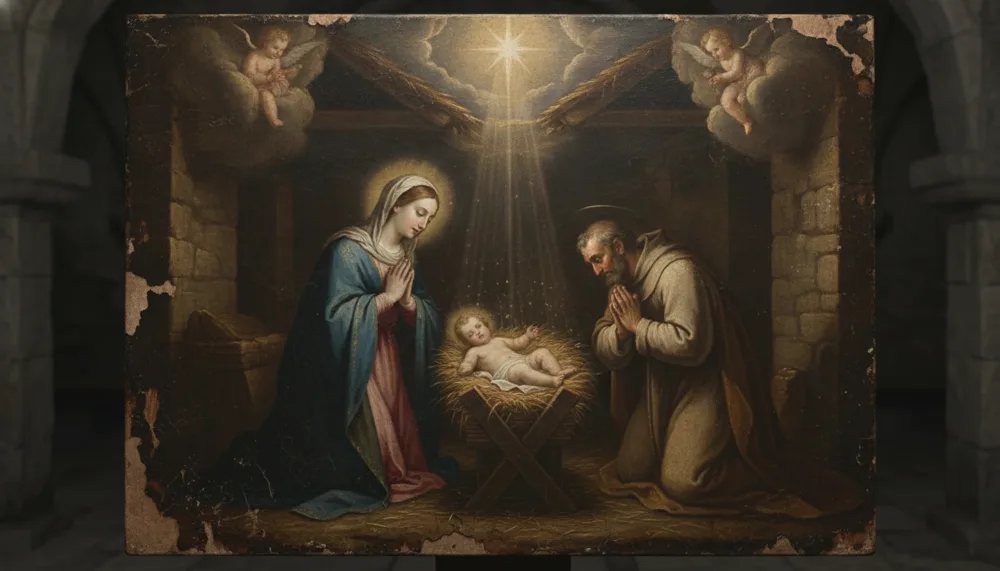
The St Andrew Christmas novena is the old Advent devotion built on a single prayer — "Hail and blessed be the hour and moment in which the Son of God was born" — said fifteen times a day, every day, from the feast of St Andrew the Apostle on November 30 through Christmas Eve. It is not properly a nine-day novena at all but a twenty-five day preparation for the Nativity, and it takes its name simply because it begins on St Andrew's feast. Its purpose is to place the whole of Advent under one steady petition: that in the hour Christ was born, God would hear a favour we hold close to our heart. Below we give the full prayer, how to pray it, its history, and the life of the Apostle whose feast opens it.
The prayer of the St Andrew Christmas novena
This is the entire devotion — one prayer, said fifteen times each day. Name your intention at the marked place:
In the name of the Father, and of the Son, and of the Holy Ghost. Amen.
Hail and blessed be the hour and moment in which the Son of God was born of the most pure Virgin Mary, at midnight, in Bethlehem, in the piercing cold. In that hour vouchsafe, I beseech Thee, O my God, to hear my prayer and grant my desires, (here name your request) through the merits of our Saviour Jesus Christ, and of His blessed Mother. Amen.
That is all there is to it. There are no nine distinct meditations to keep, no separate daily prayer — the strength of this devotion is its plainness. The same short prayer, said fifteen times a day over twenty-five days, comes to some three hundred and seventy-five repetitions before Christmas: a slow, insistent knocking at the door of Bethlehem. Because there is only the one prayer, it is easily learned by heart and carried through a working day.
How to pray the St Andrew Christmas novena
The custom is simple and old:
- Begin on November 30, the feast of St Andrew the Apostle, and pray every day through December 24, Christmas Eve. Many continue through Christmas Day itself; either close is kept.
- Say the prayer fifteen times each day. These need not be said all at once. The old and gentle way is to spread them across the day — five in the morning, five at midday, five at night; or simply to say it whenever it comes to mind, until the fifteen are done.
- Name one intention and hold to it through the whole devotion, bringing the same petition day after day.
- Do not scruple over the exact count. If you lose track, or the day runs away, pray it as often as you can and begin afresh the next morning. The number fifteen is a devout custom, not a law binding under sin, and no favour is forfeited by an honest lapse. What matters is the daily, trusting return to the manger.
If you have never kept a devotion of set repeated prayers and wonder why the Church prays this way at all, see our guide to what is a novena. The St Andrew Christmas novena sits naturally beside the other devotions of Advent — the Infant of Prague novena and the novena to Our Lady of Guadalupe, kept on December 12 — all of which turn the soul toward the coming of the Christ Child.
A note for the scrupulous
Some souls are troubled by the "fifteen times" and fear that a missed prayer voids the whole. It does not. This is a devotion, freely offered, not a contract with God. Pray it faithfully but peacefully; if you can say it only five times on a hard day, offer those five and let the rest go. The Christ Child is not a taskmaster to be satisfied by a tally, but a Saviour to be loved.
What favour to ask — and what to expect
The prayer names no single intention, and that is deliberate: it is prayed for whatever a soul most needs — a conversion, a healing, a marriage mended, work found, a soul in danger, a grace long begged. There is an old and cherished piety that God is especially ready to hear the petitions brought to Him in the hour of His Son's birth, when Heaven was, as it were, thrown open over Bethlehem.
A caution belongs here, as with every such custom. You will sometimes see the promise that whoever says this prayer fifteen times a day will infallibly obtain what he asks. Take that in the sound sense. No prayer binds God or works by its number; to think that a fixed count of words compels an answer would be superstition, which the Church condemns. The prayer "obtains what we ask" as every good prayer does — it never fails to draw down grace, and it obtains the thing named when that thing is for the good of the soul, and something better when it is not. Pray it in confidence and in surrender: Thy will be done.
The history of the St Andrew Christmas novena
The origin of this devotion is genuinely obscure, and honesty is better than invention. The prayer is not the work of St Andrew, nor was it composed by him — the Apostle lends only his feast day as the starting-post. It appears in Catholic prayer-books and on devotional holy cards from at least the nineteenth century, where it is variously headed the "Christmas Anticipation Prayer" or the "St Andrew Novena," and it spread widely through the printed prayer cards of that era, which is why it is so often searched for as a prayer card or printable. Beyond that its author and exact date are unknown; what is certain is that it belongs to the settled devotional treasury of the Church's Advent, prayed by generations of the faithful as a way of counting down to Christmas in prayer rather than in mere waiting.
The name causes reasonable confusion, so it is worth stating plainly: it is called the St Andrew Christmas novena only because it begins on the feast of St Andrew the Apostle, November 30, which is also the traditional opening of the Advent season's approach to Christmas. St Andrew is not its patron or its object; he is its calendar marker. To pray to St Andrew himself — the fisherman, the first-called of the Apostles — is a separate devotion altogether, made in the novena to St Andrew the Apostle.
Is it really a "novena"?
Strictly, no — and this trips up many who come to it. A novena, from the Latin novem, is nine days of prayer. The St Andrew Christmas devotion runs twenty-five days, from November 30 to Christmas Eve. The word "novena" has here been stretched, as it often is in popular usage, to mean simply a fixed devotion of repeated prayer offered for an intention over a set span. Think of it less as a nine-day novena and more as an Advent novena of preparation — a season-long petition rather than a nine-day one. The name has stuck by custom, and there is no harm in it, so long as one knows what is meant.
The St Andrew Christmas novena prayer card and printable
Because the whole devotion is a single short prayer, it was made for the holy card — and the "prayer card," the "printable," and the "PDF" are simply that one prayer set on a card to keep in a missal, a wallet, or beside the crib. (You will also see it called a "chaplet," though it uses no beads and no set of decades; the word is borrowed loosely, as "novena" is, for a devotion of counted prayers.) You need nothing more than the text given above: copy it, print it, or keep it on your phone, and you have the complete novena. In the Iter Fidei app the prayer is carried with a daily counter and reminders through the whole of Advent, so the fifteen repetitions can be prayed and tracked from your pocket without a printed sheet.
Who is St Andrew the Apostle?
Since the devotion opens on his feast, it is fitting to know the saint who begins it. St Andrew was a native of Bethsaida in Galilee, a fisherman on the Lake of Genesareth, the son of Jona and the brother of Simon Peter. He was first a disciple of St John the Baptist, and stood beside him on the day the Baptist pointed to Christ and said, "Behold the Lamb of God." Andrew followed at once, spent that day with the Lord, and knew Him for the Messias — and so the Greeks honour him as the Protoclete, the "first-called" of the Apostles. It was Andrew who then fetched his brother Simon to Christ, saying, "We have found the Messias." He is named again in the Gospel at the feeding of the five thousand, and when the Greeks came asking to see Jesus.
Of his later life the certain record is thin and the traditions many. The ancient writers agree that he preached in Greece, and the constant tradition holds that he was martyred at Patras in Achaia, bound — not nailed — to a cross, on which he hung two days, preaching to the people until he died. The familiar image of the X-shaped cross (the saltire, the cross of St Andrew) is a later medieval addition to the story. His relics were carried in time to Constantinople and afterward to Amalfi in Italy. He is honoured as the patron of Scotland and of Russia, and his name stands with the other Apostles in the Canon of the Mass. His feast is kept on November 30, the day the Christmas novena begins.
For the Church, Andrew is the model of the soul that hears one word about Christ and leaves everything to follow — and who, having found Him, cannot rest until he has brought his brother too. That is a fitting patron for a devotion of Advent longing, which begs, over twenty-five days, that Christ would be born anew in us and in those we love.
Praying it well through Advent
The St Andrew Christmas novena is one of the surest ways to keep Advent as Advent — a true watching for the Lord rather than a rush toward the twenty-fifth. Bind it to the Mass and the Rosary where you can; carry your one intention through the whole month; and let each of the fifteen daily prayers be a small act of longing for the Nativity. It pairs well with the other devotions of the season and of the Incarnation — the feast of the Immaculate Conception on December 8, and the great Annunciation nine-month novena that keeps the whole of Our Lady's waiting. Whatever you ask, ask it in the hour of Bethlehem, and leave the answer, in trust, to the God who was born there.
Frequently Asked Questions
What is the St Andrew Christmas novena?
It is a traditional Advent devotion consisting of a single short prayer — "Hail and blessed be the hour and moment in which the Son of God was born..." — said fifteen times a day, every day, from the feast of St Andrew the Apostle on November 30 through Christmas Eve. Its purpose is to prepare the heart for Christmas by carrying one intention, over twenty-five days, to the hour of Christ's birth. Despite the name, it is longer than a true nine-day novena.
When does the St Andrew Christmas novena start?
It begins on November 30, the feast of St Andrew the Apostle, and is prayed each day through December 24, Christmas Eve — some continue through Christmas Day. The fixed start on St Andrew's feast is the reason for the devotion's name.
How do you pray the St Andrew Christmas novena?
Say the "Hail and blessed be the hour and moment" prayer fifteen times a day, naming one intention at the marked place, every day from November 30 to Christmas Eve. The fifteen repetitions may be spread across the day — a few morning, midday, and evening — and need not be said all at once. Hold to the same intention throughout, and pray it in trust rather than counting anxiously.
Why is it called the St Andrew Christmas novena?
Only because it begins on the feast of St Andrew the Apostle, November 30. St Andrew did not compose the prayer and is not its object; his feast simply marks the day the devotion opens, which is also the traditional threshold of the Church's approach to Christmas. To pray to St Andrew himself is a separate devotion.
Is the St Andrew Christmas novena really a novena?
Not strictly. A novena is nine days of prayer, and this devotion runs twenty-five, from November 30 to Christmas Eve. The word "novena" is here used loosely for a fixed devotion of repeated prayer offered over a set season. It is better understood as an Advent novena of preparation than as a nine-day one; the name has simply held by custom.
What can I ask for in the St Andrew Christmas novena?
Anything you rightly need — a conversion, a healing, work, a soul in danger, any grace long begged. The prayer names no fixed intention so that each soul may bring its own. There is an old piety that God is especially ready to hear petitions offered in the hour of His Son's birth. Ask with confidence, but in surrender to God's will: the prayer never fails to draw down grace, and obtains what we name when it is for the good of the soul.
Does the St Andrew Christmas novena work, and does it grant any favour?
It "works" as every good prayer works — it never returns empty. But no prayer compels God by its number of repetitions; to think that saying it fifteen times forces an answer would be superstition, which the Church condemns. Pray it in faith and in resignation to God's wisdom, content to receive either the favour you named or the better thing He chooses to send. So prayed, it is a true and fruitful devotion, not a charm.
What if I miss a day or lose count of the fifteen?
No favour is lost. This is a devotion freely offered, not a law binding under sin. If you miss a day or fall short of fifteen, offer what you prayed and begin again the next morning. Pray it faithfully but peacefully — the Christ Child looks to the love of the heart, not to the tally.
The Iter Fidei app carries the St Andrew Christmas novena with a daily counter, reminders through the whole of Advent, and audio in Latin and your own language, so you can pray and track the fifteen daily prayers from your pocket. Download it here.
Sources. Holy Scripture (John 1:35-42; John 6:8-9; John 12:20-22; Matthew 4:18-20); the traditional Christmas Anticipation Prayer (Hail and blessed be the hour and moment), as carried in the traditional Catholic prayer-books and holy cards; the feast of St Andrew the Apostle (November 30); Butler's Lives of the Saints, St Andrew, Apostle; the Canon of the Mass (the Apostles named in the Communicantes); on superstition, Catechism of St Pius X, Part III, on the First Commandment.