
The Mass
What Is the Tridentine Mass?
The traditional Latin rite of the Roman Church, codified by Pope St Pius V in 1570. Its origin, its Sacrifice, and the Real Presence — explained from the sources.
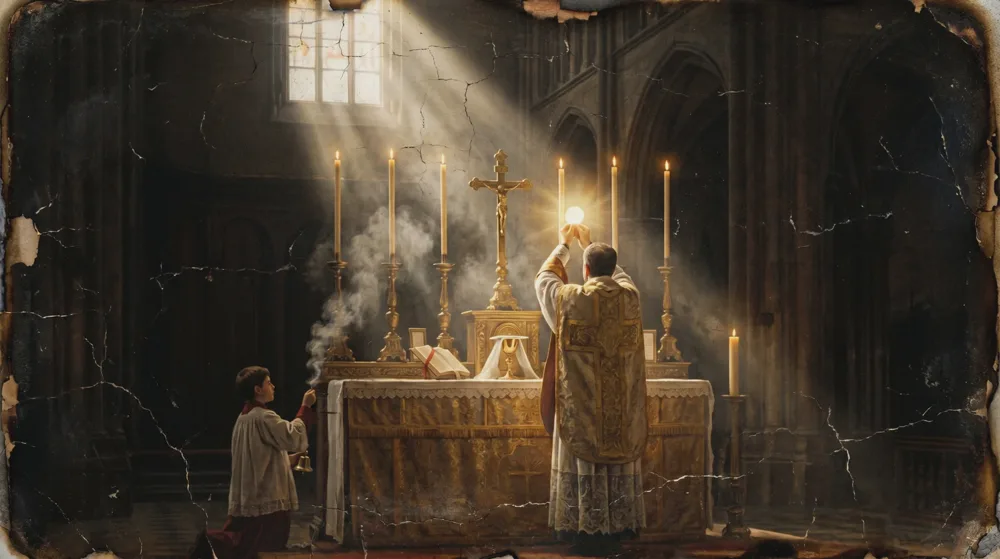
The Tridentine Mass is the traditional Latin rite of the Roman Catholic Mass, codified by Pope St Pius V in 1570 and offered, substantially unchanged, for the four centuries that followed. The name comes from Tridentum, the Latin name of the city of Trent, where the Council of Trent (1545-1563) decreed its standardization. It is the Holy Sacrifice of the Body and Blood of Christ, celebrated according to the traditional Roman rite.
What follows is a plain account of what the Tridentine Mass is, where it came from, and what the Church has always taught about it.
Why "Tridentine"?
After the Council of Trent, Pope St Pius V promulgated a single, fixed edition of the Roman Missal for the whole Latin Church by the bull Quo Primum (14 July 1570). The aim was uniformity and the removal of corruptions: one Roman rite, one missal, with the local uses of fewer than two hundred years suppressed in its favour. Because that missal issued from the Council of Trent, the Mass it contains came to be called Tridentine.
It is also called the Tridentine Latin Mass, the Traditional Latin Mass, or the Usus Antiquior (the older usage). These names point to the same reality: the Roman Mass as the Church handed it down before the liturgical changes of the later twentieth century.
The Mass is a Sacrifice
At the centre of the Tridentine Mass is not a meal or a memorial service but a sacrifice. The Roman Catechism, drawn up by the same Council of Trent, calls the Eucharist by many names, "but often, too, it is given the name of Sacrifice." It speaks of "the daily Sacrifice of our Religion," in which, "immolating this victim of all purity, we render daily to God infinite thanksgivings."
This is the Holy Sacrifice of the Mass: the same Victim who was offered once in a bloody manner upon the Cross is offered again upon the altar in an unbloody manner, by the hands of the priest. The Mass does not add to Calvary; it renews and applies it. Christ instituted it at the Last Supper, when, as the Catechism teaches following the Evangelists, He took bread and pronounced over it the words the priest still pronounces at every Mass: This is My Body; and over the chalice: This is the Chalice of My Blood, of the new and eternal Testament, the mystery of the Faith, which shall be shed for you and for many, unto the remission of sins.
The Real Presence
What rests upon the altar after the Consecration is not bread and wine, nor a symbol of Christ, but Christ Himself. The Roman Catechism states it without hedging: in the Eucharist is contained "the true body of Our Lord Jesus Christ, that very same which was born of the Virgin Mary, which is seated at the right hand of the Father."
This change is called transubstantiation: "after the Consecration there remains absolutely nothing of the substance of the bread and wine in the Sacrament," though the outward appearances — what the senses perceive — remain. Christ is present whole and entire under each species, and in the least particle of each. This is why the Tridentine Mass surrounds the Sacrament with such reverence: genuflection, silence, the priest's care over every fragment and drop.
What the Tridentine Mass looks like
Several features mark the traditional rite for anyone attending it for the first time:
- Latin. The Mass is offered in the sacred language of the Roman Church, the same words in every country.
- Ad orientem. Priest and people face the same direction, toward the altar and the East, together offering the Sacrifice to God.
- Silence. Much of the Mass, including the Canon, is prayed quietly; the action is directed to God, not performed before the congregation.
- A fixed Ordinary and changing Propers. The unchanging parts of the Mass (the Ordinary) are the same every day; the Propers — Introit, Collect, Epistle, Gospel, and the rest — change with the feast and the season of the liturgical calendar.
The Mass falls into two great parts: the Mass of the Catechumens (the readings and prayers leading up to the Offertory) and the Mass of the Faithful (the Offertory, Canon, Consecration, and Communion). (For the full order, see The Order of the Tridentine Mass.)
The Propers and the calendar that govern them are themselves a study; the day's Introit, Collect, Epistle and Gospel can be followed alongside the Mass. (Iter Fidei serves the full day's Mass and Office, in Latin and translation, in the app.)
How it differs from the later rite
The Tridentine Mass is distinct from the reformed rite introduced in 1969, commonly called the Novus Ordo (see The Tridentine Mass vs the Novus Ordo). Iter Fidei holds to the traditional Roman rite, and it is that rite this article describes. The two are not the same Mass in a different language; they differ in their prayers, their calendar, and their ceremonial. Our concern here is to set out the traditional Mass on its own terms, from the sources that gave it to us.
Where to find a Tridentine Mass
The Tridentine Mass is offered in a growing number of churches, chapels, and religious houses. A traditional-rite Mass near you can be located by community (diocesan, Fraternity, monastic) and by the kind of venue. (Iter Fidei keeps a directory of traditional Latin Mass locations, with schedules, in the app — see "find a Mass near you.") Download it here.
The Tridentine Mass is the Roman Church's Sacrifice offered as she offered it for centuries: in Latin, toward God, the same Victim of Calvary made present upon the altar. To understand it is to understand the Faith it carries.
Frequently Asked Questions
What is the Tridentine Mass?
The Tridentine Mass is the traditional Latin rite of the Roman Catholic Mass, codified by Pope St Pius V in 1570 by the bull Quo Primum and offered, substantially unchanged, for the four centuries that followed. Its name comes from the Council of Trent (1545-1563), which decreed its standardization. It is the Holy Sacrifice of the Body and Blood of Christ, the same Victim of Calvary made present upon the altar in an unbloody manner, celebrated according to the traditional Roman rite.
What is the difference between the Tridentine Mass and the Latin Mass?
They are the same thing. Tridentine Latin Mass and Traditional Latin Mass are two names for one reality: the Roman Mass as the Church handed it down before the liturgical changes of the later twentieth century. It is also called the Usus Antiquior (the older usage). All these names point to the rite of the missal of St Pius V, offered in Latin, ad orientem, with the priest and people facing God together.
What missal is used for the Tridentine Mass?
The Tridentine Mass uses the Roman Missal of Pope St Pius V (1570), in the editions that descend from it down to the traditional missal. This is the Tridentine Latin Mass missal that contains both the unchanging Ordinary of the Mass and the changing Propers — the Introit, Collect, Epistle, Gospel, and the rest — proper to each feast and season.
What are the Tridentine Mass readings and propers for today?
The Propers — Introit, Collect, Epistle, Gradual, Gospel, Offertory, and Communion — change each day with the feast and the season of the traditional liturgical calendar; only the Ordinary stays the same. To know the Tridentine Mass readings today you follow the day's place in the traditional Latin Mass calendar. (Iter Fidei serves the full day's Propers and readings, in Latin and translation, in the app.)
Where can I find a Tridentine Mass near me?
The Tridentine Mass is offered in a growing number of churches, chapels, and religious houses — diocesan parishes, communities such as the Fraternity of St Peter, and traditional monasteries. (Iter Fidei keeps a directory of traditional Latin Mass locations, with schedules, in the app — see "find a Mass near you.")
Sources. Catechism of the Council of Trent (1566), On the Sacrament of the Eucharist; Pope St Pius V, Quo Primum (1570); the institution narratives — Matthew 26, Luke 22, and 1 Corinthians 11 (Douay-Rheims).