
Prayer
The Hail Holy Queen (Salve Regina)
The Hail Holy Queen prayer (Salve Regina) in English and Latin: the Marian antiphon that closes the Rosary, with its origin and meaning.
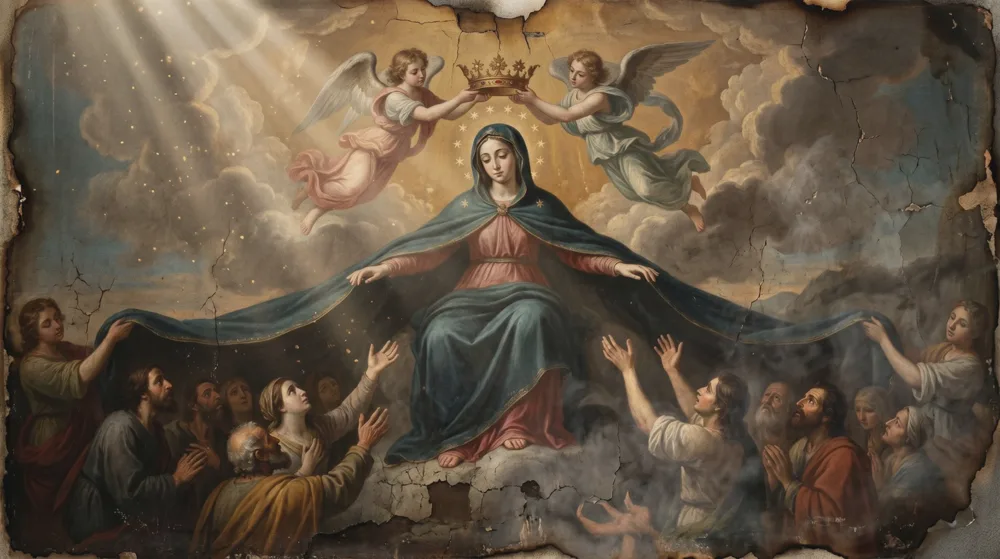
The Hail Holy Queen is the prayer that begins "Hail, holy Queen, Mother of mercy," and the Salve Regina is simply its Latin name and original form. It is the ancient Marian antiphon traditionally said at the close of the Rosary, in which we turn to the Blessed Virgin as our advocate and ask her to show us Jesus. We address her as Queen and as Mother of mercy because she is the Mother of God, and through her intercession we have recourse to her Son.
The prayer in English
This is the traditional English text of the Hail Holy Queen prayer:
Hail, holy Queen, Mother of mercy, our life, our sweetness, and our hope. To thee do we cry, poor banished children of Eve. To thee do we send up our sighs, mourning and weeping in this valley of tears. Turn, then, most gracious advocate, thine eyes of mercy toward us, and after this our exile show unto us the blessed fruit of thy womb, Jesus. O clement, O loving, O sweet Virgin Mary.
V. Pray for us, O holy Mother of God.
R. That we may be made worthy of the promises of Christ.
The Salve Regina in Latin
The prayer is older than its English form, and the Church has always sung and recited it in Latin under the title by which it is best known, the Salve Regina:
Salve, Regina, Mater misericordiae,
vita, dulcedo, et spes nostra, salve.
Ad te clamamus, exsules filii Hevae.
Ad te suspiramus, gementes et flentes
in hac lacrimarum valle.
Eia ergo, advocata nostra,
illos tuos misericordes oculos ad nos converte.
Et Iesum, benedictum fructum ventris tui,
nobis post hoc exsilium ostende.
O clemens, O pia, O dulcis Virgo Maria.V. Ora pro nobis, sancta Dei Genetrix.
R. Ut digni efficiamur promissionibus Christi.
The Hail Holy Queen in Spanish
In Spanish the Salve Regina is known as the Salve or the Dios te salve, Reina y Madre, and it is one of the best-loved prayers of Spanish-speaking Catholics. This is its traditional Spanish text:
Dios te salve, Reina y Madre de misericordia,
vida, dulzura y esperanza nuestra; Dios te salve.
A ti llamamos los desterrados hijos de Eva;
a ti suspiramos, gimiendo y llorando,
en este valle de lágrimas.
Ea, pues, Señora, abogada nuestra,
vuelve a nosotros esos tus ojos misericordiosos;
y después de este destierro, muéstranos a Jesús,
fruto bendito de tu vientre.
¡Oh clemente, oh piadosa, oh dulce Virgen María!V. Ruega por nosotros, Santa Madre de Dios.
R. Para que seamos dignos de alcanzar las promesas de Cristo.
It is the same antiphon word for word: the Spanish opens with "Dios te salve" ("God save you," the old greeting that translates the Latin Salve), names us the "desterrados hijos de Eva" (banished children of Eve), and ends, as every version does, asking Mary to show us Jesus.
Origin of the Salve Regina
The Salve Regina is one of the four great Marian antiphons of the Roman liturgy, the chant that the Church sings to honour the Mother of God; the Regina Caeli is its Eastertide companion, sung in the joy of the Resurrection. It belongs to the Divine Office, where it has long been sung at the end of Compline, the Church's night prayer, through the season after Pentecost. Its composition is traditionally placed in the eleventh century, and it has been attributed to Hermann of Reichenau, the monk known as Hermann the Lame, though the Church sings it as the common possession of the faithful rather than the work of one author.
The final triple invocation, "O clement, O loving, O sweet Virgin Mary," was added later, and devotion attached these three acclamations to the name of Saint Bernard of Clairvaux. From the cloister the antiphon passed into the daily prayer of ordinary Christians, and it became the customary prayer with which the Rosary is brought to a close. Whether sung in choir or whispered at the end of a chaplet, it is the same prayer: the exile on earth lifting his eyes to the Queen of heaven.
What it means
Every line of the Hail Holy Queen does what the Church teaches us to do when we turn to the Blessed Virgin. We do not pray to her as we pray to God. We pray to God as the author of grace, that He may give us good things and deliver us from evil; we pray to the Saints, and above all to Mary, that they may intercede for us as our advocates with God (Catechism of St. Pius X, Part II, ch. 4). The Salve Regina is that intercession put into words.
"Mother of mercy." We call Mary Queen and Mother of mercy because she is the Mother of God, and it is for this reason that she is our most powerful advocate with Jesus Christ. Her power rests on her divine motherhood: she is so powerful because she is the Mother of God, and it is impossible that He should not hear her (Catechism of St. Pius X, Part II, ch. 3). When we name her Mother of mercy we confess that the mercy we need comes from God, and that she obtains it for us from her Son.
"To thee do we cry, poor banished children of Eve." The prayer does not flatter us. It names our condition: we are exiles, banished children of Eve, mourning and weeping in a valley of tears. The Roman Catechism teaches that even the gravest sinner, crushed by the weight of his faults, may still raise himself toward God by prayer, and that Christian charity bids us come "even to tears and groanings before God" for mercy (Catechism of the Council of Trent, Part IV, On Prayer). The Salve Regina makes those very tears into a prayer.
"Most gracious advocate." The word advocate is the heart of the prayer. The Roman Catechism, treating the Angelic Salutation, says that the Church has joined to her thanksgiving "prayers and invocations to the most holy Mother of God," and wills that we have recourse to her "with a pious confidence and a profound humility," so that through her intercession God may be reconciled to us in spite of our faults (Catechism of the Council of Trent, Part IV, On Prayer). The Hail Holy Queen asks for nothing else: that our advocate turn her merciful eyes toward us and plead our cause.
"Show unto us the blessed fruit of thy womb, Jesus." The prayer does not end in Mary. It ends in Christ. We ask her, after the exile of this life is over, to show us Jesus, the blessed fruit of her womb. This is the whole logic of Catholic prayer to the Virgin: she leads to her Son. The Roman Catechism is exact on this point. Whatever we ask of the Saints, we ask through the merits of "our divine Mediator and Intercessor, Jesus Christ," in whom alone we have an Advocate with the Father (Catechism of the Council of Trent, Part IV, On Prayer). Mary's mediation does not rival Christ's; it depends on it and points to it.
The closing versicle gathers all of this into a petition: "Pray for us, O holy Mother of God, that we may be made worthy of the promises of Christ." We do not ask Mary to make the promises, but to obtain for us the grace to be made worthy of them.
"Hail, Holy Queen Enthroned Above": the sung hymn
Besides the prayer, there is a well-known hymn that begins "Hail, holy Queen enthroned above," sung to the melody Salve Regina coelitum. It is a metrical paraphrase of the antiphon, a setting of the same praise in verses fit for singing, with the repeated refrain "O Maria!" Its first stanza runs:
Hail, holy Queen enthroned above, O Maria!
Hail, Mother of mercy and of love, O Maria!
Triumph all ye Cherubim, sing with us ye Seraphim,
Heaven and earth resound the hymn: Salve, salve, salve Regina!
This hymn is the version many people first hear sung in church or in choir, and it carries the same titles the prayer gives our Lady: holy Queen, Mother of mercy. The spoken prayer and the sung hymn are two forms of one devotion. (The same tune was used in a popular film, which is where some first encounter the words; the hymn itself is a genuine and much older piece of Catholic praise.)
When to pray it
The Hail Holy Queen is traditionally said at the end of the Rosary, after the five decades, as the prayer that lifts the whole meditation up to the Queen of heaven and asks her protection. In the customary order, once the last decade is finished you pray the Salve Regina, then add the versicle and response ("Pray for us, O holy Mother of God / That we may be made worthy of the promises of Christ"), and many follow it with the closing prayer "O God, whose only-begotten Son…" It is the final spoken prayer of the Rosary, the word that hands the whole chaplet over to our Lady. If you are learning the beads, our guide on how to pray the Rosary shows where the Salve Regina falls in the order of prayers. It is also the night prayer of the Church for much of the year, sung at the close of Compline, and many of the faithful keep it as their last prayer before sleep, a fitting word for souls who know themselves to be exiles asking to be brought home.
Because it confesses Mary as Mother of God, the Salve Regina belongs beside the truth it rests on, which we treat under Mother of God, and beside the great chain of her titles invoked in the Litany of the Blessed Virgin Mary. To pray any of them well is to do what this antiphon does: to turn to the Queen, and through her, to Christ.
Frequently Asked Questions
What is the Hail Holy Queen prayer?
The Hail Holy Queen is the ancient Marian antiphon that begins "Hail, holy Queen, Mother of mercy," known in Latin as the Salve Regina. In it we turn to the Blessed Virgin as our advocate, confess ourselves to be "poor banished children of Eve" in this valley of tears, and ask her to show us Jesus, the blessed fruit of her womb. It is traditionally said at the close of the Rosary and sung at the end of Compline for much of the year.
Is the Salve Regina the same as the Hail Holy Queen?
Yes. Salve Regina is simply the Latin name and original form of the prayer; "Hail Holy Queen" is its English title. The Church has always sung and recited it in Latin under the title by which it is best known, and whether prayed in Latin or in English it is one and the same antiphon.
Why do we call Mary "Mother of mercy"?
We call Mary Queen and Mother of mercy because she is the Mother of God, and for that reason she is our most powerful advocate with Jesus Christ (Catechism of St. Pius X, Part II, ch. 3). The mercy we need comes from God; when we name her Mother of mercy we confess that she obtains that mercy for us from her Son.
Do Catholics worship Mary in this prayer?
No. We do not pray to Mary as we pray to God. We pray to God as the author of grace; we pray to Mary and the Saints that they may intercede for us as our advocates (Catechism of St. Pius X, Part II, ch. 4). The prayer itself ends not in Mary but in Christ, asking her to "show unto us the blessed fruit of thy womb, Jesus."
Who wrote the Salve Regina?
Its composition is traditionally placed in the eleventh century and attributed to Hermann of Reichenau, the monk known as Hermann the Lame, though the Church sings it as the common possession of the faithful. The final triple invocation, "O clement, O loving, O sweet Virgin Mary," was added later and devotion attached it to the name of Saint Bernard of Clairvaux.
When do you pray the Hail Holy Queen?
It is traditionally said at the end of the Rosary, after the five decades, as the prayer that lifts the whole meditation up to the Queen of heaven. It is also the night prayer of the Church for much of the year, sung at the close of Compline, and many of the faithful keep it as their last prayer before sleep.
What is the Hail Holy Queen prayer after the Rosary?
It is the Salve Regina itself. When the five decades are finished, you pray "Hail, holy Queen, Mother of mercy…" in full, then say the versicle and response, "Pray for us, O holy Mother of God / That we may be made worthy of the promises of Christ." This is the prayer that closes the Rosary; in many forms it is followed by the short collect "O God, whose only-begotten Son, by His life, death, and resurrection…"
What is the Hail Holy Queen in Spanish?
In Spanish it is the Salve, beginning "Dios te salve, Reina y Madre de misericordia, vida, dulzura y esperanza nuestra; Dios te salve." It is the same prayer translated word for word, ending, like every version, by asking our Lady to show us Jesus, "fruto bendito de tu vientre."
What is "Hail, Holy Queen enthroned above"?
It is a sung hymn, a metrical paraphrase of the Salve Regina set to the melody Salve Regina coelitum, with the refrain "O Maria!" and the line "Triumph all ye Cherubim." It puts the same praise of our Lady as Queen and Mother of mercy into verses fit for singing. It is a genuine and old piece of Catholic hymnody; it was later used in a film, which is where some first hear the words, but the hymn long predates that.
Is the Hail Holy Queen in the Bible?
The words of the prayer are not a Bible quotation, but they are woven from Scripture. Calling Mary our advocate and Mother of mercy reflects her role at Cana and at the foot of the Cross; "the blessed fruit of thy womb" is taken straight from Saint Elizabeth's greeting (Luke 1:42); and naming ourselves "banished children of Eve" recalls the exile of our first parents (Genesis 3). The prayer gathers these truths into one cry to the Queen of heaven.
See also compline.
The Iter Fidei app serves this prayer in Latin and your own language, with audio to pray along. Download it here.
Sources. Catechism of the Council of Trent (Roman Catechism, 1566), Part IV, "On Prayer," on the Angelic Salutation, on having recourse to the Mother of God with confidence and humility through her intercession, and on Jesus Christ as our one Mediator and Advocate. Catechism of St. Pius X (1908), Part II, ch. 3, "The Hail Mary," on Mary as our most powerful advocate and on the power of her divine motherhood; ch. 4, "The Invocation of the Saints," on the difference between prayer to God and intercession of the Saints.