
The Divine Office
Compline: Night Prayer
Compline is the night prayer of the Church — the last hour of the Divine Office. Its meaning, the examination of conscience, the psalms, the Nunc Dimittis, the Marian antiphon, and the text to pray it tonight.
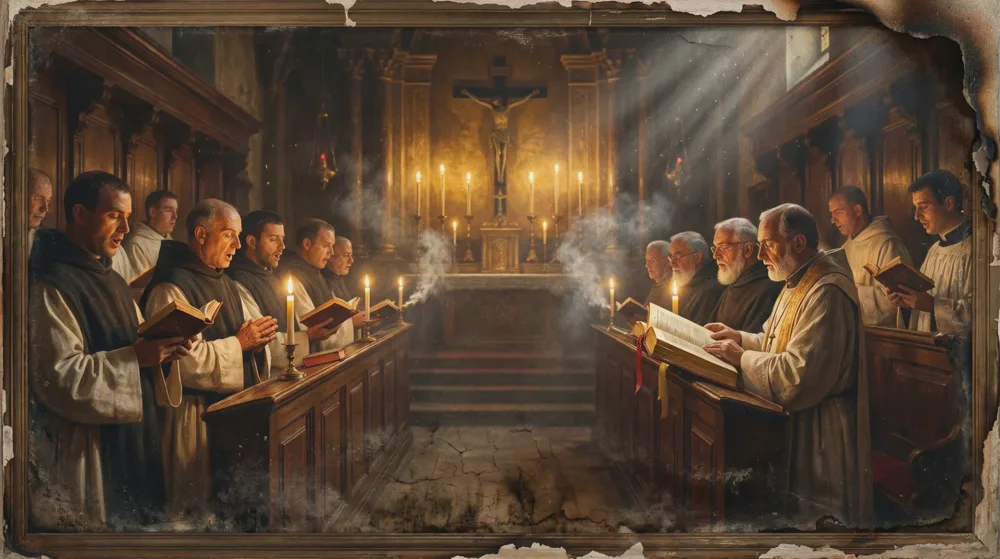
Compline is the night prayer of the Catholic Church — the last of the canonical hours of the Divine Office, prayed before sleep. Its name comes from the Latin completorium, "the completion," because it completes and seals the day. In a few short, almost unchanging psalms, the soul examines its conscience, places itself under God's protection against the perils of the dark, sings old Simeon's Nunc Dimittis, and turns at the last to Our Lady before the silence of the night. Of all the hours, Compline is the gentlest and the easiest for a layman to make his own — brief, beautiful, quickly learned by heart, and the same from one night to the next. Here we explain what Compline is, the prayer that composes it, and give you the text to pray it tonight.
What is Compline?
Compline is the final hour of the traditional Divine Office, the Church's daily round of prayer that sanctifies every part of the day and night. Where Lauds greets the dawn and Vespers closes the daylight, Compline closes the day itself — it is the Church's last word before she falls silent for sleep. To "say Compline," to "pray night prayer," and to "pray the completorium" all name one and the same hour.
Its character is unmistakable: it is a prayer of trust on the edge of sleep. The Christian lies down each night as a small image of his death, not knowing whether he will wake; and so the Church teaches him to surrender the day, examine what he has done with it, and commend his soul to God in the words of the Psalmist — "Into thy hands I commend my spirit" (Ps. 30:6). Sleep is rehearsed as a figure of death, and the bed as a figure of the grave, that the soul may learn to die well by lying down well. This is night prayer not as anxiety but as peace: the day is over, the work is laid down, and the keeping of the night is given over to God.
Compline sits within the wider Divine Office of the Roman Breviary, and to understand its place among the eight hours of the day, which begin in the night with Matins, it helps to read our fuller account of it (the reformed books of 1971, which differ from it, are called the Liturgy of the Hours). But of all those hours, Compline is the one we most recommend a layman begin with, precisely because it scarcely changes and is soon known without a book.
The shape of Compline: the night prayer of the Church
The traditional Roman Compline has a fixed and simple structure, the same nearly every night of the year. We give its parts in order, so that you may follow the movement of the hour from waking conscience to commended sleep.
- The blessing and reading. The hour opens with a short blessing — "May the almighty Lord grant us a quiet night and a perfect end" — and a brief lesson from Scripture: "Be sober and watch: because your adversary the devil, as a roaring lion, goeth about seeking whom he may devour" (1 Pet. 5:8).
- The examination of conscience. Before sleep the Christian looks back over the day and confesses his faults. This is the heart of Compline's penitential character, and we treat it at length in our guide to the examination of conscience. The hour then prays the Confiteor — "I confess to almighty God…"
- The psalms. On Sundays the psalms of Compline are Psalm 4, Psalm 90 (91), and Psalm 133 (134) — the psalms of him who lies down in peace and is kept through the night. Since St Pius X's reform of the psalter in 1911, the Roman Breviary assigns other psalms to the weekdays, while the Benedictine Office keeps these three every night; Psalm 90 remains the psalm most bound up with the hour.
- The hymn Te lucis ante terminum. The ancient evening hymn — "Before the ending of the day" — begging God to guard the sleeper from the phantoms and terrors of the night.
- The Nunc Dimittis. The canticle of holy Simeon, who held the Christ Child and was ready to die in peace (see below).
- The prayer and the blessing. A collect for protection, and the final blessing: "May the almighty and merciful Lord, the Father, the Son, and the Holy Ghost, bless and keep us."
- The Marian antiphon. The Church's last word: an antiphon to Our Lady, varying with the season — the Salve Regina, the Alma Redemptoris Mater, the Ave Regina Caelorum, or the Regina Caeli in Eastertide.
Psalm 90 (91): the psalm of the night
The psalm that has kept watch over the Church's nights for fifteen hundred years is Psalm 90 (numbered 91 in Protestant Bibles), "He that dwelleth in the aid of the most High." It is prayed at Compline precisely because it answers the fears that come with darkness — the terror of the night, the arrow that flieth in the day, the unseen evil that walks in the dark — with the promise of God's protection and His angels:
He that dwelleth in the aid of the most High, shall abide under the protection of the God of Jacob… His truth shall compass thee with a shield: thou shalt not be afraid of the terror of the night. Of the arrow that flieth in the day, of the business that walketh about in the dark… For he hath given his angels charge over thee; to keep thee in all thy ways.
(Psalm 90:1, 5–6, 11)
This is why the Church chose it to seal the day. The Christian does not sleep unguarded: he sleeps under the shield of God's truth and the charge of his guardian angel. To pray Psalm 90 at Compline is to lie down inside that promise.
The Nunc Dimittis: Simeon's canticle
At the climax of Compline the Church sings the Nunc Dimittis, the canticle of the aged Simeon. When the Christ Child was presented in the Temple, the just and devout Simeon — to whom it had been revealed that he should not see death before he had seen the Lord's Anointed — took the Infant into his arms, blessed God, and said:
Now thou dost dismiss thy servant, O Lord, according to thy word in peace: Because my eyes have seen thy salvation, Which thou hast prepared before the face of all peoples: A light to the revelation of the Gentiles, and the glory of thy people Israel.
(St. Luke 2:29–32)
Simeon, having held his Saviour, was ready to die in peace; and the Christian, having held his Saviour in faith through the day, lies down in the same peace. The canticle makes every night a small rehearsal of a holy death — "now thou dost dismiss thy servant in peace" — which is the whole spirit of Compline. The same words are prayed in the prayer for a happy death, for the night that is asked of God is the night that ends in waking, and the sleep that is asked is the sleep that ends in resurrection.
The Marian antiphon: the Church's last word
Compline does not end with the soul looking only to itself. Its very last act is to turn to Our Lady, with one of the four great seasonal Marian antiphons — the Church's good-night to her Mother:
- The Alma Redemptoris Mater — from Advent to Candlemas.
- The Ave Regina Caelorum — from Candlemas to Holy Week.
- The Regina Caeli — through Eastertide.
- The Salve Regina — through the long season after Pentecost.
So the day ends as it should, in the arms of the Mother who keeps her children through the night. To learn these antiphons by heart is itself a small school of the liturgical year, for the changing of the antiphon marks the changing of the seasons.
A word on "Great Compline" and "Small Compline"
Searchers often meet the terms Great Compline and Small Compline, and a word of honesty is owed. These belong to the Byzantine (Eastern) tradition, not to the Roman rite: Great Compline (Apodeipnon) is the longer night office sung in Lent and on certain vigils, and Small Compline is its shorter daily form, including the well-loved Orthodox Small Compline with its canon to the Mother of God. The Roman Compline we describe here is a single, fixed hour, neither "great" nor "small." We name the distinction so that the reader who finds it is not confused, while we serve the traditional Roman night prayer as the Breviary held it.
How a layman prays Compline tonight
No layman is bound to the Office, and none should fear it. Compline is the perfect door into the Divine Office for exactly the reason that it almost never changes: learn it once and you can pray it in the dark, without a book, lying in your bed. The Church has prayed it in monasteries and in Christian households alike, and many a family has said it together before the lamps went out.
- Begin with Compline alone. Of all the hours it is the shortest and the most stable; you will know it by heart within a fortnight.
- Pray it as your last act of the day — after the door is locked and the lights are low, so that the Nunc Dimittis and the Marian antiphon are the last words on your lips.
- Make the examination of conscience the heart of it. Look honestly over the day's failings, make your act of contrition, and lie down forgiven.
- Add Vespers when you are ready, so the evening opens and closes with the Church's voice; this is the natural next step, as we explain in our guide to Vespers.
- Pray it in Latin and your own tongue, and sing the Te lucis and the antiphon where you can; the Office is made to be chanted in Gregorian chant.
You do not need a shelf of leather Breviaries to keep this hour. We built the Iter Fidei Divine Office app to set the traditional Compline — psalms, hymn, Nunc Dimittis, and the right Marian antiphon for the season — already arranged for the night, bilingual and with audio, in your hand.
Frequently Asked Questions
What is Compline?
Compline is the night prayer of the Catholic Church — the last of the canonical hours of the Divine Office, prayed before sleep. Its name comes from the Latin completorium, "completion," because it completes the day. It is a short, almost unchanging hour made of an examination of conscience, fixed psalms (chiefly Psalm 90), the hymn Te lucis ante terminum, the Nunc Dimittis, and a closing antiphon to Our Lady. In it the soul commends itself to God against the perils of the night.
What is the meaning of Compline?
Compline means "completion" — it seals and completes the day, and prepares the Christian for sleep as a small image of death. Its spirit is one of trust: the day's work is laid down, conscience is examined, faults confessed, and the keeping of the night is surrendered into God's hands with Simeon's words, "now thou dost dismiss thy servant in peace." It teaches the soul to lie down well, that it may one day die well.
What psalms are said at Compline?
In the traditional Roman Compline the fixed psalms are Psalm 4, Psalm 90 (91), and Psalm 133 (134). Psalm 90, "He that dwelleth in the aid of the most High," is the heart of the hour — the psalm of protection against the terror of the night and the promise that God gives His angels charge to keep the sleeper. The canticle of the hour is the Nunc Dimittis, the song of holy Simeon.
What is the difference between Great Compline and Small Compline?
These are terms of the Byzantine (Eastern) tradition, not the Roman rite. Great Compline is the longer night office sung in Lent and on certain vigils; Small Compline is its shorter daily form, including the Orthodox Small Compline with its canon to the Mother of God. The Roman Compline is a single, fixed hour and is not divided into "great" and "small." We serve the traditional Roman night prayer.
How do I pray Compline?
Pray it as the last act of your day, before sleep, from a Breviary or an app that arranges it for the night (free apps such as iBreviary carry the modern Night Prayer; the traditional form is the one set out here). Open with the blessing and reading, examine your conscience and make an act of contrition, pray the psalms of the day, the hymn Te lucis ante terminum, the Nunc Dimittis, the closing prayer and blessing, and end with the Marian antiphon for the season. Because Compline scarcely changes, a layman can learn it by heart and pray it in the dark.
Sources. The Holy Bible, Douay-Rheims (St. Luke 2:29–32; Psalm 90:1, 5–6, 11; Psalm 30:6; 1 St. Peter 5:8); the Roman Breviary (1962), the hour of Compline; the hymn Te lucis ante terminum; the four seasonal Marian antiphons.
Iter Fidei serves the prayers, the Divine Office and the liturgical calendar, in Latin and English with audio. Join early access here.