
The Divine Office
The Breviary: The Book of the Divine Office
A breviary is the liturgical book containing the Divine Office — the psalms, hymns, and readings the Church prays at fixed hours. Its parts, the 1962 Roman Breviary, who is bound to it, and how a layman uses one.
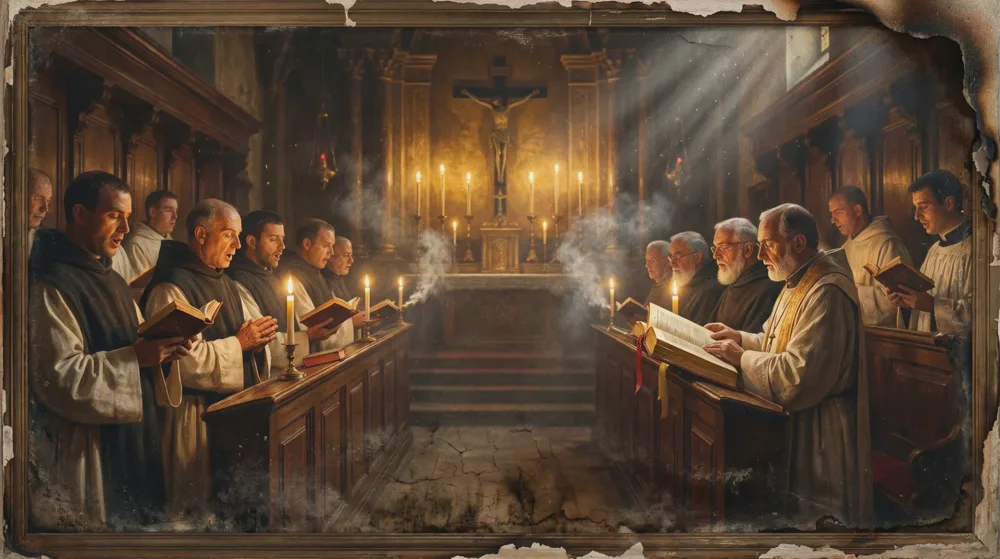
A breviary is the liturgical book containing the Divine Office — the psalms, hymns, antiphons, readings, and prayers that the Catholic Church offers to God at fixed hours of every day and night. The word comes from the Latin breviarium, "an abridgment": the single portable volume that gathered what was once scattered across a psalter, an antiphonary, a hymnal, a lectionary, and a collect book; it is pronounced BREE-vee-air-ee. Where the Missal is the book of the Mass, the breviary is the book of the Church's daily prayer — and the traditional Roman Breviary (Breviarium Romanum) is the form in which priests, monks, and not a few laymen have prayed it for centuries.
Breviary definition and meaning
To define a breviary strictly: it is the book that contains everything needed to recite the canonical hours of the Roman rite. The Office it holds is not a private devotion but the Church's own public prayer, the second great act of her worship after the Holy Sacrifice of the Mass. Its backbone is the Psalter — all 150 psalms, distributed across the week — answering the Psalmist's word: Seven times a day I have given praise to thee (Ps. 118:164, Douay-Rheims). We have explained the Office itself, hour by hour, in what the Divine Office is; here we treat the book. To "say the breviary," to "recite the Office," and — in the modern books — to "pray the Liturgy of the Hours" all name the same prayer; the plural breviaries covers the family of such books, Roman, monastic, and the proper breviaries of certain orders.
The parts of the breviary
Every breviary, whatever its edition, is built of the same great parts. Knowing them is most of the art of using one.
- The Psalter (Psalterium) — the 150 psalms arranged over the days of the week, hour by hour, with their ordinary antiphons and hymns: the skeleton of the whole book.
- The Proper of the Time (Proprium de Tempore) — the texts that change with the seasons: Advent, Christmastide, Lent, Passiontide, Eastertide, the Sundays after Pentecost.
- The Proper of the Saints (Proprium Sanctorum) — the texts proper to each saint's feast, above all the Matins lessons recounting the saint's life.
- The Common of the Saints (Commune Sanctorum) — shared formularies for classes of saints (apostles, martyrs, confessors, virgins) used when a feast has no complete proper.
- The Ordinary, rubrics, and calendar — the fixed framework of each hour and the rules that tell which office falls on which day.
Because so much text must be carried, the traditional Roman Breviary is ordinarily printed in four seasonal volumes, each repeating the Psalter and carrying its own portion of the propers.
The Roman Breviary: from St. Pius V to 1962
The Breviarium Romanum as a unified book is the fruit of the Council of Trent's reform. In 1568, by the bull Quod a nobis, Pope St. Pius V promulgated the revised Roman Breviary and imposed it on the whole Latin Church, excepting only rites and uses more than two hundred years old. In 1911, Pope St. Pius X, by the constitution Divino afflatu, redistributed the Psalter so that the weekly recitation of all 150 psalms, long crushed under the weight of the festal calendar, became real again.
The 1962 Roman Breviary is this same Latin breviary as it stood after the rubrical simplifications codified in 1960 — the last form of the traditional Office, and the edition used wherever the traditional Roman rite is kept. It is a Latin breviary at its core, though modern printings commonly set an English translation beside the Latin. A "new breviary" also exists: in 1971 the Liturgia Horarum replaced the old book in the reformed rite, with the psalms spread over four weeks and the hour of Prime suppressed. We state that as fact; the breviary we pray and serve is the traditional one of 1962, in unbroken continuity with St. Pius V.
Who is bound to pray the breviary
By the law of the Church, clerics in major orders — subdeacons, deacons, and priests — are bound to the daily recitation of the entire canonical Office (1917 Code of Canon Law, canon 135), and religious with choir obligation must chant it in common. When a priest opens his breviary, he prays in the name of the whole Mystical Body, so that day and night the praise of God never falls silent on the earth.
The laity are bound to none of it — and invited to all of it. From ancient times the faithful sang Vespers in their parish churches on Sundays and prayed Compline before sleep; the Gregorian chant of the Office grew up as much in the nave as in the choir. A layman who takes up the breviary takes up the Church's own prayer.
How a layman uses a breviary
The book intimidates at first sight; the practice is simple. The way in is to begin small and let the habit grow.
- Choose one or two hours, not eight. Compline is the classic beginning: short, nearly invariable, prayed before bed. Prime or Lauds anchors the morning; Vespers crowns the evening.
- Find the day's office. An ordo — the annual booklet listing each day's feast and its rank — tells you which office to pray; online tools do the same automatically.
- Set your ribbons — one in the Psalter at the day of the week, one in the Proper of the Time, one in the Proper or Common of the Saints, one at the Ordinary — and move among the four places in the hour's fixed pattern.
- Pray it aloud or move the lips. The Office is a spoken prayer, not a text to be skimmed; recitation, even whispered, is the tradition.
No layman should be daunted by imperfection in the rubrics. The obligation binds the cleric; the layman prays as generously as his state allows.
Printed breviaries, the breviary online, and breviary apps
A printed breviary remains the noble way: a bound book, ribbons, no battery, nothing between the soul and the psalms. New printings of the 1962 Breviarium Romanum in Latin-English are available — Baronius Press's three-volume set is the best known — alongside the used market in older Latin sets, and leather covers made to protect a book handled several times daily for decades.
The breviary online is also a settled reality. Divinum Officium renders the complete traditional Office for any date, Latin and English side by side, at no cost — the standard answer to "breviary today," whether one seeks this morning's Lauds or this evening's Vespers. Among breviary apps, iBreviary and Universalis serve the modern Liturgy of the Hours; for the traditional 1962 Office on a phone, with the old calendar and audio to pray along, we built the Iter Fidei app. An audio breviary — the hours chanted or recited aloud — is the natural extension of a prayer that was always meant to be sung.
Monastic, Benedictine, and Anglican breviaries
The Roman Breviary is not the only one. The monastic breviary (Breviarium Monasticum) is the book of the Benedictine family, arranging the Psalter according to the scheme St. Benedict lays down in his Rule (chapters 8–18). Other orders — Dominicans, Carmelites, Premonstratensians — long kept proper breviaries of their own, venerable uses protected by the two-hundred-year rule of St. Pius V. The Anglican Breviary, published in 1955, is a different case: an English rendering of the Roman Breviary of St. Pius X in the idiom of the Book of Common Prayer, produced for Anglicans who desired the Roman Office. It witnesses to the pull of that Office even outside the Church; a Catholic's book remains the Catholic breviary itself.
Frequently Asked Questions
What is a breviary?
A breviary is the liturgical book containing the Divine Office — the psalms, hymns, antiphons, lessons, and prayers the Catholic Church recites at fixed hours each day. The name comes from the Latin breviarium, an abridgment, because it condensed several older choir books into one portable volume. The traditional Roman Breviary is its principal form in the Latin Church.
Is the breviary the same as the Liturgy of the Hours?
They name the same prayer of the Church in two forms of the books. "Breviary" properly names the book of the traditional Roman Office, last edited in 1962; "Liturgy of the Hours" names the reformed Office of 1971, with a four-week psalter and without Prime. To "pray the breviary" and to "pray the Hours" both mean to pray the Divine Office.
How do you use a breviary?
Begin with one or two hours — Compline at night is the classic start — and use an ordo or an online calendar to find the day's office. Set ribbons in the Psalter, the Proper of the Time, the Proper of the Saints, and the Ordinary, and move among them in the fixed pattern of the hour. The habit is learned in weeks.
How do you pronounce breviary?
Breviary is pronounced BREE-vee-air-ee or BREV-ee-air-ee, in four syllables, with the stress on the first. It derives from the Latin breviarium, meaning an abridgment or compendium.
Can I pray the breviary online?
Yes. Divinum Officium publishes the complete traditional Roman Office for any date, in Latin with an English translation facing it, free of charge; other sites and apps serve the modern Liturgy of the Hours. An online breviary is a true breviary in content, though many keep a printed volume as well.
What is the Anglican Breviary?
The Anglican Breviary, published in 1955, is an English translation of the Roman Breviary as reformed by St. Pius X, rendered in the idiom of the Book of Common Prayer for Anglican use. It is not a Catholic liturgical book but an adaptation of one; Catholics who want the traditional Office in English use a Latin-English edition of the Roman Breviary itself.
The Iter Fidei app carries the traditional Divine Office of 1962 — the hours of the Roman Breviary in Latin and English, with the old calendar and audio to pray along — free to download here.
Sources. Holy Scripture (Douay-Rheims), Psalm 118; St. Pius V, bull Quod a nobis (1568); St. Pius X, apostolic constitution Divino afflatu (1911); the Rule of St. Benedict, ch. 8–18; 1917 Code of Canon Law, canon 135; Breviarium Romanum, editio typica 1962.