
The Divine Office
Vespers: Meaning, Order, and How to Pray It
Vespers is the evening hour of the Divine Office: five psalms, a chapter, a hymn and the Magnificat. Its order in the 1962 Roman Breviary, the psalms of each day, and how to pray it.
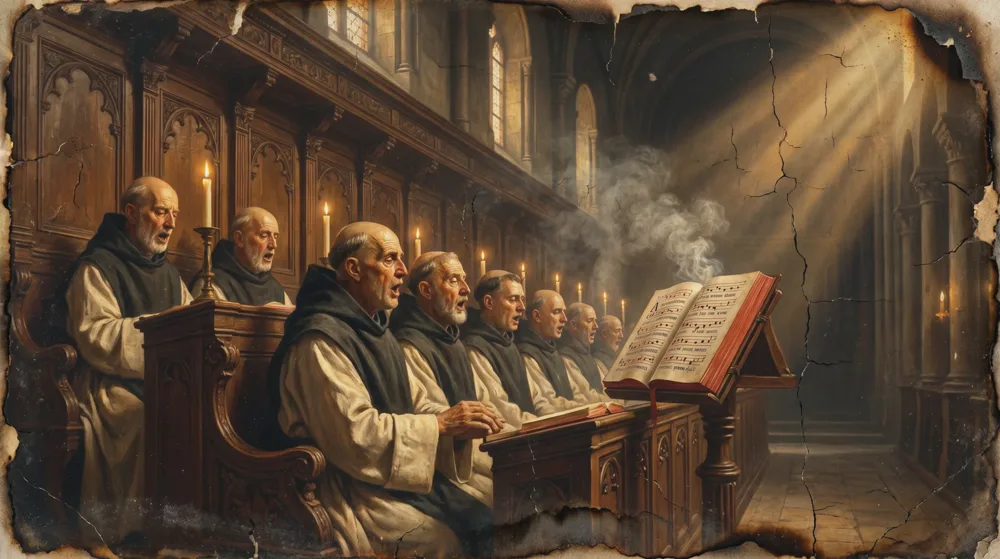
Vespers (from the Latin vespera, "evening") is the evening prayer of the Catholic Church, the hour of the Divine Office sung as the day declines. In the Roman Breviary of 1962 it is made of five psalms with their antiphons, a short chapter from Scripture, a hymn, a versicle, the Magnificat of Our Lady, and the collect of the day. It takes about fifteen to twenty minutes said, longer sung, and any of the faithful may pray it.
Below: what Vespers is, the order of the hour with its Latin and English texts, the psalms appointed for each day of the week, and how a layman can begin to pray it at home.
What is Vespers? Meaning and definition
Vespers is one of the eight hours of the Divine Office, the public prayer the Church offers to God at fixed times of the day and night, from Matins in the night to Compline at bedtime. It is not a private devotion composed at will: the words are fixed in the Breviary, and whoever prays them prays in the name of the Church.
The name comes from the Latin vespera, "evening"; the same word gave the evening star its old name, Vesper. Older English called the hour evensong. Its place in the day is the late afternoon or early evening, when the work of the day is done and the lamps are lit. The Psalmist had already joined prayer to that hour: "Let my prayer be directed as incense in thy sight; the lifting up of my hands, as evening sacrifice" (Psalm 140:2) — and the Church still sings that verse at Sunday Vespers.
With Lauds at dawn, Vespers is one of the two principal hours of the Office. On Sundays and feasts it was, for centuries, celebrated publicly in parish churches, with incense and chant; that is what people mean by a Vespers service. It is not a Mass. The Mass is the Sacrifice of the altar (see What Is the Tridentine Mass?); Vespers is the Church's praise at the close of the day.
The order of Vespers in the 1962 Breviary
Vespers in the traditional Roman Office follows the same order every evening. Only the psalms, antiphons, chapter, hymn and collect change with the day, the season and the feast.
1. The opening. The hour begins with the verse of Psalm 69:
V. Deus, in adjutórium meum inténde.
R. Dómine, ad adjuvándum me festína.
V. O God, come to my assistance.
R. O Lord, make haste to help me.
Then the Glory be to the Father, and Alleluia — replaced from Septuagesima to Easter by Laus tibi, Domine, Rex æternæ gloriæ, "Praise be to thee, O Lord, King of eternal glory."
2. Five psalms with their antiphons. Each psalm is framed by an antiphon and ends with the Glory be. On feasts the antiphons and often the psalms are proper to the day.
3. The chapter (capitulum). One or two verses of Scripture, answered by Deo gratias. On ordinary Sundays it is 2 Corinthians 1:3-4: "Blessed be the God and Father of our Lord Jesus Christ, the Father of mercies and the God of all comfort, who comforteth us in all our tribulation."
4. The hymn. A Latin hymn proper to the day or season; Sunday's is given below.
5. The versicle. On Sundays: V. Dirigátur, Dómine, orátio mea. R. Sicut incénsum in conspéctu tuo — "O Lord, direct my prayer. As incense in thy sight."
6. The Magnificat, sung under its own antiphon while, at solemn Vespers, the altar is incensed.
7. The collect. After Dóminus vobíscum, the prayer of the day, followed by any commemorations, then Benedicámus Dómino — Deo grátias, and Fidélium ánimæ per misericórdiam Dei requiéscant in pace. Amen, "May the souls of the faithful departed, through the mercy of God, rest in peace."
On certain penitential weekdays the preces, a short series of petitions, are said kneeling before the collect. Compline follows later in the evening; the Marian antiphon that closes the day belongs to it (see Compline: Night Prayer).
The hymn of Sunday Vespers
Outside the special seasons, Sunday Vespers sings Lucis Creator optime, a hymn on the first day of creation, when God made light — fitting for the day of the Resurrection. Its first two stanzas in Latin and in the English of the traditional bilingual breviaries:
Lucis Creátor óptime,
Lucem diérum próferens,
Primórdiis lucis novæ,
Mundi parans oríginem:Qui mane junctum vésperi
Diem vocári prǽcipis:
Illábitur tetrum chaos,
Audi preces cum flétibus.
O blest Creator of the light,
Who mak'st the day with radiance bright,
And o'er the forming world didst call
The light from chaos first of all;Whose wisdom joined in meet array
The morn and eve, and named them day:
Night comes with all its darkling fears;
Regard thy people's prayers and tears.
The Vespers psalms of each day, and Sunday Vespers
Since the reform of St Pius X (Divino afflatu, 1911), the Roman Breviary prays the whole Psalter every week, and Vespers takes its psalms in order from Psalm 109 onwards. The numbering is that of the Vulgate and the Douay-Rheims, one lower than most modern Bibles for most of the Psalter (Psalm 109 is Psalm 110 in Hebrew numbering; on why, see Catholic Bible Verses).
| Day | Psalms at Vespers (Vulgate numbering) |
|---|---|
| Sunday | 109 Dixit Dominus, 110 Confitebor, 111 Beatus vir, 112 Laudate pueri, 113 In exitu Israel |
| Monday | 114, 115, 119, 120, 121 |
| Tuesday | 122, 123, 124, 125, 126 |
| Wednesday | 127, 128, 129 De profundis, 130, 131 |
| Thursday | 132, 135 (in two parts), 136 Super flumina, 137 |
| Friday | 138 (in two parts), 139, 140, 141 |
| Saturday | 143 (in two parts), 144 (in three parts) |
Sunday Vespers opens with Psalm 109, "The Lord said to my Lord: Sit thou at my right hand: Until I make thy enemies thy footstool" — the psalm Our Lord applied to Himself (Matthew 22:44), and the reason Sunday Vespers has always been the hour of Christ the King and Priest. Its last psalm, 113, sings the Exodus: "When Israel went out of Egypt, the house of Jacob from a barbarous people." Feasts of Our Lady and of virgins replace some of these with psalms of praise such as 112, 121, 126 and 147; the Breviary marks them in the proper of each feast.
These psalms are the Vulgate's Psalter, the one the Latin Church has sung since the early Middle Ages (see The Latin Vulgate Bible). Prayed in the vernacular, they come from the Douay-Rheims.
The Magnificat: the crown of Vespers
Every evening, at the summit of the hour, the Church sings the canticle of the Blessed Virgin from the first chapter of St Luke. Standing, as for the Gospel, the choir sings it in Latin; the English is the Douay-Rheims (Luke 1:46-55).
Magníficat ánima mea Dóminum.
Et exsultávit spíritus meus in Deo, salutári meo.
Quia respéxit humilitátem ancíllæ suæ: ecce enim ex hoc beátam me dicent omnes generatiónes.
Quia fecit mihi magna qui potens est: et sanctum nomen ejus.
Et misericórdia ejus, a progénie in progénies timéntibus eum.
Fecit poténtiam in bráchio suo: dispérsit supérbos mente cordis sui.
Depósuit poténtes de sede, et exaltávit húmiles.
Esuriéntes implévit bonis: et dívites dimísit inánes.
Suscépit Israël púerum suum, recordátus misericórdiæ suæ.
Sicut locútus est ad patres nostros, Ábraham, et sémini ejus in sǽcula.
My soul doth magnify the Lord.
And my spirit hath rejoiced in God my Saviour.
Because he hath regarded the humility of his handmaid; for behold from henceforth all generations shall call me blessed.
Because he that is mighty, hath done great things to me; and holy is his name.
And his mercy is from generation unto generations, to them that fear him.
He hath shewed might in his arm: he hath scattered the proud in the conceit of their heart.
He hath put down the mighty from their seat, and hath exalted the humble.
He hath filled the hungry with good things; and the rich he hath sent empty away.
He hath received Israel his servant, being mindful of his mercy:
As he spoke to our fathers, to Abraham and to his seed for ever.
The Glory be to the Father follows, then the Magnificat antiphon is repeated. That antiphon is often the most beautiful text of the day: on the great feasts it gathers the whole mystery into one line, as the O Antiphons do in the last week of Advent.
How to pray Vespers at home
No layman is bound to the Office, but every layman may pray it, and Vespers is one of the best hours to begin with.
- Have the text of the day. A printed Breviary or a Vespers book from before the reform does the work if you know how to follow the calendar and the ribbons (see The Breviary). Otherwise use a source that arranges the hour for the date: our page of today's Office, the free website Divinum Officium, or the Iter Fidei Divine Office app, which sets out each evening's Vespers in Latin and English with audio.
- Keep the hour. Late afternoon to early evening, before supper or at the end of work. If the time slips, keep it an evening prayer rather than leaving it for bedtime, which belongs to Compline.
- Say it aloud, even softly. The psalms are made to be voiced; speaking them steadies the attention. Chant is the Church's own way of singing them, but recitation is enough.
- Begin small if needed. One psalm with its antiphon, the chapter, the Magnificat and the collect make a true beginning. Add the other psalms as the hour becomes familiar.
- Pray Latin and English together. The Latin is the Church's own text; the English beside it carries the sense.
If you are also curious about the modern form of evening prayer in the post-1970 books, The Liturgy of the Hours explains how it differs from the Breviary.
Frequently Asked Questions
What are Vespers in the Catholic Church?
Vespers is the evening hour of the Divine Office, the Church's official daily prayer. In the 1962 Roman Breviary it consists of the opening verse Deus in adjutorium, five psalms with antiphons, a short chapter of Scripture, a hymn, a versicle, the Magnificat and the collect of the day. With Lauds it is one of the two principal hours of the Office.
What does the word "vespers" mean?
It comes from the Latin vespera, "evening." The same root gave the evening star its name, Vesper. Older English called the hour evensong.
What time is Vespers prayed?
In the late afternoon or early evening, around sunset or at the end of the working day. In monasteries it is usually sung before supper; on Sundays parishes traditionally sang it in the afternoon. Compline, the night prayer, comes later, before sleep.
Is Vespers a Mass?
No. Vespers is an hour of the Divine Office, the Church's prayer of praise; the Mass is the Holy Sacrifice. A "Vespers service" is the public, usually sung celebration of this hour, and on some solemn days it is followed by Benediction of the Blessed Sacrament, but it is never a Mass.
What psalms are said at Sunday Vespers?
In the Roman Breviary since 1911: Psalms 109 (Dixit Dominus), 110 (Confitebor), 111 (Beatus vir), 112 (Laudate pueri) and 113 (In exitu Israel), in Vulgate numbering. Many feasts have their own psalms, marked in the Breviary.
Why is the Magnificat sung at Vespers?
Because at the close of each day the Church praises God in the words of the Mother of His Son. The Magnificat has been the Gospel canticle of Vespers in the Roman Office since ancient times, as the Benedictus is of Lauds, and at solemn Vespers the altar is incensed while it is sung.
Can a layman pray Vespers?
Yes. Clerics in major orders and choir religious are bound to the Office; the laity are not, but the hour is open to all and was sung by the faithful in parish churches for centuries. Pray it from a Breviary, a site such as Divinum Officium, or an app that arranges each evening's text.
The Iter Fidei app sets out the traditional Divine Office of 1962 for every day, Vespers and Compline included, in Latin and English with audio. Join early access here.
Sources. Holy Scripture, Douay-Rheims (Psalms 69, 109, 113, 140; Luke 1:46-55; 2 Corinthians 1:3-4; Matthew 22:44); Breviarium Romanum, editio typica 1962 (Psalter, Ordinary of Vespers); St Pius X, apostolic constitution Divino afflatu (1911).