
The Divine Office
Liturgy of the Hours: What It Is and How It Differs
The Liturgy of the Hours is the Divine Office as reformed by Paul VI in 1970-1971. Its hours, its books, how to pray it, and how it differs from the Roman Breviary of 1962.
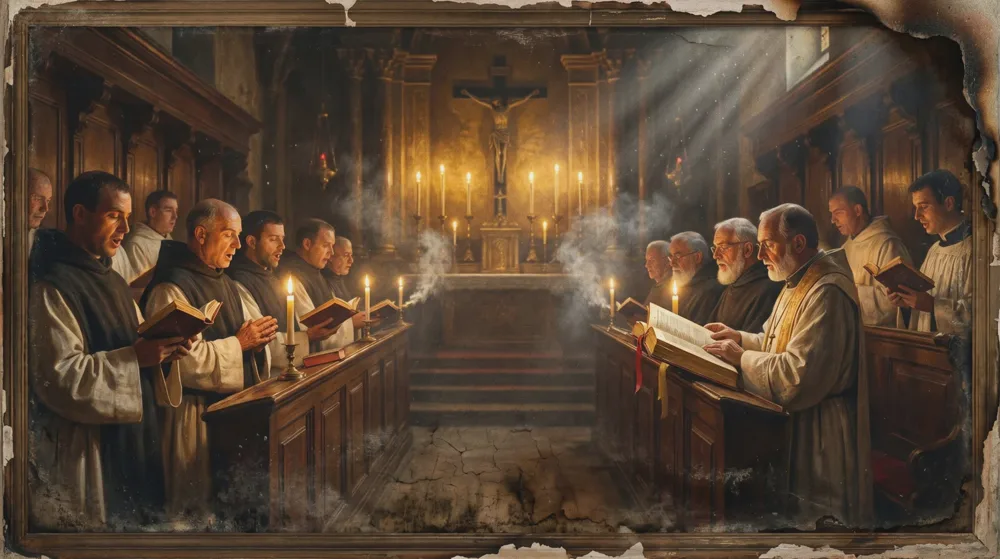
The Liturgy of the Hours is the name of the Catholic Church's daily public prayer — the Divine Office — in the form promulgated by Pope Paul VI in 1970 and published in Latin as the Liturgia Horarum from 1971. It arranges psalms, canticles, readings and intercessions into five kinds of hours (Office of Readings, Morning Prayer, Daytime Prayer, Evening Prayer, Night Prayer) over a four-week psalter. It replaced, in the modern Roman rite, the Roman Breviary, whose last edition (1962) kept eight hours and the whole Psalter every week.
Both are the same prayer of the Church in kind; they are not the same book. Below: what the Liturgy of the Hours is, its hours and books, how people pray it, and a plain comparison with the Breviary of 1962 — the form Iter Fidei serves.
What is the Liturgy of the Hours?
The Divine Office is the prayer by which the Church sanctifies the hours of the day: priests, religious and any of the faithful who join them pray, in the name of the Church, psalms and Scripture at fixed times. For fourteen centuries in the West that prayer lived in the monastic and Roman books, gathered after the Council of Trent into the Roman Breviary of St Pius V (bull Quod a nobis, 1568), reorganised by St Pius X (Divino afflatu, 1911) and last edited under John XXIII in 1960-1962. We explain that Office and its history in What Is the Divine Office?.
The Second Vatican Council's constitution on the liturgy (1963) ordered a reform of the Office. The result was promulgated by Paul VI in the apostolic constitution Laudis canticum (1 November 1970) and published in four Latin volumes, the Liturgia Horarum, from 1971. "Liturgy of the Hours" is the English rendering of that title. So when someone says "the Liturgy of the Hours" today, he normally means this reformed book and its translations; "the Breviary" or "the Divine Office" may mean either, but in traditional usage they name the older Roman Office.
The hours of the Liturgy of the Hours
The reformed Office has five kinds of hours:
- Office of Readings — the successor of Matins. It may be prayed at any hour of the day; it has three psalms or portions of psalms, a long reading from Scripture and a second reading from the Fathers, a saint or a Church document.
- Morning Prayer (Lauds) — a psalm, an Old Testament canticle, a psalm of praise, a short reading, the Benedictus, intercessions, the Lord's Prayer and the collect.
- Daytime Prayer — one hour of three psalms, said at Midmorning, Midday or Midafternoon. Outside choir one of the three suffices; they are the successors of Terce, Sext and None.
- Evening Prayer (Vespers) — two psalms, a New Testament canticle, a short reading, the Magnificat, intercessions, the Lord's Prayer and the collect.
- Night Prayer (Compline) — before sleep, ending with an antiphon to Our Lady.
The first hour of the day is preceded by the Invitatory, normally Psalm 94 (95). Prime was suppressed by the Council's decree.
The Liturgy of the Hours books
People searching for a Liturgy of the Hours book meet several editions:
- The four-volume set (The Liturgy of the Hours), published in the United States from the mid-1970s in the ICEL translation: Advent-Christmas, Lent-Easter, and two volumes for Ordinary Time. It contains every hour for every day.
- Christian Prayer, the one-volume edition with Morning, Evening and Night Prayer and a selection from the Office of Readings — the book most laypeople own.
- Shorter Christian Prayer and similar pocket books with the four-week psalter of Morning and Evening Prayer only.
- The Liturgy of the Hours, Second Edition: a new US translation, confirmed by the Holy See in 2025, with the Abbey Psalms and Canticles and newly translated Latin hymns. The USCCB set its first permitted use for Ash Wednesday 2027 and its mandatory use for Advent 2028; Ascension and Word on Fire are among its publishers.
In Latin, the book is the Liturgia Horarum (second typical edition 1985-1987). It is distinct from the Breviarium Romanum, which is the Latin book of the traditional Office.
How to pray the Liturgy of the Hours
In the modern rite, priests and transitional deacons are bound to the whole Liturgy of the Hours daily (1983 Code, can. 276); the laity are invited to it, above all to Morning and Evening Prayer.
The practical method is the same as with any breviary. Find the week of the psalter (I to IV) and the season; take the psalms from the Ordinary weeks and the proper parts (antiphons, readings, collect) from the Proper of Seasons or of Saints; follow the ribbons. Apps such as iBreviary and Universalis do this arrangement for the date, which explains their popularity; our comparison of the best Catholic prayer apps lists the others.
For a layman, the advice of tradition holds for either book: begin with one or two hours — evening prayer and night prayer — and let the habit grow. Our guides to Vespers and Compline describe those hours in their traditional form.
Liturgy of the Hours vs the Roman Breviary of 1962
The question "is the breviary the same as the Liturgy of the Hours?" has an honest answer: the same prayer in kind, two different arrangements. The main differences are below; the older book itself is described hour by hour in the Roman Breviary of 1962.
| Roman Breviary (1962) | Liturgy of the Hours (1971) | |
|---|---|---|
| Promulgated by | St Pius V (1568); reformed by St Pius X (1911); rubrics of John XXIII (1960) | Paul VI, Laudis canticum (1970) |
| Psalter cycle | All 150 psalms every week | Four weeks |
| Night office | Matins: nine psalms with three or nine lessons | Office of Readings: three psalms, two readings, any hour |
| Morning | Lauds: four psalms and an Old Testament canticle | Morning Prayer: two psalms and a canticle |
| Prime | Kept | Suppressed |
| Little hours | Terce, Sext and None, each prayed | One Daytime Prayer suffices outside choir |
| Evening | Vespers: five psalms | Evening Prayer: two psalms and a New Testament canticle |
| Psalms omitted | None | Psalms 57, 82, 108 (Vulgate; 58, 83, 109 Hebrew) and some verses of others, as the General Instruction (§131) states |
| Language of the psalms | Latin Vulgate (vernacular in bilingual editions) | Latin Liturgia Horarum; vernacular translations such as the Grail and Abbey Psalms |
| Calendar | Calendar of 1962 | General Roman Calendar of 1969 |
The Liturgy of the Hours is the official Office of the modern Roman rite. It is also a deeply rearranged one, shorter, spread over a month, with a different calendar and with whole psalms set aside. The Roman Breviary is the Office as the Latin Church prayed it, with gradual changes, from the Middle Ages until 1962; Benedict XVI's Summorum Pontificum (2007) expressly allowed clerics to pray it. That is the book behind our daily page of today's Office and the Iter Fidei Divine Office app; we set out its parts in The Breviary, and the free site Divinum Officium renders it as well.
Frequently Asked Questions
What is the Liturgy of the Hours?
It is the Divine Office, the Church's official daily prayer, in the form promulgated by Paul VI in 1970 and published from 1971. It distributes the psalms over four weeks across the Office of Readings, Morning Prayer, Daytime Prayer, Evening Prayer and Night Prayer.
Is the Liturgy of the Hours the same as the Divine Office?
It is the Divine Office of the modern Roman rite. "Divine Office" is the older name for the Church's prayer of the hours in general; in traditional usage it designates the Office of the Roman Breviary, which the Liturgy of the Hours replaced after 1971.
Is the breviary the same as the Liturgy of the Hours?
A breviary is any book containing the Office. The Roman Breviary (1568-1962) and the Liturgy of the Hours (1971) are two different arrangements of that Office: one-week psalter and eight hours against four-week psalter and five kinds of hours.
How do you pray the Liturgy of the Hours?
Choose the hour, find the psalter week and the season or feast, and take the psalms from the psalter and the proper texts from the seasonal or saints' section, following the ribbons. Most beginners start with Morning and Evening Prayer in a one-volume book or an app that arranges the day.
What is the difference between Christian Prayer and the Liturgy of the Hours?
Christian Prayer is a one-volume extract of the Liturgy of the Hours with Morning, Evening and Night Prayer and selections from the Office of Readings. The four-volume Liturgy of the Hours contains every hour for every day of the year.
What is the Liturgy of the Hours, Second Edition?
A new English translation for the United States, with the Abbey Psalms and Canticles, new intercessions and newly translated Latin hymns. Its first use is permitted from Ash Wednesday 2027 and it becomes mandatory on the First Sunday of Advent 2028.
Is there a Latin Liturgy of the Hours?
Yes: the Liturgia Horarum, the Latin typical edition (1971; second edition 1985-1987). It should not be confused with the Breviarium Romanum, the Latin book of the traditional Office.
The Iter Fidei app carries the traditional Divine Office of the Roman Breviary of 1962 — all eight hours, the old calendar, Latin and English with audio. Join early access here.
Sources. St Pius V, bull Quod a nobis (1568); St Pius X, apostolic constitution Divino afflatu (1911); John XXIII, Rubricarum instructum (1960); Breviarium Romanum, editio typica 1962; Second Vatican Council, constitution Sacrosanctum Concilium (1963), §89; Paul VI, apostolic constitution Laudis canticum (1970); General Instruction of the Liturgy of the Hours (1971).