
The Faith
The Crucifix: Why Catholics Keep Christ on the Cross
Why Catholics use a crucifix and not a bare cross — the crucifix keeps the price of our redemption and the love of God before our eyes, and is no denial of the Resurrection.
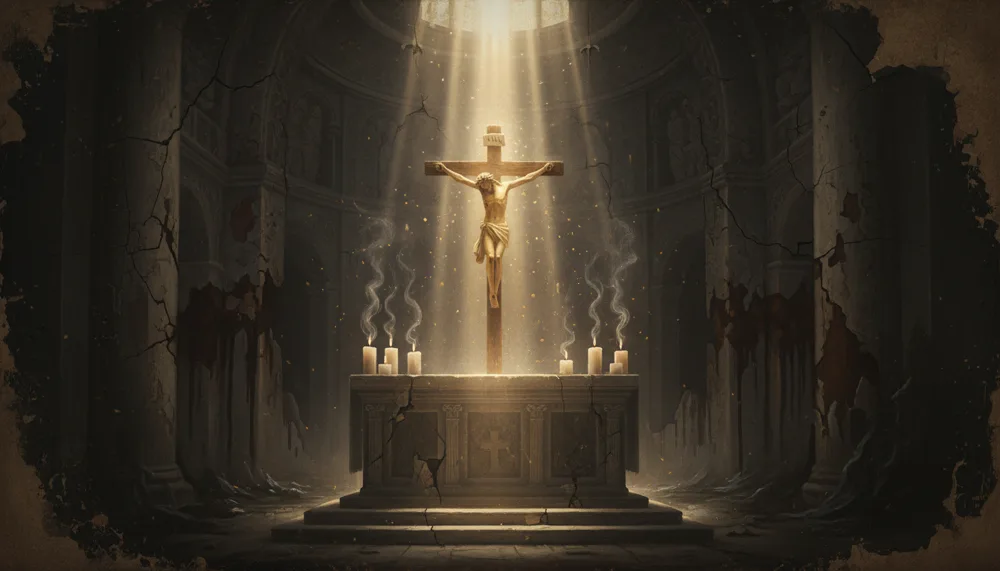
A crucifix is a cross that bears the figure of the crucified Christ, and Catholics use it because they wish to keep before their eyes the price of their redemption and the love of God who paid it. The bare cross signifies the same victory, but the crucifix shows us how that victory was won: not by force, but by the death of the Son of God. This is no denial of the Resurrection. It is the constant answer of the Church to the great cry of Saint Paul, who resolved to preach nothing else: "we preach Christ crucified" (1 Corinthians 1:23).
The crucifix and the catholic cross: what is the difference
The cross is the instrument upon which Our Lord was put to death, and it has been the standard of Christians from the beginning. A crucifix is that same cross with the body of the crucified Saviour fixed upon it — crux and corpus, the cross and the figure together. Every crucifix is a cross; not every cross is a crucifix.
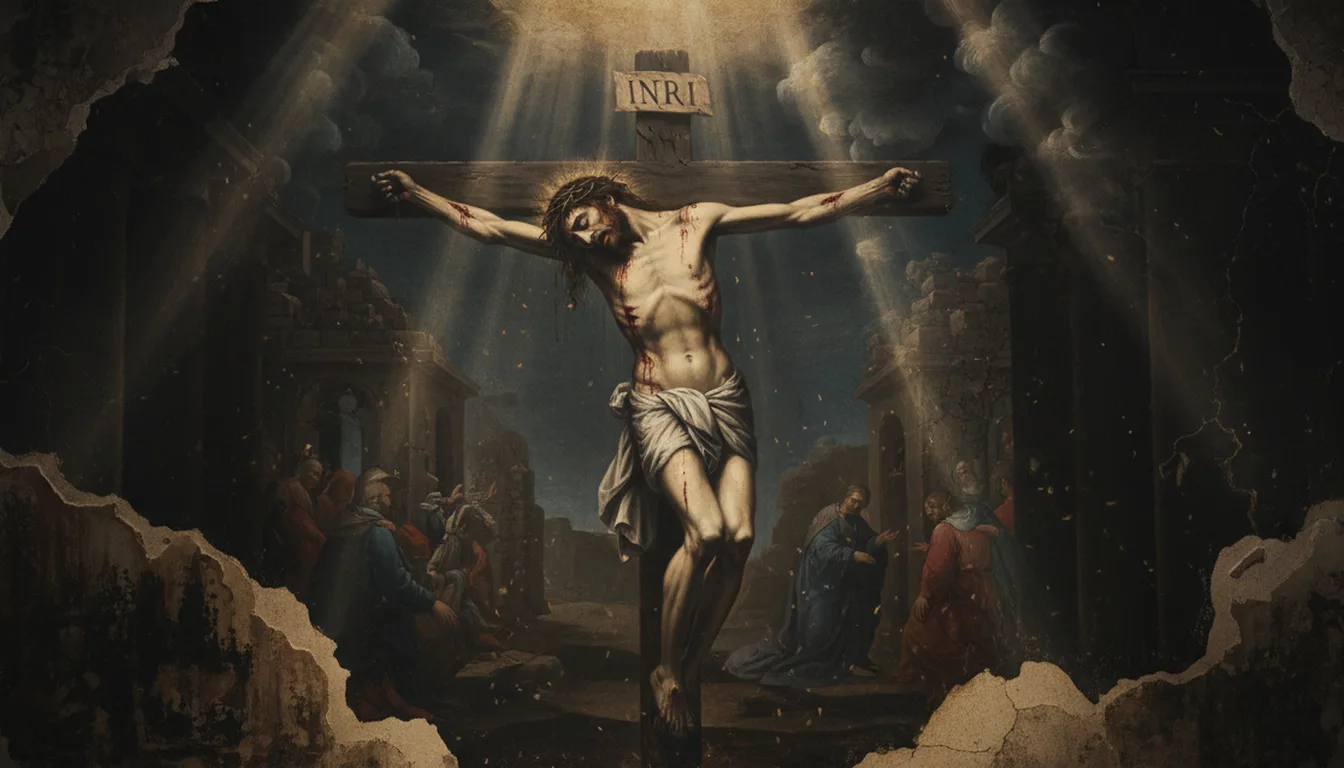
The Catholic cross, in its fullest form, is the crucifix. It hangs over the altar at every Tridentine Mass, where the same Sacrifice once offered on Calvary is renewed; it stands at the head of the Stations of the Cross; it is held before the eyes of the dying. A bare cross, of itself, says that a man was redeemed; the crucifix says by whom and at what cost. The Church has never forbidden the plain cross, and uses it readily — but she has always loved the crucifix more, because it keeps the whole truth in view.
Why do Catholics use a crucifix
We use the crucifix because it does, in wood and metal, what the Church asks every Christian to do in his heart: to remember the Passion. The Catechism of the Council of Trent, treating of the death of Our Lord, urges the pastor "to exhort the faithful to recall as often as possible the Passion of the Saviour," and cites for this the words of "the great Apostle, in which he maketh profession of knowing nothing else but Jesus Christ crucified," so that "the remembrance of so great a benefit may make an impression upon the faithful and move them to acknowledge and to admire without reserve the goodness and the love of God for us."
The crucifix is that remembrance made visible. The Catechism teaches that the death of the Cross was "a full and entire satisfaction" by which Christ paid "all the debt of our sins," a price that "not only equalleth our obligation, but is infinitely superior to it." When we lift our eyes to the crucified figure, we see that price. We see what our sins cost and what God's love was willing to spend. This is why a crucifix belongs above the bed, in the hand at the hour of death, on the wall of a Catholic home: it preaches, silently and without ceasing, the one thing Saint Paul was determined to know.
It is also why the crucifix is numbered among the sacramentals, the sacred signs by which the Church draws the mind to God. Used in faith, it is a standing meditation on the Passion and a help against the enemy. Tanquerey, in his manual of the spiritual life, places the crucifix among the strongest of these helps: "the crucifix, the sign of the cross, and above all authentic relics of the true cross are dreadful to the demon who was vanquished by the cross." The devil flies from the sign of his own defeat.
Crucifix vs cross: "He is risen, so why not an empty cross?"
The objection is sincere and deserves a plain answer. Some say the crucifix is morbid, that it leaves Christ dead upon the wood, and that a Christian should display the bare cross because Christ is risen and no longer hangs there. We answer that the crucifix denies nothing of the Resurrection, and that the objection mistakes what the image is for.
A crucifix is not a photograph claiming that Christ is still dying now. It is a memorial of an event that truly happened and that saves us still — the same kind of remembrance the Mass itself makes. We hold to the Resurrection with the whole weight of the faith; without it, as Saint Paul says, our preaching is vain. But the Risen Christ is the same Christ who was crucified, and He carries His wounds into glory: when He appeared to the Apostles He showed them His hands and His side. To depict the Crucified is not to forget Easter morning. It is to remember how Easter was bought.
The deeper answer is that the Cross is the Christian's only boast. Saint Paul did not write, "God forbid that I should glory, save in the empty tomb"; he wrote, "But God forbid that I should glory, save in the cross of our Lord Jesus Christ; by whom the world is crucified to me, and I to the world" (Galatians 6:14). The Resurrection is our hope; the Cross is the means by which that hope was won, and the Apostle glories in it.
The Catechism of Trent does not soften this. It calls the mystery of the Cross that which, "humanly speaking, is, more than all the rest, beyond the conceptions of reason," and yet "it is upon this article, indeed, that the Faith and the Christian Religion rest as upon their base." To set Christ upon the cross before our eyes is to set our faith upon its base.
The crucifix carries one warning besides. The same Catechism teaches that those who return to sin "crucify again in their hearts, as much as in them lieth, the Son of God." The figure on the cross is therefore not only a comfort but a summons: to look on Him whom our sins pierced, and to sin no more.
The crucifix and the Sign of the Cross
The crucifix and the Sign of the Cross belong together, for both keep the same mystery before us — the one in an image, the other in a gesture. When a Catholic signs himself, touching forehead, breast, and shoulders while naming the Father, the Son, and the Holy Ghost, he confesses with his body that the Son of God redeemed him upon the Cross. It is, in a movement, the same profession the crucifix makes in wood; and it is fitting to make it before a crucifix, joining the sign of our redemption to the image of it.
To venerate a crucifix is never to adore the wood or the metal. The honour passes to Him whom it represents. We kneel before the figure on Good Friday and kiss the wounds carved there precisely because it is His image and not its own. The veneration is a form of asking and of love; it is never the worship owed to God alone.
The roman catholic crucifix
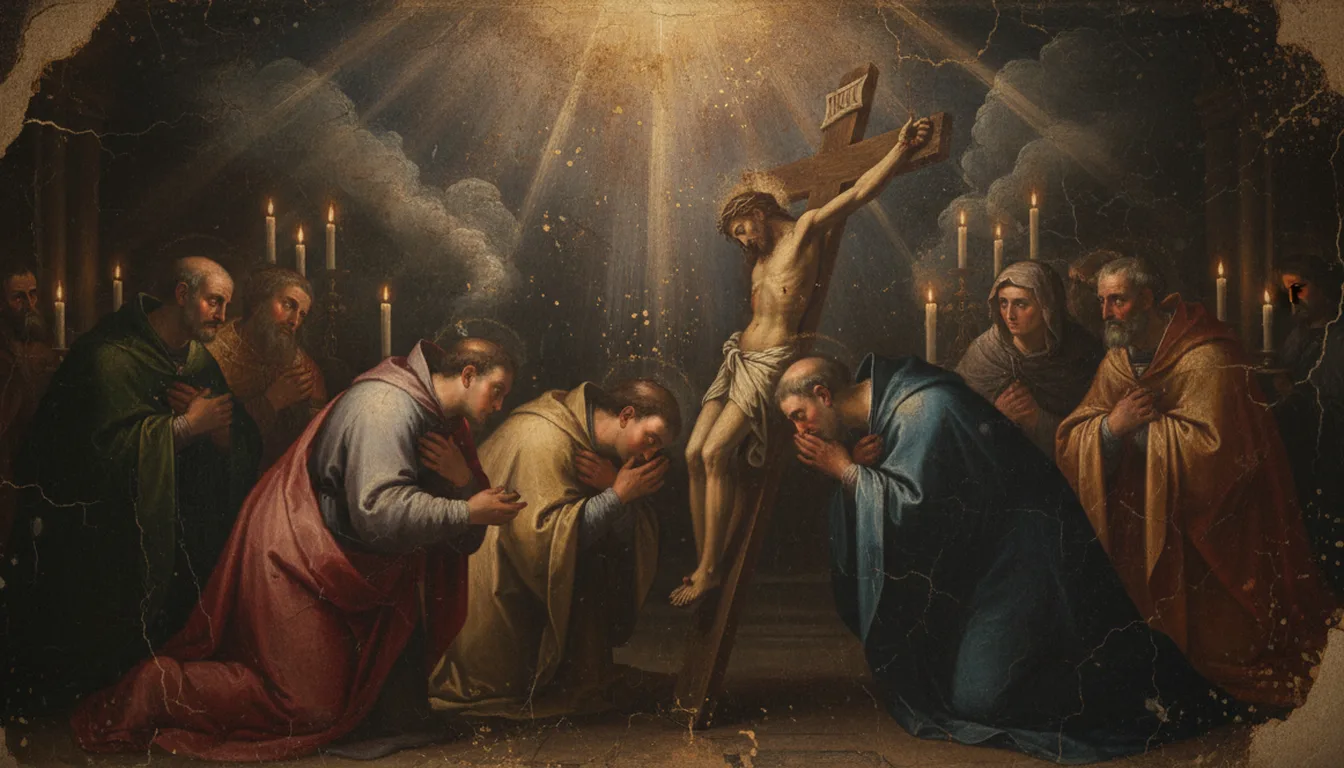
People often search for a "roman catholic crucifix" as though it were a distinct kind. In truth it is simply the crucifix as the Roman Church has always used it: the Cross of Our Lord with the figure of the crucified Saviour upon it. What may strike a newcomer is the realism — Christ shown truly dead, the head fallen, the wounds open, the body bearing the marks of the scourging. This is deliberate.
The Church does not idealise the death of her Lord; she shows it, because, as the Catechism of the Council of Trent says, "it is upon this article that the Faith and the Christian Religion rest as upon their base." A Roman crucifix usually carries above the head the title placed there by Pilate, the letters INRI — Iesus Nazarenus Rex Iudaeorum, "Jesus of Nazareth, King of the Jews" — for the Crucified is also the King.
The St Benedict crucifix
The St Benedict crucifix is the form most asked for among Catholic crosses, and with reason: it joins the image of Christ crucified to the most ancient prayer of exorcism in Western devotion. It is a true crucifix — the Cross with the corpus of the Saviour — into the centre of which the small round St Benedict medal is set, so that the medal's blessing and its lettered prayer are carried on the very figure of the Crucified. Many traditional rosaries and pectoral crosses are made this way; whether worn as a plain medal or as a crucifix with the medal inset, the sacramental and its blessing are one and the same. The difference is only in shape, not in power.
St Benedict crucifix meaning
The meaning of the St Benedict crucifix is fixed by the letters cut into the medal at its heart. Around the cross run two short Latin prayers: Crux Sacra Sit Mihi Lux, Non Draco Sit Mihi Dux — "May the Holy Cross be my light; let not the dragon be my guide" — and around the margin Vade Retro Satana, Numquam Suade Mihi Vana; Sunt Mala Quae Libas, Ipse Venena Bibas — "Begone, Satan; never tempt me with vanities; the things you offer are evil; drink your poison yourself."
At the centre stand the letters C S P B, Crux Sancti Patris Benedicti, "The Cross of our holy father Benedict." So the crucifix sets before the eyes both the image of the victory — Christ upon the Cross — and, in words, the renunciation of the devil that victory makes possible. It is no charm and works no magic. Like every sacramental, it avails through the prayer of the Church and the faith of the one who carries it.
The catholic crucifix necklace and pendant
A crucifix necklace or crucifix pendant is among the oldest of Christian customs: to carry the sign of redemption upon one's own person, over the heart. It is not jewellery in the worldly sense, though it may be beautifully made; it is a confession of faith worn in the open and a small standing meditation on the Passion. To wear it well is to remember what it is — and, when the eye falls on it, to lift the mind for a moment to Him whom it shows. A crucifix worn about the neck should be a sermon to its wearer before it is an ornament to others.
The miraculous medal and crucifix necklace
A very common form pairs the crucifix with the Miraculous Medal on a single chain — Christ crucified and His Mother joined together, as they were on Calvary, where Our Lord gave His Mother to the beloved disciple and the disciple to His Mother. The two sacramentals belong easily together: the crucifix keeps the price of our redemption before us; the Miraculous Medal commends us to her who stood beneath the Cross and through whom, in the Church's constant prayer, graces are sought. Worn together they form a small creed — Christ our Redeemer, and Mary our Mother and intercessor.
The catholic wall crucifix
The wall crucifix is the crucifix in its place of honour in the home. The Catholic house has from of old kept a crucifix on the wall — often above a door, in the chief room, or over the bed — so that the family's prayers are said before it and the sign of redemption presides over the household. It is fitting that the crucifix be the first sacred image one sees on entering and the last before sleep, for it preaches without ceasing the one thing Saint Paul was determined to know. A wall crucifix is also the natural centre of a small home altar, and the place before which the family may pray the Stations of the Cross in Lent.
The last rites crucifix
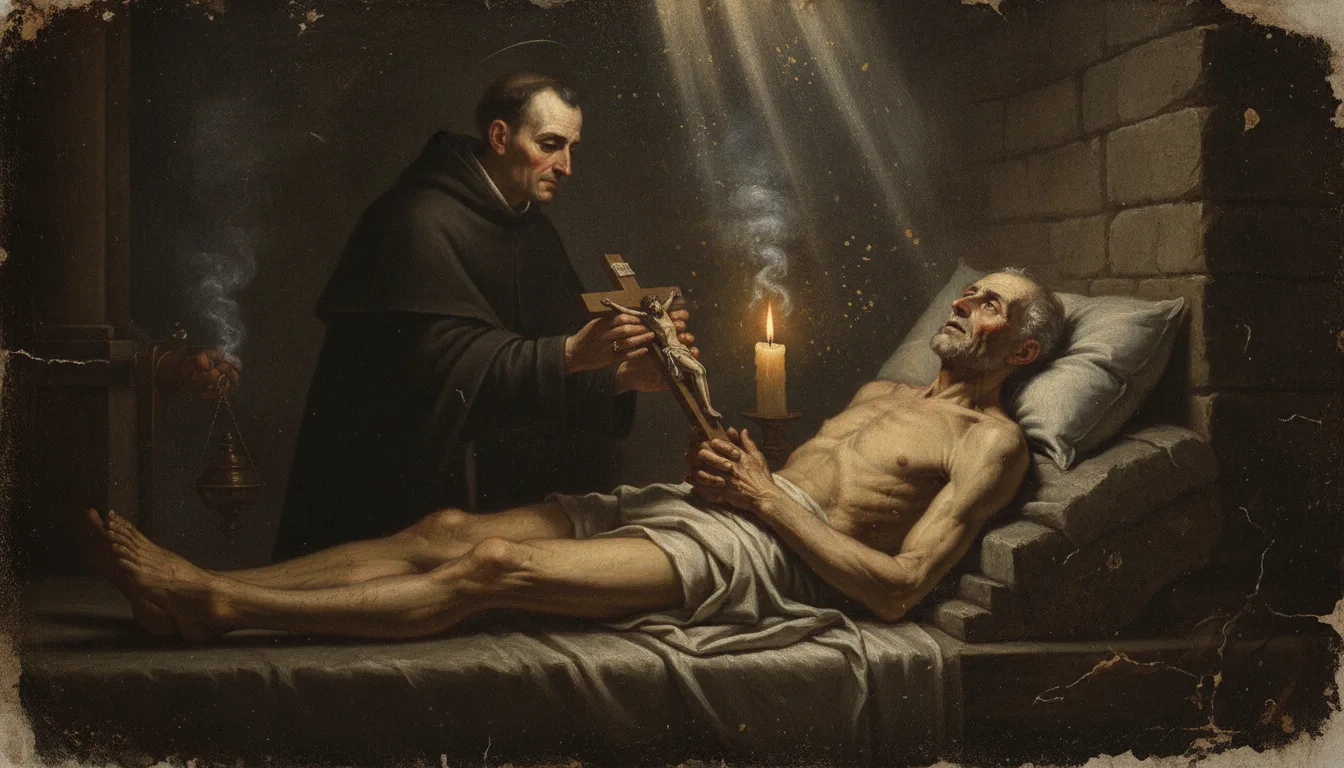
The crucifix has a particular office at the hour of death. In the traditional rite, when a priest comes to a dying person to administer the Last Rites, a crucifix is set where the sick can see it, and it is given them to hold and to kiss, that the last sight of this life may be the face of the Crucified.
From this comes the last rites crucifix, sometimes called a sick-call crucifix or sick-call set: a crucifix whose body slides or opens to hold blessed candles, holy water, and a cloth, kept in a Catholic home against the day it is needed. The Church teaches the dying to look upon the Cross precisely because, as Tanquerey writes, "the crucifix, the sign of the cross, and above all authentic relics of the true cross are dreadful to the demon who was vanquished by the cross." At the last hour, the soul clings to the sign of its salvation.
The crucifix for First Holy Communion and Confirmation
A crucifix is among the most fitting gifts for a child's First Holy Communion or for Confirmation, because it gives, in a single image, the whole reason for the day. The child who first receives the Body of Christ, given for us on the Cross, may rightly be given the image of that Cross to keep — a crucifix necklace, a small crucifix for the bedroom wall, or a crucifix joined to a rosary. The gift outlasts the day and becomes a companion of the whole Christian life, recalling the giver and, far more, the One who gave Himself. Such a crucifix is no mere keepsake; it is a sacramental, to be blessed and used in prayer.
A unique catholic crucifix: the meaning matters more than the make
Some look for a "unique" crucifix — a distinctive design, an unusual material, a hand-carved corpus. There is nothing wrong in this; the Church has always allowed and encouraged beauty in sacred art, and a finely made crucifix can lift the heart. But the worth of a crucifix does not lie in its rarity or its cost. The plainest crucifix and the most exquisite say exactly the same thing: Christ crucified, the price of redemption, the love of God.
What makes a crucifix precious is not its make but its meaning, and what makes it a sacramental is that it is blessed and used in faith. Whatever its form, a crucifix should be reverently kept, and when worn or carried it asks of us the one thing it preaches — to glory in nothing save the Cross of our Lord Jesus Christ.
Why the crucifix endures
The crucifix has hung in the homes and on the persons of Christians for as long as the Church has had homes to hang it in, and it endures for the reason it began: because it tells the truth no Christian can do without. It tells us that we were bought at a price, that the price was the blood of the Son of God, and that this is the measure of how much we are loved. A bare cross can hint at all this. The crucifix says it outright, and refuses to let us forget.
We keep Christ on the cross, then, not because we doubt that He left the tomb, but because we will not let the manner of our salvation slip from sight. The crucifix is the Gospel in a single image — Christ crucified, the price of redemption, the love of God — held up where we cannot help but see it, until the day we see Him face to face. To learn what that image holds, see our accounts of the Passion of Jesus Christ and of the Stations of the Cross.
Frequently Asked Questions
What is the difference between a crucifix and a cross?
A cross is the bare instrument upon which Our Lord was put to death; a crucifix is that same cross bearing the figure of the crucified Christ — crux and corpus together. Every crucifix is a cross, but not every cross is a crucifix. A bare cross says that a man was redeemed; the crucifix says by whom and at what cost.
Why do Catholics use a crucifix instead of a bare cross?
We use the crucifix because it keeps before our eyes the price of our redemption and the love of God who paid it. The Catechism of the Council of Trent urges the faithful "to recall as often as possible the Passion of the Saviour," and the crucifix is that remembrance made visible. The Church has never forbidden the plain cross, but she has always loved the crucifix more, because it keeps the whole truth in view.
Does the crucifix deny the Resurrection?
No. A crucifix is not a claim that Christ is still dying; it is a memorial of an event that truly happened and saves us still. The Risen Christ is the same Christ who was crucified, and He carries His wounds into glory. As St Paul wrote, "God forbid that I should glory, save in the cross of our Lord Jesus Christ" (Galatians 6:14) — the Resurrection is our hope, and the Cross the means by which it was won.
Is venerating a crucifix the same as idolatry?
No. To venerate a crucifix is never to adore the wood or the metal; the honour passes to Him whom it represents. We kneel before the figure on Good Friday and kiss the wounds carved there precisely because it is His image and not its own. The veneration is a form of asking and of love, never the worship owed to God alone.
Is the crucifix a sacramental?
Yes. The crucifix is numbered among the sacramentals, the sacred signs by which the Church draws the mind to God. Used in faith, it is a standing meditation on the Passion and a help against the enemy. Tanquerey notes that "the crucifix, the sign of the cross, and above all authentic relics of the true cross are dreadful to the demon who was vanquished by the cross."
What is a St Benedict crucifix and what does it mean?
A St Benedict crucifix is a true crucifix into which the round St Benedict medal is set at the centre, so that the medal's blessing and its lettered prayer of exorcism are carried on the very figure of the Crucified. Its meaning is fixed by the letters on the medal: Crux Sacra Sit Mihi Lux, Non Draco Sit Mihi Dux — "May the Holy Cross be my light; let not the dragon be my guide" — and Vade Retro Satana, "Begone, Satan." It joins the image of Christ's victory to the words that renounce the devil. It is no charm; like every sacramental, it avails through the prayer of the Church and the faith of the one who carries it.
Can a Catholic wear a crucifix necklace?
Yes, and it is an ancient custom. To wear a crucifix or crucifix pendant over the heart is a confession of faith carried in the open and a standing reminder of the Passion. It is not jewellery in the worldly sense, though it may be beautifully made; worn well, it should be a sermon to its wearer before it is an ornament to others. A common form pairs the crucifix with the Miraculous Medal on one chain — Christ our Redeemer and Mary our Mother joined together.
Where should a crucifix be placed in a Catholic home?
The crucifix has from of old held the place of honour in the Catholic house — on a wall in the chief room, above a door, or over the bed — so that the family's prayers are said before it. It is fitting that it be the first sacred image seen on entering and the last before sleep, and it makes the natural centre of a small home altar and of the family Stations of the Cross in Lent.
What is a last rites or sick-call crucifix?
It is a crucifix kept in the home against the hour of death, often made so that the body slides or opens to hold blessed candles, holy water, and a cloth for when a priest comes to administer the Last Rites. In the traditional rite a crucifix is set before the dying and given them to hold and to kiss, that the last sight of this life may be the face of the Crucified.
The Iter Fidei app carries the Douay-Rheims Bible, the catechism, and the traditional prayers. Join early access here.
Sources. Scripture per the Douay-Rheims: 1 Corinthians 1:23; Galatians 6:14. Catechism of the Council of Trent (Roman Catechism, 1566), Part I, On the Fifth Article of the Creed: the Passion and death of Our Lord (the remembrance of the Passion, the price of redemption, the mystery of the Cross as the base of the faith, those who "crucify again" the Son of God). A. Tanquerey, The Spiritual Life: A Treatise on Ascetical and Mystical Theology, on the crucifix and the sign of the cross as helps against the demon. The lettering and Latin prayers of the St Benedict crucifix (Crux Sacra Sit Mihi Lux..., Vade Retro Satana...) per the traditional medal of St Benedict, blessed by the prescribed Benedictine rite. The use of the crucifix at the deathbed per the traditional Roman Ritual for the visitation and care of the sick.