
The Faith
What Does God Say About Work?
What does God say about work? Work is a duty and a means of sanctification, given to man before the Fall and made laborious after it. We give the Douay-Rheims verses and the Catholic teaching on hard work, diligence, and labour offered to God.
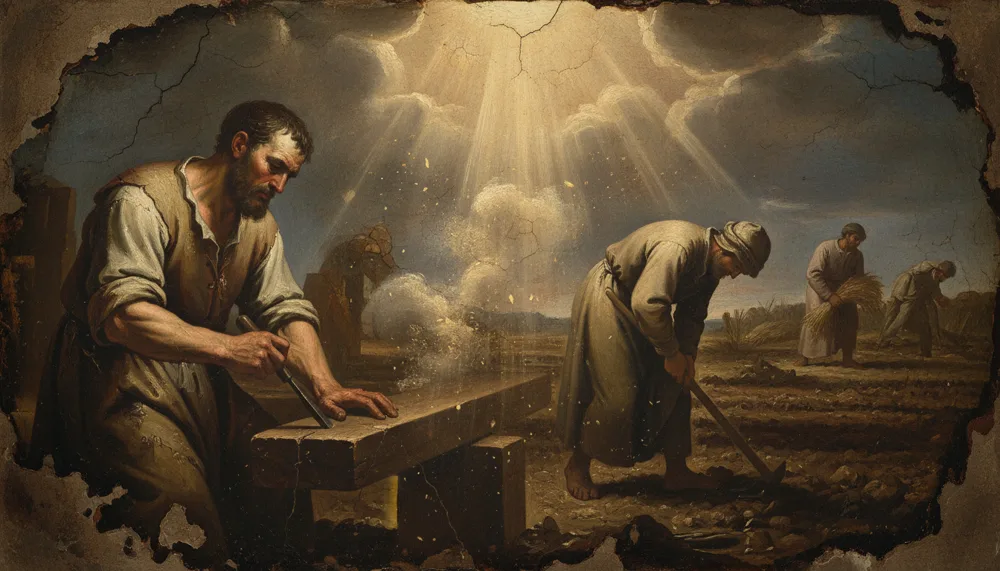
What God says about work is that it is a duty laid on man and a means of his sanctification: given to Adam before the Fall as his appointed task, and made laborious after it as the wage of sin. In the sweat of thy face shalt thou eat bread (Gen. iii. 19), the Lord tells fallen man; and Saint Paul lays down the rule for the Church: if any man will not work, neither let him eat (2 Thess. iii. 10). Work is therefore neither a curse to be escaped nor an idol to be served, but an obedience to be offered.
This is the answer the Church gives, drawn from Scripture and her catechisms, and it differs from the popular readings on both sides. (This is one entry in our series on what God says about the things that occupy and trouble men.)
What does the Bible say about hard work?
The Bible treats work as belonging to man from the beginning. Before there was any sin to punish, God placed Adam in paradise to dress it, and to keep it (Gen. ii. 15). Work, then, is not the wound; it is part of man's nature as a creature made in God's image. Idleness was never the state of innocence.
What the Fall added was not work but toil. To the man God said the verse the whole subject turns on: In the sweat of thy face shalt thou eat bread, till thou return to the earth out of which thou wast taken (Gen. iii. 19). The sweat is the mark of fallen work. The Bible never pretends otherwise; it does not promise the labourer an easy field, but that the labour itself, borne in obedience, has worth.
So when the New Testament speaks of hard work, it speaks of a command. Saint Paul, who worked night and day with his own hands rather than be a burden, gives the Thessalonians the sharpest rule in Scripture: if any man will not work, neither let him eat. For we have heard there are some among you who walk disorderly, working not at all, but curiously meddling (2 Thess. iii. 10–11). Note the precision: the man condemned is the one who will not work, not the one who cannot. The Bible's severity falls on the will, never on the sick or the poor whom God commands us to relieve.
What does God say about working hard? Diligence against sloth
Working hard, in the Catholic sense, is the virtue of diligence — and its enemy has a name. The Catechism of Saint Pius X numbers sloth among the seven capital vices and teaches that one triumphs over sloth by diligence and fervour in the service of God; these vices are called capital because they are the source and the cause of many other vices and sins (On the Capital Sins). Sloth fathers a whole brood: negligence in duty, the omitting of prayer, and at last a coldness toward God. We treat it at length in what God says about laziness, the sister question to this one; it is one of the seven deadly sins whose remedy is its opposite virtue.
Diligence is not mere busyness, and still less the worship of one's career. Hard work is good, but a means, not an end. The man who works hard for money alone has merely chosen a respectable idol; on the disordered love of wealth see the Ten Commandments and their guard against covetousness. The point of working hard is to discharge the duty God has given and to have the means to do good.
Work as a means of sanctification
Here the Catholic teaching parts most clearly from the world's. Work is not only a duty owed; it is an offering that sanctifies the one who makes it. The toil of fallen man — the sweat of Genesis iii. 19 — is the thing the Christian takes up and gives back to God, so that the curse becomes a coin of merit.
Labour borne in a state of grace is no longer mere drudgery; it is a participation in the cross. (On the grace that gives our acts their merit, see sanctifying grace; and faith without works is dead — the works of a living faith are wrought, very largely, in the ordinary labour of one's calling.) In our own day St Josemaría Escrivá made this sanctification of ordinary work the centre of his preaching, and those drawn to it may pray the novena to St Josemaría Escrivá.
The model the Church holds up is Saint Joseph the worker, the carpenter of Nazareth, in whose shop the Son of God Himself worked with His hands for the hidden years of His life. That God incarnate spent the greater part of His earthly life at manual labour, and not at public preaching, is the Church's plainest sermon on the dignity of work. Honest labour is not beneath the Christian; it is the very life Our Lord chose to live.
So the labourer's tasks are woven into the duties of Catholic marriage and the providing for a household, and the daily offering of one's work belongs beside mental prayer and the Rosary. To the toiling Our Lord says: Come to me, all you that labour and are burdened, and I will refresh you (Matt. xi. 28) — the Christian labours toward rest, the rest of the Lord's Day now and the eternal rest hereafter, on which see the Four Last Things.
Work and rest: the Lord's Day
The Bible that commands work also commands rest. The third Commandment binds the Christian to keep holy the Lord's Day; the Catechism of Saint Pius X teaches that it forbids us servile works and every other occupation which turns us away from divine worship, that we may rest from our toils. So the man who never rests is a transgressor, treating his labour as a god that admits no Sabbath; and the man who never works is the sluggard of Scripture. Between the two stands the Christian, who labours six days and on the seventh lifts his eyes to the One for whom he labours.
The popular misreadings, charitably corrected
Three errors the searcher is likely to have met must be answered — firmly, and with no contempt for the persons who hold them.
The prosperity reading, common in some Protestant preaching, makes hard work a lever on God: work diligently and He will reward you with wealth. Scripture promises no such thing. It promises the sweat of the face (Gen. iii. 19), and Our Lord, the worker of Nazareth, died poor. Work is owed to God whether it prospers or not; its true wage is paid in the next life. (On the salvation that is God's free gift and not a wage we extort, see what God says about salvation.)
The new-age reading turns work into self-actualisation — labour as the path to one's "best self," found by listening within. This empties work of God. The Christian's work is not first about fulfilling himself but about obeying his Maker and serving his neighbour; the fulfilment, where it comes, is a fruit and not the root. (On that ordering of the will, see what God says about obedience and free will.)
The fundamentalist reading seizes if any man will not work, neither let him eat (2 Thess. iii. 10) as a club against the poor and the unable. Saint Paul condemns the one who will not work, the disorderly idler — not the sick man, the widow, or the child. The same Scripture commands the relief of the needy as a grave duty. We hold both: labour is a duty for those who can, and mercy a duty toward those who cannot.
Where this leaves us
What God says about work, said plainly, is this: He gave it to man as a task before sin and left it as a discipline after sin, that by the sweat of his face he might eat his bread and, offering that labour to God, sanctify his soul. Work is a duty — if any man will not work, neither let him eat (2 Thess. iii. 10) — and a gift, for in the workshop of Nazareth the Lord Himself hallowed it. We labour diligently against sloth, rest on the day He commands, and offer the whole of it back to Him. (For the verses gathered, see our hub of Catholic Bible verses.)
Frequently Asked Questions
What does God say about work?
God says that work is a duty laid on man and a means of his sanctification. He gave it to Adam before the Fall, placing him in paradise to dress it, and to keep it (Gen. ii. 15), and after sin He left it as a discipline: In the sweat of thy face shalt thou eat bread (Gen. iii. 19). Saint Paul fixes the rule for the Church — if any man will not work, neither let him eat (2 Thess. iii. 10) — so that work is neither a curse to flee nor an idol to serve, but an obedience to be offered to God.
Does God work?
Yes. Holy Scripture shows God Himself at work in creating the world and in upholding it, and Our Lord says, My Father worketh until now; and I work (John v. 17). The Son of God spent the hidden years of His life labouring with His hands in the workshop of Saint Joseph at Nazareth, hallowing honest toil. That God works is the very ground of the dignity the Church gives to human labour.
What does God say about hard work?
When Scripture speaks of hard work it speaks of a command and of the virtue of diligence. Saint Paul, who worked night and day with his own hands rather than burden anyone, condemns the man who will not work, the disorderly idler — never the sick man, the widow, or the poor whom God commands us to relieve. The Catholic does not work hard to wring wealth from God, who promised the labourer only the sweat of his face; he works hard to discharge his duty, to provide for his household, and to offer the labour back to God as a coin of merit.
The Iter Fidei app carries the Douay-Rheims Bible, the catechism, and the prayers. Join early access here.
Sources. Holy Scripture (Douay-Rheims): Genesis ii. 15; iii. 17, 19; 2 Thessalonians iii. 10–11; Matthew xi. 28. Catechism of Saint Pius X (1908): On the Capital Sins (Part V, Chapter 6 — the seven capital vices; sloth triumphed over by diligence and fervour in the service of God; why these vices are called capital); On the Third Commandment (Part III — servile works forbidden on the Lord's Day, that we may rest from our toils and give ourselves to divine worship).