
The Faith
What Does God Say About Soulmates?
God does not speak of soulmates. Scripture speaks of marriage as a vocation and a sacrament, and of charity that wills the eternal good of another and is faithful unto death — not a fated cosmic match.
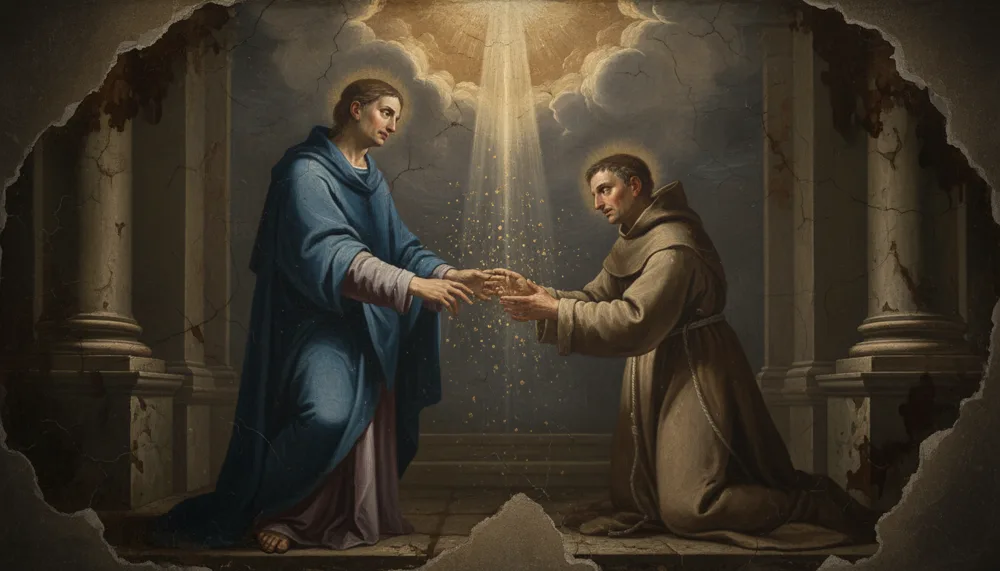
God says nothing about soulmates, because there is no such thing. Scripture does not promise each soul one destined partner waiting in the world; it teaches that marriage is a vocation and a sacrament, and that true love is a charity willed by the free choice of two persons and kept by grace until death. There is no fated cosmic match to be found. There is a covenant to be made, and kept.
We answer the question plainly here, because the soulmate myth is one of the gentlest and most widespread errors of the age, and it does real harm to real marriages. It is worth knowing what God has actually said.
What does the Bible say about soulmates?
Nothing. The word does not appear in Scripture, and neither does the idea. What Scripture says is something far better and far more demanding.
In the beginning God made man and woman and joined them: "Wherefore a man shall leave father and mother, and shall cleave to his wife: and they shall be two in one flesh" (Genesis ii. 24, Douay-Rheims). Our Lord took up these very words and sealed them: "What therefore God hath joined together, let no man put asunder" (Matthew xix. 6). Notice what is said and what is not. God does not say He matched two souls before the foundation of the world; He says He joins two who marry, and that what He joins is one flesh and indissoluble. The bond is real, but it is made in time, by consent, and confirmed by God — not foreordained as a romantic destiny.
The Roman Catechism (Trent, 1566) defines marriage from these same texts: "the conjugal union of man and woman, contracted according to the Laws of the Church, and constituting an inseparable community of life." Its essence, the catechism teaches, lies in the bond that consent produces — "a true cession which man and woman make to each other of themselves." A cession is a gift freely given. It is not the discovery of a person fated to be yours.
This is why we treat marriage as one of the seven sacraments and a true vocation. To understand what God says about soulmates, begin with what He says about catholic marriage itself.
Does God have a soulmate for me? Is there one person for everyone?
There is no one person for everyone. The "one destined soulmate" is not a Catholic idea but a new-age and romantic one, dressed up to look like Providence. God's providence is real and orders all things, but it does not abolish the will He gave us. Marriage requires a choice — a true and free consent — and a thing that is fated cannot be chosen.
The danger of the myth is practical. If you believe one person was destined for you, then the ordinary trials of married life look like proof you married the "wrong" one, and the next attractive soul looks like the "right" one you missed. The myth that promises a perfect match ends, again and again, in the sin of divorce. The truth is plainer and stronger: you choose a spouse, and then by grace you make that spouse the right one, by fidelity, sacrifice, and love that does not quit.
So if you ask whether God has a soulmate for you, the answer is that God has a vocation for you — marriage, or the priesthood, or the consecrated life, or a holy single life — and within marriage He gives the grace to love the one you have freely bound yourself to. Discerning that vocation is a work of prayer, not of waiting for a sign. It is why we commend mental prayer and the rosary to anyone seeking God's will for their state in life. Seek the vocation and the grace; the romantic match was never promised.
What true love actually is
The age has emptied the word love until it means a feeling that comes and goes. Scripture means something else. Saint Paul does not describe an emotion; he describes charity, the greatest of the three theological virtues: "Charity is patient, is kind: charity envieth not, dealeth not perversely; is not puffed up... beareth all things, believeth all things, hopeth all things, endureth all things. Charity never falleth away" (1 Corinthians xiii. 4–8).
Read those verbs. Charity is patient and endures; it is a thing done, not a thing felt. To love a person is to will the eternal good of that person — above all, that he reach heaven — and to keep willing it when the feeling has gone cold and the days are hard. This is why the love proper to marriage can be commanded and vowed: you cannot vow a feeling, but you can vow fidelity. We have set this out at length in Love Is Patient, Love Is Kind, and it is the surest cure for the soulmate myth. The romantic match asks, do I still feel it? Charity asks, do I still will your good, and am I keeping my word?
A soul that loves this way will need sanctifying grace, for charity is poured into the heart by God and not summoned by sentiment. And it will need to do battle, for nothing in fallen man is more contested than fidelity. The spiritual combat against lust and self-love is fought daily inside marriage, not only outside it.
Where the popular answers go wrong
The Protestant and self-help reading often makes "soulmate" a synonym for "the one God picked," and so smuggles a romantic fate into a Bible that never teaches it. The new-age reading goes further, treating love as the union of two energies or two halves of one pre-existing soul — a pagan myth, not the Christian one, where two whole persons freely become one flesh. The fundamentalist reading sometimes turns God's permissive will into a single hidden bullseye you must hit or forfeit happiness, which is a chain, not the freedom Christ gives.
Against all three, the Church is firm and clear. Marriage is instituted by God, raised to a sacrament by Christ, made by free consent, and indissoluble until death. The Roman Catechism teaches that the bond, once contracted, can be dissolved by nothing but death — "the bond which it establishes between them is absolutely indissoluble." That is sterner than any soulmate fantasy and infinitely more secure. A feeling can fade; a sacrament does not. We say this charitably toward every person who has believed the myth — many have, in good faith — but we will not soften the doctrine, because softening it has wrecked homes. What God says about family rests on this same indissoluble bond.
What God actually offers
God does not offer a soulmate. He offers a vocation, a sacrament, and the grace to be faithful in it unto death — which is more than any romance could give. The two become one flesh because God joins them, not because the stars did. And the love that holds them is charity: patient, kind, enduring, and never falling away. Choose well, in prayer; then keep your word, in grace. That is the whole of it, and it is enough. For how the Church answers the other hard questions of the age, see what God says throughout Scripture and Tradition.
Frequently Asked Questions
What does God say about soulmates?
God says nothing about soulmates, because there is no such thing. Scripture does not promise each soul one destined partner; it teaches that marriage is a vocation and a sacrament, made by free consent and confirmed by God. Our Lord says, "What therefore God hath joined together, let no man put asunder" (Matthew xix. 6) — He joins those who marry, He does not foreordain a romantic fate.
What does the Bible say about soulmates?
The word never appears in Scripture, and neither does the idea. What the Bible teaches is better and more demanding: "a man shall leave father and mother, and shall cleave to his wife: and they shall be two in one flesh" (Genesis ii. 24, Douay-Rheims). The bond is real, but it is made in time by consent and made indissoluble by God — not destined before the world began.
Does God have a soulmate for me?
No. God has a vocation for you — marriage, the priesthood, the consecrated life, or a holy single life — and within marriage He gives the grace to love the spouse you freely bind yourself to. Discerning that vocation is a work of prayer, not of waiting for a fated sign.
Is there one person for everyone?
There is no one destined person for everyone. The "one true soulmate" is a new-age and romantic notion dressed up to look like Providence; but God's providence does not abolish the free will He gave us, and a thing that is fated cannot be freely chosen. You choose a spouse, and then by fidelity and grace you make that spouse the right one.
What is true love according to the Bible?
True love is charity, not a feeling that comes and goes. Saint Paul writes, "Charity is patient, is kind... beareth all things... endureth all things. Charity never falleth away" (1 Corinthians xiii. 4–8). To love is to will the eternal good of another and to keep willing it when the feeling has gone cold — which is why love can be vowed, for you cannot vow a feeling but you can vow fidelity.
Is the idea of a soulmate a sin?
The idea itself is an error rather than a sin, but it is a harmful one. Believing one person was fated for you makes the ordinary trials of marriage look like proof you chose wrongly, and it has driven many to the sin of divorce. The Church holds instead that marriage is indissoluble until death — "the bond which it establishes between them is absolutely indissoluble" (Roman Catechism, 1566).
How do I find the person God wants me to marry?
Do not wait for a sign; seek your vocation in prayer. Commend the matter to God through mental prayer and the rosary, live in sanctifying grace, and choose well among those you might rightly marry. Then keep your word in grace, for it is fidelity and charity, not a cosmic match, that God has promised to bless.
The Iter Fidei app carries the Douay-Rheims Bible, the catechism, and the prayers. Join early access here.
Sources. Holy Bible, Douay-Rheims: Genesis ii. 24; Matthew xix. 6; 1 Corinthians xiii. 4–8. Catechism of the Council of Trent (Roman Catechism, 1566), Part II, On the Sacrament of Matrimony.