
The Faith
What Does the Bible Say About Divorce? The Catholic Answer
God says a valid marriage cannot be dissolved: 'What therefore God hath joined together, let no man put asunder.' The Bible and the Church on divorce.
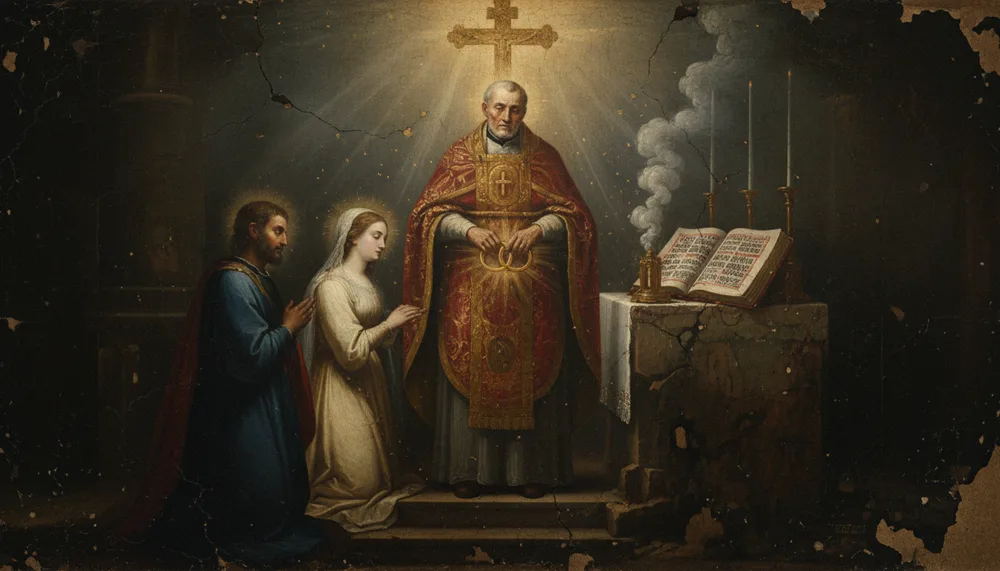
What does God say about divorce? He says a valid marriage cannot be undone by any human power: "What therefore God hath joined together, let no man put asunder" (Matthew xix. 6). The Bible teaches, and the Catholic Church has always held, that whoever puts away a true spouse and marries another commits adultery; so a second union after divorce is a sin, while the marriage bond itself endures until death.
This is a hard saying, and Our Lord knew it was hard. But it is His own word, not an invention of the Church, and we read it here with the Church and her catechisms rather than as a string of isolated verses pulled in opposite directions. This article belongs to our wider series on what God says about the questions that press on us.
What does the Bible say about divorce?
The clearest passage is in St Matthew. The Pharisees came to tempt Our Lord, asking whether a man might put away his wife for every cause. He answered by going back behind Moses to the beginning:
"Have ye not read, that he who made man from the beginning, made them male and female? And he said: For this cause shall a man leave father and mother, and shall cleave to his wife, and they two shall be in one flesh. Therefore now they are not two, but one flesh. What therefore God hath joined together, let no man put asunder." (Matthew xix. 4–6)
When they pressed Him about the bill of divorce that Moses had allowed, He drew the line sharply:
"Because Moses by reason of the hardness of your heart permitted you to put away your wives: but from the beginning it was not so. And I say to you, that whosoever shall put away his wife, except it be for fornication, and shall marry another, committeth adultery." (Matthew xix. 8–9)
St Mark records the same teaching without exception of any kind: "Whosoever shall put away his wife, and marry another, committeth adultery against her. And if the wife shall put away her husband, and be married to another, she committeth adultery" (Mark x. 11–12). St Paul repeats it as a command of the Lord, not his own: "the wife depart not from her husband. And if she depart, that she remain unmarried, or be reconciled to her husband. And let not the husband put away his wife" (1 Corinthians vii. 10–11).
These are the central Bible verses about divorce, and they say one thing: the bond God forges in a true marriage no man may break. They stand near the heart of the moral law, among the Bible verses every Catholic should know.
Is divorce a sin?
Here we must be exact, because the word "divorce" is used loosely. The Church distinguishes the marriage bond from the common life of the spouses.
A civil divorce that merely dissolves the legal arrangement and ends the shared household is not, in itself, a sin. There are grave cases — abuse, danger, persistent infidelity — where a husband and wife may lawfully cease to live together. St Paul allows exactly this: "let her remain unmarried, or be reconciled to her husband." The separation may even be a duty, to protect a spouse or the children.
What God forbids is the claim that the bond itself is broken, and above all the attempt to contract a new marriage while the first spouse lives. That is where sin enters. The Roman Catechism reasons directly from Our Lord's words: "Whosoever shall put away his wife, and marry another, committeth adultery; and if a woman shall put away her husband, and be married to another, she committeth adultery." So divorce is a sin when it is treated as a licence to remarry, because before God the first marriage still stands. A second "marriage" after divorce is not a marriage at all but an adulterous union — and adultery is forbidden by the sixth of the Ten Commandments.
This is one of the clearest places where the Catholic reading parts from much of the Protestant world. We treat the words of Christ as binding law that no authority can soften; the question of Catholic versus Protestant teaching often turns on just this point — whether the Church may dissolve what God has joined.
Why a valid marriage cannot be dissolved
The reason the bond holds is not a rule the Church added. It is the nature of marriage as God made it. The Catechism of St Pius X states it plainly: "the bond of Matrimony is indissoluble, or that it can be broken only by the death of one of the spouses, because God established it thus from the beginning, and Jesus Christ Our Lord in His turn solemnly proclaimed it."
The Roman Catechism explains why even the State is powerless here: "the bond of Christian marriage cannot be broken by the civil authority, because the latter can neither interfere in matter of sacrament nor put asunder what God has joined together." A judge may dissolve a contract of property; he cannot dissolve a sacrament. For the baptised, marriage is itself a sacrament, and so a sacred sign of an unbreakable union, the union of Christ with His Church.
Moses had permitted the bill of divorce, the Roman Catechism notes, but "the Evangelical Law has suppressed this double liberty, and has thus brought back Matrimony to its first state." Our Lord did not relax the old law; He restored marriage to what it was in paradise before the hardness of men's hearts disfigured it. We set this out at length in our study of Catholic marriage, the sacrament of Matrimony, which shows the same teaching from its root.
What does God say about adultery and divorce?
Adultery and divorce are bound together in Our Lord's own words, and it helps to see exactly how. He names adultery in two distinct places, and they must not be confused.
First, adultery is the one cause for which a man may put away his wife: "whosoever shall put away his wife, except it be for fornication, and shall marry another, committeth adultery" (Matthew xix. 9). The Church reads this exception, with the Fathers and the Roman Catechism, as permitting separation — the spouses may cease to live together when one has been unfaithful — but not as breaking the bond. Even the innocent party, wronged by the other's adultery, is not thereby free to marry again while the guilty spouse lives. The sin of the one does not dissolve the marriage of the two.
Second, remarriage after divorce is itself adultery. To put away a true spouse and take another is to live in an adulterous union, "for she that is married to another while her husband liveth, shall be called an adulteress" (Romans vii. 3). Even the man who marries a woman put away shares in that sin: "he that marrieth her that is put away from her husband, committeth adultery" (Luke xvi. 18).
St Paul states the one condition that frees a spouse: "A woman is bound by the law as long as her husband liveth; but if her husband die, she is at liberty: let her marry to whom she will; only in the Lord" (1 Corinthians vii. 39). This is the hard heart of the teaching: what the world calls a fresh start, Our Lord calls by a graver name, because before God the first marriage still stands. Adultery and divorce thus meet at the same point — fidelity to a bond God has made and no man may unmake.
What does God say about the cause "except for fornication"?
Many ask whether this single exception opens a door to remarriage. It does not. The Greek phrase rendered "except it be for fornication" has been understood by the Latin Church to allow the spouses to separate — to live apart — when one is unfaithful, immoral, or where the union was unlawful from the start. It does not permit the surviving bond to be broken and a new marriage contracted.
St Mark and St Luke record the same command with no exception at all: "Whosoever shall put away his wife, and marry another, committeth adultery against her" (Mark x. 11); "Every one that putteth away his wife, and marrieth another, committeth adultery" (Luke xvi. 18). Read together with St Matthew, the meaning the Church has always drawn is plain: separation may sometimes be lawful, even a duty; remarriage while the first spouse lives never is.
Can a Catholic remarry after divorce?
A Catholic is free to marry again in only two cases. The first is the death of the first spouse, which the Apostle expressly allows (1 Corinthians vii. 39). The second is a declaration of nullity, in which a Church tribunal finds, after investigation, that no true marriage ever existed (see below). A civil divorce decree, however final in the eyes of the State, changes nothing before God: where the first marriage was valid and the first spouse lives, a new marriage remains forbidden. This is not severity; it is the Church refusing to call adultery by another name.
Divorce and separation
The Bible never confuses divorce with separation, and neither does the Church. Separation ends the common life of the spouses; divorce claims to end the bond between them. The first is sometimes lawful, even necessary; the second the Church has no power to grant. Notice that in St Paul's rule even the wife who lawfully departs must "remain unmarried," free only to be reconciled, not to take another (1 Corinthians vii. 10–11). The Church allows spouses to separate "as to bed and board" for adultery, and for other grave causes such as danger to the faith, cruelty, or peril to soul or body, yet the bond remains.
So a Catholic enduring an abusive or dangerous marriage is not bound to share a roof with peril. Separation, and even the civil divorce that secures it in law, may be the right course to protect a spouse or children. What no decree can do is sever the bond or open the door to a new marriage while the first spouse lives. Separation guards the person; the bond guards the truth of what God has joined.
Divorce is not annulment
A frequent confusion must be cleared away. The Church does not grant divorces, and an annulment is not a "Catholic divorce."
Divorce claims to break a marriage that truly existed. An annulment — more exactly, a declaration of nullity, given by a Church tribunal — declares that a true marriage never came into being — that something was lacking from the start which the law requires for a valid bond: real consent, the freedom of both parties, the absence of a diriment impediment. The Roman Catechism teaches that the consent of the two, "formulated by words which indicate the present," is what makes the marriage; if that consent was never truly given, or given by one not free to give it, there was no marriage to dissolve, only its appearance.
So an annulment dissolves nothing. It examines whether God ever joined this man and this woman at all. Where He did, no power on earth or in the Church can put them asunder. Where He did not, the Church may recognise the truth and declare the parties free. The two acts could not be more different: one would defy Our Lord's command, the other obeys it.
Firm in the teaching, charitable to the divorced
The doctrine is unbending, but the Church is not unkind to those whom divorce has wounded. A person who is divorced — especially one abandoned against his or her will, who has not remarried — carries no guilt for the breaking of the home and remains a full member of the Church, called to the sacraments, to prayer, and to a holy life. Such a soul often bears a heavy cross with great faith, and we honour it.
The difficulty arises only with a new union while the first spouse lives, which the Church cannot bless without denying Christ's words. Even here her answer is not condemnation but a call to grace: to draw near to God in the spiritual life, and where the heart is burdened, to seek the mercy that waits in the sacrament of confession. She guards the indissoluble bond precisely because she takes the love it signifies seriously. Those wounded by a broken marriage may find that the same Scripture that speaks so firmly here speaks tenderly elsewhere — to the anxious, to those carrying anger, and above all to those who must forgive.
What God says about divorce, then, is finally a word about fidelity — His to us, and ours to one another. "What therefore God hath joined together, let no man put asunder." The bond is meant to last because the love it images lasts forever.
Frequently Asked Questions
What does God say about divorce?
God says a valid marriage cannot be undone by any human power: "What therefore God hath joined together, let no man put asunder" (Matthew xix. 6). He permits spouses to live apart in grave cases, but He forbids the claim that the bond is broken and forbids remarriage while the first spouse lives. As the Catechism of St Pius X teaches, "the bond of Matrimony is indissoluble" and "can be broken only by the death of one of the spouses."
What does God say about divorce in the Bible?
In the Bible God says a valid marriage cannot be undone by man: "What therefore God hath joined together, let no man put asunder" (Matthew xix. 6). Our Lord teaches that Moses permitted the bill of divorce only "by reason of the hardness of your heart," but "from the beginning it was not so" (Matthew xix. 8). St Mark and St Paul repeat the same command, that the bond holds while both spouses live (Mark x. 11–12; 1 Corinthians vii. 10–11).
What does God say about divorce and remarriage?
God forbids remarriage while the first spouse lives: "Whosoever shall put away his wife, and marry another, committeth adultery" (Matthew xix. 9). A civil divorce that merely ends the shared household is not in itself a sin, and may even be a duty in grave cases; what God forbids is the claim that the bond is broken and the attempt to contract a new marriage. The Church therefore cannot bless such a union without denying the words of Christ, though she calls those in it not to despair but to seek His grace.
What does God say about remarriage after divorce?
Because the bond God forged in a true marriage endures until death, a second union after divorce is no marriage but an adulterous tie: "Whosoever shall put away his wife, and marry another, committeth adultery" (Matthew xix. 9). Our Lord names but one cause for which a man may put away his wife — "except it be for fornication" — yet even this permits separation, not the breaking of the bond. The sin of the one spouse does not free the other to remarry, for the marriage still stands before God. A Catholic may marry again only after the death of the first spouse, or after a Church tribunal has declared the first marriage null from the start.
What does God say about adultery and divorce?
Our Lord ties them together: He names adultery as the one cause for which a man may put away his wife — "except it be for fornication" (Matthew xix. 9) — but this permits separation, not the breaking of the bond. He also calls remarriage after divorce adultery itself: "she that is married to another while her husband liveth, shall be called an adulteress" (Romans vii. 3). The innocent spouse, wronged by adultery, may lawfully live apart, yet is not free to marry again while the other lives.
What does God say about marriage and divorce?
God says marriage is one flesh, made by Him, and that man may not divide it: "they two shall be in one flesh... What therefore God hath joined together, let no man put asunder" (Matthew xix. 5–6). Marriage was indissoluble from the beginning; Moses permitted the bill of divorce only for the hardness of men's hearts, and Our Lord restored marriage to its first state. For the baptised, marriage is a sacrament, and the Roman Catechism teaches that not even the civil authority can dissolve it.
What is the difference between divorce and annulment?
Divorce claims to break a marriage that truly existed; an annulment declares that a valid marriage never came into being because something essential was lacking from the start, such as free consent or the absence of a diriment impediment. The Church cannot dissolve a true marriage, so an annulment is not a "Catholic divorce" but a finding of nullity.
What is the difference between divorce and separation?
Separation ends the shared household; divorce claims to end the bond. St Paul allows the first while keeping the bond intact: "if she depart, that she remain unmarried, or be reconciled to her husband" (1 Corinthians vii. 10–11). For grave causes spouses may separate "as to bed and board," but only death dissolves a valid marriage.
The Iter Fidei app carries the Douay-Rheims Bible, the catechism, and the prayers of the Church. Join early access here.
Sources. Holy Scripture (Douay-Rheims): Matthew xix. 4–9; Mark x. 11–12; Luke xvi. 18; Romans vii. 3; 1 Corinthians vii. 10–11, 39. Catechism of the Council of Trent (Roman Catechism, 1566), Part II, "On the Sacrament of Matrimony" (on indissolubility, divorce, separation, and consent). Catechism of St Pius X (1908), Part IV, ch. 9, "Matrimony" (§ on the indissoluble bond and civil divorce). Council of Trent, Session XXIV, on the indissolubility of Matrimony (as cited in the Roman Catechism).