
The Spiritual Life
The Spiritual Combat
Catholic spiritual warfare is the interior battle of every soul against the world, the flesh, and the devil — waged with four weapons: distrust of self, confidence in God, the right use of the faculties, and prayer.
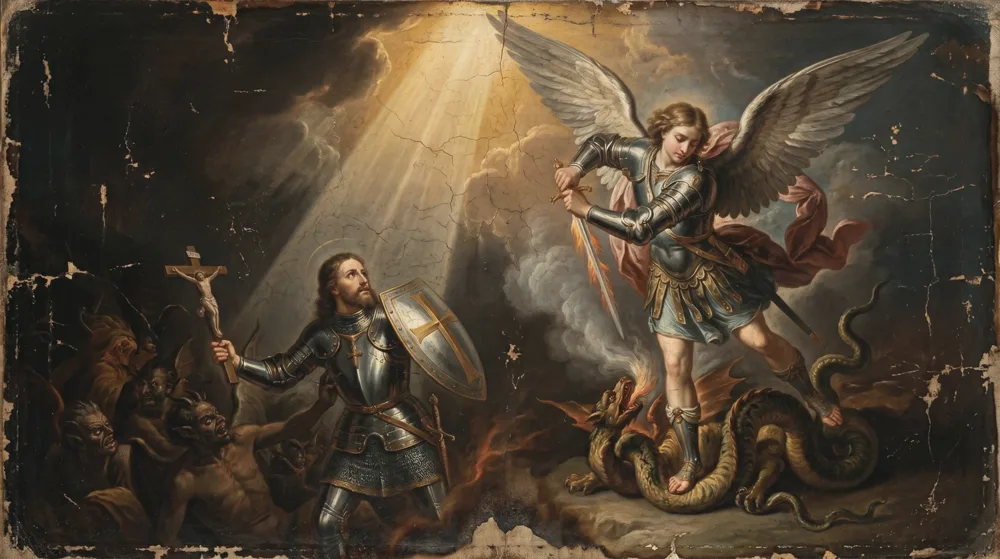
The spiritual combat is the interior war that every Christian wages, all his life long, against the world, the flesh, and the devil. It is not a metaphor but the plain condition of the soul on earth: the Roman Catechism teaches that, so long as the soul dwells in this mortal body, "the flesh, the world, and the devil attack us on every side" (Catechism of the Council of Trent, on the Sixth Petition). Catholic spiritual warfare is therefore not reserved to monks or to the heroic few — it is the ordinary labour of salvation, and the crown, as Scupoli says, is granted only to those who fight.
What the spiritual combat is
The classic Catholic treatise on this subject is The Spiritual Combat of Don Lorenzo Scupoli, the small book that Saint Francis de Sales carried in his pocket for eighteen years and called his "master in the things of the spirit and of the interior life." Its first lesson is to correct a common error: holiness does not consist in external works alone — in fasts, vigils, long vocal prayers, or even frequent Communion taken by themselves. These are powerful means, but they are means. Christian perfection consists, Scupoli writes, "in the knowledge of the greatness of God and of our own nothingness, in the love of the Lord and the hatred of ourselves, in the submission of our spirit to God."
The battlefield, then, is interior. "If there is no harder war," Scupoli observes, "seeing that in fighting against oneself one finds within oneself an adversary, neither is there any victory more pleasing to God." The enemy is not chiefly outside us. It is our own disordered passions, exploited from without by the devil and the world.
What is spiritual warfare?
Spiritual warfare is the modern English name for what the older Catholic books call the spiritual combat: the lifelong battle of the soul against the world, the flesh, and the devil. The definition is not modern at all — Saint Paul gives it when he writes that "our wrestling is not against flesh and blood, but against principalities and powers, against the rulers of the world of this darkness" (Eph. vi, 12), and commands us to "put you on the armour of God" (Eph. vi, 11): truth, justice, faith, the word of God, and prayer.
The meaning of spiritual warfare in the Bible, then, is a real conflict with real adversaries, whose stake is the salvation of the soul. Where much contemporary usage narrows the term to dramatic contests with demons, the traditional doctrine is soberer and more searching: the ordinary front of the war runs through our own disordered passions, and the ordinary weapons are the four Scupoli teaches — distrust of self, confidence in God, the right use of the faculties, and prayer. Whoever asks what spiritual warfare means is really asking how to be saved; the rest of this article is the old answer.
The Spiritual Combat book: Scupoli and its history
The Spiritual Combat (in Italian Il combattimento spirituale) is a Catholic ascetical treatise first published at Venice in 1589. Its author, Don Lorenzo Scupoli (c. 1530–1610), was a priest of the Theatines, the reforming order founded by Saint Cajetan. The book appeared anonymously in its first editions, and its authorship was for a time disputed; the Theatines have always claimed it for Scupoli, and the attribution is now standard. From an early 24-chapter edition it grew, through the author's own revisions, to the 66 chapters of the mature text we read today.
Few small books have been so loved by the saints. Saint Francis de Sales discovered it as a young man, carried it in his pocket for some eighteen years, read a chapter or two of it daily, and recommended it to everyone he directed, calling it his "dear book" and his "master in the things of the spirit." Through the Russian Philokalia and the Unseen Warfare of Saint Nicodemus of the Holy Mountain — itself a free adaptation of Scupoli — the treatise passed even into the Christian East. It has never been out of print in the West for long, and remains one of the surest guides to the interior life ever written.
What the book contains is not a system of meditations but a manual of tactics. After establishing wherein Christian perfection truly consists, Scupoli sets out the four weapons (treated below), then applies them to particular battles: the disordered movements of the senses, the government of the will, the resisting of sudden temptations, the practice of the presence of God, the right approach to Holy Communion and to spiritual reading, and finally the great assaults the enemy reserves for the hour of death. It is meant to be read slowly, a little at a time, and returned to often — which is exactly how its greatest readers used it.
The three enemies: the world, the flesh, and the devil
Catholic spiritual warfare has always named three adversaries. The Roman Catechism distinguishes them clearly. The flesh is the enemy that "dwells and lives with us" — our own fallen nature, with its anger and cupidity, whose darts wound us daily. The world is the corrupt order of values around us, which loves and pursues honours and pleasures that are, the same Catechism teaches with Scripture, "but vanity and affliction of spirit." The devil is the more terrible enemy still, for "our wrestling is not against flesh and blood, but against the principalities and the powers, against the rulers of the darkness of this world" (Eph. vi, 12, cited by Trent).
Saint Pius X's Catechism reminds us that vice itself is a habit — "the bad habit which one has contracted of falling into some sin" — formed by the repeated consent of the will. The seven capital vices are the inner gates through which the three enemies enter, and each is conquered by its opposite virtue: pride by humility, anger by patience, sloth by diligence in the service of God. This is why true Christian mortification belongs to the combat: it is the deliberate weakening of the flesh so that grace may govern.
The four weapons of the spiritual combat
Scupoli arms the soul with four weapons, "as so many sure weapons, necessary to him who would carry off the palm." We take them in his order.
Distrust of self
The first is distrust of self. "Distrust of self is so necessary to us in this combat that, without it, not only should we be powerless to carry off the victory, but we should not even be able to overcome the least of our passions." This is not despair, nor low spirits.
It is the sober conviction that "of ourselves we are utterly incapable of performing a single action, nay of having so much as one thought" pleasing to God without His grace — which is simply Saint Paul's "not that we are sufficient of ourselves to think anything as of ourselves" (II Cor. iii, 5). The presumption that we can stand by our own strength is, Scupoli warns, "so subtle a stuff that it slips unawares into our heart." When we fall, the remedy is not to be astonished, as though our weakness were a surprise, but to learn from the fall and distrust ourselves the more.
Confidence in God
Distrust of self alone, however, would leave us disarmed and force us to flight. To it must be joined an absolute trust in God, "hoping and expecting from him alone the graces and the helps that ensure victory." Scupoli sets the order plainly: before every undertaking, first consider our own weakness, then turn our gaze to the power, wisdom, and goodness of God, and so resolve to fight. The sign that we have these two virtues is the temper of our falls. He who trusts God "is in no wise astonished at his faults"; he conceives a calm and peaceful sorrow, and "sets himself again at once to the work." Excessive trouble after sin is not humility but wounded pride — the discovery that the strength we had counted on was our own.
The right use of the faculties
The third weapon is the right use of the understanding and the will. Ignorance darkens the understanding; the passions blind it further, so that it "no longer sees things as they are." Scupoli's rule is to keep the will "entirely free of every disordered affection," examining each object with the eyes of the understanding before love or hatred can carry us away — judging things "in conformity with the teachings of the Holy Spirit, and not according to the witness of the senses and the maxims of the world." This is the discipline by which the soul learns to call vanity vanity and the cross a source of joy.
Prayer
The fourth weapon, and the one that obtains the other three, is prayer. Scupoli makes the understanding's first light depend on it: "we must ask the Holy Spirit to pour forth his light in our hearts," and He will not refuse it to those who sincerely seek to do God's will.
The Catechism of Saint Pius X defines prayer as "a raising of the mind to God to adore Him, to thank Him, and to ask of Him what we need," and teaches that God "wills that we pray to Him, in order to acknowledge that it is He who gives all good things." The Roman Catechism, commenting on lead us not into temptation, commands us to implore God's help "every day," because "the devil our enemy sows at every hour beneath our steps the most terrible dangers." Mental prayer, made with the mind alone, is the chief school of this vigilance.
How to begin the battle each morning
Scupoli would have the soldier of Christ take the field "from the very morning." On waking, consider yourself standing in an enclosed field of battle; place Jesus Christ your Captain, with the Virgin Mary, Saint Joseph, and the Archangel Saint Michael, upon your right, and the enemy upon your left. The remedy he prescribes is concrete: "Cry out often for succour from the very depths of your heart; call to your aid your Lord, the Virgin Mary, and all the Saints, and you shall infallibly bear away the victory."
This is why the prayer to St Michael has held so constant a place in Catholic spiritual warfare — it is the invocation of the very captain Scupoli sets at our right hand against the spirits of darkness. Nor is Scupoli alone in this soldierly cast of prayer: Saint Ignatius of Loyola, a soldier before his conversion, built his Spiritual Exercises upon the same summons to serve under the standard of Christ the King.
The combat does not end until death; Scupoli devotes his last chapters to the four assaults the enemy wages at that hour. But the soul that fights with these four weapons does not fight alone. As the morning meditation has the guardian Angel say: your God "is infinitely more powerful than your enemy," and "desires far more ardently to save you than the devil desires to destroy you."
Frequently Asked Questions
How to combat spiritual warfare?
Catholic spiritual warfare is waged chiefly within, against our own disordered passions, which the world and the devil exploit. Scupoli arms the soul with four weapons in order: distrust of self, confidence in God, the right use of the understanding and will, and prayer. Begin each day on the field of battle, placing Christ your Captain with the Virgin Mary, Saint Joseph, and Saint Michael at your right, and "cry out often for succour from the very depths of your heart" — for God "is infinitely more powerful than your enemy" and "desires far more ardently to save you than the devil desires to destroy you."
Who wrote The Spiritual Combat book?
The Spiritual Combat was written by Don Lorenzo Scupoli (c. 1530–1610), a priest of the Theatine order, and first published anonymously at Venice in 1589. The attribution to Scupoli, long upheld by his order, is now standard. He revised and enlarged the book over his lifetime, from an early 24-chapter form to the 66 chapters read today.
What is the Scupoli Spiritual Combat book about?
It is a Catholic manual of ascetical tactics for the interior life. Scupoli teaches that Christian perfection lies not in external works alone but in knowing the greatness of God and our own nothingness, and arms the soul with four weapons — distrust of self, confidence in God, the right use of the faculties, and prayer — applying them to the daily battles of the senses, the will, sudden temptation, Holy Communion, and the hour of death.
What does spiritual warfare mean in the Bible?
In Scripture, spiritual warfare means the real combat of the soul against the powers of darkness and its own fallen nature. Saint Paul states it plainly: "our wrestling is not against flesh and blood, but against principalities and powers" (Eph. vi, 12), and the armour he prescribes — truth, justice, faith, the word of God, and prayer (Eph. vi, 13-18) — is entirely spiritual. Our Lord Himself warns that "the kingdom of heaven suffereth violence, and the violent bear it away" (Matt. xi, 12), and Job calls man's life on earth "a warfare" (Job vii, 1). The Church has always read these texts literally: the war is real, and no baptized soul is exempt from it.
Why did Saint Francis de Sales love The Spiritual Combat?
Saint Francis de Sales carried The Spiritual Combat in his pocket for some eighteen years, read a little of it each day, and called it his "master in the things of the spirit and of the interior life." He recommended it to all he directed because it teaches, in plain and practical terms, the one labour Christ asked of every soul: to distrust ourselves, to trust in God, to fight, and to pray.
The spiritual combat is the work of a lifetime, but its terms are simple and were given by Christ Himself, who, as Scupoli says, "taught us to distrust ourselves, to trust in God, to fight and to pray." We fight under a Captain who has already conquered the world and the prince of darkness. The victory is His, and He gives it to those who keep the field.
The Iter Fidei app carries the prayers, the devotions, and a guide to the spiritual life, free to taste before you download — a help for the daily combat. Join early access here.
Sources. The Spiritual Combat (Il combattimento spirituale), Don Lorenzo Scupoli (Venice, 1589), Preface and Chapters I–VIII, XVI, with the concluding chapters on the hour of death. On Saint Francis de Sales' use of the book, see his Letters and the testimony of his early biographers. Catechism of the Council of Trent (Roman Catechism, 1566), Chapter on the Sixth Petition of the Lord's Prayer ("And lead us not into temptation"), §§ I–III. Catechism of Saint Pius X (1908), Part II, Chapter 1 (Prayer in General); Part V, Chapter 6 (Vices and the Other Grave Sins). Sacred Scripture: II Corinthians iii, 5; Ephesians vi, 12 (Douay-Rheims).