
The Sacraments
The Seven Sacraments of the Catholic Church
The seven sacraments are Baptism, Confirmation, the Holy Eucharist, Penance, Extreme Unction, Holy Orders, and Matrimony — outward signs instituted by Christ to give grace.
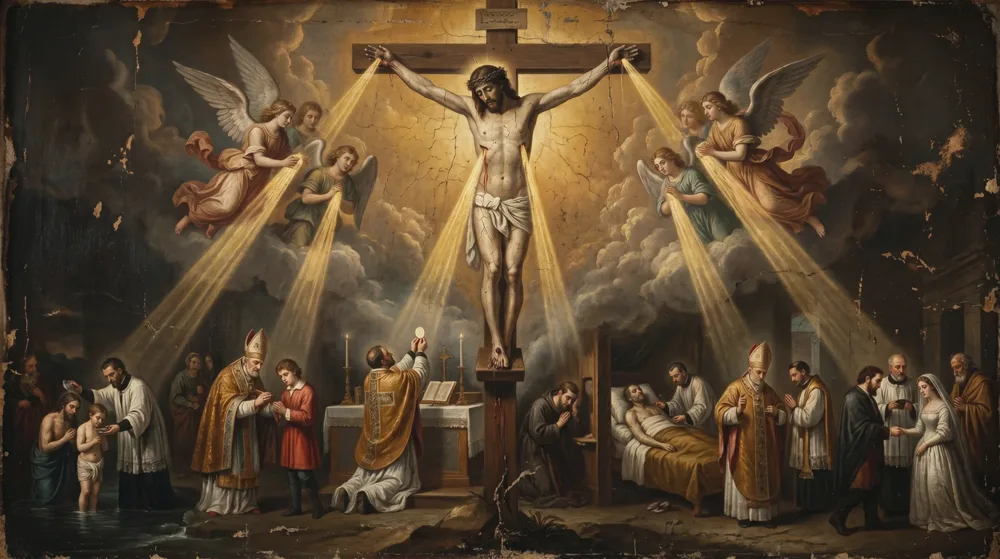
The seven sacraments of the Catholic Church are Baptism, Confirmation, the Holy Eucharist, Penance (Confession), Extreme Unction, Holy Orders, and Matrimony. A sacrament is an outward sign instituted by Christ to give grace: a sensible thing — water, oil, bread, words — that both signifies and truly produces the grace of God in the soul. The Catechism of Saint Pius X states the count and the order plainly: "There are seven sacraments, which are: Baptism, Confirmation, the Eucharist, Penance, Extreme Unction, Holy Orders, and Matrimony." This article explains, from the sources, what each of the seven catholic sacraments is and what grace it gives.
What is a sacrament?
Before naming the seven, the Church defines the thing itself. The Catechism of Saint Pius X teaches that "by the word sacrament is meant a sensible and efficacious sign of grace, because all the sacraments signify, by means of sensible things, the divine grace which they produce in our soul." The word holds two things at once: the sacrament signifies grace, and it produces it. In Baptism the water poured on the head, with the words "I baptise thee in the name of the Father, and of the Son, and of the Holy Ghost," is "a sensible sign of that which Baptism works in the soul: as water washes the body, so the grace given by Baptism cleanses the soul from sin."
The Roman Catechism, drawn up by the Council of Trent (1566), gives the classic definition received from Saint Augustine: a sacrament is "the visible sign of an invisible Grace, instituted for our sanctification." Three things are required to make a sacrament: the matter (the sensible thing employed, such as water in Baptism or oil in Confirmation), the form (the words pronounced), and a minister who has the intention of doing what the Church does. The grace the sacraments confer is "a supernatural interior gift, which is given to us without any merit on our part, but through the merits of Jesus Christ, in view of life everlasting."
That every sacrament was instituted by Christ, and that there are seven and no more, is the constant teaching the Church guards. What follows takes the seven in their traditional order.
What are the seven sacraments?
The catechisms of Trent and of Saint Pius X divide them chiefly into sacraments of the dead (Baptism and Penance, which give the life of grace to the soul dead in sin) and sacraments of the living (the other five, which increase grace in a soul already in grace), and they note the three that imprint a character. More recent catechesis also sorts the seven by their purpose, and the grouping is a useful one.
Three are sacraments of Christian initiation — Baptism, Confirmation, and the Holy Eucharist — which make and complete the Christian and feed him. Two are sacraments of healing — Penance and Extreme Unction — which restore the soul wounded by sin and strengthen the body in danger of death. Two are sacraments of vocation and state of life — Holy Orders and Matrimony — which consecrate men to the service of God and of the Christian family. The order below is the traditional ordering of the catechisms.
1. Baptism
Baptism is "the sacrament by which we are born again to the grace of God and become Christians." It is the gate of the whole sacramental life, for it "renders us capable of receiving the other sacraments." Its matter is natural water poured upon the head; its form is the words "I baptise thee in the name of the Father, and of the Son, and of the Holy Ghost."
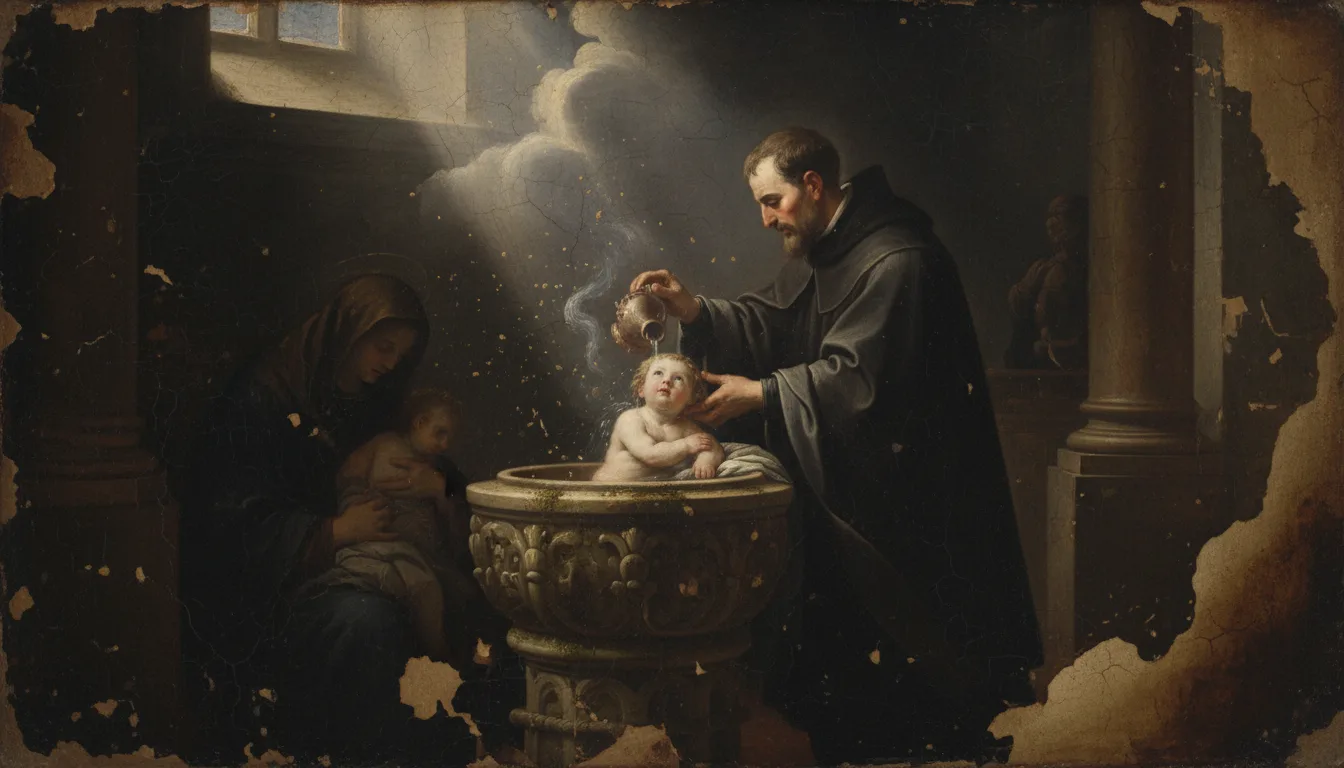
Its effects are great. Baptism "confers the first sanctifying grace, which blots out original sin, and also actual sin if there be any. It remits all the punishment due for these sins, imprints the character of Christian, makes us children of God, members of the Church, and heirs of heaven." Ordinarily it is given by a bishop or priest, but in danger of death "any person can administer it," provided he uses water, says the words, and intends to do what the Church does. For a fuller account of the gate of the sacraments, see Catholic Baptism.
2. Confirmation
Confirmation "gives us the Holy Ghost, imprints upon our soul the character of soldiers of Christ, and makes us perfect Christians." It perfects what Baptism began: it "confirms us in the faith and perfects the other virtues and the gifts which we received in holy Baptism," and from this strengthening it takes its name.
In it are received the seven gifts of the Holy Ghost: "Wisdom, Understanding, Counsel, Fortitude, Knowledge, Piety, and the Fear of God." Its matter, besides the bishop's imposition of hands, is the anointing of the forehead with holy Chrism — olive oil mingled with balm, consecrated by the bishop. The anointing is made on the forehead, where fear and shame show, "in order that the confirmed may understand that he ought not to blush at the name and profession of a Christian, nor to be afraid of the enemies of the faith." The ordinary minister is the bishop alone. For a fuller treatment, see the Sacrament of Confirmation.
3. The Holy Eucharist
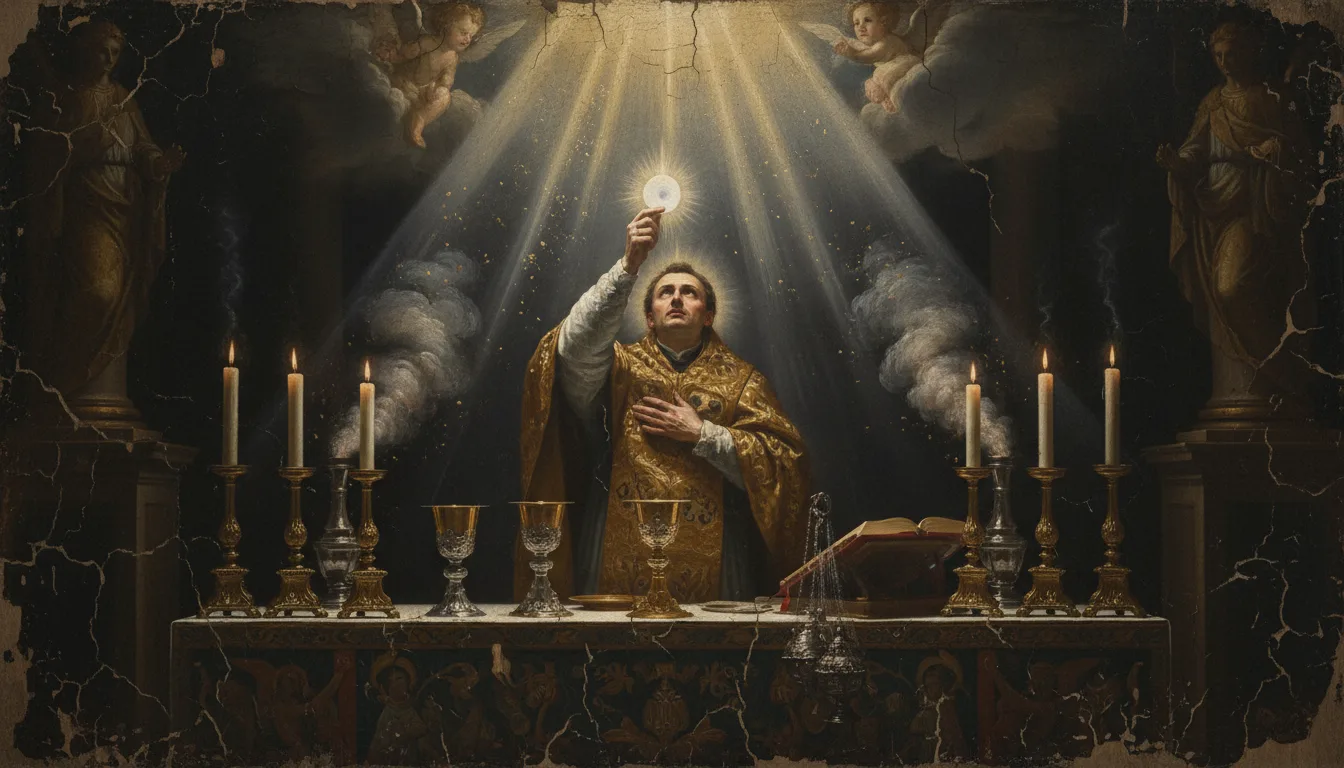
The Eucharist is the greatest of the seven, for it does not merely give grace but contains the Author of grace Himself. It is "a sacrament which, by the wonderful change of the whole substance of the bread into the Body of Jesus Christ and of that of the wine into His precious Blood, contains truly, really, and substantially the Body, the Blood, the Soul, and the Divinity of Jesus Christ Our Lord, under the species of bread and wine, to be our spiritual food."
In the Eucharist "there is truly the same Jesus Christ who is in heaven and who was born of the most Blessed Virgin upon the earth." The change of the substances — which the Church calls Transubstantiation — takes place at the moment the priest pronounces the words of consecration at holy Mass: "This is My Body; this is My Blood." This sacrament is offered and confected in the Holy Sacrifice of the Mass; its older form is the Tridentine Mass, the rite codified after the Council of Trent. For a fuller account, see the Eucharist; the first reception of the sacrament is treated in First Holy Communion, and its worship outside Mass in Eucharistic Adoration.
4. Penance (Confession)
Penance, "also called Confession, is the sacrament instituted by Jesus Christ to remit the sins committed after Baptism." Christ instituted it on the day of His Resurrection, when He breathed on the Apostles and said, "Receive ye the Holy Ghost: whose sins you shall forgive, they are forgiven them; and whose sins you shall retain, they are retained." It restores the sanctifying grace lost by mortal sin.
The Roman Catechism calls it "a second plank" after the shipwreck of sin: Baptism is given once and cannot be repeated, whereas Penance "becometh necessary, and requireth to be renewed, every time that one falleth into sin after Baptism." Its parts are "the contrition, the confession, and the satisfaction of the penitent, and the absolution of the priest," whose form is "I absolve thee from thy sins." For a fuller account, see what is Confession and the practical how to go to Confession, aided by an examination of conscience.
5. Extreme Unction
Extreme Unction is "the sacrament instituted for the spiritual and even bodily comfort of the sick who are in danger of death." It is the anointing given when sickness is grave, ordinarily after the dying person has received Penance and the Eucharist. Since the reform of 1972 it is commonly called the Anointing of the Sick. It is treated more fully under the Anointing of the Sick and, together with Confession and Viaticum, as part of the Last Rites.
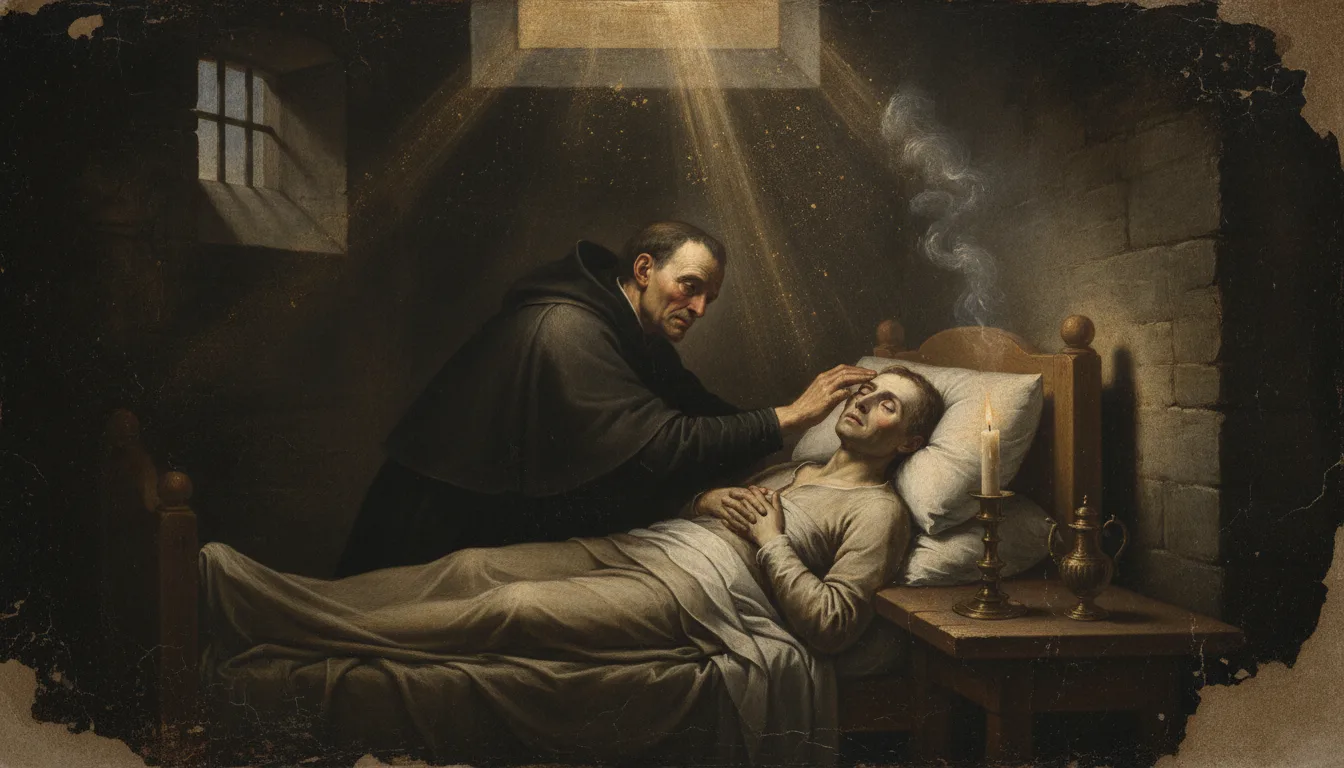
Its effects, as the Catechism of Saint Pius X lists them, are five: it increases sanctifying grace; it remits venial sins and even the mortal sins the repentant sick person can no longer confess; it takes away the weakness and languor toward good that remain after sins are pardoned; it gives strength "to bear suffering with patience, to resist temptations, and to die a holy death"; and it helps recover bodily health "if this is profitable to the salvation of the soul." For this reason it is good to receive it while still in possession of one's senses, and not to wait until all hope is lost.
In the traditional rite of the Rituale Romanum (typical edition of 1952, the one used with the Missal of 1962), the priest anoints the eyes, ears, nostrils, lips, hands, and feet with the oil of the sick blessed by the bishop on Holy Thursday, saying at each anointing: Per istam sanctam unctionem et suam piissimam misericordiam, indulgeat tibi Dominus quidquid per visum deliquisti — "By this holy anointing and His most tender mercy, may the Lord pardon thee whatever sins thou hast committed by sight" — and so on for each sense. The rite revised in 1972 reduces the anointings to the forehead and the hands, with a new form of words.
6. Holy Orders
Holy Orders "gives the power to exercise the sacred functions that pertain to the worship of God and the salvation of souls, and which imprints upon the soul of him who receives it the character of a minister of God." It is called Order because it comprises several degrees subordinate one to another, from which results the sacred hierarchy: the Episcopate, which contains the fullness of the priesthood; the Priesthood; the Diaconate; and the Minor Orders.
Christ established the priestly Order at the Last Supper, conferring on the Apostles and their successors the power to consecrate the Holy Eucharist, and on the day of His Resurrection the power to forgive and retain sins. The minister of this sacrament is the bishop alone. The priesthood is necessary in the Church, for without it the faithful "would be deprived of the Holy Sacrifice of the Mass and of the greater part of the sacraments." For a fuller account, see Holy Orders; on why this sacrament is reserved to men, see can women be priests.
7. Matrimony
Matrimony is "a sacrament instituted by Our Lord Jesus Christ, which establishes a holy and indissoluble union between man and woman and gives them the grace to love one another in holiness and to bring up their children in a Christian manner." Instituted by God in the earthly paradise and raised by Christ to the dignity of a sacrament, it signifies "the indissoluble union of Jesus Christ with the holy Church, His spouse."
Its bond is indissoluble: it "can be broken only by the death of one of the spouses." Among Christians the contract cannot be separated from the sacrament, so that "there can be no true marriage without the sacrament." Its effects are twofold: it gives an increase of sanctifying grace and "the special grace to fulfil faithfully all the duties of the married state." Uniquely among the seven, the ministers are the spouses themselves, who reciprocally confer and receive the sacrament before the parish priest and two witnesses. For a fuller account, see Catholic Marriage.
The seven sacraments in order
For those who want the seven catholic sacraments in order at a glance, the traditional sequence of the catechisms is this:
- Baptism — the gate of the sacramental life, which makes us Christians.
- Confirmation — which makes us perfect Christians and soldiers of Christ.
- The Holy Eucharist — which contains Christ Himself as our spiritual food.
- Penance — which remits the sins committed after Baptism.
- Extreme Unction — which comforts and strengthens the sick in danger of death.
- Holy Orders — which gives the power to exercise the sacred functions.
- Matrimony — which sanctifies the union of man and woman.
This order is not arbitrary. The first three are the sacraments of initiation, received in the order birth–growth–nourishment; the next two heal the soul and the body; the last two consecrate men to a state of life. The Roman Catechism and the Catechism of Saint Pius X both list them in this same sequence.
The seven sacraments in the Bible
The Church does not invent the seven sacraments; she receives them from Christ, and each can be traced to the Scriptures. The phrase "seven sacraments" is not itself in the Bible — neither is the word "Trinity" — but the realities are. Each rests on the words and acts of Our Lord and the practice of the Apostles.
- Baptism — "Going therefore, teach ye all nations; baptizing them in the name of the Father, and of the Son, and of the Holy Ghost" (Matthew 28:19); "Unless a man be born again of water and the Holy Ghost, he cannot enter into the kingdom of God" (John 3:5).
- Confirmation — the Apostles "laid their hands upon them, and they received the Holy Ghost" (Acts 8:17); Saint Paul speaks of being "anointed" and "sealed" with the Spirit (2 Corinthians 1:21–22).
- The Holy Eucharist — "This is My body, which is given for you... This is the chalice, the new testament in My blood" (Luke 22:19–20); the whole sixth chapter of Saint John, "My flesh is meat indeed" (John 6:56).
- Penance — "Whose sins you shall forgive, they are forgiven them; and whose sins you shall retain, they are retained" (John 20:23).
- Extreme Unction — "Is any man sick among you? Let him bring in the priests of the Church, and let them pray over him, anointing him with oil in the name of the Lord" (James 5:14).
- Holy Orders — "Do this for a commemoration of Me" (Luke 22:19); "Impose not hands lightly upon any man" (1 Timothy 5:22); the imposition of hands on Timothy (2 Timothy 1:6).
- Matrimony — "What therefore God hath joined together, let no man put asunder" (Matthew 19:6); "This is a great sacrament; but I speak in Christ and in the church" (Ephesians 5:32).
The Council of Trent gathered this scriptural witness and defined that all seven were "instituted by Jesus Christ, our Lord." That every sacrament is rooted in Scripture and in the unbroken practice of the Church is the answer to those who ask where the seven sacraments are found in the Bible.
The seven sacraments and the Orthodox
A common question is whether the seven orthodox sacraments are the same as the Catholic ones. The Eastern Orthodox churches do hold seven sacraments — which they call the Holy Mysteries — and they name the same seven: Baptism, Chrismation (their Confirmation), the Eucharist, Confession, Holy Unction, Holy Orders, and Marriage. On the number and the realities there is broad agreement, because both East and West received them from the same apostolic age.
Differences lie in discipline and form rather than in count. In the East, Baptism, Chrismation, and First Communion are commonly given together to infants; Chrismation is administered by the priest with chrism blessed by the bishop, not by the bishop's own hand; and the Orthodox permit, under conditions, the dissolution of marriage that the Catholic Church does not. We note these as matters of fact, without rancour. The shared inheritance of seven sacraments is itself a witness to how early and how universally the Church held them.
The Defense of the Seven Sacraments
The phrase "Defense of the Seven Sacraments" names a famous book: the Assertio Septem Sacramentorum adversus Martinum Lutherum ("Defense of the Seven Sacraments against Martin Luther"), published in 1521 under the name of King Henry VIII of England. When the early Protestant reformers reduced the sacraments to two or three — keeping Baptism and the Lord's Supper while rejecting the others — a defense of the full seven was written against them. For this work Pope Leo X granted the author the title Fidei Defensor, "Defender of the Faith."
The point the book pressed remains the Catholic teaching: that Christ instituted seven sacraments, not two, and that the Church has no power to add to them or take from them. The Council of Trent later defined the same against the reformers: "If any one saith, that the sacraments of the New Law were not all instituted by Jesus Christ, our Lord; or, that they are more, or less, than seven... let him be anathema." The history is a reminder that the number seven is not a medieval accretion but a doctrine the Church has defended at cost.
Why seven?
The seven sacraments answer the whole of the Christian life. As the natural life is born, grown, fed, healed, and ordered, so the supernatural life has its sacraments: Baptism gives birth, Confirmation gives growth, the Eucharist gives food, Penance heals the soul that has fallen, Extreme Unction strengthens at the end, Holy Orders provides ministers, and Matrimony sanctifies the family. Three confer a permanent character on the soul and so are never repeated — Baptism, Confirmation, and Holy Orders. The grace they pour into the soul flowers in turn as the seven heavenly virtues, the habits by which the Christian lives out what the sacraments first give. Together the seven sacraments of the Catholic Church are the ordinary channels by which the grace merited on the Cross reaches the souls of men.
All our articles on the sacraments, by theme
Baptism and Confirmation
- Catholic Baptism
- Confirmation
- The Sacrament of Confirmation explained
The Holy Eucharist
- The Holy Eucharist
- Transubstantiation
- First Holy Communion
The traditional Latin Mass
- What is the Tridentine Mass?
- The Order of the Tridentine Mass
- The propers of the Mass
- The Roman Missal of 1962
- The traditional Latin Mass calendar
- The Tridentine Mass vs the Novus Ordo
- Vetus Ordo and Usus Antiquior
- Gregorian chant
Penance and Confession
The commandments, sin and the precepts
- The Ten Commandments
- The precepts of the Church
- Mortal and venial sin
- The seven deadly sins
Extreme Unction
- Anointing of the Sick
- The Last Rites
Holy Orders and Matrimony
- Holy Orders
- Catholic Marriage
Frequently Asked Questions
What are the seven sacraments?
They are Baptism, Confirmation, the Holy Eucharist, Penance (Confession), Extreme Unction, Holy Orders, and Matrimony. A sacrament is an outward sign instituted by Christ to give grace, and the Catechism of Saint Pius X teaches that there are seven and no more. Three are sacraments of initiation, two of healing, and two of vocation and state of life.
What are the seven sacraments of the Catholic Church?
The seven sacraments of the Catholic Church, in their traditional order, are Baptism, Confirmation, the Holy Eucharist, Penance, Extreme Unction, Holy Orders, and Matrimony. Each was instituted by Christ as "a sensible and efficacious sign of grace," signifying and truly producing the grace it gives. They are the ordinary channels by which the grace merited on the Cross reaches the souls of men.
What are the seven sacraments in the Catholic religion?
In the Catholic religion the seven sacraments are Baptism, Confirmation, the Eucharist, Penance, Extreme Unction, Holy Orders, and Matrimony. The Roman Catechism of the Council of Trent defines a sacrament, with Saint Augustine, as "the visible sign of an invisible Grace, instituted for our sanctification." Every one of the seven requires the proper matter, form, and a minister who intends to do what the Church does.
What are the seven sacraments in the Catholic faith?
They are Baptism, Confirmation, the Holy Eucharist, Penance (Confession), Extreme Unction, Holy Orders, and Matrimony — the seven held by the Catholic faith from the beginning. The Church guards that Christ Himself instituted each, and that there are seven and no more. They answer the whole of the Christian life: birth, growth, food, healing, strengthening at the end, ministry, and the family.
Why are there seven sacraments?
There are seven because the supernatural life mirrors the natural: Baptism gives birth, Confirmation gives growth, the Eucharist gives food, Penance heals the soul that has fallen, Extreme Unction strengthens at the end, Holy Orders provides ministers, and Matrimony sanctifies the family. Three — Baptism, Confirmation, and Holy Orders — imprint a permanent character on the soul and are never repeated.
What are the seven sacraments in order?
In the traditional order of the catechisms they are: 1. Baptism, 2. Confirmation, 3. the Holy Eucharist, 4. Penance, 5. Extreme Unction, 6. Holy Orders, 7. Matrimony. The first three are sacraments of initiation, the next two of healing, and the last two of vocation and state of life. The Roman Catechism and the Catechism of Saint Pius X list them in this same sequence.
Are the seven sacraments in the Bible?
Yes. The phrase "seven sacraments" is not in Scripture, but each sacrament rests on the words and acts of Christ and the Apostles: Baptism in Matthew 28 and John 3, the Eucharist in Luke 22 and John 6, Penance in John 20, Extreme Unction in James 5, Holy Orders in Luke 22 and 2 Timothy 1, Confirmation in Acts 8, and Matrimony in Matthew 19 and Ephesians 5. The Council of Trent defined that Christ instituted all seven.
Do the Orthodox have the same seven sacraments?
Yes. The Eastern Orthodox churches hold seven sacraments, which they call the Holy Mysteries, and name the same seven as the Catholic Church: Baptism, Chrismation, the Eucharist, Confession, Holy Unction, Holy Orders, and Marriage. The differences lie in discipline and form — such as giving the three sacraments of initiation together to infants — rather than in the number, which both East and West received from the apostolic age.
What is the Defense of the Seven Sacraments?
It is the Assertio Septem Sacramentorum of 1521, a book written against Martin Luther to defend that Christ instituted seven sacraments and not two, when the reformers had rejected five of them. For it the author received from Pope Leo X the title "Defender of the Faith." The Council of Trent later defined the same teaching: that the sacraments of the New Law are neither more nor less than seven.
The Iter Fidei app carries the prayers and a guide to the sacraments, for those who wish to live them rather than only read of them. Join early access here.
Sources. Catechism of Saint Pius X, Part IV: The Sacraments in General; Baptism; Confirmation; The Eucharist; Penance; Extreme Unction; Holy Orders; Matrimony. Catechism of the Council of Trent (Roman Catechism, 1566), Part II: On the Sacraments in General (citing Saint Augustine); On the Sacrament of Penance. Council of Trent, Session VII, Canon 1 on the Sacraments in General (on the number seven; Waterworth translation, 1848). Rituale Romanum (typical edition 1952), Title V: De sacramento Extremae Unctionis. Assertio Septem Sacramentorum adversus Martinum Lutherum (1521). Scripture cited per the Douay-Rheims (Matthew 19, 28; Luke 22; John 3, 6, 20; Acts 8; James 5; 2 Corinthians 1; Ephesians 5; 1 and 2 Timothy).