
Scripture
Whose Sins You Forgive: Confession in John 20:23
In John 20:23 the risen Christ gives the Apostles the power to forgive and retain sins — the scriptural foundation of sacramental Confession and the priest's absolution. We give the Douay-Rheims verse and the Catholic reading.
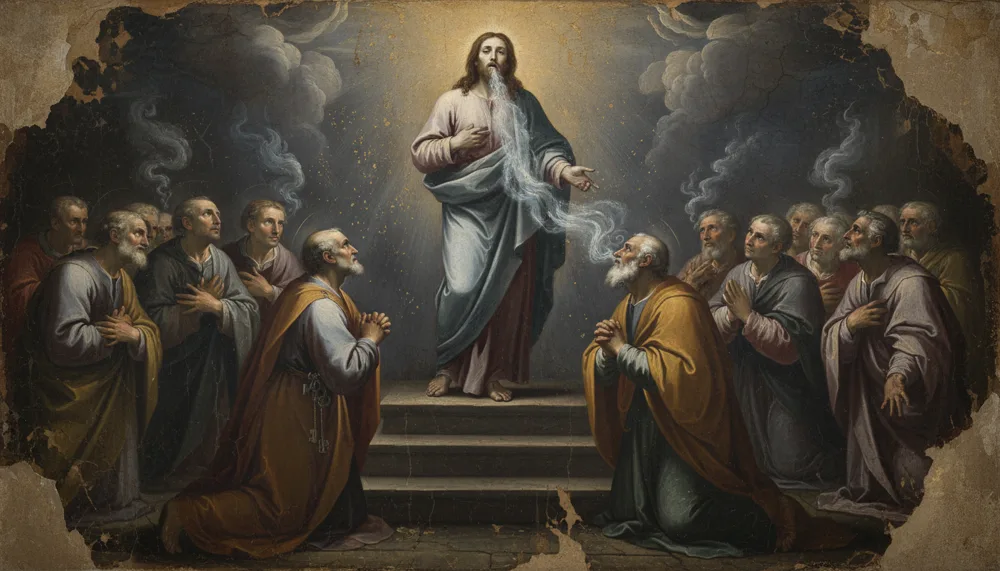
On the day of His Resurrection the risen Christ breathed on the Apostles and gave them His own power to forgive sins. The words are recorded in John 20:23, in the Douay-Rheims:
Whose sins you shall forgive, they are forgiven them; and whose sins you shall retain, they are retained.
This is what Our Lord said about forgiveness at the founding of His Church: not a sentiment, but a power, handed to men. And so the answer to “does Jesus forgive all sins” is yes — there is no sin so great or so many that He will not pardon — but He forgives them through the means He Himself established: the absolution of the priest in the Sacrament of Penance. To see why a single verse carries the whole confessional, we read it in the Douay text and in the mind of the Church, not as an isolated slogan.
What did Jesus say about forgiveness in John 20:23?
The setting matters. It is the evening of Easter; the Apostles are gathered behind closed doors. Our Lord comes, shows them His wounds, and breathes upon them — the only place in the Gospels where He breathes on men, an echo of the breath of life in Genesis. Then He speaks: “Receive ye the Holy Ghost. Whose sins you shall forgive, they are forgiven them; and whose sins you shall retain, they are retained.”
Two things in the Douay wording are decisive. First, the verb is active: you forgive, they are forgiven. Christ does not say merely that God will forgive those whom the Apostles declare forgiven; He gives the Apostles to do the forgiving, and binds heaven to their act. Second, the power runs both ways — to forgive and to retain. A man who can only ever pronounce pardon is no judge; one who can forgive or withhold must first hear and weigh. The Catechism of the Council of Trent draws exactly this conclusion: “if Our Lord gave to Priests the power of retaining and remitting sins, evidently He also established them judges in this matter.” Forgiveness in this verse is a judgement, and a judgement requires that the case be known.
Christ the author of Confession
The Roman Catechism is blunt about who instituted Confession: “Confession was instituted by Our Lord Jesus Christ… For one day, when His Apostles, after His Resurrection, were assembled in the same place, He breathed upon them, saying: Receive ye the Holy Ghost; whose sins you shall forgive, they are forgiven them; and whose sins you shall retain, they are retained.” The Catechism of St Pius X says the same in plainer words: “Jesus Christ instituted the sacrament of Penance on the day of His Resurrection, when, having entered into the cenacle, He solemnly gave to His Apostles the power to remit sins.” This is not a later invention of the Church but the first gift of the risen Lord to His ministers, and it stands among the seven sacraments He left her.
The power is rooted earlier still. To Peter Our Lord had already said, “I will give to thee the keys of the kingdom of heaven. And whatsoever thou shalt bind upon earth, it shall be bound also in heaven: and whatsoever thou shalt loose upon earth, it shall be loosed also in heaven” (Matthew 16:19). The keys and the breath are the same authority: to open and to bind.
The Roman Catechism notes that the very image of the keys tells us Confession is not optional — “just as it is not possible to enter into a closed place without the help of him who has the key thereof, so likewise no one can enter heaven, if its gates be not opened by the Priests to whom Jesus Christ has confided the keys.” This is also why Catholics confess to a man at all; we treat that question at length in Why Do Catholics Confess Their Sins to a Priest?
Does Jesus forgive all sins — and can He forgive all sins?
He can, and He does. The Catechism of St Pius X puts the question and answers it without reserve: “Has the sacrament of Penance the power to remit all sins, however numerous and however great they may be? — The sacrament of Penance has the power to remit all sins, however numerous and however great they may be, provided one receive it with the requisite dispositions.” The Roman Catechism agrees: “There is no crime so great and so horrible that it cannot be effaced by the Sacrament of Penance, not only once, but twice, but always.”
So the despair behind the question — can my sin be forgiven? — is answered: yes. But notice the condition the Catechism attaches, the same one St John gives in his first Epistle: “If we confess our sins, he is faithful and just, to forgive us our sins, and to cleanse us from all iniquity” (1 John 1:9). Forgiveness is offered to every sin; it is received by the one who confesses and repents. The few passages in Scripture and the Fathers that seem to call a sin “irremissible” mean, says the Roman Catechism, not that Christ withholds pardon, but that the hardened man will not ask it. The door is open; one must walk through it.
A power given to men, not only to God
Here the verse is most often mistaken. A common reading — old already in the days of the Novatians, against whom St Ambrose wrote — holds that God alone can forgive sin, so the priest at most announces a pardon God grants directly. We say this charitably, for the instinct behind it is reverent: it wishes to keep forgiveness in God's hands. But it cannot be squared with what Our Lord said. He did not tell the Apostles to declare sins forgiven; He told them, “whose sins you shall forgive, they are forgiven them.”
St Ambrose answered the objection with a question: “who honours God the more, he who obeys His Commandments, or he who resists them? God has commanded us to obey His Ministers, and when we obey them, it is God alone that we honour.” The priest forgives, but in the name and by the power of Christ; the form of absolution itself — I absolve thee from thy sins — names the act the verse commands.
St Augustine read the raising of Lazarus the same way. Christ raised the dead man Himself, then bade the bystanders “loose him, and let him go” — showing, Augustine says, that “Priests have received the power to loose”: God gives life to the soul, and through His ministers looses the bonds that still bind it. To deny the priest this power is to make the keys idle. It is the power of Holy Orders, handed down from the Apostles to the bishops and priests of the Church.
What this means for the confessional
From a single verse the whole shape of Confession follows. Because the priest must forgive or retain, he must hear; so the penitent makes “a distinct accusation of our sins, made to the confessor in order to receive absolution” (St Pius X). Because the act is a judgement, sorrow is required: the penitent brings contrition, which we distinguish in Contrition and Attrition, and confesses the mortal sins he can recall, on which see Mortal and Venial Sin. The fruit is the restoration of sanctifying grace — the soul, says the Roman Catechism, re-established “in the grace of God.” This is the sacrament we set out in What Is Confession?; to prepare for it, the penitent makes an examination of conscience before he kneels.
It is no accident that Our Lord gave this power on Easter, three days after He gave His Body and Blood at the Last Supper. The risen Christ provided for the sins His people would commit after Baptism. Like the Real Presence, this is a gift received on His word, not measured by our feeling.
So read, John 20:23 is not a verse to be argued around but the charter of mercy. Christ does forgive all sins; He forgives them in the way He chose, through men He sent, by a power He breathed into them on the day He rose. To make the most of the verses that carry the faith, read each within the Church, as we do across our Catholic Bible Verses. The slogan asks whether God will forgive; the Gospel answers where — at the feet of the priest, where Christ placed the keys.
Frequently Asked Questions
Does Jesus forgive sins?
Yes. The forgiveness of sins is the very work for which Christ came, and on the day of His Resurrection He provided for it permanently by giving His Apostles the power to forgive: "Whose sins you shall forgive, they are forgiven them" (John 20:23, Douay-Rheims). He does not merely pardon a soul once and leave it; through the Sacrament of Penance He continues to forgive the sins His people commit after Baptism, for as long as they live.
Does Jesus forgive all sins — and can He forgive all sins?
He can and He does. The Catechism of St Pius X teaches that the Sacrament of Penance "has the power to remit all sins, however numerous and however great they may be, provided one receive it with the requisite dispositions." The Roman Catechism is just as plain: "There is no crime so great and so horrible that it cannot be effaced by the Sacrament of Penance." No sin exhausts the mercy of Christ; what is required is the sinner's contrition and confession.
Will Jesus forgive all sins?
He will. The risen Christ instituted Confession precisely so that the sins of His people after Baptism would have a remedy, and the Catechism of St Pius X teaches that the sacrament can remit all sins "however numerous and however great they may be, provided one receive it with the requisite dispositions." The will to pardon is never lacking on Christ's side; what is required is the sinner's contrition and confession. As St John writes, "If we confess our sins, he is faithful and just, to forgive us our sins" (1 John 1:9). The few sins called "irremissible" are so, the Roman Catechism says, only because the hardened man will not ask pardon.
Did Jesus give the Apostles authority to forgive sins?
Yes — this is the plain sense of John 20:23. On Easter evening the risen Christ breathed on the Apostles and said, "Receive ye the Holy Ghost. Whose sins you shall forgive, they are forgiven them; and whose sins you shall retain, they are retained." The verb is active: they forgive, and the sins are forgiven. The Catechism of the Council of Trent concludes that He thereby "established them judges in this matter," a power passed from the Apostles to the bishops and priests of the Church.
Who can forgive sins according to the Bible?
God forgives sin, and in John 20:23 Christ gives that power to His Apostles to exercise in His name. Scripture shows both: only God can remit sin by His own authority (Mark 2:7), yet the risen Lord deliberately confers the act of forgiving upon men — "whose sins you shall forgive, they are forgiven them." The priest does not forgive instead of God or apart from Him; he forgives by the power Christ breathed into His ministers, which is why the form of absolution reads "I absolve thee from thy sins."
Can God forgive mortal sins?
Yes, without exception. The Roman Catechism teaches that no crime "is so great and so horrible that it cannot be effaced by the Sacrament of Penance, not only once, but twice, but always." For mortal sins committed after Baptism, this sacrament is the ordinary remedy Christ established: the penitent confesses the mortal sins he can recall, with contrition, and receives absolution, by which sanctifying grace lost through grave sin is restored. On the distinction itself, see Mortal and Venial Sin.
What did the Catholic Church sell to forgive sins?
The Church has never sold the forgiveness of sins, and to sell a sacrament or spiritual gift is itself the grave sin of simony, which she condemns. The forgiveness given in Confession is free, resting on Christ's word in John 20:23 and on the penitent's contrition, never on money. The historical confusion concerns the abuse of indulgences — which remit temporal punishment, not sin itself, and presuppose that the sin is already forgiven; the Council of Trent both reformed those abuses and reaffirmed the doctrine.
The Iter Fidei app carries the Douay-Rheims Bible and prepares you for the sacrament of John 20:23, with an examination of conscience and a guide in the confessional. Join early access here.
Sources. Douay-Rheims Bible (Rheims New Testament 1582; Challoner revision) — John 20:19-23; Matthew 16:19; 1 John 1:9; John 11:43-44 (the raising of Lazarus); Catechism of the Council of Trent (1566), On the Sacrament of Penance and On Confession (Christ the author of Confession; the priest as judge; the keys; “no crime so great… that it cannot be effaced”; the effects of the sacrament); Catechism of St Pius X (1908), On the Sacrament of Penance (the institution on the day of the Resurrection; the power to remit all sins however numerous and great; the form of absolution); St Augustine on the raising of Lazarus and the power to loose; St Ambrose, On Penance (against the Novatians; obedience to Christ's ministers honours God); Council of Trent, Session XIV (1551), on the Sacrament of Penance.