
Scripture
I Am the Way, the Truth, and the Life: John 14:6
'I am the way, and the truth, and the life. No man cometh to the Father, but by me.' The Douay-Rheims text of John 14:6 and its plain Catholic meaning: Christ is the only Mediator, and there are not many roads to God.
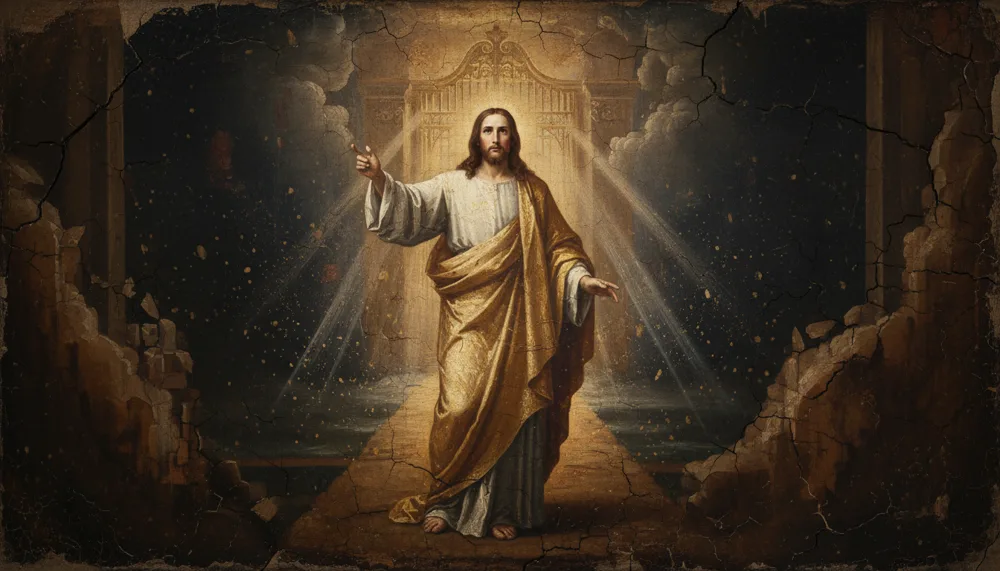
When men ask what Our Lord meant by "I am the way, the truth, and the life," the answer is in the words themselves, and they admit no softening. In the Douay-Rheims, the traditional Catholic English Bible drawn from the Latin Vulgate, John xiv. 6 reads:
I am the way, and the truth, and the life. No man cometh to the Father, but by me.
Jesus is the way, the truth, and the life — and the same breath that names Him so closes every other door: no man cometh to the Father, but by me. The verse is not a sentiment; it is an exclusion. There is one road to God, and it is a Person. The age says all roads lead to God; the Lord says the opposite, and we hold with the Lord.
What Jesus meant by "I am the way, the truth, and the life"
The words were spoken at the Last Supper, the night before He died. Thomas had just said, Lord, we know not whither thou goest; and how can we know the way? (John xiv. 5). The Lord answers not with a map but with Himself. He does not say He shows the way, teaches the truth, gives life. He says He is them.
He is the way because there is no coming to the Father except through Him — through His flesh, His Cross, His Church. He is the truth because He is the eternal Word, and every truth that saves is His. He is the life because in Him is the life of grace now and glory hereafter, I am the resurrection and the life (John xi. 25). Saint Augustine puts it plainly: where would you walk, but in the way; and whither, but to the truth; and to gain what, but life? Christ is at once the road and the country, the path and the home.
This is why the second half of the verse is not a hard appendix to a warm saying. It is the saying. To be the way is to be the only way. No man cometh to the Father, but by me. This belongs among the great Catholic Bible verses precisely because it gathers the whole economy of salvation into one line — and forbids the comfortable evasions men reach for when the line costs them something.
Is Jesus the only way to God?
Yes. The Lord leaves no room. Saint Peter, filled with the Holy Ghost, says it again before the rulers: there is no other name under heaven given to men, whereby we must be saved (Acts iv. 12). Saint Paul says it once more: there is one God, and one mediator of God and men, the man Christ Jesus (1 Timothy ii. 5). One name, one Mediator, one way. Scripture never offers a second.
The Catechism of the Council of Trent and the Catechism of Saint Pius X teach the same as doctrine. Christ alone could satisfy for sin, "because the offence offered to God by sin was, from a certain point of view, infinite, and to repair it there was needed a person of infinite merit." No angel could do it; no man could do it; no other religion can do it. Only the God-Man, perfect God and perfect man, redeeming the world by His precious Blood. To say "all paths reach God" is to say the Cross was unnecessary — and there is no insult to charity graver than that.
We say this firmly because the Lord said it firmly. To repeat His words is not arrogance; it is fidelity. The man who softens no man cometh to the Father, but by me into one path among many has not made the Gospel kinder. He has emptied it.
"All roads lead to God": the lie of religious indifferentism
The modern slogan that every religion is a different road up the same mountain is called religious indifferentism, and it is condemned by the constant teaching of the Church. It contradicts John 14:6 directly. If Christ is the way, then the roads that bypass Him do not arrive; they wander. The Catechism of Saint Pius X is exact: the false religions are precisely those that "do not believe in the Christ Messias, come in the person of Jesus Christ," and outside the one true Faith "there is not and there cannot be any true holiness."
We say this without hatred and without flinching. The Church does not teach that those raised outside her are all lost through no fault of their own; she teaches that one who, without any fault of his own, finds himself outside the Church, yet "sincerely seeks the truth and does the will of God as best he can," is united to her soul and is in the way of salvation. But mark the mechanism: even he is saved by Christ, drawn toward the one Church, not by his own religion as a parallel road.
The way is still Christ alone. Indifferentism says the roads are equal; the Church says the roads that save all secretly join the one Way. These are not the same claim, and a soul's eternity hangs on the difference. This is one reason the old quarrel of Catholic versus Protestant, and the worn question of whether Catholics are Christian, are settled the moment one takes the verse at its word.
Christ the only Mediator — and the Church He founded
To say Christ is the one Mediator is not to set Him against His Church but to receive Him through her. The Lord who is the way left a way to Himself: the Church of the living God, the pillar and ground of the truth (1 Timothy iii. 15). The Catechism of Saint Pius X compares her to the Ark of Noe — "outside the Catholic, Apostolic, Roman Church no one can be saved, just as no one could be saved from the flood outside the Ark." That is John 14:6 made visible: the one Way gave us the one Ark, and to enter Him is to enter her.
Nor does His sole mediation abolish the saints; it grounds them. The Blessed Virgin, the Mother of God, and the saints intercede only in Christ and through His merits, never beside Him. When we honour the Immaculate Heart of Mary or pray a litany, we ask their prayers to the one Mediator, as one beggar asks another to plead with the King. Their power is borrowed; His is His own. So the same verse that excludes every false road upholds every true intercession — for all of it runs to the Father by the Son.
"Let not your heart be troubled": where the verse begins
John 14:6 does not stand alone. It answers a trouble. Three verses earlier the Lord had said, Let not your heart be troubled... In my Father's house there are many mansions... I go to prepare a place for you (John xiv. 1-2), words we draw out elsewhere on let not your heart be troubled. The disciples were frightened of losing Him; He answers their fear by being Himself the road to the place He goes to prepare. So the exclusivity of Christ is not cold.
It is the only ground of hope: there is a way home, and it is sure, because it is a Person who cannot fail. The same Lord says, Come to me, all you that labour — see come to me all you who labour — and Ask, and it shall be given you (ask and it shall be given). The narrow way is not a closed way. It is open, and it is the only one that opens.
This is why the verse steadies the soul against fear and against despair, and why it is the root of hope: the man on the right road need not be troubled, however dark the day, for the Way does not lose those who walk in Him.
Walking the Way: truth held, life lived
Because Christ is the truth, we may not pick and choose what He revealed; to deny one revealed truth is to step off the way. Because He is the life, the road must be walked, not merely admired — the spiritual combat of the saints, the daily war against pride, lust, and every vice, is simply staying on the Way to the end. He that hath my commandments, and keepeth them; he it is that loveth me (John xiv. 21), the Lord adds in the same discourse. To trust Him is to trust in the Lord with all your heart and to walk where He walked — to the Father, by the Cross, in His Church.
Frequently Asked Questions
What did Jesus mean by "I am the way, the truth, and the life"?
He did not say He shows the way, teaches the truth, and gives life; He said He is them. He is the way because there is no coming to the Father except through Him; the truth because He is the eternal Word; the life because in Him is the life of grace now and glory hereafter. As St Augustine says, Christ is at once the road and the country, the path and the home.
Is Jesus the only way to God?
Yes. The verse admits no softening: No man cometh to the Father, but by me. St Peter says there is no other name under heaven given to men, whereby we must be saved (Acts iv. 12), and St Paul, there is one mediator of God and men, the man Christ Jesus (1 Timothy ii. 5). Only the God-Man, of infinite merit, could satisfy for sin; to say all paths reach God is to say the Cross was unnecessary.
Does John 14:6 mean people of other religions are all lost?
No. The Church teaches that one who, without any fault of his own, finds himself outside her, yet sincerely seeks the truth and does the will of God as best he can, is united to her soul and is in the way of salvation. But mark the mechanism: even he is saved by Christ, drawn toward the one Church, not by his own religion as a parallel road. The Way is still Christ alone.
What is religious indifferentism, and why is it false?
It is the slogan that every religion is a different road up the same mountain, and it is condemned by the constant teaching of the Church because it contradicts John 14:6 directly. Indifferentism says the roads are equal; the Church says the roads that save all secretly join the one Way, which is Christ. These are not the same claim, and a soul's eternity hangs on the difference.
How can Christ be the only Mediator if Catholics pray to the saints?
His sole mediation does not abolish the saints; it grounds them. The Blessed Virgin and the saints intercede only in Christ and through His merits, never beside Him. When we ask their prayers, we ask them to plead with the one Mediator, as one beggar asks another to plead with the King — their power is borrowed, His is His own.
The verse, rightly held
"I am the way, and the truth, and the life. No man cometh to the Father, but by me." Held as the Church holds it, the line is the most consoling and the most demanding in the Gospel at once. Consoling, because there is a way, and it is sure. Demanding, because there is only one, and it is Christ — not Christ as an option among many, but Christ as the Mediator without whom no man reaches God. The roads that bypass Him do not climb the same mountain; they descend. To walk the Way is to walk to the Father, in the truth He revealed, by the life He gives, within the Ark He built. There is no other.
The Iter Fidei app carries the Douay-Rheims Bible, the prayers and litanies, in Latin and your own language. Join early access here.
Sources. Holy Scripture (Douay-Rheims): John xi. 25; xiv. 1-2, 5-6, 21; Acts iv. 12; 1 Timothy ii. 5; iii. 15. St Augustine, Tractates on the Gospel of John (on Christ as the way, the truth, and the life). Catechism of the Council of Trent (Roman Catechism, 1566), Part I, Articles III and IV (the Incarnation and the Redemption). Catechism of Saint Pius X (1908), The Creed, Chapter 5 (the Fourth Article — the satisfaction and infinite merits of Christ) and Chapter 10 (the Ninth Article — the one true Church, "outside the Church no salvation," and those outside her).