
The Sacraments
Order of the Mass in Latin: The Tridentine Mass Text
The order of the traditional Latin Mass, part by part, from the Prayers at the Foot of the Altar to the Last Gospel, with the main Latin texts of the Ordinary and their English translation.
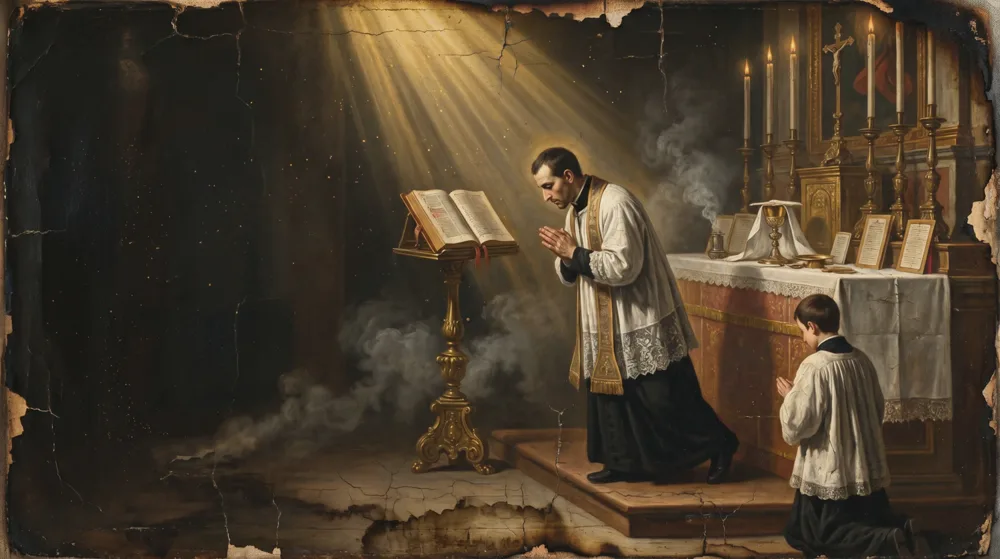
The order of the Mass in Latin, in the traditional Roman rite, runs in a fixed sequence: the Prayers at the Foot of the Altar, the Mass of the Catechumens (from the Introit to the Creed), the Mass of the Faithful (from the Offertory to the Postcommunion), and the dismissal, blessing and Last Gospel. Below is that order part by part, as it stands in the Roman Missal of 1962, with the principal Latin texts of the Ordinary and their English translation.
The Ordinary printed here is the same at every Traditional Latin Mass. The texts that change each day (Introit, Collect, Epistle, Gradual, Gospel, Offertory, Secret, Communion, Postcommunion) are explained in the Propers of the Latin Mass. S. marks the priest (Sacerdos), M. the server (Minister), who answers in the name of the people at a Low Mass.
The order of the Mass at a glance
- Prayers at the Foot of the Altar: Psalm 42, Confiteor
- Introit
- Kyrie
- Gloria
- Collect
- Epistle
- Gradual and Alleluia (or Tract)
- Gospel, then the sermon
- Credo
- Offertory: offering of the host and chalice, Lavabo, Orate fratres
- Secret
- Preface and Sanctus
- The Roman Canon, with the Consecration
- Pater noster
- Agnus Dei and the prayers before Communion
- Communion of the priest and of the faithful
- Communion antiphon and Postcommunion
- Ite, missa est, blessing
- Last Gospel
- After a Low Mass: the Leonine prayers
Prayers at the Foot of the Altar
The priest makes the sign of the cross at the foot of the altar and begins the antiphon of Psalm 42, which he then says in alternation with the server.
S. In nomine Patris, et Filii, et Spiritus Sancti. Amen.
S. Introibo ad altare Dei.
M. Ad Deum qui laetificat iuventutem meam.
S. In the name of the Father, and of the Son, and of the Holy Ghost. Amen.
S. I will go in unto the altar of God.
M. To God who giveth joy to my youth.
Psalm 42 (Iudica me, Deus) is omitted in Passiontide and at Masses for the dead. Then, after the versicle Adiutorium nostrum in nomine Domini ("Our help is in the name of the Lord"), the priest says the Confiteor (its words and meaning are explained in the Confiteor), and the server repeats it in the name of the people:
Confiteor Deo omnipotenti, beatae Mariae semper Virgini, beato Michaeli Archangelo, beato Ioanni Baptistae, sanctis Apostolis Petro et Paulo, omnibus Sanctis, et tibi, pater: quia peccavi nimis cogitatione, verbo et opere: mea culpa, mea culpa, mea maxima culpa. Ideo precor beatam Mariam semper Virginem, beatum Michaelem Archangelum, beatum Ioannem Baptistam, sanctos Apostolos Petrum et Paulum, omnes Sanctos, et te, pater, orare pro me ad Dominum Deum nostrum.
I confess to almighty God, to blessed Mary ever Virgin, to blessed Michael the Archangel, to blessed John the Baptist, to the holy Apostles Peter and Paul, to all the Saints, and to thee, father, that I have sinned exceedingly in thought, word and deed: through my fault, through my fault, through my most grievous fault. Therefore I beseech blessed Mary ever Virgin, blessed Michael the Archangel, blessed John the Baptist, the holy Apostles Peter and Paul, all the Saints, and thee, father, to pray to the Lord our God for me.
The priest then goes up to the altar, praying quietly the Aufer a nobis and the Oramus te, Domine, and kisses the altar, which holds the relics of the martyrs.
The Mass of the Catechumens
This first part is so called because in the early Church the catechumens, not yet baptized, attended it and were dismissed before the Sacrifice. It is the part of prayer and instruction.
Introit. The priest reads the entrance antiphon of the day at the Epistle side of the altar, the right-hand side as the people see it.
Kyrie. Nine invocations, said alternately by priest and server:
Kyrie, eleison. Kyrie, eleison. Kyrie, eleison.
Christe, eleison. Christe, eleison. Christe, eleison.
Kyrie, eleison. Kyrie, eleison. Kyrie, eleison.
Lord, have mercy. Christ, have mercy. Lord, have mercy.
Gloria. Said on feasts, throughout Paschal time, and on the Sundays outside Advent and the weeks from Septuagesima to Easter; it is omitted on ordinary weekdays and at Masses for the dead:
Gloria in excelsis Deo. Et in terra pax hominibus bonae voluntatis. Laudamus te. Benedicimus te. Adoramus te. Glorificamus te. Gratias agimus tibi propter magnam gloriam tuam. Domine Deus, Rex caelestis, Deus Pater omnipotens. Domine Fili unigenite, Iesu Christe. Domine Deus, Agnus Dei, Filius Patris. Qui tollis peccata mundi, miserere nobis. Qui tollis peccata mundi, suscipe deprecationem nostram. Qui sedes ad dexteram Patris, miserere nobis. Quoniam tu solus Sanctus. Tu solus Dominus. Tu solus Altissimus, Iesu Christe. Cum Sancto Spiritu, in gloria Dei Patris. Amen.
Glory to God in the highest. And on earth peace to men of good will. We praise Thee. We bless Thee. We adore Thee. We glorify Thee. We give Thee thanks for Thy great glory. O Lord God, heavenly King, God the Father almighty. O Lord Jesus Christ, the only-begotten Son. O Lord God, Lamb of God, Son of the Father, who takest away the sins of the world, have mercy on us. Who takest away the sins of the world, receive our prayer. Who sittest at the right hand of the Father, have mercy on us. For Thou only art holy. Thou only art the Lord. Thou only, O Jesus Christ, art most high, together with the Holy Ghost, in the glory of God the Father. Amen.
Collect. The priest turns to the people with Dominus vobiscum ("The Lord be with you"), to which the server answers Et cum spiritu tuo ("And with thy spirit"), then says Oremus and the Collect of the day.
Epistle, Gradual, Alleluia or Tract. The Epistle is read at the Epistle side; the server answers Deo gratias. The chants between the readings follow: the Alleluia in most of the year, the Tract in Septuagesima and Lent.
Gospel. The missal is carried to the Gospel side. The priest bows at the middle of the altar and prays the Munda cor meum, then reads the Gospel while the people stand:
S. Dominus vobiscum. M. Et cum spiritu tuo.
S. Sequentia sancti Evangelii secundum Matthaeum. M. Gloria tibi, Domine.
S. The Lord be with you. M. And with thy spirit.
S. The continuation of the holy Gospel according to Matthew. M. Glory be to Thee, O Lord.
At the end the server answers Laus tibi, Christe ("Praise be to Thee, O Christ"). On Sundays the sermon usually follows, often after the Epistle and Gospel have been read again in English. The Epistle and Gospel of the day's Mass in the 1962 Missal are given on our page of today's Gospel.
Credo. The Nicene Creed is said on Sundays and the greater feasts. All genuflect at Et incarnatus est:
Credo in unum Deum, Patrem omnipotentem, factorem caeli et terrae, visibilium omnium et invisibilium. Et in unum Dominum Iesum Christum, Filium Dei unigenitum. Et ex Patre natum ante omnia saecula. Deum de Deo, lumen de lumine, Deum verum de Deo vero. Genitum, non factum, consubstantialem Patri: per quem omnia facta sunt. Qui propter nos homines et propter nostram salutem descendit de caelis. Et incarnatus est de Spiritu Sancto ex Maria Virgine: Et homo factus est. Crucifixus etiam pro nobis: sub Pontio Pilato passus, et sepultus est. Et resurrexit tertia die, secundum Scripturas. Et ascendit in caelum: sedet ad dexteram Patris. Et iterum venturus est cum gloria, iudicare vivos et mortuos: cuius regni non erit finis. Et in Spiritum Sanctum, Dominum et vivificantem: qui ex Patre Filioque procedit. Qui cum Patre et Filio simul adoratur et conglorificatur: qui locutus est per Prophetas. Et unam, sanctam, catholicam et apostolicam Ecclesiam. Confiteor unum baptisma in remissionem peccatorum. Et exspecto resurrectionem mortuorum. Et vitam venturi saeculi. Amen.
I believe in one God, the Father almighty, maker of heaven and earth, and of all things visible and invisible. And in one Lord Jesus Christ, the only-begotten Son of God, born of the Father before all ages. God of God, Light of Light, true God of true God; begotten, not made; consubstantial with the Father, by whom all things were made. Who for us men and for our salvation came down from heaven. And became incarnate by the Holy Ghost of the Virgin Mary: and was made man. He was crucified also for us, suffered under Pontius Pilate, and was buried. And on the third day He rose again according to the Scriptures; and ascended into heaven, and sitteth at the right hand of the Father. And He shall come again with glory to judge the living and the dead; of whose kingdom there shall be no end. And in the Holy Ghost, the Lord and giver of life, who proceedeth from the Father and the Son; who together with the Father and the Son is adored and glorified; who spoke by the Prophets. And one holy, catholic and apostolic Church. I confess one baptism for the remission of sins. And I look for the resurrection of the dead, and the life of the world to come. Amen.
The Mass of the Faithful
Here the Sacrifice itself is offered. In the early Church only the baptized remained: about the middle of the second century St Justin Martyr already wrote that none may partake of the Eucharist but the baptized who believe what the Church teaches and live as Christ enjoined.
Offertory. After Dominus vobiscum and Oremus, the priest reads the Offertory antiphon of the day, then offers the host:
Suscipe, sancte Pater, omnipotens aeterne Deus, hanc immaculatam hostiam, quam ego indignus famulus tuus offero tibi Deo meo vivo et vero, pro innumerabilibus peccatis, et offensionibus, et negligentiis meis, et pro omnibus circumstantibus, sed et pro omnibus fidelibus christianis vivis atque defunctis: ut mihi, et illis proficiat ad salutem in vitam aeternam. Amen.
Receive, O holy Father, almighty and eternal God, this spotless host, which I, Thy unworthy servant, offer unto Thee, my living and true God, for my numberless sins, offences and negligences, and for all here present, as also for all faithful Christians, living and dead, that it may avail both me and them unto salvation in life everlasting. Amen.
He mingles a drop of water with the wine and offers the chalice (Offerimus tibi, Domine), invokes the Holy Ghost (Veni, sanctificator), washes his fingers while saying verses of Psalm 25 (Lavabo inter innocentes manus meas), and prays to the Holy Trinity (Suscipe, sancta Trinitas). Then he turns to the people:
S. Orate, fratres: ut meum ac vestrum sacrificium acceptabile fiat apud Deum Patrem omnipotentem.
M. Suscipiat Dominus sacrificium de manibus tuis ad laudem et gloriam nominis sui, ad utilitatem quoque nostram, totiusque Ecclesiae suae sanctae.
S. Pray, brethren, that my sacrifice and yours may be acceptable to God the Father almighty.
M. May the Lord receive the sacrifice from thy hands, to the praise and glory of His name, for our benefit and that of all His holy Church.
Secret. The prayer over the offerings, proper to the day, said in a low voice.
Preface and Sanctus. The dialogue before the Preface is among the oldest texts of the Mass:
S. Dominus vobiscum. M. Et cum spiritu tuo.
S. Sursum corda. M. Habemus ad Dominum.
S. Gratias agamus Domino Deo nostro. M. Dignum et iustum est.
S. The Lord be with you. M. And with thy spirit.
S. Lift up your hearts. M. We have lifted them up unto the Lord.
S. Let us give thanks to the Lord our God. M. It is meet and just.
Sanctus, Sanctus, Sanctus Dominus Deus Sabaoth. Pleni sunt caeli et terra gloria tua. Hosanna in excelsis. Benedictus qui venit in nomine Domini. Hosanna in excelsis.
Holy, Holy, Holy, Lord God of hosts. Heaven and earth are full of Thy glory. Hosanna in the highest. Blessed is He that cometh in the name of the Lord. Hosanna in the highest.
The Roman Canon. The priest prays the Canon in a low voice, beginning Te igitur, clementissime Pater. It contains the commemoration of the living, the Communicantes with the names of Our Lady, St Joseph, the Apostles and the early martyrs (among them the early popes Linus, Cletus and Clement), the Hanc igitur and the Quam oblationem. Then comes the Consecration. Over the host:
Hoc est enim Corpus meum.
For this is My Body.
Over the chalice:
Hic est enim Calix Sanguinis mei, novi et aeterni testamenti: mysterium fidei: qui pro vobis et pro multis effundetur in remissionem peccatorum.
For this is the Chalice of My Blood, of the new and eternal testament: the mystery of faith: which shall be shed for you and for many unto the remission of sins.
At each Consecration the priest genuflects, elevates the Sacred Host and then the Chalice for the people to adore, and genuflects again; the server rings the bell. The Canon continues with the Unde et memores, the commemoration of the dead, the Nobis quoque peccatoribus, and closes with the doxology Per ipsum, et cum ipso, et in ipso, which ends aloud: Per omnia saecula saeculorum. Amen.
Pater noster. The priest sings or says the Lord's Prayer alone; the server answers the last petition:
Pater noster, qui es in caelis, sanctificetur nomen tuum. Adveniat regnum tuum. Fiat voluntas tua, sicut in caelo et in terra. Panem nostrum quotidianum da nobis hodie. Et dimitte nobis debita nostra, sicut et nos dimittimus debitoribus nostris. Et ne nos inducas in tentationem.
M. Sed libera nos a malo.
Our Father, who art in heaven, hallowed be Thy name. Thy kingdom come. Thy will be done on earth as it is in heaven. Give us this day our daily bread. And forgive us our trespasses, as we forgive those who trespass against us. And lead us not into temptation.
M. But deliver us from evil.
The priest continues in a low voice with the Libera nos, breaks the Host, makes three signs of the cross over the chalice with a small particle while saying aloud Pax Domini sit semper vobiscum ("The peace of the Lord be always with you"), and lets the particle fall into the chalice. The English text and history of the prayer are in the Our Father.
Agnus Dei.
Agnus Dei, qui tollis peccata mundi: miserere nobis.
Agnus Dei, qui tollis peccata mundi: miserere nobis.
Agnus Dei, qui tollis peccata mundi: dona nobis pacem.
Lamb of God, who takest away the sins of the world, have mercy on us.
Lamb of God, who takest away the sins of the world, have mercy on us.
Lamb of God, who takest away the sins of the world, grant us peace.
At a Mass for the dead the endings are dona eis requiem (twice) and dona eis requiem sempiternam. Three quiet prayers of preparation follow.
Communion
The priest strikes his breast three times, saying each time:
Domine, non sum dignus, ut intres sub tectum meum: sed tantum dic verbo, et sanabitur anima mea.
Lord, I am not worthy that Thou shouldst enter under my roof; say but the word, and my soul shall be healed.
He receives the Host and the Precious Blood. Then, turning to the people with the Host raised over the ciborium, he says Ecce Agnus Dei, ecce qui tollit peccata mundi ("Behold the Lamb of God, behold Him who taketh away the sins of the world"), and the Domine, non sum dignus is said three times again. The 1962 Missal no longer prescribes the second Confiteor that earlier editions placed here, though many congregations keep the custom. The faithful receive kneeling and on the tongue as the priest says to each:
Corpus Domini nostri Iesu Christi custodiat animam tuam in vitam aeternam. Amen.
May the Body of our Lord Jesus Christ preserve thy soul unto life everlasting. Amen.
After the ablutions the priest reads the Communion antiphon of the day and, after Dominus vobiscum, the Postcommunion. The prayers before and after Communion of the old prayer books fit naturally around this moment.
The end of Mass
S. Ite, missa est. M. Deo gratias.
S. Go, the Mass is ended. M. Thanks be to God.
At a Mass for the dead the priest says Requiescant in pace, and when a procession follows the Mass, Benedicamus Domino. He then prays the Placeat tibi, sancta Trinitas at the middle of the altar and blesses the people (except at a Requiem):
Benedicat vos omnipotens Deus, Pater, et Filius, et Spiritus Sanctus. M. Amen.
May almighty God bless you, the Father, and the Son, and the Holy Ghost. M. Amen.
The Last Gospel. At the Gospel side the priest reads the first fourteen verses of St John. All genuflect at Et Verbum caro factum est:
In principio erat Verbum, et Verbum erat apud Deum, et Deus erat Verbum. [...] Et Verbum caro factum est, et habitavit in nobis: et vidimus gloriam eius, gloriam quasi Unigeniti a Patre, plenum gratiae et veritatis.
M. Deo gratias.
In the beginning was the Word, and the Word was with God, and the Word was God. [...] And the Word was made flesh, and dwelt among us, and we saw His glory, the glory as it were of the only begotten of the Father, full of grace and truth.
M. Thanks be to God.
Under the rubrics of 1960 this is always the prologue of St John; earlier missals sometimes replaced it with the Gospel of a commemorated feast. It is left out on a few occasions, among them the Easter Vigil and the Christmas Mass of the Day, whose own Gospel is that same prologue, as told in our Christmas article.
After a Low Mass: the Leonine prayers
After a Low Mass the priest kneels at the foot of the altar and leads the prayers prescribed by Leo XIII: three Hail Marys, the Hail Holy Queen, the versicle Ora pro nobis, sancta Dei Genitrix, the prayer Deus, refugium nostrum et virtus for the conversion of sinners and the freedom and exaltation of the Church, and the Prayer to St Michael. St Pius X added the threefold invocation Cor Iesu sacratissimum, miserere nobis ("Most Sacred Heart of Jesus, have mercy on us").
The fixed and the changing
Two threads run through this order. The Ordinary (Confiteor, Kyrie, Gloria, Credo, Offertory prayers, Preface dialogue, Sanctus, Canon, Pater noster, Agnus Dei, Communion prayers, Last Gospel) is the same at every Mass. The Propers change with the feast and the season, as fixed by the traditional Latin Mass calendar. A hand missal puts both side by side; how to use one is explained in the Latin Mass missal. How this order differs from the reformed Order of Mass of 1969 (the Offertory prayers, the single Canon, the Last Gospel) is set out in the Tridentine Mass vs the Novus Ordo.
Frequently Asked Questions
What is the order of the Mass in Latin?
In the traditional Roman rite: the Prayers at the Foot of the Altar; Introit, Kyrie, Gloria, Collect, Epistle, Gradual, Gospel and Credo (the Mass of the Catechumens); Offertory, Secret, Preface, Sanctus, Canon with the Consecration, Pater noster, Agnus Dei, Communion and Postcommunion (the Mass of the Faithful); then Ite, missa est, the blessing and the Last Gospel.
Where can I find the Mass in Latin text with English?
The main Latin texts of the Ordinary, with their English translation, are printed above. The complete text, including the quiet prayers of the priest and the Propers of each day, is in any 1962 hand missal, and the 1962 missal in the Iter Fidei app carries the Ordinary and the day's Propers in Latin and English. To follow this order at the altar itself, find a Latin Mass near you.
Which part of the Mass Ordinary is not in Latin?
The Kyrie eleison is Greek, a remnant of the early centuries when the Roman liturgy was celebrated in Greek. A few Hebrew words also remain untranslated out of reverence: Amen, Alleluia, Hosanna and Sabaoth.
What are the main parts of the Tridentine Mass?
Two: the Mass of the Catechumens, the part of prayer and instruction that ends with the Creed, and the Mass of the Faithful, the Sacrifice itself, from the Offertory to the Communion. They are framed by the Prayers at the Foot of the Altar at the beginning and the Last Gospel at the end.
What does the congregation say at a Latin Mass?
At a Low Mass the server makes the responses in the name of the people; the faithful pray silently, following in their missal, and many join the Leonine prayers in English at the end. At a Sung Mass the congregation may sing the responses and the chants of the Ordinary (Kyrie, Gloria, Credo, Sanctus, Agnus Dei) with the choir.
Why is the Canon said silently?
The Canon is the most sacred part of the Mass, the moment when the priest, acting in the person of Christ, offers the Sacrifice. The Council of Trent defended the custom of saying it in a low voice (Session XXII, canon 9). The silence surrounds the Consecration with reverence and draws the faithful into adoration.
The Iter Fidei app carries the complete Order of Mass in Latin and English and the Propers of every day according to the 1962 Missal. Join early access here.
Sources. Missale Romanum, editio typica 1962: Ordo Missae, Ritus servandus in celebratione Missae and Rubricae generales; Council of Trent, Session XXII (1562); Holy Scripture, Psalm 42, Psalm 25, Matthew 8:8, John 1:1-14 (Douay-Rheims).