
Prayer
The Hail Mary
The Hail Mary — the great Marian prayer in English and the Latin Ave Maria. Its two parts, its meaning grounded in the catechism, and when to pray it.
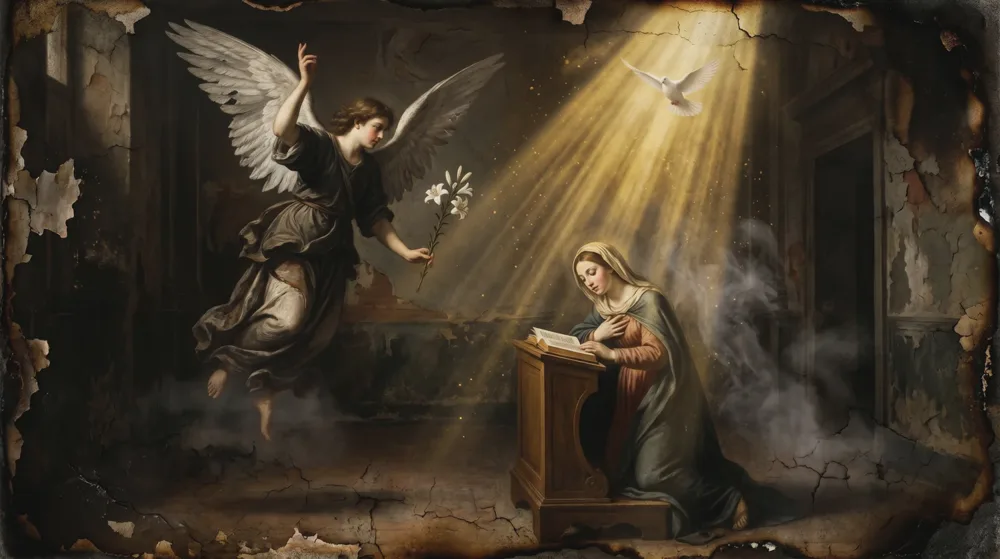
The Hail Mary is the great Marian prayer of the Church, by which we have recourse to the Most Blessed Virgin, asking her to pray for us. It is woven from two strands: the words by which the Archangel Gabriel and Saint Elizabeth greeted Mary in the Gospel, and the petition the Church has added — Holy Mary, Mother of God, pray for us sinners. Because it opens with the salutation of the Angel — Hail Mary, full of grace — it is called the Angelic Salutation, and in its traditional Latin form it is known across the world as the Ave Maria.
The Hail Mary prayer
This is the prayer in its traditional English wording:
Hail Mary, full of grace, the Lord is with thee;
blessed art thou amongst women,
and blessed is the fruit of thy womb, Jesus.
Holy Mary, Mother of God,
pray for us sinners,
now and at the hour of our death. Amen.
The Ave Maria in Latin
The Hail Mary has an ancient and continuous Latin form, the Ave Maria, sung and recited in the Roman rite for centuries:
Ave Maria, gratia plena, Dominus tecum;
benedicta tu in mulieribus,
et benedictus fructus ventris tui, Iesus.
Sancta Maria, Mater Dei,
ora pro nobis peccatoribus,
nunc et in hora mortis nostrae. Amen.
The Hail Mary prayer in Spanish
The same prayer is prayed by the faithful in Spanish as the Dios te salve, María — word for word the Latin Ave Maria, in the traditional Castilian wording sung and recited across the Hispanic world:
Dios te salve, María, llena eres de gracia, el Señor es contigo;
bendita tú eres entre todas las mujeres,
y bendito es el fruto de tu vientre, Jesús.
Santa María, Madre de Dios,
ruega por nosotros, pecadores,
ahora y en la hora de nuestra muerte. Amén.
It is the same Angelic Salutation in every tongue: the Angel's greeting and Saint Elizabeth's blessing, then the Church's petition. The opening Dios te salve, María, llena eres de gracia renders Hail Mary, full of grace, and the close ruega por nosotros, pecadores is pray for us sinners.
What it means
The catechism teaches plainly whose words these are. As Saint Pius X puts it, "the words of the Hail Mary are partly those of the Archangel Gabriel, partly those of Saint Elizabeth, and partly those of the Church." The prayer thus falls into two parts: a salutation drawn from Scripture, and a petition given by the Church.
The words of the Angel and of Saint Elizabeth
The first part is the word of God set on our lips. Hail, full of grace, the Lord is with thee, blessed art thou amongst women are the words the Archangel Gabriel addressed to Mary when he came, on the part of God, to announce to her the mystery of the Incarnation that was to be wrought in her; we dwell on the meaning of that opening salutation, Hail Mary, full of grace, and on the fullness of grace it declares, in a study of its own. To these the Church joins the words of Saint Elizabeth at the Visitation — blessed art thou amongst women, and blessed is the fruit of thy womb — which she spoke by the inspiration of God when, three months before the birth of Saint John the Baptist, she was visited by the Most Blessed Virgin, who already bore in her womb her divine Son. The Church then names that fruit: Jesus. Every time we say Hail Mary, full of grace, we repeat the very greeting of heaven and of the Gospel.
In saying these words we do not merely recite history. The Roman Catechism of the Council of Trent places the Angelic Salutation under thanksgiving: in it "we render to God a splendid homage of praises and of thanksgivings, for all the heavenly gifts wherewith He hath been pleased to fill the most holy Virgin, and at the same time we congratulate her herself upon her incomparable happiness." Saluting the Blessed Virgin with the Angel's own words, we rejoice with her and recall the singular gifts and privileges with which God favoured her in preference to all other creatures; saluting her with Elizabeth's words, we rejoice in her dignity as Mother of God and bless God for having given us Jesus Christ through Mary. The Hail Mary, then, is first an act of praise to God for what He has done in her.
The petition of the Church
To this thanksgiving the Church has added a prayer of her own, and the Catechism of Trent notes that she did so "not without reason." All the remaining words — Holy Mary, Mother of God, pray for us sinners, now and at the hour of our death — were added by the Church. By them, says Saint Pius X, "we ask the protection of the Most Blessed Virgin during this life and especially at the hour of death, when we shall have the greatest need of it." We have recourse to her, the Catechism of Trent teaches, "with a pious confidence and a profound humility," as "children of Eve exiled in this vale of tears," invoking "the Mother of mercy, the advocate of the faithful people, that she may pray for us, poor sinners."
Why ask Mary to pray for us, rather than only addressing God directly? Because, as the catechism answers, the Most Blessed Virgin is our most powerful advocate with Jesus Christ. We do not pray to her as we pray to God: to God we say have pity on us, hear us; to the saints we say pray for us. The Hail Mary asks Mary to be our intercessor — to obtain for us, by her prayer, the graces we need. And she is heard, the catechism reasons, for a simple cause: "she is the Mother of God, and it is impossible that He should not hear her." This is also why she holds the title we explore in Mother of God — the very dignity the Hail Mary confesses.
The two parts thus belong together. We praise God for the grace He poured into Mary, and on the strength of that same grace we ask her to turn toward us. The prayer that begins in the joy of the Annunciation ends at the hour of our death — the one hour in which, the catechism says, we shall have the greatest need of her help.
When to pray it
The Hail Mary is most of all the prayer of the Rosary, in which it is repeated through the decades while the mind meditates the mysteries of the life of Christ. Saint Pius X teaches that, of all the devotions in honour of the Blessed Virgin, the one the Church recommends "in a most special way" is the recitation of the holy Rosary. If you wish to learn the structure of that devotion, see How to Pray the Rosary.
It is also the prayer we say after the Our Father. The Catechism of St Pius X notes that, "after having said the prayer that Jesus Christ taught us" — the Our Father — "we pray the Most Blessed Virgin to obtain for us the graces we have asked for." So the Lord's Prayer and the Hail Mary stand naturally side by side: the first taught by Christ, the second placing His own Mother's intercession behind our petitions. Beyond these, the Hail Mary belongs to the Angelus, prayed morning, noon, and evening, and to the daily habit of the faithful soul, who has recourse to Mary in every need — the same soul that may give itself wholly to her in the total consecration to Mary — and above all keeps for the hour of death the words pray for us sinners, now and at the hour of our death.
Frequently Asked Questions
What is the Hail Mary prayer?
The Hail Mary is the great Marian prayer of the Church, by which we ask the Most Blessed Virgin to pray for us. It is woven from two strands: the words by which the Archangel Gabriel and Saint Elizabeth greeted Mary in the Gospel, and the petition the Church added — Holy Mary, Mother of God, pray for us sinners. Because it opens with the Angel's greeting, it is called the Angelic Salutation, and in its traditional Latin form it is the Ave Maria.
What does Hail Mary mean?
Hail renders the Angel's greeting Ave — a salutation of joy and reverence — and full of grace declares that Our Lady was filled by God with grace beyond every other creature. The whole prayer first praises God for the gifts He poured into Mary, then begs her, as Mother of God and our advocate, to intercede for us sinners now and at the hour of our death. As the Catechism of St Pius X teaches, its words are "partly those of the Archangel Gabriel, partly those of Saint Elizabeth, and partly those of the Church."
What is a Hail Mary?
A Hail Mary is a single recitation of this prayer, the Angelic Salutation. It is the prayer repeated through the decades of the Rosary while the mind meditates the mysteries of Christ's life, and it is also said after the Our Father, in the Angelus, and whenever the faithful soul has recourse to Our Lady. Said once, it both honours God for His work in Mary and asks her prayers for us.
Is the Hail Mary in the Bible?
Its first half is taken directly from Sacred Scripture. The words Hail, full of grace, the Lord is with thee are the Archangel Gabriel's greeting at the Annunciation, and blessed art thou amongst women, and blessed is the fruit of thy womb are Saint Elizabeth's words at the Visitation, both in the first chapter of Saint Luke. The second half — Holy Mary, Mother of God, pray for us sinners, now and at the hour of our death — is the petition the Church herself has added; it is not a quotation of Scripture but a prayer built upon it.
Where Is the Hail Mary in the Bible?
The scriptural words are found in the Gospel of Saint Luke, chapter 1. The Angel's salutation is at the Annunciation (Saint Luke 1:28), and Saint Elizabeth's blessing is at the Visitation (Saint Luke 1:42), where she cries out: Blessed art thou among women, and blessed is the fruit of thy womb (Douay-Rheims). The Church joined these two greetings and added the name of Jesus and her own petition.
Where Did the Hail Mary Come From?
It grew over time from the words of the Gospel into the prayer we know. The faithful long greeted Our Lady with the Angel's and Saint Elizabeth's words; the Church then joined these, named the blessed fruit as Jesus, and finally added the petition Holy Mary, Mother of God, pray for us sinners. As the Catechism of St Pius X teaches, the Hail Mary is thus "partly those of the Archangel Gabriel, partly those of Saint Elizabeth, and partly those of the Church."
Who Wrote the Hail Mary?
No single author composed it. The first words were spoken by the Archangel Gabriel and by Saint Elizabeth under the inspiration of God, as recorded by Saint Luke; the closing petition was added by the Church in her wisdom, not without reason, to ask Our Lady's protection in life and at the hour of death. It is therefore the work of heaven, of Scripture, and of the Church together, not the invention of any one man.
How to Pray the Hail Mary
Say the prayer slowly and with attention, mindful that the first part praises God for the graces He poured into Mary and the second begs her intercession. It is most often prayed in the Rosary, repeated through the decades while the mind meditates the mysteries of Christ's life; it is also said after the Our Father and in the Angelus, morning, noon, and evening. To pray it within the Rosary, see How to Pray the Rosary.
The Hail Mary joins heaven's greeting to the Church's appeal: the word the Angel spoke at the Incarnation, and the cry of exiled children to the Mother of mercy. We say it, and we ask her to be heard for us — now, and at the hour we shall need her most.
The Iter Fidei app serves this prayer in Latin and in your own language, with audio so you can pray along. Download it here.
Sources. Catechism of St Pius X, Part II, ch. 3, The Hail Mary. Catechism of the Council of Trent (Roman Catechism), treatise on prayer, on the Angelic Salutation and on invocation of the saints. Scripture: Saint Luke 1 (the Annunciation and the Visitation), Douay-Rheims.