
The Sacraments
The Tridentine Mass vs the Novus Ordo: What Is the Difference?
The traditional Latin Mass and the reformed rite of 1969 differ in language, orientation, prayers, calendar, and lectionary. We set out the differences plainly, in a clear comparison table, from the traditional rite.
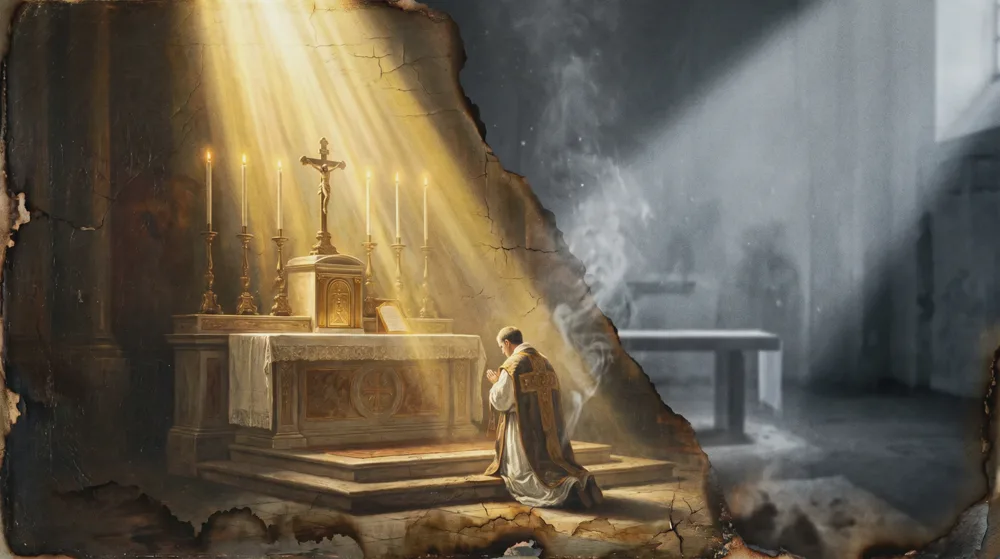
The Tridentine Mass is the traditional Latin rite codified by Pope St Pius V in 1570; the Novus Ordo is the reformed rite of Mass promulgated in 1969. They are not the same Mass in different languages. They differ in their language, their orientation, their prayers, their calendar, their lectionary, and their ceremonial.
Iter Fidei holds to the traditional Roman rite. What follows describes the traditional Mass on its own terms, and sets out where the later rite departs from it. (For the rite itself, see What Is the Tridentine Mass?) Join early access here.
Tridentine Mass vs Novus Ordo: the comparison at a glance
If you want the answer in one place, here is the old Mass vs the new Mass, point by point.
| Tridentine Mass (traditional Latin Mass) | Novus Ordo (reformed rite) | |
|---|---|---|
| When it arose | Roman Mass fixed by the Council of Trent; codified by St Pius V in Quo Primum, 1570 (in the 1962 editio typica for present use) | Promulgated by Paul VI, 1969 (Roman Missal, 1970) |
| Language | Latin, the sacred tongue, the same in every land | Almost always the vernacular (Latin permitted but rare) |
| Orientation | Ad orientem — priest and people face the same way, toward the altar and the East | Usually versus populum — priest faces the people |
| Canon / Eucharistic Prayer | One fixed Roman Canon, prayed silently | Several alternative Eucharistic Prayers, often aloud |
| Offertory | Fixed, explicitly sacrificial prayers (the Suscipe) | Shorter "blessing" formulas of a different character |
| Calendar | Traditional calendar; saints and ranks as kept for centuries | Revised calendar of 1969 |
| Lectionary | One-year cycle; fixed Epistle and Gospel | Multi-year cycle (Sundays A/B/C, weekdays I/II) |
| Communion | Kneeling, on the tongue, from the priest's hand | Standing and in the hand permitted |
| Last Gospel | Ends with the Prologue of St John | Omitted |
| Rubrics | Numerous fixed genuflections, signs of the Cross, care for fragments | Greatly simplified; many gestures reduced or optional |
Both are valid Masses of the Roman rite. What divides them is not their validity but the shape of the prayer — and that is no small thing.
The difference between Tridentine and Novus Ordo, explained
Language. The Tridentine Mass, also called the Vetus Ordo or usus antiquior (see Vetus Ordo and Usus Antiquior for these names), is offered in Latin, the sacred language of the Roman Church, one and the same in every country. The Novus Ordo, though it may be said in Latin, is in practice almost always offered in the vernacular. A sacred tongue, set apart from daily speech and unchanging across the ages, guards the prayer of the Church from the drift of fashion and translation.
Orientation (ad orientem). In the Tridentine Mass, priest and people face the same direction — ad orientem, toward the altar and the East — together offering the Sacrifice to God. The Novus Ordo is usually offered versus populum, the priest facing the people across a free-standing altar. The older posture makes the priest plainly what he is: a man leading his people Godward, not a presider addressing an assembly.
The Offertory. The traditional rite has a fixed set of Offertory prayers — beginning Suscipe, sancte Pater ("Receive, O holy Father") — that name the Mass as a sacrifice offered "for my innumerable sins, offences, and negligences," for all present, and "for all faithful Christians, living and dead." These prayers were replaced in the reformed rite with shorter formulas that speak of bread and wine to be offered rather than of a propitiatory sacrifice.
The Canon. The Tridentine Mass uses one fixed Canon — the venerable Roman Canon — prayed quietly at the heart of the Sacrifice. The Novus Ordo introduced several alternative Eucharistic Prayers and the option of praying them aloud, the shortest of which is markedly briefer than the Roman Canon.
The calendar. The two rites follow different liturgical calendars. A feast, its rank, its octave, and the very saint kept on a given day are frequently not the same. The traditional calendar preserves seasons and observances — Septuagesima, the Ember Days, the older octaves — that the reform reduced or removed. (See The Traditional Latin Mass Calendar and The Liturgical Year.)
The lectionary. The Tridentine Mass has a one-year cycle of readings, with a fixed Epistle and Gospel for each day, returning year by year so that the faithful come to know them by heart; our page of today's Gospel gives the Epistle and Gospel of the day in the 1962 Missal. The Novus Ordo introduced a much larger multi-year lectionary (Sundays in a three-year cycle, weekdays in two). (On the fixed texts of the day, see The Propers of the Tridentine Mass.)
Communion. In the traditional rite, the faithful receive Holy Communion kneeling and on the tongue, from the hand of the priest, the server holding the paten beneath. The reformed rite permits Communion standing and in the hand. (See First Holy Communion.)
The rubrics and ceremonial. The Tridentine Mass ends with the Last Gospel (the Prologue of St John), and retains throughout numerous fixed signs of reverence — genuflections, repeated signs of the Cross over the offerings, the joining of thumb and forefinger after the Consecration, the priest's care over every fragment. The reform simplified or made optional much of this. To follow the older rite part by part, see The Order of the Tridentine Mass.
What does not change
On the doctrine of the Mass itself, the Church's teaching is fixed and does not bend with rites. The Mass is the Holy Sacrifice of the Body and Blood of Christ, the same Victim of Calvary offered in an unbloody manner. The Roman Catechism teaches that after the Consecration "there remains absolutely nothing of the substance of the bread and wine" — Christ Himself is present, whole and entire.
This Sacrifice was foretold of old. The prophet Malachias announced it plainly:
For from the rising of the sun even to the going down, my name is great among the Gentiles, and in every place there is sacrifice, and there is offered to my name a clean oblation. (Malachias 1:11, Douay-Rheims)
That clean oblation is the Mass — and that is the faith the traditional rite was built to express, prayer by prayer.
Why the difference matters
The form of worship carries the faith — lex orandi, lex credendi, the law of prayer is the law of belief. The traditional Mass surrounds the Sacrifice with a language, an orientation, and a ceremonial ordered wholly to God and to the doctrine of the Real Presence — sung, where it can be, to her own Gregorian chant.
The Tridentine Mass and the Novus Ordo differ, then, not in a few externals but in the shape of the prayer. To attend the traditional Mass is to pray as the Roman Church has always prayed, and you can find a Traditional Latin Mass near you to do so.
Frequently Asked Questions
Is the Tridentine Mass and the Latin Mass the same thing?
In ordinary speech, yes. The "Traditional Latin Mass" or "TLM" is the Tridentine Mass — the Roman rite codified by St Pius V in 1570 and used in the 1962 Missal. The Novus Ordo may also be celebrated in Latin, but when Catholics say "the Latin Mass" they almost always mean the traditional rite, not the reformed Mass said in Latin.
Are both the old Mass and the new Mass valid?
Yes. The Church holds both the Tridentine Mass and the Novus Ordo to be valid Masses of the Roman rite, at which Our Lord is truly made present. The question between traditional Catholics and the reform is not validity but the worthiness, richness, and clarity of the rite — which prayer best guards and expresses the faith.
Why do traditional Catholics prefer the Tridentine Mass?
Because its language, its ad orientem orientation, its silent Roman Canon, and its explicitly sacrificial Offertory all teach, without a word of explanation, that the Mass is the Sacrifice of Calvary and that Christ is really present. The form preaches the faith.
What is the main difference between the Tridentine and Novus Ordo offertory?
The traditional rite offers a fixed, propitiatory prayer — the Suscipe, sancte Pater — naming the host as "this spotless host" offered for sins, for the living, and for the dead. The reformed rite replaced it with a shorter blessing over "the bread we offer" and "the wine we offer."
When did each Mass arise — 1570, 1962, or 1969?
The Tridentine Mass was codified by St Pius V in 1570 and is used today in the form of the 1962 Missal. The Novus Ordo was promulgated by Paul VI in 1969 (with the Roman Missal published in 1970).
Sources. Catechism of the Council of Trent (1566), On the Sacrament of the Eucharist; Pope St Pius V, Quo Primum (1570); the Ordinary of the Roman Missal (1962); Malachias 1:11 (Douay-Rheims).