
The Liturgical Year
The Traditional Liturgical Year
The liturgical year of the traditional Roman calendar — Advent, Christmas, Septuagesima, Lent, Eastertide, and the season after Pentecost, with the liturgical colors and the traditional fasts.
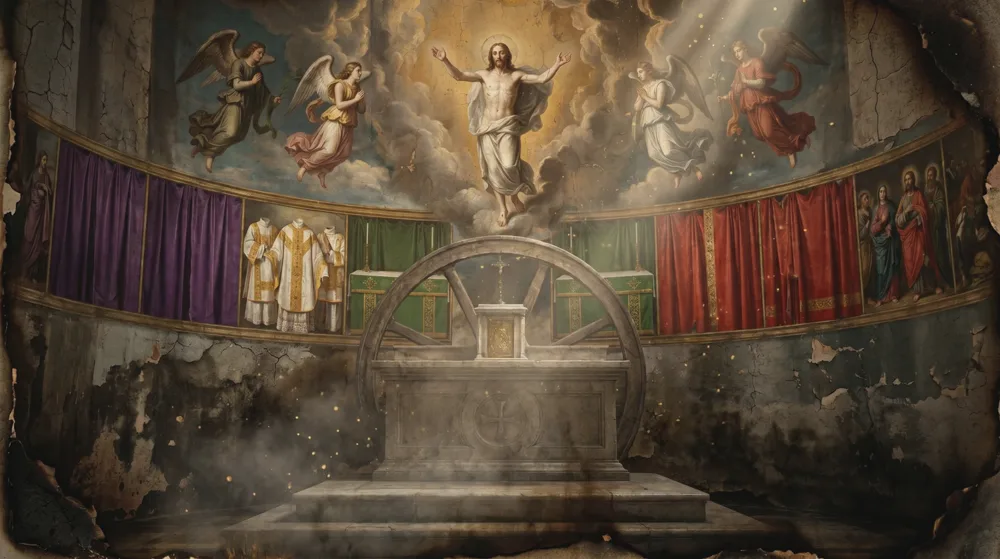
The liturgical year is the way the Church sets the whole mystery of Our Lord — His coming, His birth, His Passion, His Resurrection, His sending of the Holy Ghost — into the cycle of the months, so that the faithful live each year through what He did once for our salvation. In the traditional liturgical calendar, that year unfolds in a fixed order of liturgical seasons: Advent, Christmas, Septuagesima, Lent, Eastertide, Pentecost, and the long season after Pentecost — each with its own liturgical colors and its own observances. This is the year the Church kept before the changes of the later twentieth century: it retains Septuagesima as the gate of Lent and the Ember Days as the four seasonal fasts.
What the liturgical year is
The Church did not invent her year for ornament. By instituting feasts, she keeps before us the mysteries of Our Lord and honours the Blessed Virgin, the Angels, and the Saints, that we may imitate their virtues and ask their intercession. The Catechism of Saint Pius X teaches that special mention is made of Sunday among the feasts because it is the principal feast of Christians, the day of the Lord, consecrated to the divine service — as the Sabbath was the chief day among the Jews by the institution of God Himself. Around the weekly return of Sunday the whole year is built.
The traditional Roman year turns on two great poles: Christmas, fixed to the 25th of December, and Easter, which moves with the moon. Everything else falls into place around them. The seasons before and after each pole prepare the soul and prolong the feast.
The seasons of the year
Advent
The year opens with Advent, the four weeks before Christmas. The Catechism of Saint Pius X states that the fast of Advent was instituted to dispose us to celebrate holily the feast of Christmas. It is a season of penance and of waiting: the violet vestments are worn, the Gloria falls silent at Sunday Mass, and the Church cries out for the coming of her Saviour. In the home the season is marked by the Advent wreath, whose four candles are lit one by one as Christmas draws near. Solemn marriages are forbidden from the first Sunday of Advent, because this is a time consecrated to penance and prayer.
Christmastide
From the Nativity the Church passes into the Christmas season, clothed in white, the colour of joy and of the feasts of the Lord. The Octave of Christmas, the feast of the Circumcision, the Epiphany — the manifestation of the new-born King to the Magi — and the days that follow keep the mystery of God made man. The white of these days proclaims the gladness of the Incarnation.
Septuagesima
Before Lent the traditional calendar keeps Septuagesima — the three Sundays of Septuagesima, Sexagesima, and Quinquagesima that the modern reformed calendar suppressed but the traditional year retains. Here the violet returns, the Alleluia is laid aside until Easter, and the Gloria is again omitted on Sundays. Septuagesima is the porch of Lent: the Church begins to turn the heart toward penance before the fast itself begins, so that Ash Wednesday does not find the soul unprepared. Its last day is Fat Tuesday — Shrove Tuesday, the eve of the fast — when the faithful were shriven in Confession and the household ate up the foods the coming forty days would forbid.
Lent
Lent is the great fast of forty days. The Catechism of Saint Pius X teaches that Lent was instituted to imitate in some manner the rigorous fast of forty days which Jesus Christ kept in the desert, and to prepare us by penance to celebrate holily the feast of Easter. The vestments are violet, the altars bare, the Alleluia withheld. Lent is also the most fitting time, says the Catechism, to satisfy the precept of yearly confession, according to the custom approved throughout the whole Church.
The final stretch of Lent is Holy Week, from Palm Sunday through the Sacred Triduum — Holy Thursday, Good Friday, and Holy Saturday — when the Church follows Our Lord step by step to His Passion, death, and burial. Friday and Saturday carry their own weekly memory: Friday in honour of the Passion, Saturday in memory of the burial of Our Lord and in honour of the Blessed Virgin.
Eastertide
At Easter the long fast breaks into the Eastertide of joy. White returns, the Alleluia is restored, and for fifty days the Church keeps the Resurrection. Within this season fall the Ascension and the approach to Pentecost. By the third precept of the Church, every Christian who has come to the age of discretion is bound to receive Holy Communion during the Paschal season — the Easter duty — which gives this time its name among the faithful.
Pentecost and the season after Pentecost
Pentecost, fifty days after Easter, keeps the descent of the Holy Ghost upon the Apostles; its colour is red, the colour of fire and of the martyrs. From the octave of Pentecost the year settles into its longest stretch, the season after Pentecost, which runs in green until Advent comes round again. Trinity Sunday opens it, Corpus Christi falls within it, and the Feast of Christ the King crowns it on the last Sunday of October before the Sundays after Pentecost carry the Church to the end of her year. Green is the colour of these ordinary Sundays — the colour of growth, of the Church living out the mysteries she has celebrated.
The liturgical colors
The traditional year speaks to the eye through its liturgical colors, worn by the priest at Mass:
- White — the feasts of the Lord, of Our Lady, and of saints who were not martyrs; the seasons of Christmas and Easter.
- Red — Pentecost, the feasts of the Cross, and the martyrs.
- Green — the ordinary Sundays after Epiphany and after Pentecost.
- Violet — the penitential seasons of Advent, Septuagesima, and Lent.
- Black — the Masses for the dead and Good Friday.
The colour tells the worshipper at once where the Church stands in her year — in penance or in feast, in mourning or in joy.
The Catholic liturgical year calendar at a glance
The whole catholic liturgical year calendar can be read at a glance as a table of seasons, their place in the year, and their colour. Two seasons move with Easter (Septuagesima, Lent, Eastertide and the count of Sundays after Pentecost); the rest are fixed or reckoned from Christmas.
| Season | Begins | Liturgical colour |
|---|---|---|
| Advent | First Sunday of Advent (27 Nov – 3 Dec) | Violet |
| Christmastide | 25 December | White |
| Time after Epiphany | 13 January | Green |
| Septuagesima | Septuagesima Sunday (moves with Easter) | Violet |
| Lent | Ash Wednesday | Violet |
| Holy Week & Triduum | Palm Sunday | Violet, then red / black |
| Eastertide | Easter Sunday | White |
| Pentecost | 50 days after Easter | Red |
| Time after Pentecost | Trinity Sunday | Green |
The traditional year is reckoned by Sundays within each season, not by a running number of weeks: a date is named the Second Sunday of Advent or the Twelfth Sunday after Pentecost, never simply "week 30."
The Ember Days
Four times in the year the traditional calendar keeps the Ember Days — three days of fasting (Wednesday, Friday, and Saturday) in each of the four seasons: in Advent, in Lent, in the octave of Pentecost, and in September. The Catechism of Saint Pius X teaches that the fast of the Ember Days was instituted to consecrate each season of the year by a penance of a few days; to ask of God the preservation of the fruits of the earth; to thank Him for the fruits already given; and to pray Him to give His Church holy ministers, whose ordination is performed on the Ember Saturdays. These four sets of fast days bind the natural year to the year of grace.
Fasting and abstinence
The second precept of the Church commands us to fast on the appointed days. Fasting, in the traditional discipline, consists in taking only one full meal a day and abstaining from the forbidden foods; by a condescension of the Church a small collation is permitted in the evening. It prepares us for prayer, does penance for sins committed, and preserves us from committing new ones. Abstinence from meat is kept on Fridays — and on Saturdays where no dispensation has been granted — that we may do penance each week, on Friday in honour of the Passion and on Saturday in memory of the burial of Our Lord.
The fasts of the year are thus woven into its seasons: the fast of Advent, the fast of Lent, the Ember Days of the four seasons, and the fasts of the Vigils that prepare the principal feasts. Those not bound to fast are still not dispensed from all mortification, the Catechism warns, for all of us are bound to do penance.
Dom Prosper Guéranger and The Liturgical Year
No work has done more to make the traditional year loved than The Liturgical Year (L'Année liturgique) of Dom Prosper Guéranger, the abbot who restored the Benedictine Order in France at the Abbey of Solesmes in the nineteenth century. Begun in 1841 and continued by his monks after his death in 1875, Dom Prosper Guéranger's The Liturgical Year runs to fifteen volumes that follow the Roman calendar day by day — Advent, Christmas, Septuagesima, Lent, Passiontide, Paschal Time, and Time after Pentecost — giving for each day its history, its Mass and Office, and a meditation drawn from the Fathers.
For those who wish to live the seasons described above, Guéranger's The Liturgical Year remains the great companion: it explains why the Alleluia is buried at Septuagesima, why the violet returns, what the Church intends by each feast. It is the very calendar this article describes — the year before the changes of the later twentieth century — opened out into a daily school of prayer. Saint Thérèse of Lisieux and Pope Saint Pius X both drew on it; it is still the most quoted authority on the meaning of the traditional liturgical seasons.
All our articles on the liturgical year, season by season
Advent and Christmastide
- Advent
- The Advent wreath
- Gaudete Sunday
- The O Antiphons
- O Come, O Come, Emmanuel
- Christmas
- The Epiphany
Septuagesima and Lent
- Fat Tuesday
- Ash Wednesday
- Lent
- When is Lent?
Holy Week and the Triduum
- Holy Week
- Palm Sunday
- The Sacred Paschal Triduum
- Holy Thursday
- Good Friday
- Holy Saturday and the Easter Vigil
Eastertide and Pentecost
- Easter
- When is Easter?
- The Ascension
- Pentecost
The season after Pentecost
- Corpus Christi
- Christ the King
Feasts through the year
Fasting and holy days
- Fasting and abstinence
- Lenten fasting and abstinence
- The holy days of obligation
Frequently Asked Questions
What is the liturgical year?
The liturgical year is the ordered cycle by which the Church sets the whole mystery of Our Lord — His coming, birth, Passion, Resurrection, and the sending of the Holy Ghost — into the round of the months, so that the faithful relive each year what He did once for our salvation. In the traditional Roman calendar it unfolds through Advent, Christmas, Septuagesima, Lent, Eastertide, Pentecost, and the long season after Pentecost, each with its own liturgical colour and observances. It is built around two poles: Christmas, fixed to the 25th of December, and Easter, which moves with the moon.
When does the liturgical year begin?
The liturgical year begins on the First Sunday of Advent, not on the first of January. This is the Sunday nearest the feast of Saint Andrew (30 November), so the year opens between the 27th of November and the 3rd of December. The Church begins her year in penance and waiting, crying out for the coming of her Saviour, that she may be prepared to keep the feast of Christmas.
When does the new liturgical year start?
The new liturgical year always starts on the First Sunday of Advent, so its date shifts each year between the 27th of November and the 3rd of December — whichever Sunday falls nearest to the feast of Saint Andrew on the 30th of November. There is no fixed calendar date, because Advent is reckoned by Sundays and not by the day of the month. The previous year ends on the Saturday before, with the last Sunday after Pentecost.
Which church season begins the liturgical year?
Advent is the season that begins the liturgical year. It is a time of penance and holy waiting, lasting the four weeks before Christmas, during which the Church puts on violet vestments, silences the Gloria at Sunday Mass, and cries out for the coming of her Saviour. The Catechism of Saint Pius X teaches that the fast of Advent was instituted to dispose us to celebrate holily the feast of Christmas.
How many seasons are in the liturgical year?
The traditional Roman calendar keeps seven liturgical seasons: Advent, Christmas, Septuagesima, Lent, Eastertide, Pentecost, and the long season after Pentecost. Each has its own liturgical colour and observances — violet for the penitential seasons of Advent, Septuagesima, and Lent; white for Christmas and Easter; red for Pentecost; and green for the Sundays after Pentecost. The later reformed calendar suppressed Septuagesima, but the traditional year retains it as the porch of Lent.
What are the colors of the liturgical year?
The traditional liturgical year keeps five colours, each worn by the priest at Mass to mark the season or feast. White is worn for the feasts of the Lord and of Our Lady, for saints who were not martyrs, and through Christmas and Easter. Red marks Pentecost, the feasts of the Cross, and the martyrs. Green is worn on the ordinary Sundays after Epiphany and after Pentecost. Violet clothes the penitential seasons of Advent, Septuagesima, and Lent. Black is kept for the Masses of the dead and for Good Friday. The colour tells the faithful at once whether the Church stands in penance or in feast.
What are the seasons of the liturgical year?
The traditional Roman calendar keeps seven seasons in this order: Advent, Christmas, Septuagesima, Lent, Eastertide, Pentecost, and the long season after Pentecost. Two of them, Septuagesima and the count of Sundays after Pentecost, move each year with the date of Easter; the rest fall around the two fixed and moveable poles of Christmas and Easter. The reformed calendar of 1969 suppressed Septuagesima and renamed the green Sundays "Ordinary Time," but the traditional year retains the full sevenfold pattern.
What week of the liturgical year is it?
The week is reckoned from the seasons, not from a running count of weeks: the Church names her Sundays by their place within each season — the Second Sunday of Advent, the Third Sunday after Easter, the Twelfth Sunday after Pentecost, and so on. To know where you stand, find the nearest pole, Christmas or Easter, and count the Sundays from it. The Iter Fidei app shows the exact day, season, and Mass of the traditional calendar at a glance.
When does the liturgical year end?
The liturgical year closes with the last Sunday after Pentecost, immediately before the First Sunday of Advent comes round again. The Gospel of that final Sunday is Our Lord's discourse on the end of the world and His coming in judgment (Matthew xxiv), so the year ends as it began — with the soul turned toward His coming. The green of the Sundays after Pentecost gives way once more to the violet of Advent.
For the day-by-day reckoning of feasts, their ranks, and the two cycles of the year, see our companion article on the traditional Latin Mass calendar.
The Iter Fidei app carries the traditional calendar, the Mass of each day, and the prayers of the season. Join early access here.
Sources. Catechism of Saint Pius X, Part III, ch. 4, The Precepts of the Church (the first and second precepts: Sundays and feasts, fasting, abstinence, the fasts of Lent, Advent, the Ember Days and the Vigils; the third precept: the Easter duty); the Proper of the Time of the traditional Roman Missal.