
The Liturgical Year
All Souls' Day
All Souls' Day, kept on November 2, is the Commemoration of All the Faithful Departed, when the Church prays, offers Mass, and gains indulgences for the holy souls suffering in purgatory.
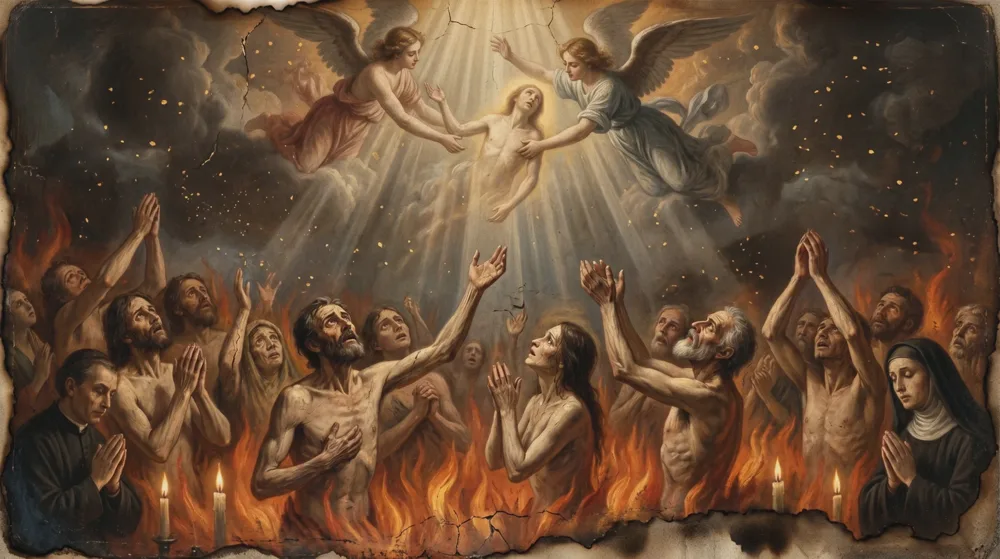
All Souls' Day, kept on November 2, is the Commemoration of All the Faithful Departed: the day on which the whole Latin Church prays, offers the Holy Sacrifice, and gains indulgences for the souls in purgatory. It is the Catholic feast of the dead — not a folk custom but an act of charity owed to those who died in God's grace and are still being purified before they enter heaven.
What Is All Souls' Day
All Souls' Day is the liturgical commemoration of all the faithful who have died in the state of grace and are not yet admitted to the vision of God. It follows immediately upon All Saints' Day (November 1), and the order is deliberate: having honoured her children who already enjoy heaven, the Church turns at once to those who still suffer, that her intercession may speedily bring them to the company of the blessed. The Roman Martyrology opens November 2 with the words, "Today we keep the commemoration of all the deceased faithful."
The two days form one movement of the Communion of Saints. The Church Triumphant in heaven, the Church Suffering in purgatory, and the Church Militant on earth are not three separate societies but one Body, bound by charity. The Catechism of Saint Pius X teaches that the members of the Church are partly in heaven, partly in purgatory, and partly upon earth, and that "charity unites the three Churches." Because of this bond, the living can act for the dead. On All Souls' Day the Church does exactly that.
All Saints' Day and All Souls' Day: The Difference
The two feasts are constantly confused, and the search for "All Saints Day vs All Souls Day" is really a search for one distinction. All Saints' Day (November 1) honours the Church Triumphant: the saints in heaven, the canonised and the countless unnamed, who already see God and need no help from us — we ask their prayers, we do not pray for them. All Souls' Day (November 2) commemorates the Church Suffering: the faithful departed in purgatory, who cannot help themselves and whom we must help. In a word, on November 1 we keep the feast of those who pray for us; on November 2 we pray for those who cannot yet pray for themselves.
The two are kept back to back on purpose, and they belong to the same doctrine, the Communion of Saints. All Saints' Day is a holy day of obligation in the universal calendar; All Souls' Day is not. The first wears white vestments and rings with the Gloria; the second wears black and sings the Dies Irae. One is triumph, the other is suffrage — and together they show the one Body of Christ reaching across death.
The Faithful Departed and the Holy Souls in Purgatory
To understand the feast, we must hold the doctrine of purgatory. The souls commemorated on November 2 died in friendship with God, but they carry a debt. The rule, as Dom Guéranger states it, is that "for every fault satisfaction must be made to God's justice, either in this world or the next." A soul may die forgiven of its guilt yet still owe the temporal penalty of sin, or die before its purification is complete. Such a soul cannot enter heaven, for nothing defiled enters there; it is purified in purgatory. This is the doctrine the Council of Trent defined, and it is treated more fully in our article on purgatory.
These are the holy souls. They are certain of heaven and they can no longer help themselves, for the time of merit ended at death. They can only suffer and wait. But they can be helped. Here the Communion of Saints becomes a practical doctrine. Merit cannot be transferred from one soul to another, but satisfaction can: "God accepts it in payment of another's debt, whether the soul be in this world or in purgatory, provided he be united by grace to the mystical Body." What we cannot do for ourselves twice over, we may offer for them. This communion of the living and the dead is the heart of the Communion of Saints.
Praying for the Dead: An Ancient Tradition
Prayer for the dead is no late invention. The Roman Catechism of Trent calls "the Prayers that are addressed to God for the souls of the departed, in order to bring them forth from Purgatory, a tradition and a consequence of the doctrine of the Apostles." The custom of offering the Eucharist in suffrage for the faithful departed, writes Cardinal Schuster, "dates from the first beginnings of the Church, spoken of as traditional usage in the days of St. Ignatius and St. Polycarp." From the days of the Apostles the faithful at Rome built their tombs along the consular roads, and on fixed days the Church came to offer upon them the Sacrifice of the Redemption — purifying and strengthening, by the dogma of the Resurrection, what even the pagans had felt as a duty toward their dead.
The commemoration as a fixed annual feast came later. In 998, according to Sigebert of Gembloux, St. Odilo, Abbot of Cluny, ordained that the Office of the Dead be said after Vespers of All Saints in all the monasteries under his crosier, to be kept in perpetuity on the morrow of All Saints'. The observance spread, Rome adopted it, and it became the law of the whole Latin Church. This is the prayer the Church gives the holy souls — the petition we know as eternal rest: Requiem aeternam dona eis, Domine.
The Masses for the Dead
The chief act of All Souls' Day is the Mass. The Holy Sacrifice is propitiatory; it is offered, in the words of the Catechism of Saint Pius X, "to relieve the souls in purgatory," and it may be applied for the dead as truly as for the living. No prayer of the living equals this offering, for it is Christ Himself, immolated under the sacred species, who is presented to the Father for them.
So great is this help that the Church multiplies it on November 2. The custom of three Masses on this day began among the Dominicans of Valencia in the fifteenth century and was long a privilege of Spain, Portugal and Latin America; in the midst of the First World War, Pope Benedict XV, by the Apostolic Constitution Incruentum Altaris (August 10, 1915), extended it to every priest of the whole Church — one Mass for whatever intention the priest chooses, one for all the faithful departed, and one for the intentions of the Sovereign Pontiff.
Every Mass said on November 2 enjoys, moreover, the favour of a privileged altar for the soul for whom it is applied. The vestments are black, the Sequence Dies Irae is sung, and the prayers ask without ceasing that the souls of the faithful departed rest in peace. The whole day is ordered toward the one work of suffrage.
Prayers for All Souls' Day
The Church gives the holy souls her own prayer, short and constant, drawn from the liturgy of the dead. It is the prayer to say at the cemetery, before the Mass, or whenever the departed come to mind:
Eternal rest grant unto them, O Lord, and let perpetual light shine upon them. May they rest in peace. Amen.
Requiem aeternam dona eis, Domine, et lux perpetua luceat eis. Requiescant in pace. Amen.
A second prayer is the Church's own: the Collect of the first Mass of All Souls' Day in the Roman Missal, the Fidelium Deus, which asks for the departed the forgiveness of all their sins:
O God, the Creator and Redeemer of all the faithful, grant to the souls of Thy servants and handmaids the remission of all their sins, that through pious supplications they may obtain the pardon which they have always desired. Who livest and reignest with God the Father, in the unity of the Holy Ghost, God, world without end. Amen.
Fidelium, Deus, omnium Conditor et Redemptor: animabus famulorum famularumque tuarum remissionem cunctorum tribue peccatorum; ut indulgentiam, quam semper optaverunt, piis supplicationibus consequantur: Qui vivis et regnas cum Deo Patre in unitate Spiritus Sancti Deus, per omnia saecula saeculorum. Amen.
The most powerful suffrage of all is not a prayer we say but the Sacrifice we offer — the Mass, treated below — and to it the Church joins the Office of the Dead and the De Profundis (Psalm 129), "Out of the depths I have cried to Thee, O Lord." Fuller forms are gathered in our article on eternal rest.
Indulgences for the Holy Souls
Besides the Mass, the Church offers her treasury of satisfaction through indulgences, which the living may apply to the dead. The Catechism of Saint Pius X lists the means by which "we can relieve the souls in purgatory" precisely as "applying in their favour Masses, alms, indulgences, and other good works." An indulgence remits the temporal punishment still due for forgiven sin; gained for a departed soul, it pays down the debt that holds it from heaven.
Around All Souls' Day the Church attaches indulgences above all to the visit of a church and of a cemetery with prayer for the dead, on the usual conditions of confession, Communion, and prayer for the Pope's intentions; throughout the year she has also enriched with indulgences the De Profundis and the Office of the Dead. To walk through a cemetery in early November, praying for the souls buried there, is not sentiment; it is an exercise of charity that reaches the dead and shortens their purgation.
The All Souls' Day Plenary Indulgence
The greatest of these is the plenary indulgence applicable only to the dead, attached to November 2 itself. Its history must be told exactly, for the rule changed in 1967.
Before 1967: the toties quoties. In the Raccolta in force under Pius XII and at the time of the 1962 Missal (n. 544, from a decree of the Holy Office of June 25, 1914), the faithful could gain a plenary indulgence, applicable only to the souls in purgatory, toties quoties — "as often as" they visited a church or public oratory on November 2 to pray for the dead.
The conditions were confession and Communion, and, at each visit, six Our Fathers, six Hail Marys and six Glory Be's for the intentions of the Sovereign Pontiff; from 1939 those who had not gained it on November 2 could gain it on the following Sunday. The Raccolta added a plenary indulgence on each day of the octave of All Souls for those who visited a cemetery and prayed, even mentally, for the dead (n. 546), and indulgences for prayers offered for the departed during the whole month of November (n. 543).
What changed in 1967–1968. Pope Paul VI's Apostolic Constitution Indulgentiarum Doctrina (January 1, 1967) laid down that a plenary indulgence may be gained only once a day, which put an end to the toties quoties, and required for every plenary indulgence the exclusion of all attachment to sin, even venial. The Enchiridion Indulgentiarum of 1968, which replaced the Raccolta, fixed the present form.
What the Church grants today. Under the current Enchiridion, a plenary indulgence applicable only to the souls in purgatory is granted, once, to the faithful who on the day of the Commemoration of All the Faithful Departed devoutly visit a church or oratory and there recite an Our Father and the Creed; and, once on each day from November 1 to 8, to those who devoutly visit a cemetery and pray, even mentally, for the dead.
The usual conditions apply: sacramental confession, Holy Communion, prayer for the intentions of the Sovereign Pontiff, and the exclusion of all attachment to sin, even venial; where that attachment remains, the indulgence is partial. The repeated visits that the old faithful made from church to church on November 2 are therefore no longer each rewarded with a plenary indulgence — but no prayer for the dead is ever lost.
So great a gift the Church holds out at the beginning of November, that the souls might be loosed in number — and it is given to the dead, not to ourselves, an act of pure charity toward those who can do nothing in return.
All Souls' Day in the Philippines
In the Philippines, where the faith took deep root, All Souls' Day — Araw ng mga Patay, the Day of the Dead — is among the most universally kept of Catholic observances. Whole families return to the cemeteries on November 1 and 2 to clean and adorn the graves, light candles, and keep vigil through the night, offering Masses and prayers for their departed. The custom is not folk superstition wearing a Catholic veneer but the very thing the Church commands raised to a national act of piety: to visit the tombs, to pray for the dead, to gain the indulgences. Where it remains ordered to that end — suffrage for the holy souls, grounded in the Resurrection — it is the Commemoration of the Faithful Departed lived out in full, not a celebration of death.
Is This the "Day of the Dead"?
Many searching for the "Day of the Dead" mean a Catholic observance, and there is a true one: it is All Souls' Day. The Church's commemoration of the dead is not a celebration of death, nor a folk festival of skulls and offerings to ancestors, but an act of faith and charity grounded in the Resurrection. Where popular customs have grown up around these days, they are Catholic only insofar as they serve the one purpose the Church assigns: to pray, to offer Mass, and to gain indulgences for the holy souls. Stripped of that purpose, they are no longer the faithful's commemoration of the dead but something else wearing its name.
Frequently Asked Questions
What is All Souls' Day?
All Souls' Day is the liturgical Commemoration of All the Faithful Departed: the day on which the whole Latin Church prays, offers the Holy Sacrifice, and gains indulgences for the souls in purgatory. It honours those who died in the state of grace but are not yet admitted to the vision of God, that the Church's intercession may speedily bring them to heaven. It is the Catholic feast of the dead — not a folk custom but an act of charity owed to the holy souls.
When is All Souls' Day?
All Souls' Day is kept every year on November 2, the day after All Saints' Day (November 1). The order is deliberate: having honoured her children who already enjoy heaven, the Church turns at once to those still being purified. Should November 2 fall on a Sunday, the commemoration is observed the following day in the traditional calendar.
When is All Souls' Day 2026?
In 2026 All Souls' Day falls on Monday, November 2. The date is fixed — November 2 each year, the day after All Saints' Day — with one exception in the traditional calendar: when November 2 falls on a Sunday, as it did in 2025, the commemoration is transferred to Monday, November 3.
What is the purpose of All Souls' Day?
The purpose of All Souls' Day is suffrage for the dead: to relieve and release the holy souls in purgatory by prayer, by the Holy Sacrifice of the Mass, and by indulgences applied in their favour. The souls commemorated died in friendship with God yet still owe the temporal penalty of sin and cannot help themselves, for the time of merit ended at death. Through the Communion of Saints the living can pay down that debt for them, which is an exercise of charity, not sentiment.
Is All Souls' Day a holy day of obligation?
No. The Commemoration of All the Faithful Departed on November 2 is not a holy day of obligation, and the faithful are not bound under pain of sin to attend Mass on it. The obligation falls the day before, on All Saints' Day (November 1), which is a holy day of obligation in the universal calendar. Yet the absence of strict obligation takes nothing from the duty of charity: to pray, to assist at the Masses for the dead, and to gain indulgences for the holy souls remains a grave work of mercy the Church earnestly commends.
What is the difference between All Saints' Day and All Souls' Day?
All Saints' Day (November 1) honours the saints already in heaven, whose prayers we ask; All Souls' Day (November 2) prays for the faithful departed in purgatory, who cannot yet help themselves. The first is a holy day of obligation and keeps white vestments and the Gloria; the second is not of obligation and keeps black vestments and the Dies Irae. One is the feast of those who pray for us, the other our suffrage for those who need our prayers — two halves of the one Communion of Saints.
What prayer do you say on All Souls' Day?
The Church's own prayer for the dead is the Requiem aeternam: "Eternal rest grant unto them, O Lord, and let perpetual light shine upon them. May they rest in peace. Amen." To it the faithful join the De Profundis (Psalm 129) and the prayer that God grant the departed "the remission of all their sins." Above every spoken prayer stands the Holy Sacrifice of the Mass offered for them, which is the most powerful suffrage the living can give the dead.
How do you gain the plenary indulgence on All Souls' Day?
Under the rule in force today, visit a church or oratory on November 2 and there recite an Our Father and the Creed for the holy souls, then fulfil the usual conditions: sacramental confession, Holy Communion, and prayer for the intentions of the Sovereign Pontiff, with no attachment to sin, even venial. The plenary indulgence so gained is applicable only to the dead and can be gained once; where attachment to sin remains, it is partial. A devout visit to a cemetery with prayer for the dead carries a plenary indulgence, once a day, from November 1 to 8. Before 1967 the November 2 indulgence was toties quoties — gained at each visit, with six Our Fathers, Hail Marys and Glory Be's for the Pope's intentions — but that form was abolished by Paul VI and is no longer granted.
How many Masses are offered on All Souls' Day?
Every priest may celebrate three Masses on All Souls' Day, a privilege extended to the whole Church by Pope Benedict XV in 1915 (Incruentum Altaris): one for whatever intention he chooses, one for all the faithful departed, and one for the intentions of the Sovereign Pontiff. The Masses are Requiem Masses, with black vestments and the Sequence Dies Irae, ordered wholly to suffrage for the holy souls. No prayer of the living equals this offering, for it is Christ Himself presented to the Father for them.
The faithful departed cannot repay us. That is the measure of the charity All Souls' Day asks. We pray for them now; others will pray for us when our turn comes to wait. This is the Communion of Saints at work — the living and the dead bound in one Body, and death no barrier to love.
The Iter Fidei app carries the prayers for the dead, the traditional calendar of feasts, and the catechism, for those who wish to keep this commemoration as the Church intends. Join early access here.
Sources. Catechism of the Council of Trent (1566), Fourth Part, On Prayer. Catechism of Saint Pius X (1905), Ninth Article (the Communion of Saints) and The Holy Sacrifice of the Mass. Dom Prosper Guéranger, The Liturgical Year, Commemoration of All the Faithful Departed. Bl. Cardinal Ildefonso Schuster, The Sacramentary (Liber Sacramentorum). Dom Pius Parsch, The Church's Year of Grace. The Roman Martyrology, November 2. Missale Romanum (1962), Commemoration of All the Faithful Departed (Collect Fidelium Deus). Benedict XV, Apostolic Constitution Incruentum Altaris (August 10, 1915). The Raccolta (official English edition of the Preces et Pia Opera, 1938, Benziger 1943), nn. 538, 543–546. Paul VI, Apostolic Constitution Indulgentiarum Doctrina (January 1, 1967), and the Enchiridion Indulgentiarum (1968 and later editions).