
Prayer
Eternal Rest: The Prayer for the Dead
The Eternal Rest prayer (Requiem aeternam) in English and Latin, and how we help the holy souls in purgatory who can no longer help themselves.
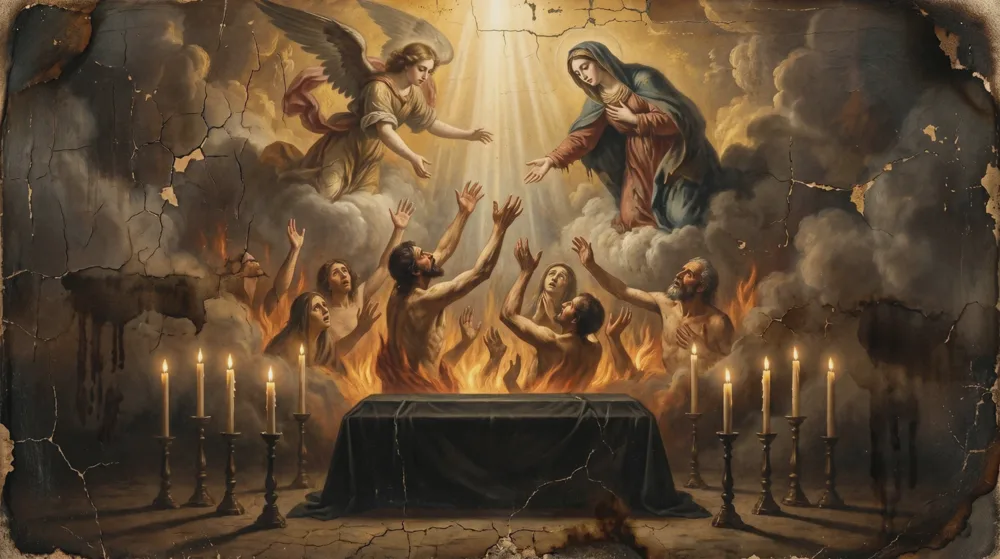
The Eternal Rest prayer is the Church's short prayer for the dead: "Eternal rest grant unto them, O Lord, and let perpetual light shine upon them. May they rest in peace." We pray it for the faithful departed who are being purified in purgatory, asking God to admit them at last into the light of heaven. This is the prayer behind the Latin word Requiem — from Requiem aeternam dona eis, Domine — and it is one of the surest acts of charity a Christian can perform for someone he loves.
The prayer for the dead
Eternal rest grant unto them, O Lord,
and let perpetual light shine upon them.
May they rest in peace. Amen.
When said for one soul, the words change to the singular: Eternal rest grant unto him (or her), O Lord, and let perpetual light shine upon him.
The Latin: Requiem aeternam
The prayer has a fixed traditional Latin form. It opens the Introit of the Requiem Mass, the Mass offered for the dead, and gives that Mass its name.
Requiem aeternam dona eis, Domine,
et lux perpetua luceat eis.
Requiescant in pace. Amen.
For a single soul: Requiem aeternam dona ei, Domine, et lux perpetua luceat ei. Requiescat in pace. Amen. The words come from the liturgy itself, which is why the prayer is so old and so universal: every Catholic burial, every visit to a grave, every All Souls' Day carries it.
Eternal rest grant unto him, her, and them
The same prayer is said for one person or for many; only the pronoun changes. Catholics keep all three forms ready, because we pray now for one soul, now for a whole company of the dead.
For a man: Eternal rest grant unto him, O Lord, and let perpetual light shine upon him. May he rest in peace. Amen.
For a woman: Eternal rest grant unto her, O Lord, and let perpetual light shine upon her. May she rest in peace. Amen.
For many: Eternal rest grant unto them, O Lord, and let perpetual light shine upon them. May they rest in peace. Amen.
In Latin the singular forms read Requiem aeternam dona ei, Domine... Requiescat in pace, and the plural dona eis... Requiescant in pace. The "o Lord" of the English ("eternal rest grant unto him, O Lord") simply renders the Latin Domine — the direct address to God to whom the petition is made.
What it means
To understand why we pray for the dead at all, we must hold the doctrine of purgatory. The Catechism of the Council of Trent teaches plainly that beyond hell "there is another hell where is the fire of Purgatory," in which "the souls of the just are purified in sufferings which last a determined time, until they be worthy to enter into the eternal Country, for nothing defiled can penetrate therein." Many who die in the grace of God still carry "some stain to wash away and some debt to pay," and so they go "to purify themselves by the fire of Purgatory." They are saved — but not yet home. You can read the fuller teaching in our article on what purgatory is, and on what happens after death.
The two halves of the prayer name exactly what these souls lack. We ask first for rest — requiem — because they are still in suffering, still working out the last of their purification. We ask second for perpetual light — lux perpetua — which is the light of the face of God, the vision of heaven they were made for and do not yet possess. To pray "eternal rest" is therefore to ask God to bring this purification to its end and to open heaven's gates to the soul.
Eternal rest meaning
The phrase means exactly what it says: we are asking God to grant the dead rest — release from the labour of purification — and eternal rest, the unending peace of heaven that has no more night and no more suffering. "Eternal rest" is not the sleep of annihilation; the soul is fully awake and alive. It is the rest of arrival, the soul at last at home in God, its longing satisfied. The Latin requiem carries the same sense: a ceasing from toil, the Sabbath rest that the Letter to the Hebrews promises to the people of God.
Rest in eternal peace: meaning
"Rest in eternal peace" — and the familiar "may he rest in eternal peace" or "may his soul rest in eternal peace" — is the closing line of the prayer turned into a blessing over the dead. It renders the Latin Requiescat in pace, the source of the letters R.I.P. carved on Christian gravestones for centuries. R.I.P. does not mean "rest in peace" as a mere farewell; it is a prayer — "may he rest in peace" — a petition that the soul be granted the peace of God. When we say "may he rest in eternal peace" we are not stating that he already does, but asking God that he may. That is why the words belong on a grave: they invite every passer-by to pray for the one buried there.
The prayer rests on a truth the Church calls the Communion of Saints. The Catechism of St Pius X teaches that "the Communion of Saints extends also to heaven and to purgatory, because charity unites the three Churches: Triumphant, Suffering, and Militant." The Church in heaven is triumphant, the Church on earth is militant, and "the souls in purgatory" form the Church Suffering.
Because one charity binds all three, the same catechism teaches that "we can relieve the souls in purgatory by applying in their favour Masses, alms, indulgences, and other good works." The holy souls cannot merit for themselves any longer; their time of meriting ended at death. But we who are still in the fight can offer for them. Our prayer reaches across that frontier. We treat this bond more fully in our article on the Communion of Saints.
This is why the prayer for the dead is not sentiment but justice and mercy together. The souls in purgatory are real members of the Church, near to glory and unable to hasten it themselves. To leave them unprayed-for is to forget our own family. The Catechism of St Pius X lists them among those for whom every Christian is bound to pray: "for ourselves, for our parents, superiors, benefactors, friends, and enemies... and for the holy souls in purgatory."
How we help the holy souls
The highest help is the Holy Sacrifice of the Mass. The Catechism of St Pius X teaches that the Mass is offered "to relieve the souls in purgatory," and that "those for whom the Mass is applied... may be either the living or the dead." Of all the things we can do for a departed soul, having Mass offered for him is the greatest, because it applies to him the very sacrifice of Christ. After the Mass come our prayers, our almsgiving, the indulgences the Church grants, and our own penances offered on their behalf.
The Eternal Rest prayer is the simplest of these helps and the one always within reach. The same catechism counsels the old Catholic habit: "When I hear the bell toll the death of someone, I will strive to say a De profundis or a Requiem for the soul of the deceased." A few words said at the sound of a passing bell, at a graveside, or at the news of a death is a true work of mercy.
When to pray it
We pray the Eternal Rest prayer whenever the dead are brought to mind:
- At the news of a death, and at funerals, wakes, and burials.
- When visiting a grave or cemetery, for the one buried there and for all who lie nearby.
- On the anniversary of a parent's, spouse's, or friend's death.
- Throughout November, the month of the holy souls, and above all on All Souls' Day (2 November), when the whole Church prays for the dead.
- Daily, as a fixed habit — added to night prayers, or said at the end of the Rosary, for all the faithful departed.
It is the custom to add the prayer after other prayers as a closing intention, so that no day passes without a thought for those who have gone before us.
The Eternal Rest prayer at a funeral
At a Catholic funeral the Eternal Rest prayer is everywhere, because the whole rite is built around it. The Requiem Mass takes its very name from the opening words of its Introit — Requiem aeternam dona eis, Domine — and the prayer returns at the absolution over the coffin and at the graveside, where the priest prays Requiem aeternam dona ei, Domine and the people answer Et lux perpetua luceat ei. Mourners can and should pray it silently throughout the rite, and again as the body is lowered into the ground.
For those attending a funeral, it is the right prayer to carry on the lips: short enough to remember, fitted exactly to the moment, and a real act of charity for the one being buried rather than a mere expression of grief. Those choosing readings for the service will find the Church's own selection among the traditional Bible verses for funerals. It is also the prayer to say afterward, on the anniversary and on visits to the grave, when the funeral is long past but the soul may still be in purgatory and still in need.
Can we pray the Eternal Rest prayer for pets?
The Eternal Rest prayer is a prayer for the souls in purgatory — that is, for departed human beings being purified before heaven. Animals do not have rational, immortal souls and so do not undergo purgatory or enter heaven in the way persons do; there is no purification to pray for and no debt to remit. For that reason the prayer, properly understood, is not said for pets.
This is no coldness toward the animals God has given us. We may rightly thank God for the creatures that have served and gladdened us, and the Church blesses animals in life — for example on the feast of St Anthony the Abbot or St Francis. But the Eternal Rest prayer belongs to the holy souls. To redirect it to a pet would empty it of its meaning, which is the relief of a person suffering in purgatory. Our grief for an animal is real and good; it is simply not what this prayer is for.
Frequently Asked Questions
What is the Eternal Rest prayer?
It is the Church's short prayer for the dead: Eternal rest grant unto them, O Lord, and let perpetual light shine upon them. May they rest in peace. We pray it for the faithful departed being purified in purgatory, asking God to admit them at last into the light of heaven. It is the prayer behind the Latin word Requiem.
What is the Eternal Rest prayer in Latin?
The fixed traditional Latin form is Requiem aeternam dona eis, Domine, et lux perpetua luceat eis. Requiescant in pace. Amen. For a single soul it becomes dona ei... luceat ei... Requiescat in pace. The words open the Introit of the Requiem Mass and give that Mass its name.
Why do Catholics pray for the dead?
Because many who die in the grace of God still carry some stain to wash away and some debt to pay, and so are purified in purgatory. The Communion of Saints binds the Church Triumphant, Suffering, and Militant in one charity, and the holy souls can no longer merit for themselves. We who are still in the fight can offer for them by Masses, alms, indulgences, and prayer.
What does the prayer actually ask for?
Its two halves name exactly what the holy souls lack. We ask first for rest — requiem — because they are still in the suffering of purification, and second for perpetual light — lux perpetua — the light of the face of God, the vision of heaven they were made for and do not yet possess. To pray it is to ask God to bring their purification to its end.
When should the Eternal Rest prayer be said?
Whenever the dead are brought to mind: at the news of a death and at funerals; when visiting a grave; on the anniversary of a death; throughout November and above all on All Souls' Day (2 November); and daily, as a fixed habit added to night prayers or the end of the Rosary. The old custom is to say it at the sound of a passing bell.
What does "rest in eternal peace" mean?
It is the closing line of the prayer — Requiescat in pace, the source of R.I.P. on gravestones — turned into a blessing over the dead. It is not a statement that the soul is already at peace, but a petition that God may grant it. "May he rest in eternal peace" and "may his soul rest in eternal peace" are short forms of the same prayer, asking that the departed reach the unending peace of heaven.
Can I pray the Eternal Rest prayer for a pet?
No. The prayer is for the holy souls in purgatory — departed persons being purified before heaven. Animals do not have immortal, rational souls and do not undergo purgatory, so there is nothing the prayer is asking for on their behalf. We may thank God for the creatures he gave us, but this prayer belongs to the faithful departed.
What is the difference between "him," "her," and "them" in the prayer?
Only the pronoun changes with whom we pray for. For a man: grant unto him... shine upon him... may he rest in peace. For a woman: grant unto her... may she rest. For many souls at once: grant unto them... may they rest. In Latin the singular is ei / Requiescat and the plural eis / Requiescant.
We say it best in the plural, for the whole Church Suffering at once: Eternal rest grant unto them, O Lord, and let perpetual light shine upon them. May they rest in peace. What we ask for them today, others will one day ask for us. That is the Communion of Saints, and the Eternal Rest prayer is its plainest and most faithful expression.
The Iter Fidei app serves this prayer in Latin and in your own language, with audio to pray along, so you can keep the holy souls in your daily prayer. Join early access here.
Sources. Catechism of the Council of Trent (1566), on the Fifth Article of the Creed (the descent into hell; the fire of purgatory) and on the Ninth Article (the Communion of Saints), and on the petition "Deliver us from evil" of the Lord's Prayer. Catechism of St Pius X (1908), on the Ninth Article of the Creed (the Church Triumphant, Suffering, and Militant; relieving the souls in purgatory), on prayer in general (for whom we ought to pray), on the Holy Sacrifice of the Mass (the Mass applied for the dead), and on pious exercises (the Requiem at the passing bell).