
Prayer
Prayer for Protection: Psalm 91, St Michael, Guardian Angel
Traditional Catholic prayers for protection: Psalm 90 (91) in the Douay-Rheims, the prayer to St Michael, the Guardian Angel prayer, the night and morning prayers of the Breviary, St Patrick's Breastplate and the St Benedict medal.
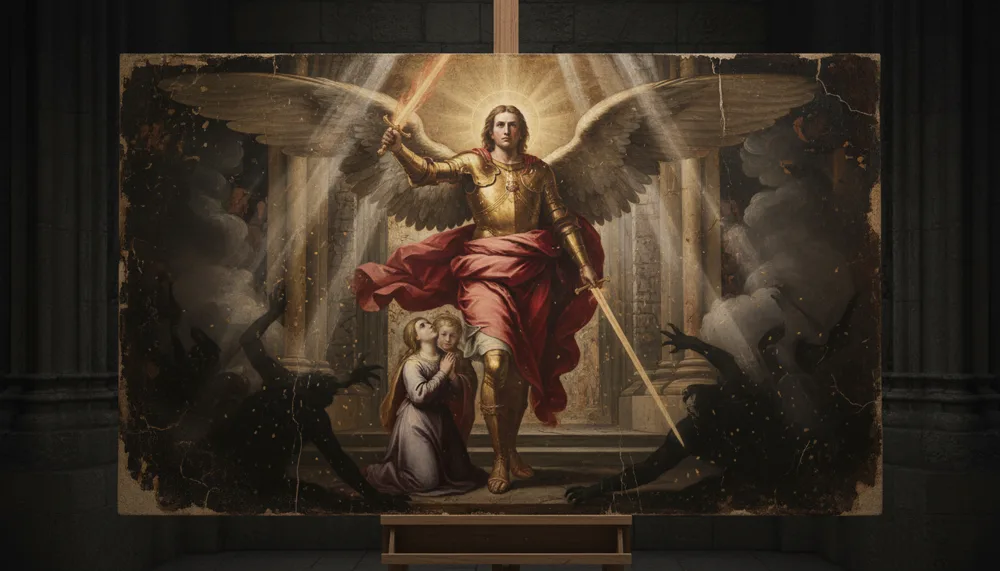
A Catholic prayer for protection is a petition to God: that He guard soul and body, family and home, from sin, from danger and from the snares of the devil. The Church has given us her surest words for it in Scripture and in her liturgy: Psalm 90 (91 in the Hebrew numbering), the prayer to St Michael the Archangel, the Guardian Angel prayer, the night and morning prayers of the Breviary, and the Sub tuum praesidium. Here are those texts in full, in the Douay-Rheims and the traditional English forms, for the night, for the family, for the road and for the home.
Psalm 90 (91): the great prayer of protection
No prayer for protection is surer than this psalm, because God Himself put it into the mouth of His people. It is Psalm 90 in the Latin Vulgate and the Douay-Rheims, and Psalm 91 in Bibles that follow the Hebrew numbering; it is the same text. Here it is in full:
He that dwelleth in the aid of the most High, shall abide under the protection of the God of Jacob. He shall say to the Lord: Thou art my protector, and my refuge: my God, in him will I trust. For he hath delivered me from the snare of the hunters: and from the sharp word. He will overshadow thee with his shoulders: and under his wings thou shalt trust. His truth shall compass thee with a shield: thou shalt not be afraid of the terror of the night.
Of the arrow that flieth in the day, of the business that walketh about in the dark: of invasion, or of the noonday devil. A thousand shall fall at thy side, and ten thousand at thy right hand: but it shall not come nigh thee. But thou shalt consider with thy eyes: and shalt see the reward of the wicked. Because thou, O Lord, art my hope: thou hast made the most High thy refuge.
There shall no evil come to thee: nor shall the scourge come near thy dwelling. For he hath given his angels charge over thee; to keep thee in all thy ways. In their hands they shall bear thee up: lest thou dash thy foot against a stone. Thou shalt walk upon the asp and the basilisk: and thou shalt trample under foot the lion and the dragon.
Because he hoped in me I will deliver him: I will protect him because he hath known my name. He shall cry to me, and I will hear him: I am with him in tribulation, I will deliver him, and I will glorify him. I will fill him with length of days; and I will shew him my salvation. (Psalm 90 [91], 1-16, Douay-Rheims)
The Roman Breviary sings it at Sunday Compline, between Psalm 4 and Psalm 133, and Benedictine monks say it every night, since their Compline repeats those three psalms daily. The Missal makes it the Tract of the First Sunday of Lent, whose Gospel is the temptation in the desert: there the devil himself quotes two verses of this psalm to tempt Our Lord (Matthew 4:6), and is driven off by the word of God.
Notice what the psalm actually promises. It does not promise that nothing will ever touch us; it promises that God Himself is the refuge, that His angels are charged to keep us, and that He is with us in tribulation, not only after it. The shield is a Person, the living God.
The prayer to St Michael the Archangel
After the psalm, the Church turns us to the prince of the heavenly host. In 1886 Pope Leo XIII added this short prayer to the prayers said at the foot of the altar after every Low Mass, and there it remained until the liturgical changes of the 1960s:
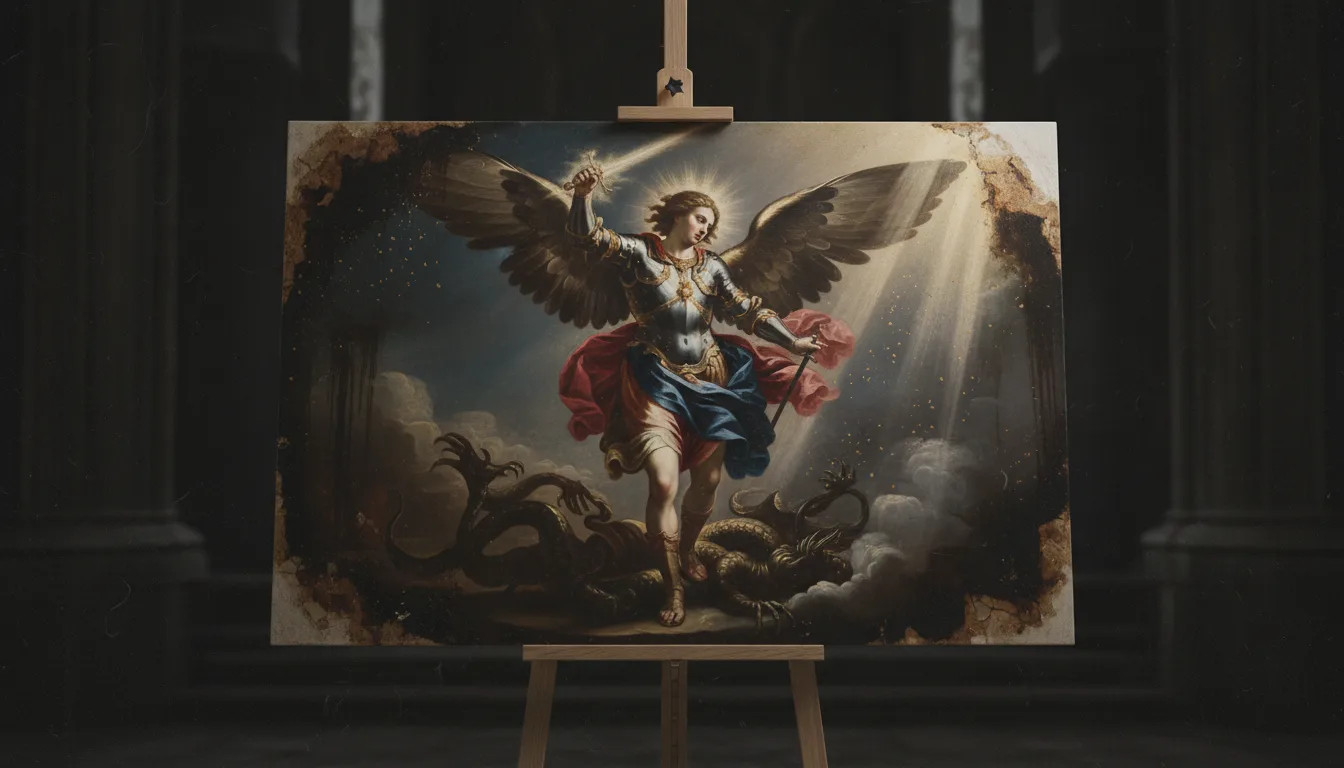
Saint Michael the Archangel, defend us in battle; be our protection against the malice and snares of the devil. May God rebuke him, we humbly pray; and do thou, O Prince of the heavenly host, by the power of God, cast into hell Satan and all the evil spirits who wander through the world for the ruin of souls. Amen.
It is short enough to learn in a single reading, so that the soul under assault can reach for it at once, without a book. Every word turns to God: "May God rebuke him", "by the power of God". The Christian commands nothing in his own name. It should not be confused with the long exorcism the same Pope published in 1890, which the faithful may also pray privately against the devil's influence (the full Latin text, with audio, is in the Join early access here.), nor with the solemn exorcism of a possessed person, reserved to the priest authorised by the bishop. For the Latin text and the history of the short prayer, see The Prayer to St Michael the Archangel.
A prayer for protection from evil and from enemies
When the petition is against the powers of darkness, the St Michael prayer is the Church's first answer. Against visible enemies, the Psalter gives David's own words as he hands his cause to God: "Judge thou, O Lord, them that wrong me: overthrow them that fight against me. Take hold of arms and shield: and rise up to help me" (Psalm 34 [35]:1-2). Psalm 33 (34), whose antiphon opens Wednesday Compline, promises: "The angel of the Lord shall encamp round about them that fear him: and shall deliver them" (verse 8). The Christian does not curse those who wish him harm; he asks to be kept safe and prays for them, as Our Lord commands: "Love your enemies: do good to them that hate you: and pray for them that persecute and calumniate you" (Matthew 5:44).
The Guardian Angel prayer
We are never alone in the fight. God has given each of us an angel to keep us, which is the very promise of Psalm 90: "he hath given his angels charge over thee; to keep thee in all thy ways." The Church puts the Angele Dei on our lips, in its familiar English verse form:
Angel of God, my Guardian dear, to whom God's love commits me here; ever this day be at my side, to light and guard, to rule and guide. Amen.
It is the classic bedtime prayer for children, short enough to learn by heart. For its Latin original and the doctrine of the holy angels, see The Guardian Angel Prayer (Angel of God).
A prayer for safe travel and protection on the road
The Roman Breviary has its own prayer for setting out, the Itinerarium, which calls on the archangel who guarded young Tobias on his journey. We translate its antiphon and first collect from the Latin of the Breviary:
May the almighty and merciful Lord direct us into the way of peace and prosperity, and may the Angel Raphael accompany us on the way, that we may return home in peace, health and joy.
O God, who didst make the children of Israel walk dry-shod through the midst of the sea, and didst open to the three Wise Men the way to Thee by the guidance of a star: grant us, we beseech Thee, a prosperous journey and a peaceful time, that with Thy holy Angel as our companion we may happily reach the place to which we are going, and at length the haven of eternal salvation. Through Christ our Lord. Amen.
St Raphael, whose name means "God heals", is invoked both for travellers and for the sick, which is why the Church joins protection and healing so easily. His story is told in St Raphael the Archangel, and his feast on October 24 is prepared by the Novena to St Raphael the Archangel.
A night prayer for protection: Compline
The hours of sleep are when the soul is most defenceless, and the Church has always armed the night with prayer. Her night office, Compline, opens with a blessing: "May almighty God grant us a quiet night and a perfect end." It sings the response "Into thy hands, O Lord, do I commend my spirit," and frames the Canticle of Simeon with this antiphon, which anyone can say at the bedside:
Protect us, Lord, while we are awake and safeguard us while we sleep; that we may keep watch with Christ, and rest in peace.
The prayer of the office is the Visita, quaesumus, the finest prayer for the protection of a house in the whole Roman liturgy:
Visit, we beseech thee, O Lord, this dwelling, and drive far from it the snares of the enemy; let thy holy angels dwell herein to preserve us in peace, and let thy blessing be always upon us. Through Christ our Lord. Amen.
A father or mother can say it each evening in the name of the whole household, after the examination of conscience and an act of contrition. The full office, its psalms and its Marian antiphons are in Compline: Night Prayer. Its first psalm gives the last word of the day: "In peace in the self same I will sleep, and I will rest: For thou, O Lord, singularly hast settled me in hope" (Psalm 4:9-10).
A morning prayer for protection
As the night is sealed with prayer, so the day is opened with it. At Prime, the first hour of the day, the Breviary has this collect, which asks God's protection first of all against sin. We translate it from the Latin:
O Lord God Almighty, who hast brought us to the beginning of this day, save us this day by Thy power, that we may fall into no sin this day, but that our words may ever proceed, and our thoughts and works be directed, to the doing of Thy justice. Through Christ our Lord. Amen.
Joined to the Sign of the Cross and the Guardian Angel prayer, it gives the day to God before we have lived an hour of it. For work, for a hard decision, for a step into the unknown, Psalm 120 (121) supplies the promise: "The Lord keepeth thee from all evil: may the Lord keep thy soul. May the Lord keep thy coming in and thy going out; from henceforth now and for ever" (verses 7-8).
A prayer for family protection and for the home
For the family, the Church looks to the home at Nazareth. The 1962 Missal gives, on the feast of the Holy Family (the first Sunday after Epiphany), this collect, which any household can make its own. We translate it from the Latin:
O Lord Jesus Christ, who, being subject to Mary and Joseph, didst hallow home life with virtues beyond words: grant that, by the help of them both, we may be taught by the example of Thy Holy Family and attain to its everlasting fellowship. Who livest and reignest world without end. Amen.
The man God chose as guardian of the Holy Family guards the homes that entrust themselves to him; Pope Pius IX declared him Patron of the Universal Church in 1870. For the house itself, the Visita, quaesumus above is the Church's own prayer. The Roman Ritual provides for the blessing of homes by a priest in Eastertide, and custom adds the Epiphany blessing; holy water at the door and a crucifix on the wall remind the household each day to whom the house belongs. To pray for a son, a daughter or a grandchild, the Guardian Angel prayer and the Holy Family collect serve well, naming the child; more is in A Prayer for My Children.
Under Our Lady's protection: the Sub tuum and the Memorare
The oldest known prayer to Our Lady is itself a prayer for protection. The Sub tuum praesidium is found, in Greek, on an Egyptian papyrus usually dated to the third or fourth century:
We fly to thy protection, O holy Mother of God. Despise not our petitions in our necessities, but deliver us always from all dangers, O glorious and blessed Virgin. Amen.
With it goes the Memorare, traditionally ascribed to St Bernard and spread in the seventeenth century by the priest Claude Bernard:
Remember, O most gracious Virgin Mary, that never was it known that anyone who fled to thy protection, implored thy help, or sought thy intercession, was left unaided. Inspired with this confidence, I fly unto thee, O Virgin of virgins, my Mother; to thee do I come; before thee I stand, sinful and sorrowful. O Mother of the Word Incarnate, despise not my petitions, but in thy mercy hear and answer me. Amen.
Its history and use are in The Memorare.
St Patrick's Breastplate
Many people looking for a "shield" prayer for protection mean the Lorica, or Breastplate, of St Patrick. In honesty: Irish tradition attributes it to the Apostle of Ireland, but most scholars date the Old Irish text that has come down to us to a later age, around the seventh or eighth century. It is a very ancient prayer, wholly Trinitarian and centred on Christ. Here is part of it, in the translation printed in the Catholic Encyclopedia of 1913:
I bind to myself today God's Power to guide me, God's Might to uphold me, God's Wisdom to teach me, God's Eye to watch over me, God's Ear to hear me, God's Word to give me speech, God's Hand to guide me, God's Way to lie before me, God's Shield to shelter me, God's Host to secure me, against the snares of demons, against the seductions of vices, against the lusts of nature, against everyone who meditates injury to me, whether far or near, whether few or with many.
Christ, protect me today against every poison, against burning, against drowning, against death-wound, that I may receive abundant reward. Christ with me, Christ before me, Christ behind me, Christ within me, Christ beneath me, Christ above me, Christ at my right, Christ at my left, Christ in the heart of everyone who thinks of me, Christ in the mouth of everyone who speaks to me, Christ in every eye that sees me, Christ in every ear that hears me. I bind to myself today the strong virtue of an invocation of the Trinity, I believe the Trinity in the Unity, the Creator of the Universe.
The Sign of the Cross, holy water and the St Benedict medal
The briefest prayer for protection is the Sign of the Cross, which Christians were already tracing on their foreheads before every action in the time of Tertullian:
In the name of the Father, and of the Son, and of the Holy Ghost. Amen.
Among the saints, St Benedict has long been invoked against the assaults of the enemy. His medal carries, in initials around the cross, a prayer of combat. Here is the Latin and its translation:
Crux sacra sit mihi lux, non draco sit mihi dux. Vade retro, Satana, nunquam suade mihi vana; sunt mala quae libas, ipse venena bibas. May the holy Cross be my light; let not the dragon be my guide. Begone, Satan! Never counsel me vain things; what thou offerest me is evil: drink thou thine own poison.
The letters were found in 1647 painted on the walls of the abbey of Metten in Bavaria and explained by a manuscript of 1415; Benedict XIV approved the medal by his briefs of 1741 and 1742. The other face bears the words Crux Sancti Patris Benedicti, "the Cross of our holy Father Benedict". The saint's intercession is asked at length in the Novena to St Benedict.
One word, once, about the spirit of all this. A medal, holy water and the Sign of the Cross are not amulets. They are sacramentals: signs blessed by the Church that move us to prayer, through which God freely gives His grace. They do not work like a charm that a syllable said wrongly would break. The Roman Catechism counts superstition among the sins against the First Commandment. The power is always God's; ours is the trust.
Frequently Asked Questions
What is the most powerful Catholic prayer for protection?
The power is in God, not in a formula. The Church gives first place to Psalm 90 (91), which she sings at Sunday Compline and on the First Sunday of Lent, and to the Prayer to St Michael the Archangel of Leo XIII. Both turn wholly to God, and that is their strength.
What is a good short prayer for protection?
The Sign of the Cross; the Sub tuum praesidium, "We fly to thy protection, O holy Mother of God"; and the Compline antiphon, "Protect us, Lord, while we are awake and safeguard us while we sleep." All three can be said in a few seconds, without a book.
Is there a Catholic prayer for protection from evil spirits?
Yes: the short Prayer to St Michael the Archangel, against "the malice and snares of the devil." It does not command the demons in our own name; every petition appeals to the power of God. The longer exorcism of Leo XIII may also be prayed privately, in a state of grace and with humility, without addressing the demons; it is not the solemn exorcism of a possessed person, which belongs to the priest authorised by the bishop.
What is a good night prayer for protection?
The prayers of Compline: Psalm 90, the antiphon "Protect us, Lord, while we are awake and safeguard us while we sleep," and the collect "Visit, we beseech thee, O Lord, this dwelling." For children, the Guardian Angel prayer learned by heart is the classic.
What is a good prayer for family protection and guidance?
The collect of the Holy Family from the 1962 Missal, said together, with the Visita, quaesumus for the house and a confident recourse to St Joseph, guardian of Jesus and Mary. For guidance in a decision, the Prime collect asks that "our thoughts and works be directed" to God's justice.
Is there a Catholic prayer for safe travel and protection?
Yes. The Roman Breviary's Itinerarium asks that "the Angel Raphael accompany us on the way, that we may return home in peace, health and joy," followed by the collect for a prosperous journey given above.
Is there a prayer for healing and protection?
Psalm 90 itself promises that "the scourge" shall not come near the dwelling of one who trusts in God, and the Church invokes St Raphael, whose name means "God heals", for the sick as well as for travellers. We ask in confidence and leave the manner of the answer to God.
Does the St Benedict medal protect by itself?
No. It is a sacramental approved by Benedict XIV: worn with faith, it is a continual prayer against the enemy, and the grace comes from God alone. It is customary to have it blessed by a priest.
Iter Fidei brings you these prayers and psalms in Latin and English with audio, along with the Divine Office of the 1962 Breviary and the traditional calendar. Join early access here.
Sources. Psalms 90 (91), 4, 33 (34), 34 (35) and 120 (121), Matthew 4 and 5, Douay-Rheims Bible; Roman Breviary (Compline, Prime, Itinerarium); Roman Missal of 1962 (First Sunday of Lent, Holy Family); the Prayer to St Michael the Archangel, Pope Leo XIII (1886); Angele Dei, Sub tuum praesidium, Memorare; the Lorica of St Patrick; briefs of Benedict XIV on the St Benedict medal (1741-1742); the Roman Catechism.