
Prayer
The Glory Be (Gloria Patri)
The Glory Be prayer — full text in English and the Latin Gloria Patri. The little doxology to the Holy Trinity, its meaning grounded in the catechism, and when to pray it.
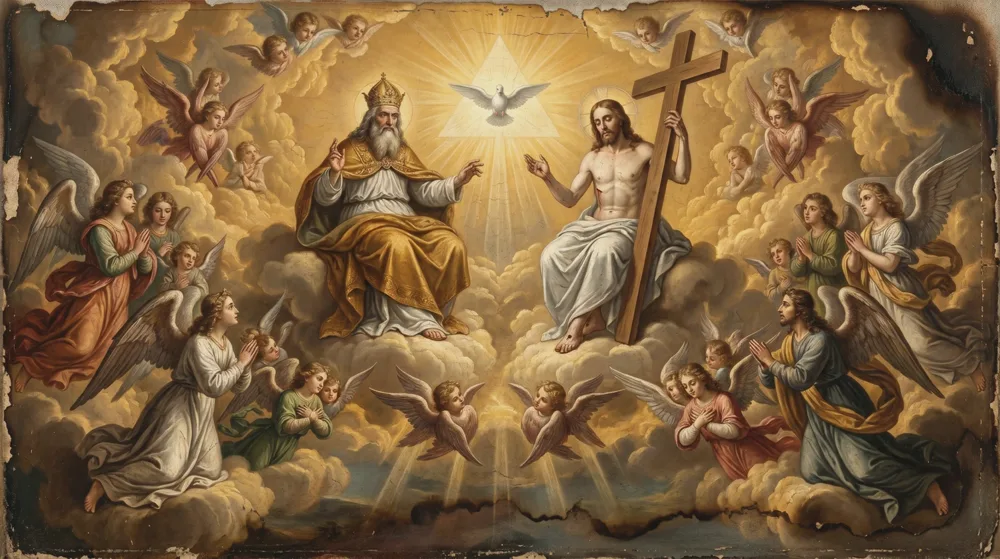
The Glory Be is the Church's little doxology, a short prayer of praise to the Most Holy Trinity — Glory be to the Father, and to the Son, and to the Holy Ghost. It is one of the shortest and most constantly repeated prayers of the faithful, said in the Rosary, in the Divine Office, and through the day. In its traditional Latin form it is known as the Gloria Patri, and the Catechism of the Council of Trent calls it "that magnificent praise of the Holy Trinity which concludes the Psalms and the sacred Canticles."
The Glory Be prayer
This is the prayer in its traditional English wording:
Glory be to the Father, and to the Son,
and to the Holy Ghost.
As it was in the beginning, is now,
and ever shall be, world without end. Amen.
The Gloria Patri in Latin
The Glory Be has an ancient and continuous Latin form, the Gloria Patri, sung and recited in the Roman rite for centuries — after every psalm at the Office, at the foot of the altar, and throughout the prayers of the Church:
Gloria Patri, et Filio, et Spiritui Sancto.
Sicut erat in principio, et nunc, et semper,
et in saecula saeculorum. Amen.
The Glory Be in Spanish (Gloria al Padre)
In Spanish the Glory Be is the Gloria al Padre, said in the same places — the Rosary, the Office, and through the day — by the faithful of every Spanish-speaking land:
Gloria al Padre, y al Hijo, y al Espíritu Santo.
Como era en el principio, ahora y siempre,
por los siglos de los siglos. Amén.
It is the same prayer, word for word, as the English and the Latin: praise to the three divine Persons, then the confession that this glory is from the beginning and without end. Wherever the Rosary is prayed, this is how the decade is sealed.
What the Glory Be means
The Glory Be is a doxology — a word of glory. It does not ask for anything. It gives. In it we confess and adore the central mystery of the Faith: that there is one God in three Persons, the Father, the Son, and the Holy Ghost. The whole prayer is built around that order of the three divine Persons, and the catechism teaches it precisely as a praise of the Trinity.
Glory to the three Persons
When we say Glory be to the Father, and to the Son, and to the Holy Ghost, we name the three Persons of the one Godhead. The Catechism of the Council of Trent sets out exactly what we are confessing: "There are in truth three Persons in one single and self-same Godhead: that of the Father, who is begotten of no other; that of the Son, who is begotten of the Father before all ages; that of the Holy Ghost, who proceedeth from the Father and the Son, from all eternity." The Father, the catechism continues, "with His only Son and the Holy Ghost He formeth one only God, one only Lord."
The little word and — to the Father, and to the Son, and to the Holy Ghost — guards the whole mystery. We do not give a greater glory to the first Person and a lesser to the others. The catechism is emphatic on this point: in the three Persons we proclaim "the same eternity, the same glory, and the same majesty," and we "must not believe that we mean to suppose in the Trinity anything first and last, greater and lesser."
So the Holy Ghost "is God, like the Father and the Son," the Trent catechism teaches, "equal to them in all things, Almighty like them, eternal like them." The Glory Be confesses that equal glory in a single breath. To the truth of the Trinity we offer one undivided act of praise. This is the mystery we set out more fully in The Holy Trinity.
That is also why the Glory Be is the natural companion of The Sign of the Cross, in which the same three Persons are named while the cross is traced upon us. Both prayers do the same thing: they place us, body and voice, before the one God in three Persons.
As it was in the beginning, world without end
The second half of the Glory Be — As it was in the beginning, is now, and ever shall be, world without end — answers the praise of the first half. It confesses that the glory of God is not something we begin to give now, nor something that will pass away. The Trinity is eternal. The catechism teaches that the Father is "the principle without principle," that the Son is "begotten of the Father before all ages," and that the Holy Ghost proceeds "from all eternity." The glory we render, therefore, only joins a glory that the three Persons have possessed of themselves from before the world was made — as it was in the beginning — and that ever shall be, world without end. Our doxology is a small echo, in time, of an eternal majesty.
In this the Glory Be teaches us what worship is. The first end of prayer, and the highest, is to adore God for His own sake — to give Him glory because He is God, before we ask Him for anything. The Catechism of St Pius X teaches that adoration is the chief act of the virtue of religion, the homage the creature owes the Creator. The Glory Be is that homage in its purest, shortest form: praise of the Blessed Trinity asking nothing in return.
A summary of the Faith in two lines
For all its brevity, the Glory Be holds the same truth the Creed unfolds at length. The Creed opens with the Father almighty, confesses the Son begotten of the Father, and professes faith in the Holy Ghost; the Glory Be gathers all three into one act of praise. To pray it is to profess, every time, what the Apostles' Creed sets out article by article — that the one God we adore is Father, Son, and Holy Ghost. The shortest prayer and the rule of faith confess the same God.
What "glory be to God" means
The opening words — glory be to God — say plainly what the whole prayer does. To give glory to God is to acknowledge His infinite excellence and to refer it back to Him in praise. Scripture commands this directly: "whether you eat or drink, or whatsoever else you do, do all to the glory of God" (1 Cor 10:31), and "to the only God our Saviour ... be glory and magnificence, empire and power, before all ages, and now, and for all ages of ages" (Jude 1:25).
The Glory Be takes that scriptural command and makes it a daily act, naming the three Persons to whom the one glory is due. So glory be to God is not a wish that God may become more glorious — He cannot — but our creaturely confession that all glory already belongs to Him.
"Glory be to God in the highest" and the Gloria of the Mass
The phrase glory be to God in the highest is sometimes confused with the Glory Be, but it belongs to a different and longer prayer: the Gloria in excelsis Deo, the Greater Doxology sung at Mass. It opens with the song of the angels at Bethlehem — "Glory to God in the highest, and on earth peace to men of good will" (Lk 2:14) — and unfolds into a long hymn of praise to the Father and to Christ the Lamb. The Glory Be, by contrast, is the Lesser Doxology, the short Gloria Patri of two lines. Both praise the Trinity; the one at the altar in the angels' words, the other after every psalm in the Church's own.
When to pray the Glory Be
The Glory Be belongs above all to the Rosary. We say Glory be to the Father at the end of each decade, after the ten Hail Marys, so that the meditation on the mysteries of Christ closes, each time, in praise of the Trinity who wrought our salvation. If you wish to learn the structure of that devotion, see How to Pray the Rosary.
It belongs no less to the Divine Office, the public prayer of the Church. There the Gloria Patri is sung or said at the end of every psalm and canticle — which is why the Trent catechism describes it as the praise "which concludes the Psalms and the sacred Canticles." The Church takes each psalm of David and seals it with the confession of the Trinity, turning the whole Psalter into Christian prayer.
Beyond these, the Glory Be is a prayer for the whole day. We add it to the Our Father and the Hail Mary; we say it in thanksgiving for a grace received; we use it to close a time of prayer. Because it is so short and asks nothing, it can be said at any moment — a word of glory lifted to the Father, and to the Son, and to the Holy Ghost, in the midst of any work.
The Our Father, the Hail Mary, and the Glory Be
These three are the first prayers a Catholic learns and the building-blocks of the Rosary. They fit together in a clear order. The Our Father is the prayer Christ Himself taught, addressed to God the Father; the Hail Mary asks the prayers of His Mother; and the Glory Be closes by giving glory to the whole Trinity. Petition, intercession, and praise — the three movements of all Christian prayer in a single string of beads. Said together they form a complete little act of worship: we ask God for our needs, we beg Our Lady's help, and we end by giving God the glory. To learn each one in turn, see The Our Father and The Hail Mary.
"The glory of God is a human being fully alive"
This much-quoted line comes from St Irenaeus of Lyons (2nd century), in his Against Heresies (IV, 20, 7). His full sentence is fuller and more exact than the popular shortened version: "the glory of God is a living man, and the life of man is the vision of God." Irenaeus is not saying that man's self-fulfilment is itself God's glory, as the clipped quotation is sometimes made to suggest. He is saying that man comes alive — truly lives — when he beholds God, and that this living creature, raised to the sight of his Maker, redounds to God's glory. Read whole, it points exactly where the Glory Be points: man's true life is to know and adore the living God, and in that adoration God is glorified.
Frequently Asked Questions
What is the Glory Be prayer?
The Glory Be is the Church's little doxology, a short prayer of praise to the Most Holy Trinity: "Glory be to the Father, and to the Son, and to the Holy Ghost. As it was in the beginning, is now, and ever shall be, world without end. Amen." It asks for nothing; it gives glory. In its traditional Latin form it is the Gloria Patri, and the Catechism of the Council of Trent calls it "that magnificent praise of the Holy Trinity which concludes the Psalms and the sacred Canticles."
What is the Glory Be prayer in Latin?
In Latin it is the Gloria Patri: "Gloria Patri, et Filio, et Spiritui Sancto. Sicut erat in principio, et nunc, et semper, et in saecula saeculorum. Amen." This is the form sung and recited in the Roman rite for centuries — after every psalm at the Divine Office, at the foot of the altar, and throughout the prayers of the Church.
What does the Glory Be mean?
It is a doxology — a word of glory — that confesses and adores the central mystery of the Faith: one God in three Persons, Father, Son, and Holy Ghost. The little word and guards their equality: we give "the same eternity, the same glory, and the same majesty" to all three. The second half — "as it was in the beginning, is now, and ever shall be" — confesses that this glory is eternal; our praise only joins a glory the Trinity has possessed of itself from before the world was made.
When do you pray the Glory Be?
The Glory Be belongs above all to the Rosary, said at the end of each decade after the ten Hail Marys. It belongs no less to the Divine Office, sung at the end of every psalm and canticle. Beyond these it is a prayer for the whole day: added to the Our Father and the Hail Mary, said in thanksgiving for a grace, or used to close a time of prayer. Because it is so short and asks nothing, it can be said at any moment.
How do you say the Glory Be in Spanish?
In Spanish it is the Gloria al Padre: "Gloria al Padre, y al Hijo, y al Espíritu Santo. Como era en el principio, ahora y siempre, por los siglos de los siglos. Amén." It is identical, line for line, to the English and the Latin, and is said in the same places — the Rosary and the Divine Office above all.
Is the Glory Be in the Bible?
The exact wording of the Gloria Patri is not a quoted verse; it is the Church's own composition, an ancient doxology in use by the early centuries. But its substance is thoroughly scriptural. The naming of the three Persons follows Our Lord's own baptismal command — "baptizing them in the name of the Father, and of the Son, and of the Holy Ghost" (Mt 28:19) — and the act of giving glory to God is commanded throughout Scripture (1 Cor 10:31; Jude 1:25). The Glory Be gathers these into the Church's shortest hymn of praise.
Is the Glory Be the same as "Glory to God in the highest"?
No. "Glory to God in the highest" is the opening of the Gloria in excelsis Deo, the long Greater Doxology sung at Mass, taken from the angels' song at Bethlehem (Lk 2:14). The Glory Be is the Gloria Patri, the short Lesser Doxology of two lines, said after the psalms and at the end of each Rosary decade. Both praise the Holy Trinity, but they are distinct prayers.
The Glory Be is the smallest creed and the purest praise. In a handful of words it names the one God in three Persons and gives Him the glory that was His in the beginning, is now, and shall be without end. We say it constantly because the Trinity is constantly worthy of it.
The Iter Fidei app serves this prayer in Latin and in your own language, with audio so you can pray along. Join early access here.
Sources. Catechism of the Council of Trent (Roman Catechism), First Part, on the Apostles' Creed: Chapter 2 (First Article — the Most Holy Trinity, the three Persons, the same eternity, glory, and majesty) and Chapter 9 (Eighth Article — the Holy Ghost, equal to the Father and the Son, the "magnificent praise of the Holy Trinity which concludes the Psalms and the sacred Canticles"). Catechism of St Pius X, Part III, on prayer and the virtue of religion (adoration as the homage owed to God). St Irenaeus of Lyons, Against Heresies IV, 20, 7 ("the glory of God is a living man, and the life of man is the vision of God"). Holy Scripture, Douay-Rheims: Matthew 28:19; Luke 2:14; 1 Corinthians 10:31; Jude 1:25.