
Prayer
The Apostles' Creed
The Apostles' Creed is the ancient summary of the Catholic Faith in twelve articles — the text in English and Latin, with a line on each, grounded in the traditional Catechisms.
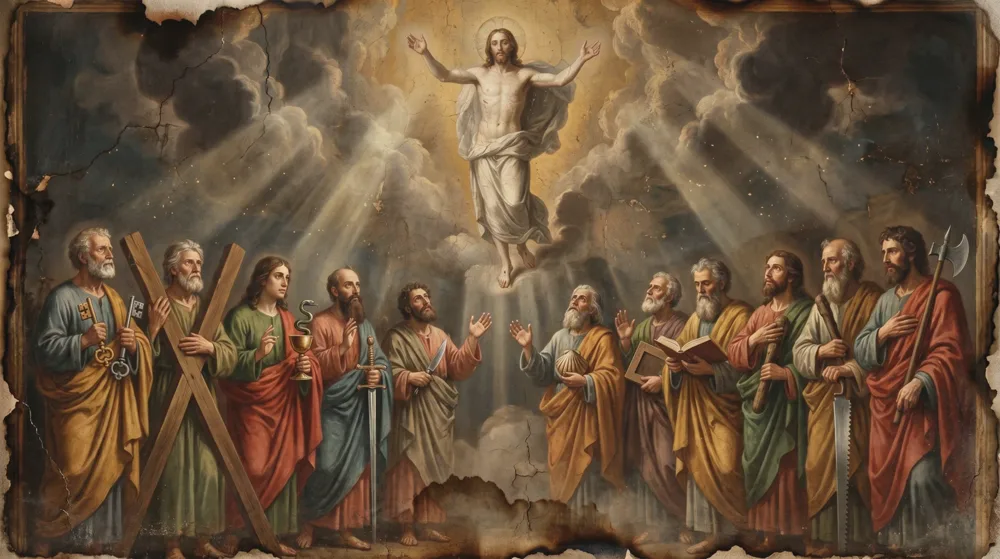
The Apostles' Creed is the ancient summary of the Catholic Faith in twelve articles, the short profession every Catholic professes at Baptism and recites at the start of the Rosary. We call it the Apostles' Creed because, as St Pius X teaches, it is "a summary of the truths of faith taught by the Apostles" (Catechism of St Pius X, The Creed in General); the Roman Catechism adds that the Apostles drew up this formula of Christian faith "that all might think and speak the same thing" (Roman Catechism, Part I, The Creed).
The Apostles' Creed prayer is not a private composition but the rule of belief itself. The Roman Catechism calls each of its truths an article, "as the members of the body are divided by joints (articuli)": whatever is to be believed distinctly and separately is rightly called an article (Roman Catechism, Part I, The Creed). To learn the Creed is to learn what it means to be Catholic.
The Apostles' Creed in English
I believe in God,
the Father Almighty,
Creator of heaven and earth.
And in Jesus Christ, His only Son,
Our Lord;
who was conceived by the Holy Ghost,
born of the Virgin Mary;
suffered under Pontius Pilate,
was crucified, died, and was buried;
He descended into hell;
the third day He arose again from the dead;
He ascended into heaven,
sitteth at the right hand of God the Father Almighty;
from thence He shall come to judge
the living and the dead.
I believe in the Holy Ghost;
the holy Catholic Church;
the Communion of Saints;
the forgiveness of sins;
the resurrection of the body;
and life everlasting.
Amen.
The Apostles' Creed in Latin
Credo in Deum,
Patrem omnipotentem,
Creatorem caeli et terrae.
Et in Jesum Christum, Filium ejus unicum,
Dominum nostrum:
Qui conceptus est de Spiritu Sancto,
natus ex Maria Virgine,
passus sub Pontio Pilato,
crucifixus, mortuus, et sepultus:
descendit ad inferos;
tertia die resurrexit a mortuis;
ascendit ad caelos;
sedet ad dexteram Dei Patris omnipotentis:
inde venturus est judicare
vivos et mortuos.
Credo in Spiritum Sanctum;
sanctam Ecclesiam catholicam;
Sanctorum communionem;
remissionem peccatorum;
carnis resurrectionem;
vitam aeternam.
Amen.
The Apostles' Creed in Spanish
The same Creed is professed by the faithful in every tongue. In Spanish (el Credo de los Apóstoles) it reads:
Creo en Dios,
Padre Todopoderoso,
Creador del cielo y de la tierra.
Y en Jesucristo, su único Hijo,
Nuestro Señor;
que fue concebido por obra y gracia del Espíritu Santo,
y nació de Santa María Virgen;
padeció bajo el poder de Poncio Pilato,
fue crucificado, muerto y sepultado;
descendió a los infiernos;
al tercer día resucitó de entre los muertos;
subió a los cielos;
y está sentado a la diestra de Dios Padre Todopoderoso;
desde allí ha de venir a juzgar
a los vivos y a los muertos.
Creo en el Espíritu Santo,
la santa Iglesia católica,
la comunión de los Santos,
el perdón de los pecados,
la resurrección de la carne
y la vida eterna.
Amén.
The words differ; the Faith is one. The Latin Credo stands behind every translation, which is why the Church has always held the Creed in Latin as the common measure of every vernacular form.
What it means
The word Credo, "I believe," at the head of the Creed is not a guess or an opinion. St Pius X explains its force: "I believe" means "I hold everything that is contained in these twelve articles to be perfectly true; and I believe these truths more firmly than if I saw them with my eyes, because God, who can neither deceive nor be deceived, has revealed them to the Holy Catholic Church and through this Church to us" (Catechism of St Pius X, The Creed in General). Faith here is the virtue by which we give full and entire assent to the truths revealed by God, and without it, Scripture says, it is impossible to please Him (Roman Catechism, Part I, On Faith).
The Roman Catechism notes that the Creed falls naturally into three parts, after the three Persons of the Holy Trinity: the first article confesses the Father and the work of Creation; the articles on Christ confess the Son and the work of Redemption; the closing articles confess the Holy Ghost, "the head and source of our sanctification" (Roman Catechism, Part I, The Creed). The whole mystery of the Holy Trinity is therefore enclosed in summary in this one prayer, which is why it answers, more fully than any other, the question of what Catholics believe.
A short line on each of the twelve articles:
- I believe in God, the Father almighty, Creator of heaven and earth. One God, almighty, who made all things visible and invisible out of nothing.
- And in Jesus Christ, His only Son, Our Lord. The eternal Son of God, true God, our one Lord and Redeemer.
- Who was conceived by the Holy Ghost, born of the Virgin Mary. The Son took flesh and became man in the womb of the Virgin, who is thereby Mother of God.
- Suffered under Pontius Pilate, was crucified, died, and was buried. His true Passion and death on the Cross, by which He paid the price of our sins.
- He descended into hell; the third day He arose again from the dead. His soul descended to the just who awaited Him; on the third day He truly rose, in the same body.
- He ascended into heaven, sitteth at the right hand of God the Father almighty. Risen, He ascended in glory and reigns in equal majesty with the Father.
- From thence He shall come to judge the living and the dead. He will return at the end of time to judge every man, a truth bound to what happens after death.
- I believe in the Holy Ghost. The third divine Person, true God with the Father and the Son, the source of our sanctification.
- The holy Catholic Church, the communion of saints. The one Church Christ founded, and the sharing of spiritual goods among her members, treated in the communion of saints.
- The forgiveness of sins. The power left to the Church to remit sins, exercised above all in Baptism and Penance.
- The resurrection of the body. At the last day our bodies will rise and be reunited to our souls.
- And life everlasting. The endless beatitude of the blessed in the vision of God — the end for which we were made.
Recited together, these twelve articles "contain the principal truths to be believed concerning God, Jesus Christ, and the Church, His Spouse" (Catechism of St Pius X, The Creed in General).
Nicene Creed vs Apostles' Creed
Catholics profess two Creeds, and they teach the same Faith. The Apostles' Creed is the shorter, older formula used at Baptism, in the Rosary, and in private prayer. The Nicene Creed is the longer profession sung at Mass, drawn up by the Councils of Nicaea and Constantinople to confess the divinity of the Son and the Holy Ghost against the heresies of the age. Where the Apostles' Creed states the truths plainly, the Nicene Creed states them with the precision the Church forged in defending them. Both rest on the same Apostolic deposit. A third profession, the Athanasian Creed (Quicumque vult), sets out the doctrine of the Trinity and of the Incarnation at greater length; the Breviary has it recited at Prime on Trinity Sunday.
The Apostles' Creed in the Lutheran and other traditions
The Apostles' Creed predates the divisions of the sixteenth century, so it is recited not only by Catholics but by Lutherans, Anglicans, and many other communities that broke from the Church. Because the formula is so old, the words used are almost the same. There are, however, two real points to note. First, some Protestant versions drop or footnote the clause "He descended into hell," whereas the Catholic Creed keeps it as an article of faith, understanding it of Christ's true descent in soul to the just who awaited Him.
Second, the words are the same but the meaning is not always held in the same sense: when the Creed says "the holy Catholic Church" and "the forgiveness of sins," the Catholic professes the visible Church Christ founded and the forgiveness given through her sacraments of Baptism and Penance. The same letters can be read with a different faith behind them; the Creed is fully understood only within the Church that handed it down.
Is there a "new" Apostles' Creed prayer?
Some search for a new Apostles' Creed prayer, and it is worth being clear. The Apostles' Creed is not revised or rewritten; its twelve articles are fixed and have been confessed at Baptism since the early Church. Modern translations may render a word differently — "Holy Spirit" for "Holy Ghost", for instance — but no article is added, removed, or changed. What some call a "new" version is only a fresh translation of the one ancient text. The Faith does not change, and neither does the Creed that summarizes it; we pray the same words the Apostles handed down.
When to pray it
We pray the Apostles' Creed at the beginning of the Rosary, holding the crucifix — which is why it opens any guide on how to pray the Rosary. It belongs to morning and night prayers, to the renewal of our baptismal Faith, and to any moment when we wish to recall what we believe.
St Pius X teaches that "it is most useful to recite the Creed frequently, so as to impress the truths of faith more and more deeply on our hearts" (Catechism of St Pius X, The Creed in General). Said slowly, article by article, it is an act of faith and a catechism in twelve lines. The Dominican St Peter of Verona died professing it on the road from Como to Milan in 1252, and a very old tradition says that he traced its first words, Credo in Deum, in his own blood.
Frequently Asked Questions
What is the Apostles' Creed?
The Apostles' Creed is the ancient summary of the Catholic Faith in twelve articles, the short profession of belief recited at Baptism and at the beginning of the Rosary. St Pius X teaches that it is "a summary of the truths of faith taught by the Apostles" (Catechism of St Pius X, The Creed in General). Each of its twelve statements is called an article, as the members of the body are divided by joints (Roman Catechism, Part I, The Creed).
Who wrote the Apostles' Creed?
The Roman Catechism teaches that the Apostles themselves, having received the command to preach the Gospel to every creature, drew up this formula of Christian faith, which was called a symbol because "it was made up of various parts, each of which was contributed by an Apostle" (Roman Catechism, Part I, The Creed). For this reason the Church calls it the Apostles' Creed: it is not a private composition but the Apostolic deposit handed down whole. We hold its truths on the authority of God, who revealed them through the Apostles to His Church.
When was the Apostles' Creed written?
The Roman Catechism teaches that the Apostles themselves drew up a formula of Christian faith "that all might think and speak the same thing" (Roman Catechism, Part I, The Creed); an ancient tradition, recorded by Rufinus in the fourth century, places this before they went out to preach. The text was handed down and confessed at Baptism from the earliest centuries, taking the fixed twelve-article form we recite today. We hold it not as a late invention but as the Apostolic deposit set down in the age of the Apostles.
Where did the Apostles' Creed come from?
It comes from the Apostles and from the Gospel they preached. Charged to preach the Gospel to every creature, the Apostles drew up one short formula of belief as a common rule of Faith (Roman Catechism, Part I, The Creed), which was then confessed at Baptism throughout the early Church. Every article rests on the Apostolic deposit, the same Faith Christ entrusted to His Church, not on any later or human invention.
Is the Apostles' Creed biblical?
Every article of the Creed is drawn from Sacred Scripture, for it is the summary of the Faith the Apostles preached from the Gospel. The phrase itself does not appear as a single text, but each truth is found in the inspired books: the Father almighty and Creator (Genesis 1:1), Christ conceived of the Holy Ghost and born of the Virgin (Matthew 1:18-20; Luke 1:35), the resurrection of the body (John 11:25), and life everlasting (1 John 5:11). St Paul commands us to "hold the form of sound words" (2 Timothy 1:13), which is exactly what the Creed preserves.
Is the Apostles' Creed in the Bible?
It is not found in the Bible as a single passage, but every one of its twelve articles is taken from Scripture. The Creed is the Apostles' faithful summary of what the inspired books teach, gathered into one rule of belief. So while you will not read the Creed word for word in any book of the Bible, you will find each of its truths there, from the Father almighty and Creator (Genesis 1:1) to life everlasting (1 John 5:11).
What is the difference between the Nicene and Apostles' Creed?
Both Creeds profess the same Faith on the same Apostolic deposit. The Apostles' Creed is the shorter, older formula used at Baptism, in the Rosary, and in private prayer; the Nicene Creed is the longer profession sung at Mass, drawn up by the Councils of Nicaea and Constantinople to confess the divinity of the Son and the Holy Ghost against the heresies of the age. Where the Apostles' Creed states the truths plainly, the Nicene Creed states them with the precision the Church forged in defending them.
The Creed is the shortest road into the whole Faith. To say it with attention is to stand where the Apostles stood and to confess, in twelve articles, the God who made us, redeemed us, and calls us to life everlasting.
The Iter Fidei app serves this prayer in Latin and your own language, with audio to pray along. Join early access here.
Sources. Roman Catechism (Catechism of the Council of Trent, 1566), Part I, introduction on Faith and the Creed. Catechism of St Pius X, "The Creed in General." Holy Bible, Douay-Rheims.