
Devotions
The Seven Sorrows Chaplet (the Servite Rosary)
The Seven Sorrows Chaplet, or Servite Rosary, honours the seven sorrows of Mary: its seven sorrows, how it is prayed, and the promises attached to the devotion.
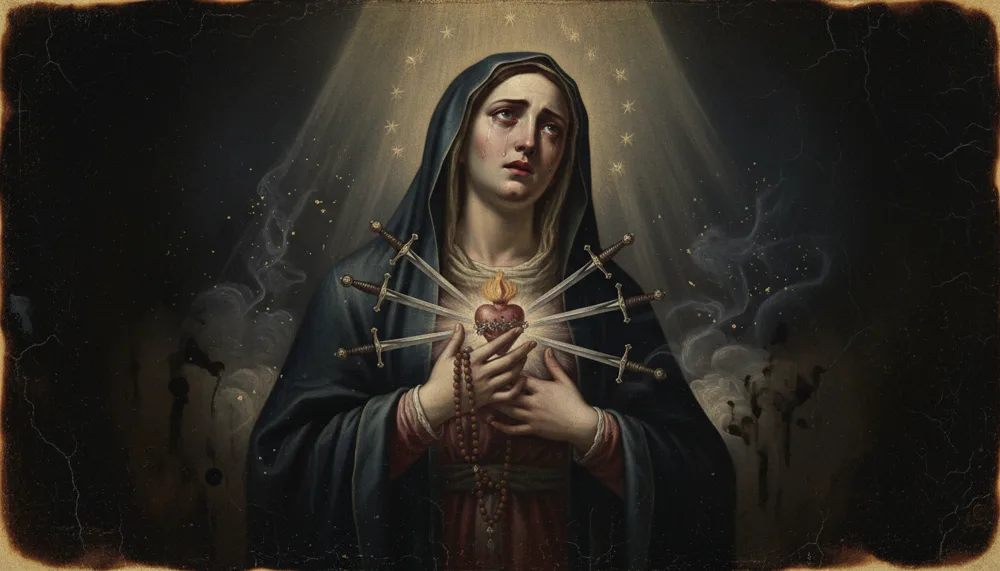
The Seven Sorrows Chaplet, also called the Servite Rosary, the Chaplet of the Seven Sorrows, or — in the older English manuals — the Rosary of the Seven Dolors, is a Marian devotion that meditates on the seven great sorrows of Our Lady from Simeon's prophecy to the burial of her Son. It is prayed in seven groups, each made of one Our Father and seven Hail Marys, offered in honour of the Mother of Sorrows. The seven sorrows of Mary fixed by the Church's liturgy are the prophecy of Simeon, the flight into Egypt, the loss of the boy Jesus in the temple, the meeting on the way to Calvary, the crucifixion, the taking down from the cross, and the entombment.
This Seven Sorrows of Mary chaplet is one of the older treasures of the Church's Catholic devotions, and it belongs in a particular way to the Servite Order, who from their very beginning bound themselves to the sufferings of the Blessed Virgin.
What is the Seven Sorrows Chaplet?
A chaplet is a short, fixed set of prayers counted on beads, smaller than the full Rosary and devoted to one mystery or one saint. If you are new to the form, our article on what a chaplet is sets out the difference between a chaplet and the Rosary. The Seven Sorrows Chaplet takes as its single object the compassion of Mary — her suffering-with — at the side of her crucified Son.
The devotion to Mary's sorrows has its root in Scripture, in the words Simeon spoke over the infant Christ: "thy own soul a sword shall pierce" (Luke 2:35). From this seed the Fathers — Ephrem, Ambrose, Augustine, Bernard — composed meditations on the Mother of God's grief. In the Middle Ages the faithful kept a popular devotion to her five sorrows during the Passion; later these were fixed at seven and extended backward from Calvary to embrace her whole life.
The Servite friars gave the devotion its settled form. From their foundation in thirteenth-century Florence they had a particular love for the sufferings of Mary; St Philip Benizi gave the habit as a scapular to lay people and so began the Brotherhood of the Sorrows of Mary. Out of this Servite tradition came both the feast and the chaplet we keep today. The chaplet is therefore rightly called the Servite Rosary.
The seven sorrows of Mary
The seven sorrows fixed by the liturgical office, and meditated upon in order through the chaplet, are these:
- The prophecy of Simeon — the sword foretold over the Child in the temple (Luke 2:34-35).
- The flight into Egypt — Mary carrying her Son into exile to escape Herod (Matthew 2:13-14).
- The loss of the boy Jesus in the temple — the three days' search (Luke 2:43-45).
- The meeting of Jesus on the way to Calvary — the encounter on the road of the Cross.
- The crucifixion — Mary standing beneath the Cross of her dying Son (John 19:25).
- The taking down of Jesus from the cross — her Son laid in her arms.
- The burial of Jesus — the entombment, and her solitude afterward.
The Church draws these from the Gospels themselves, and the older mind of Christendom read them as a single martyrdom of the heart. As the Servite tradition teaches and the liturgy proclaims, on the mountain of sacrifice Mary "as Mother gave her Son, as bride offered herself with Him"; by her sufferings she shared in the work of our redemption, standing at the foot of the Cross. This is why the devotion is never sentimental: it leads the soul straight back to Calvary, and to the price of sin — the same Calvary the Church places at the heart of Holy Week. To grasp what Mary's heart is in this devotion, see our article on the Immaculate Heart of Mary.
How to pray the Seven Sorrows Chaplet
The Servite Rosary is simple, and its structure is fixed. The chaplet beads carry seven groups of seven, often joined to a medal of Our Lady of Sorrows.
Begin with an act of contrition and the intention to meditate on the sorrows of the Mother of God. Then, for each of the seven sorrows in turn:
- Announce the sorrow and pause a moment to meditate on it.
- Pray one Our Father.
- Pray seven Hail Marys, holding the sorrow before the mind through each Ave.
Doing this seven times — once for each sorrow — gives seven Our Fathers and forty-nine Hail Marys on the body of the chaplet. To these the Servite custom adds three concluding Hail Marys in honour of the tears Mary shed, which brings the total of Aves to fifty-two, or, in the older fuller form, seventy-seven, the number the tradition assigns to her tears.
A traditional closing prayer follows, asking, through the merits of Mary's tears and sorrows, for the grace of true sorrow for sin and final perseverance. The whole is short — it may be prayed in a quarter of an hour — yet it carries the soul through the entire Passion seen from the side of the Mother.
If you already pray the Rosary, you will find the rhythm familiar: the Our Father and the Aves are the same beads of every Catholic, here gathered around the sorrows rather than the joyful, sorrowful, and glorious mysteries. The Seven Sorrows Chaplet is a fitting companion to the Rosary, not a rival to it, and it sits well beside the other counted devotions such as the Chaplet of St Michael.
The Seven Sorrows Chaplet prayers
For those who want the words in full, here are the prayers of the Seven Sorrows Chaplet as the Servite tradition hands them down. The chaplet uses only prayers every Catholic already knows — the Our Father, the Hail Mary, and a short opening and closing — gathered around the seven sorrows.
Opening. Make an act of contrition and announce the intention:
My God, I offer Thee these prayers in honour of the seven sorrows of Thy holy Mother, that I may share in her compassion and obtain true sorrow for my sins. Grant me, through her tears, the grace of repentance.
Before each sorrow, announce it and add this versicle, which the older books place between the groups:
V. Pray for us, O Virgin most sorrowful.
R. That we may be made worthy of the promises of Christ.
Then for each of the seven sorrows, in order, pray one Our Father and seven Hail Marys, dwelling on that sorrow.
After the seven groups, the Servite custom adds three Hail Marys in honour of the tears Mary shed.
Closing prayer:
Let intercession be made for us, we beseech Thee, O Lord Jesus Christ, now and at the hour of our death, before the throne of Thy mercy, by the Blessed Virgin Mary, Thy Mother, whose most holy soul was pierced by a sword of sorrow in the hour of Thy bitter Passion. Through Thee, Jesus Christ, Saviour of the world, who livest and reignest with the Father and the Holy Ghost, world without end. Amen.
These are devotional prayers, not part of the Mass; the texts vary slightly between older manuals, but the structure — opening, seven sorrows of one Our Father and seven Hail Marys each, three Hail Marys, closing prayer — is fixed.
The promises of the devotion
The tradition attaches to faithful devotion to the Seven Sorrows of Mary a set of promises, handed down in the Servite and broader traditional spiritual literature. The Mother of God is held to obtain for those who honour her sorrows:
- Peace in their families.
- Enlightenment in the mysteries of God.
- Consolation in their troubles and protection in their labours.
- Defence in their spiritual life, and the shielding of them against the enemy of souls through life, especially at the hour of death.
We pass these on as the tradition gives them, with the sobriety proper to such things: a promise is not a transaction, and the devotion is fruitful only where it is joined to a contrite heart and a real turning from sin. It belongs among the traditional prayers the faithful have always carried in the heart. The point of the chaplet is never a tally of favours, but conformity to Christ crucified through the heart of His Mother — the heart that, in the words of the liturgy, was "the co-sufferer" in our redemption.
Why honour Mary in her sorrows
Some ask why the Church gives so much to the grief of one woman. The answer lies in who she is. She is the Mother of God — Theotokos — and the dignity of her motherhood is the measure of her sorrow; the depth of the wound is the depth of the love. Our article on the Mother of God sets out this title and what the Church has always confessed in it. To honour Mary's sorrows is to honour the Passion of her Son, for her sorrow had no object but Him.
The Church keeps this devotion in her calendar twice over: on the Friday in Passion week, when she weeps with Mary beside the crucified Jesus, and again on the 15th of September, the feast of the Seven Sorrows, which follows hard upon the Exaltation of the Holy Cross. This September feast, taken by the Church from the Servites' own Office and Mass, was fixed for the universal Church by Pope Pius VII in 1814, in memory of his return from captivity under Napoleon. The chaplet is the daily, domestic form of what the liturgy keeps on those days.
To pray the Seven Sorrows Chaplet, then, is to take a small place at the foot of the Cross beside the Mother who never left it. It asks little — seven Our Fathers, the Aves of her tears, a quarter-hour of attention — and gives much: a heart slowly conformed to her compassion, and through her, to her Son.
The Rosary of the Seven Dolors
The older English prayer books most often call this devotion the Rosary of the Seven Dolors. Dolor is simply the Latin word for sorrow — the word of the liturgy itself, which names the September feast Septem Dolorum Beatae Mariae Virginis and calls Our Lady the Mater Dolorosa, the Sorrowful Mother of the Stabat Mater.
The Rosary of the Seven Dolors, the Seven Sorrows Rosary, the Servite Rosary, and the Seven Sorrows Chaplet are therefore one and the same devotion: seven groups of one Our Father and seven Hail Marys, prayed on the same beads while meditating on the same seven sorrows. Where an old manual or a grandmother's chaplet card speaks of the "seven dolors of Mary," nothing different is meant; only the older, more Latin name has been kept. We use the names interchangeably in this article, as the tradition itself does.
Frequently Asked Questions
How to pray the Seven Sorrows Chaplet?
Begin with an act of contrition and the intention to meditate on the sorrows of Our Lady. Then for each of the seven sorrows in turn, announce the sorrow, pause to meditate, and pray one Our Father followed by seven Hail Marys. Done seven times this gives seven Our Fathers and forty-nine Hail Marys, to which the Servite custom adds three Hail Marys in honour of Mary's tears, closing with the traditional prayer for true sorrow for sin and final perseverance.
How to pray the Rosary of the Seven Sorrows?
The Rosary of the Seven Sorrows is the same devotion as the Seven Sorrows Chaplet, also called the Servite Rosary. It is counted on beads arranged in seven groups of seven, each group joining one Our Father to seven Hail Marys while the mind dwells on one of Mary's sorrows, from the prophecy of Simeon to the burial of her Son. The whole may be prayed in about a quarter of an hour.
How to pray the Seven Sorrows Rosary?
Take the chaplet in hand, joined to a medal of Our Lady of Sorrows, and pass through the seven sorrows in order: the prophecy of Simeon, the flight into Egypt, the loss of the boy Jesus in the temple, the meeting on the way to Calvary, the crucifixion, the taking down from the Cross, and the burial. For each sorrow pray one Our Father and seven Hail Marys, holding the sorrow before the mind through every Ave, then conclude with three Hail Marys for her tears and the closing prayer.
What are the prayers of the Seven Sorrows Chaplet?
The Seven Sorrows Chaplet uses only familiar prayers. After an opening act of contrition and intention, you pray, for each of the seven sorrows, one Our Father and seven Hail Marys, with the versicle "Pray for us, O Virgin most sorrowful — That we may be made worthy of the promises of Christ" announced before each. The Servite custom then adds three Hail Marys for Mary's tears, and the chaplet ends with a closing prayer asking, through the Mother whose soul was pierced by a sword, for intercession now and at the hour of our death.
Is the Chaplet of the Seven Sorrows the same as a rosary?
It is a chaplet, not the full Rosary, though it is often called the Servite Rosary or the Rosary of the Seven Sorrows and is counted on beads. The ordinary Rosary meditates on the joyful, sorrowful, and glorious mysteries across fifteen decades; the Chaplet of the Seven Sorrows takes only Mary's seven sorrows, in seven groups of one Our Father and seven Hail Marys. It is a companion to the Rosary, not a substitute for it.
What is the Rosary of the Seven Dolors?
The Rosary of the Seven Dolors is the older English name for the Seven Sorrows Chaplet, from the Latin dolor, sorrow — the word the liturgy uses for the feast of the Seven Dolors of the Blessed Virgin Mary. It is prayed exactly as described above: seven groups of one Our Father and seven Hail Marys, one group for each of Mary's seven sorrows, with three Hail Marys for her tears and the closing prayer. Chaplet, rosary, and dolors here name one and the same Servite devotion.
Who is St Mary of the Seven Sorrows?
"St Mary of the Seven Sorrows" is not a separate saint but the Blessed Virgin Mary herself, honoured under the title of her seven sorrows — the same Mother of God invoked as Our Lady of Sorrows or the Mater Dolorosa. Churches and parishes bearing this name are dedicated to her under that title. The Church keeps her sorrows liturgically on the Friday in Passion week and on the 15th of September, and the chaplet is the daily devotion attached to the title.
The Iter Fidei app carries the traditional 1962 liturgical calendar with the exact dates of the feasts of Our Lady of Sorrows, the Mass and Office of every day, and the prayers and chaplets — including the Servite Rosary — in Latin and your own language, with audio to pray along. Join early access here.
Sources. The Gospel of St Luke 2:34-35, 43-45, of St Matthew 2:13-14, and of St John 19:25 (Douay-Rheims). The traditional liturgy of the Feast of the Seven Sorrows of the Blessed Virgin Mary (15 September) and its proper Office and Mass, borrowed by the universal Church from the Order of Servites; the Friday in Passion week. The Servite tradition of devotion to the Sorrows of Mary (St Philip Benizi; the Brotherhood of the Sorrows of Mary). Pope Pius VII's extension of the September feast to the Western Church, 1814.