
The Faith
Guardian Angels: the Catholic Teaching
What the Catholic Church teaches about guardian angels: that God gives to every soul an angel to light, guard, rule, and guide it. We set out the doctrine from Scripture, the feast of the Holy Guardian Angels on October 2nd, and the Angel of God prayer in English and Latin.
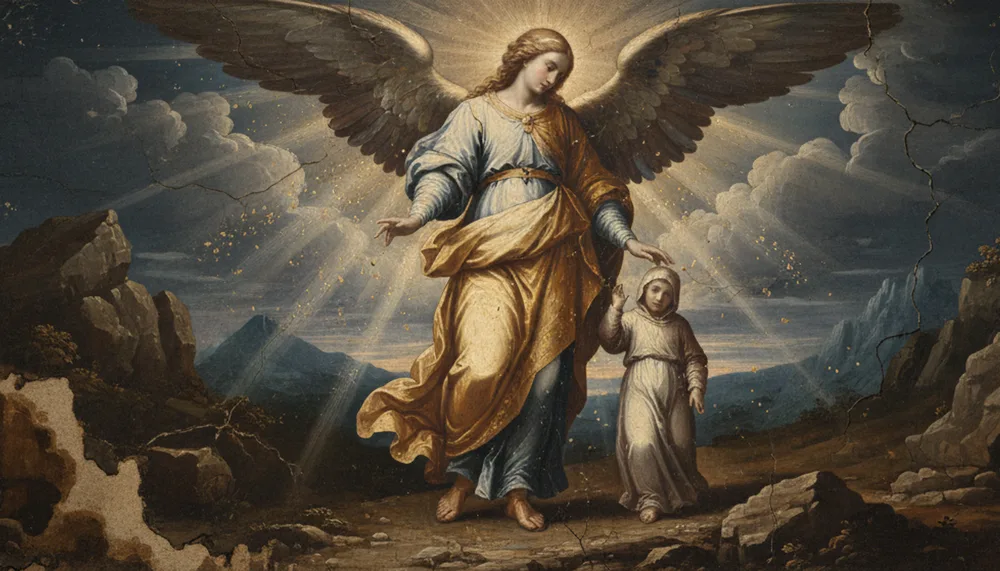
A guardian angel is a created spirit appointed by God to watch over a particular human soul — to defend it from evil, to enlighten its mind, to prompt it toward good, and to carry its prayers before the throne of God. This is not a sentiment but a doctrine the Catholic Church has held from the beginning, founded on the plain words of Our Lord and confirmed throughout the Scriptures. We set it out here as the faith has always held it: with confidence, never with superstition.
What is a guardian angel?
A guardian angel is one of the angels — pure spirits, created by God before the visible world, possessing intellect and will but no bodies. Of these countless spirits, God assigns to each man, from the moment of his birth and indeed from the womb, one angel charged with his keeping. Our Lord Himself teaches this when He says of children: "See that you despise not one of these little ones: for I say to you, that their angels in heaven always see the face of my Father who is in heaven" (Matthew 18:10). The Church has always read this as the warrant for the doctrine: each little one has his angel, who beholds the face of God.
The work of the guardian angel is fourfold, and the traditional prayer names it exactly: to light, to guard, to rule, and to guide. He lights the mind by holy thoughts; he guards the body and soul from the assaults of the devil; he rules by restraining us from sin; he guides us along the road that leads to heaven. He cannot force the will — that remains free — but he never ceases to prompt, to warn, and to intercede.
Every human being has a guardian angel, baptised or not, in the state of grace or out of it. The angel does not abandon even the sinner, but works the more earnestly for his return. This is the constant teaching of the Fathers and of Saint Thomas Aquinas, who treats the matter at length: the guardianship begins at birth and endures to the hour of death, when the angel conducts the faithful soul toward its judgement and, please God, its reward.
What the Scriptures say about guardian angels
The doctrine does not rest on a single text. The whole of Scripture is woven through with the ministry of guardian angels.
The clearest single witness is the ninetieth Psalm, recited every night by the Church at Compline: "For he hath given his angels charge over thee; to keep thee in all thy ways. In their hands they shall bear thee up: lest thou dash thy foot against a stone" (Psalm 90:11-12). Here the office of the angel is stated outright — a charge laid upon him by God, to keep a man in all his ways. It was this very Psalm that Satan quoted, twisting it, in the temptation of Our Lord in the desert; the words are true, though the devil abused them.
Other passages confirm it:
- "The angel of the Lord shall encamp round about them that fear him: and shall deliver them" (Psalm 33:8).
- "Behold I will send my angel, who shall go before thee, and keep thee in thy journey, and bring thee into the place that I have prepared. Take notice of him, and hear his voice" (Exodus 23:20-21). God's command to heed the angel's voice is the model of our own obedience to the inward promptings of grace.
- In the Acts of the Apostles, when Saint Peter is delivered from prison and knocks at the door, the faithful, not believing it is he, say: "It is his angel" (Acts 12:15). The early Church plainly held that each man has his angel.
- Saint Paul calls the angels "ministering spirits, sent to minister for them who shall receive the inheritance of salvation" (Hebrews 1:14).
The Book of Tobias shows the angelic ministry at full length: the Archangel Raphael walks beside young Tobias the whole journey, guards him, instructs him, drives off the demon, and only at the end reveals himself — "I am the angel Raphael, one of the seven, who stand before the Lord" (Tobias 12:15). It is the very pattern of the guardian angel's hidden, faithful companionship.
Are guardian angels biblical?
It is sometimes asked whether guardian angels are truly in the Bible, or whether they are a later invention of piety. The answer is plain: the doctrine is biblical, drawn from the very mouth of Our Lord. The word "guardian angel" is not used as a fixed term in Scripture, just as the word "Trinity" is not; but the reality is taught everywhere, as the texts above show.
The strongest biblical foundations are three. First, Our Lord's own words in Matthew 18:10, that the "little ones" have "their angels" who behold the face of God — the angels are spoken of as belonging to particular persons. Second, Psalm 90:11, "he hath given his angels charge over thee, to keep thee in all thy ways," which states the office of guardianship outright. Third, the scene in Acts 12:15, where the faithful, hearing Peter at the door, suppose "it is his angel" — proof that the early Church already held each man to have his own angel.
To these the whole of Scripture adds its weight: the angel sent before Israel in Exodus 23:20, the encamping angel of Psalm 33:8, the ministering spirits of Hebrews 1:14, and the long companionship of Raphael with Tobias. The guardian angels of the Bible are therefore not a poetic fancy but a teaching the Church has always read in the sacred text and proposed for our belief.
The feast of the Holy Guardian Angels (October 2nd)
The Church keeps a feast of the Holy Guardian Angels on October 2nd. Devotion to the angels is as old as the Church, but a distinct universal feast came later: Pope Paul V granted it in 1608, and Pope Clement X in 1670 extended it to the whole Latin Church and fixed it on the second of October, the day after the feast of Saint Remigius. In the traditional Roman calendar it is a feast of double rite, with its own Mass and Office in honour of the angel guardians.
The feast falls within the autumn, near the great feast of Saint Michael (Michaelmas, September 29th) and the older harvest of angelic devotion. The Church bids us on this day give thanks for the unseen protector at our side and renew our resolve to follow his guidance. The Collect of the day asks God, who "in thine unspeakable providence dost vouchsafe to send thy holy angels to keep us," to grant that we may be defended by their protection and rejoice in their fellowship for ever.
If you keep the older books, you will find that the season around Michaelmas and the feast of the Guardian Angels is a natural time to read about the angelic hierarchies, the three named archangels of Scripture, and the warfare of Saint Michael against the dragon.
The Guardian Angel prayer (Angel of God / Angele Dei)
The chief prayer to the guardian angel is the Angel of God, known in Latin from its opening words as the Angele Dei. It is short enough for a child to learn and contains the whole doctrine in four lines. The traditional English text runs:
Angel of God, my guardian dear,
to whom His love commits me here,
ever this day be at my side,
to light and guard, to rule and guide.
Amen.
In Latin:
Angele Dei, qui custos es mei,
me, tibi commissum pietate superna,
illumina, custodi, rege et guberna.
Amen.
The four verbs of the Latin — illumina, custodi, rege, guberna — are the same four offices of the angel: enlighten, guard, rule, and govern. The prayer is traditionally enriched with an indulgence — and under the usual conditions a plenary indulgence may be gained — and it has long been taught for morning and evening, before a journey, and at any moment of danger or temptation. We treat it in full, with its meaning and uses, in our note on the Guardian Angel prayer.
There is no need for elaborate formulas. A simple word at the start of the day — "My angel, be with me and keep me from sin" — is heard, for the angel is always near. The Church warns, however, against turning the angels into objects of curiosity or superstition: we do not name them after fancies of our own, nor seek private signs, but honour the holy guardian God has given and obey his quiet promptings toward the good.
Guardian angels in pictures and sacred art
Because the guardian angels are pure spirits without bodies, the Church has always known that any image of them is a symbol, not a portrait. Yet she has not forbidden such images; she has used them, to teach and to console. The familiar pictures — an angel with great wings watching over a child, or guiding two children across a broken bridge, or standing behind a soul in prayer — are not depictions of what an angel "looks like," for an angel looks like nothing the eye can see. They are visible reminders of an invisible truth: that we are never alone, that a faithful protector walks at our side.
The wings in these pictures signify the angel's swiftness in doing God's will and his constant coming and going between earth and the throne of God. The light or halo signifies his nearness to God and his purity — these are part of the visual language of Catholic symbols, each detail standing for an unseen truth. The protecting gesture — a hand on the shoulder, an arm thrown out before danger — sets before the eye the fourfold office of the Angele Dei: to light, to guard, to rule, and to guide. Such an image set above a child's bed, with the Angel of God prayer learned by heart, is a sound and ancient way to keep the doctrine alive in a household. We honour what the picture represents, never the picture itself.
Guardian Angels parishes and churches
Many Catholic parishes throughout the world bear the name Guardian Angels (or Holy Guardian Angels, or Our Lady Queen of Angels), a sign of how dear this devotion has been to the faithful. To dedicate a church to the Holy Guardian Angels is to place the whole congregation, and the village or town around it, under the protection invoked at the altar. Where such a parish keeps the traditional calendar, its patronal feast falls on October 2nd, with the proper Mass and Office of the Holy Guardian Angels. If your own parish carries this title, the feast of October 2nd is your titular day, and the Angele Dei is, in a true sense, the parish prayer.
Frequently Asked Questions
What is a guardian angel?
A guardian angel is a pure created spirit whom God appoints to watch over a particular human soul throughout its life — to enlighten the mind, defend against evil, restrain from sin, guide toward heaven, and carry the soul's prayers to God. The doctrine rests on Our Lord's own words in Matthew 18:10 and on Psalm 90.
Does every person have a guardian angel?
Yes. The Church teaches that God gives a guardian angel to every human being, from birth, whether baptised or not, and whether in the state of grace or in sin. The angel never abandons the soul, but labours all the more for a sinner's conversion, and remains with him to the hour of death.
How do I know who my guardian angel is?
We are not given the name of our guardian angel in this life, and the tradition firmly discourages trying to discover or invent one — that is the path of superstition, not faith. We are simply told that we have one, and bidden to honour him, thank him, and follow his promptings. It is enough to call upon him as "my angel" and to live so as not to grieve him by sin.
What does a guardian angel look like?
Angels are pure spirits without bodies, so they have no appearance of their own. When they appear in Scripture, or in the Marian apparitions approved by the Church, they take on a visible form for the sake of the men they are sent to — as Raphael walked with Tobias in the likeness of a young man. The wings and robes of sacred art are symbols of their swiftness and their nearness to God, not portraits.
When is the feast of the Guardian Angels?
The feast of the Holy Guardian Angels is kept on October 2nd. It was extended to the whole Latin Church and fixed on that day by Pope Clement X in 1670, and in the traditional calendar it is celebrated with its own Mass and Office.
Are guardian angels biblical?
Yes. The reality of guardian angels is taught in Scripture, even though the phrase "guardian angel" is not used as a fixed term. Our Lord says the "little ones" have "their angels" who behold the face of God (Matthew 18:10); Psalm 90:11 says God gives His angels charge to keep a man in all his ways; and in Acts 12:15 the faithful speak of Peter's own angel. The Church has always read these texts as the foundation of the doctrine.
Where are guardian angels in the Bible?
The chief passages are Matthew 18:10, Psalm 90:11-12, Psalm 33:8, Exodus 23:20-21, Acts 12:15, and Hebrews 1:14, together with the whole Book of Tobias, where the Archangel Raphael accompanies and guards young Tobias on his journey. Read together, these show the constant biblical ministry of the angels in keeping and guiding the people of God.
If you wish to read further, see our notes on the three archangels named in Scripture — Saint Michael, Saint Gabriel, and Saint Raphael, the patron of travellers; on the Saint Michael chaplet; and on the communion of saints, to which the holy angels belong. You may also pray our prayer for protection.
Sources/Fonti/Fuentes/Fontes/Źródła. Sacred Scripture, Douay-Rheims version (Matthew 18:10; Psalm 90:11-12; Psalm 33:8; Exodus 23:20-21; Acts 12:15; Hebrews 1:14; Tobias 12:15). Saint Thomas Aquinas, Summa Theologiae I, q. 113 (on the guardianship of the angels). The traditional Roman Missal and Breviary, feast of the Holy Guardian Angels (October 2nd). Dom Prosper Guéranger, The Liturgical Year.
Iter Fidei serves traditional prayers, the psalms and the liturgical calendar, in Latin and English with audio. Join early access here.