
The Saints
St Gabriel the Archangel
St Gabriel the Archangel is the messenger of God who announced the Incarnation to the Blessed Virgin; here is what Scripture tells of him, his feast on March 24, his patronage, his symbols and the Collect of his Mass.
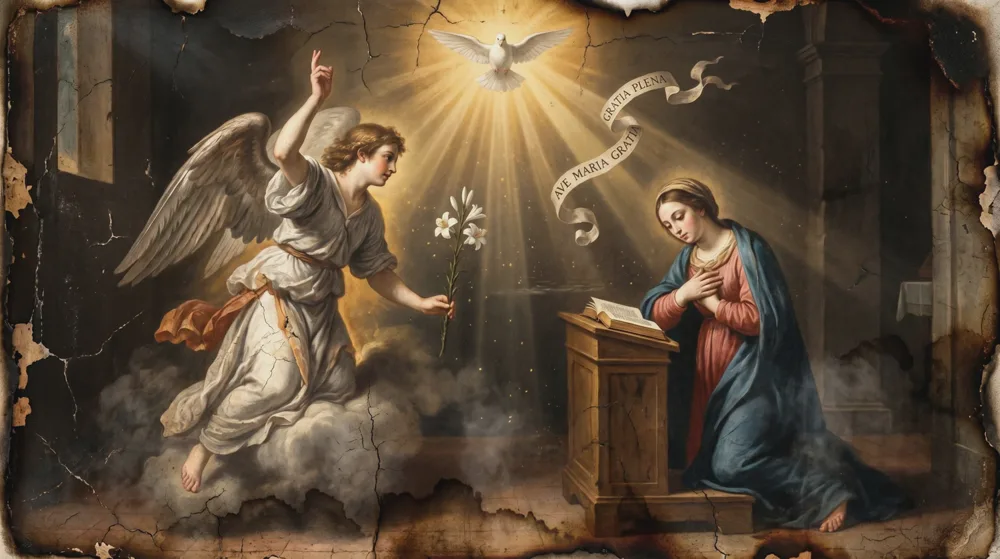
St Gabriel the Archangel is the messenger sent by God to announce to the Blessed Virgin Mary that she would conceive and bear the Son of God. His name means "strength of God" or "God is my strength," and Holy Scripture names him in three great announcements: to the prophet Daniel, to the priest Zachary, and to Our Lady at Nazareth. In the traditional Roman calendar the Church keeps his feast on March 24, the day before the Annunciation he himself proclaimed.
Who St Gabriel the Archangel is
Gabriel is not a saint who lived and died among men. He is one of the holy angels, a pure spirit created by God, ranked among the archangels — one of the nine choirs of angels — and one of those who, in his own words, "stand before God." Scripture names only three angels: Michael, Raphael, and Gabriel. Where Michael is the prince of the heavenly host and Raphael the healer and guide, Gabriel is the bearer of God's word — the herald sent down at the turning points of salvation history.
He appears first in the prophet Daniel, to whom he was sent to make known the time of the coming of the Messiah (Daniel ix). He appears again in the Gospel of St Luke, standing at the right side of the altar of incense, to announce to the aged priest Zachary the birth of his son, the Precursor, St John the Baptist (Luke i). And finally Gabriel is sent as God's ambassador to a virgin of Nazareth: "And the angel being come in, said unto her: Hail, full of grace, the Lord is with thee: blessed art thou among women" (Luke i. 28, Douay-Rheims). At his word — and at Mary's Fiat — the Word was made flesh.
So Gabriel is bound, more than any other angel, to the mystery of the Incarnation. The words of his greeting open the Hail Mary, the prayer the whole Church repeats every day. His cultus is no late invention: Butler notes that "there is abundant archaeological evidence that the cultus of St Gabriel is in no sense a novelty." An ancient chapel beside the Appian Way preserves a fresco in which the archangel, his name written beneath, holds the place of principal patron, and early Christian art of East and West shows that his part in the Incarnation was remembered long before the devotional revival of the thirteenth century.
Archangel Gabriel in the Bible
Gabriel is named four times in Holy Scripture — twice in the Old Testament and twice in the New — and each appearance carries a message about the coming of the Saviour. He is, in this strict sense, a scriptural angel: not one whose name comes to us from legend or private revelation, but one set down in the inspired text itself.
In the Old Testament he appears in the book of the prophet Daniel. First a voice commands, "Gabriel, make this man to understand the vision" (Daniel viii. 16), and he explains the vision of the ram and the he-goat. Then, while Daniel prays, "the man Gabriel, whom I had seen in the vision at the beginning, flying swiftly touched me at the time of the evening sacrifice" (Daniel ix. 21, Douay-Rheims), and gives the prophecy of the seventy weeks — the reckoning of the years until the Anointed One should come. So before the Gospel opens, Gabriel is already the angel of the Messiah's coming.
In the New Testament he appears in the first chapter of St Luke. He stands "on the right side of the altar of incense" (Luke i. 11) to announce to the priest Zachary the birth of St John the Baptist; and because Zachary doubts, he is struck dumb until the child is born. To Zachary the angel gives his own name and office: "I am Gabriel, who stand before God: and am sent to speak to thee, and to bring thee these good tidings" (Luke i. 19).
To stand before God is the language of the highest service; it tells us where this angel belongs and from whom his word comes. Six months later, St Luke tells us, "the angel Gabriel was sent from God into a city of Galilee, called Nazareth" (Luke i. 26), to the Virgin Mary, with the Annunciation.
These four passages — Daniel viii, Daniel ix, Luke i. 5-25, and Luke i. 26-38 — are the whole of what Scripture tells us of Gabriel by name. Everything the Church teaches of him rests on them. We hold to the text and add nothing to it.
What St Gabriel is patron of: messengers and communications
Because Gabriel is the angel who carries God's message to men, the Church has long honoured him as the patron of messengers. Butler calls him "the appropriate patron-saint of postal, telegraph and telephone workers," and on January 12, 1951, Pope Pius XII, by apostolic letter, named St Gabriel the heavenly patron of telecommunications and of all who work in them. Where a man's work is to bear a message faithfully and deliver it whole, he has in Gabriel a heavenly model: the messenger who delivered the greatest message ever entrusted to a creature, and delivered it without adding or subtracting a word.
This patronage is not sentiment. It rests on what Gabriel did. He stood before God, received the announcement of the Incarnation, and bore it intact to the one for whom it was meant. Those whose calling is to communicate — to speak truly, to carry word over distance, to keep a message from being corrupted in transit — may rightly ask his intercession. So too may parents, preachers, and any soul charged with telling others the truth of God.
The angels are not distant abstractions. Each of us is given a guardian to watch over our way, as we pray in the Guardian Angel prayer; and to the whole host belongs the office of carrying out God's will toward men. St Gabriel holds among them the office of the herald.
A traditional prayer to St Gabriel
The Church's own prayer for his feast is the Collect of the Mass of March 24 in the Missale Romanum of 1962. It is addressed to Our Lord, whose Incarnation Gabriel announced:
O God, who from among all the Angels didst choose the Archangel Gabriel to announce the mystery of Thy Incarnation: mercifully grant that we who keep his feast on earth may feel the benefit of his patronage in heaven. Who livest and reignest with God the Father in the unity of the Holy Ghost, God, world without end. Amen.
The best-known St Gabriel prayer of the English prayer-books asks for exactly what his office suggests — that we may receive the fruits of the mystery he announced:
O blessed Archangel Gabriel, we beseech thee, do thou intercede for us at the throne of divine mercy in our present necessities, that as thou didst announce to Mary the mystery of the Incarnation, so through thy prayers and patronage in heaven we may obtain the benefits of the same, and sing the praise of God forever in the land of the living. Amen.
Both prayers, with the Latin of the Collect and nine days of Scripture, make up the novena to St Gabriel the Archangel, prayed from March 15 to 23 so that it ends on the eve of his feast. They are fitly joined to the Angelus, the thrice-daily prayer that opens with Gabriel's errand — "The Angel of the Lord declared unto Mary" — and so renews each day the memory of the message he carried.
The feast day of St Gabriel the Archangel
St Gabriel's feast falls on March 24. By a decree of the Sacred Congregation of Rites dated October 26, 1921, issued by command of Pope Benedict XV, the feast was directed to be kept as a greater double on that day throughout the Western Church. In the Missal and Breviary of 1962 it keeps its place on March 24 as a feast of the third class, with white vestments. Because the day always falls in Lent, under the rubrics of 1960 the Lenten weekday takes precedence and St Gabriel is commemorated, his Collect said after that of the day; when March 24 falls in Holy Week, even the commemoration is omitted. Each year's arrangement can be followed in the 1962 liturgical calendar.
The day was chosen with care. It stands immediately before the feast of the Annunciation on March 25, so that the herald is honoured on the eve of the very mystery he announced. The Church first commemorates the messenger, then the message; first Gabriel at the threshold, then the Word made flesh within the Virgin's womb. The Mass sets before us the same words Gabriel spoke: its Lesson is his visit to Daniel (Daniel ix. 21-26) and its Gospel the Annunciation (Luke i. 26-38). To keep this day well is to stand for a moment where Mary stood — to hear again the salutation that opened the work of our redemption.
St Gabriel is one of the archangels Michael, Gabriel, and Raphael, named in Scripture and venerated by the Church from antiquity; the other two have their own feasts in the traditional calendar — St Michael the Archangel on September 29, defender of the Church against the powers of darkness, and St Raphael the Archangel on October 24, the guide and healer of Tobias.
Archangel Michael and Gabriel: how they differ
The two archangels most often named together are Michael and Gabriel, and the faithful sometimes confuse their offices. They are not the same and do not do the same work. Michael is the prince of the heavenly host, the warrior who casts down the rebel angels and defends the Church against the powers of darkness; his name is the war-cry of heaven, "Who is like God?" Gabriel is the herald, the bearer of God's word, the angel of the Annunciation; his name means "strength of God." Michael fights; Gabriel announces; Raphael heals and guides. To ask Gabriel's prayers is to ask the grace of receiving and keeping God's word; to say the prayer to St Michael is to ask protection in spiritual battle. The Church honours each in his own feast and asks of each his proper aid.
The symbol of St Gabriel: lily and trumpet
In Christian art St Gabriel is shown with signs drawn from his scriptural office. He most often carries a lily, the flower of purity, held out toward Our Lady in countless Annunciation scenes — a sign of Mary's spotlessness and of the chaste mystery he came to proclaim. He is sometimes shown with a scroll or sceptre, marking him as God's ambassador, and at times with a trumpet, because he is the herald who proclaims. These are the traditional symbols of Gabriel, and they teach by sight what Scripture teaches by word: he is the messenger of the Incarnation.
A word of caution belongs here. Searches sometimes turn up so-called "sigils" of the archangels — geometric marks offered as tokens of occult power, to be drawn, worn, or used in rituals to "summon" or "channel" an angel. The Church rejects this absolutely. The good angels are not summoned by signs or commanded by charms; they are servants of God who answer prayer, not magic. We honour Gabriel's lily and trumpet as art and as catechesis, and nothing more. The right way to approach the archangel is the way the Church has always taught: by prayer, in humility, through Christ our Lord.
Is Gabriel honoured outside the Catholic Church?
Gabriel is venerated in the Eastern churches as well, often together with St Michael, and he is named in the Scriptures held in common by all Christians. He is also named in the Qur'an. The angel is one and the same — the Gabriel of Daniel and St Luke — but the Catholic understanding of him is the one set out here, drawn from Scripture and the Church's own liturgy.
A word for our own day
We live surrounded by messages — more words sent over greater distances than any age before us — and yet starved of the one Word that saves. St Gabriel reminds us what a message is for. He carried God's word and changed the world, not by eloquence of his own but by faithfulness to what he was given. To ask his intercession is to ask for that same fidelity: to receive God's word, to keep it whole, and to bear it to others without dilution. The other angels and saints of the traditional calendar, month by month, are gathered in our guide to the Catholic saints.
Frequently Asked Questions
Who is Archangel Gabriel in one sentence?
He is the archangel who "stand[s] before God" (Luke i. 19) and was sent to announce the coming of the Messiah to Daniel, the birth of St John the Baptist to Zachary, and the Incarnation of the Son of God to the Blessed Virgin Mary.
When was St Gabriel the Archangel born?
He was not born at all. Gabriel is one of the holy angels, a pure spirit created by God, with no body and no human birth; he has existed since the moment of his creation.
Why is Gabriel called a saint if he is an angel?
"Saint" means holy, and the Church gives the title to the holy angels who stand before God as well as to the saints among men. Gabriel has his own feast in the Missal and Breviary, so he is honoured as St Gabriel the Archangel.
Is the angel Gabriel male or female?
Angels are pure spirits and have no sex. Scripture, however, always speaks of Gabriel as "he," and Daniel calls him "the man Gabriel" (Daniel ix. 21), because he appeared in the form of a man; the Church's liturgy and art follow that usage, never the feminine "Gabrielle."
Is St Gabriel the Archangel the same as St Gabriel of Our Lady of Sorrows?
No. St Gabriel of Our Lady of Sorrows was a young Italian Passionist, Francis Possenti, who died in 1862 and is kept on February 27 (28 in leap years); he took the archangel's name in religion. The two share a name and nothing else.
Why do some calendars put St Gabriel's feast on September 29?
The reformed General Roman Calendar of 1969 suppressed the separate feasts of Gabriel and Raphael and joined them to St Michael's on September 29. In the 1962 calendar that day remains the Dedication of St Michael alone, and Gabriel keeps his own feast on March 24.
What were Gabriel's other words to Mary at the Annunciation?
After his greeting he said, "Fear not, Mary, for thou hast found grace with God" (Luke i. 30), announced that her Son would be called "the Son of the most High" (Luke i. 32), and answered her question with "the Holy Ghost shall come upon thee" (Luke i. 35) and "no word shall be impossible with God" (Luke i. 37).
The Iter Fidei app carries the prayers to the saints, the Angelus and the traditional calendar of feasts, so the proper of each day is at hand. Join early access here.
Sources. Holy Scripture, Douay-Rheims (Daniel viii. 16; ix. 21-26; St Luke i. 5-38); Missale Romanum 1962 and Breviarium Romanum 1962, feast of St Gabriel the Archangel, March 24 (Collect, Lesson, Gospel); the prayer O blessed Archangel Gabriel, from the traditional prayer-books; Butler's Lives of the Saints, St Gabriel the Archangel (March 24); decree of the Sacred Congregation of Rites, October 26, 1921, under Pope Benedict XV (Acta Apostolicae Sedis 13, 1921); apostolic letter of Pope Pius XII naming St Gabriel patron of telecommunications (January 12, 1951).