
Devotions
The Stations of the Cross (the Way of the Cross)
The Stations of the Cross — the Way of the Cross, fourteen stations meditating on Our Lord's Passion from His condemnation to His burial. The full list, the prayers, and how to make the Via Crucis.
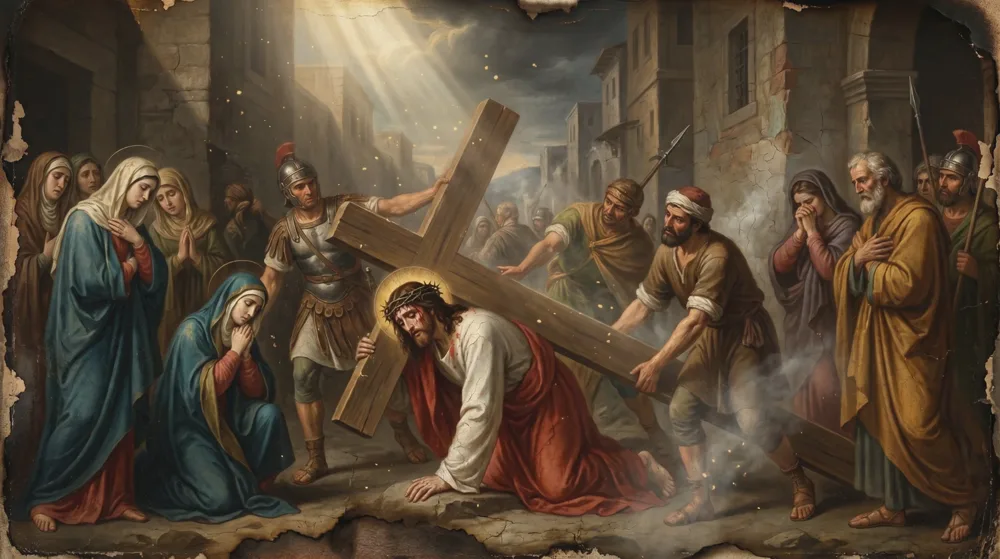
The Stations of the Cross — also called the Way of the Cross, or in Latin the Via Crucis — is the devotion in which we walk, in mind and often in body, the road Our Lord travelled with His Cross, from His condemnation by Pilate to His burial in the tomb. There are fourteen stations, each a scene of the Passion, before which we pause to pray and to meditate. It is above all a Lenten and a Friday devotion, kept before the fourteen images set along the walls of nearly every Catholic church.
What the Way of the Cross is
The Way of the Cross is a method of meditating on the Passion. At each of the fourteen stations we recall one moment of Our Lord's suffering, adore Him, grieve for the sins that nailed Him there, and ask the grace to amend our lives. The devotion grew from the ancient custom of pilgrims who walked the actual streets of Jerusalem along which Christ carried the Cross. Because most Christians could never reach the Holy Land, the Church, chiefly through the Franciscans who guarded the holy places, brought the Via Crucis home — erecting the stations in churches so that every soul might make the same journey in spirit.
The Fourth Article of the Creed teaches what we contemplate here: that Jesus Christ, "to redeem the world by His Precious Blood," "suffered under Pontius Pilate, the Governor of Judea, died on the tree of the Cross, and, on being taken down therefrom, was buried" (Catechism of St Pius X). The Stations set that one sentence before our eyes, scene by scene.
The 14 Stations of the Cross
The fourteen stations, in their traditional order, are:
- Jesus is condemned to death.
- Jesus is made to carry His Cross.
- Jesus falls the first time under the Cross.
- Jesus meets His afflicted Mother.
- Simon of Cyrene helps Jesus to carry His Cross.
- Veronica wipes the face of Jesus.
- Jesus falls the second time.
- Jesus speaks to the women of Jerusalem.
- Jesus falls the third time.
- Jesus is stripped of His garments.
- Jesus is nailed to the Cross.
- Jesus dies upon the Cross.
- Jesus is taken down from the Cross.
- Jesus is laid in the sepulchre.
Some of these scenes are recorded plainly in the Gospels — the condemnation, the carrying of the Cross, Simon of Cyrene, the women of Jerusalem, the Crucifixion, the death, the burial (see Matthew 27, Luke 23, John 19, Douay-Rheims). Others — the three falls, the meeting with His Mother, Veronica's veil — belong to the constant tradition of the Church's meditation on the Passion. Together the fourteen carry us from Pilate's judgment hall to the sealed tomb.
The Via Crucis prayers
The Stations of the Cross have no single fixed text; the most widely used is that of St Alphonsus Liguori, kept in countless missals and prayer-books. Whatever form is used, the pattern is the same and easily learned.
At each station, we genuflect or kneel and say:
V. We adore Thee, O Christ, and we bless Thee.
R. Because by Thy holy Cross Thou hast redeemed the world.
Then we read the short meditation for that station — what Our Lord suffered there — and make a brief act of contrition and love. We commonly close each station with an Our Father, a Hail Mary, and a Glory Be, and pass to the next, often singing a verse of the Stabat Mater, the hymn of Our Lady standing beneath the Cross. After the fourteenth station it is customary to add prayers for the intentions of the Church and an act of thanksgiving for the Redemption.
This is the great fruit of the devotion. Why did Our Lord suffer so much? "Jesus Christ suffered so much in order to satisfy divine justice all the more abundantly; to display His love for us still more; and to inspire us with the deepest horror of sin" (Catechism of St Pius X). The Way of the Cross is meant to work exactly that — love drawn out, and horror of sin driven in.
The 14 Stations of the Cross prayers, station by station
The St Alphonsus Liguori form (first published in Italian in 1761) opens with an act of contrition said before the altar:
My Lord Jesus Christ, Thou hast made this journey to die for me with love unutterable, and I have so many times unworthily abandoned Thee; but now I love Thee with my whole heart, and because I love Thee I repent sincerely for ever having offended Thee. Pardon me, my God, and permit me to accompany Thee on this journey. Thou dost go to die for love of me; I wish also, my beloved Redeemer, to die for love of Thee. My Jesus, I will live and die always united to Thee.
Then each station follows the same pattern: the versicle "We adore Thee, O Christ…", a short consideration of the scene, and a prayer that applies it to the soul and ends with the act of love that recurs, in nearly the same words, at every station. The First Station shows the whole shape:
My adorable Jesus, it was not Pilate, no, it was my sins that condemned Thee to die. I beseech Thee, by the merits of this sorrowful journey, to assist my soul in its journey towards eternity. I love Thee, my beloved Jesus; I repent with my whole heart for having offended Thee. Never permit me to separate myself from Thee again. Grant that I may love Thee always; and then do with me what Thou wilt.
At the stations that follow, the prayer takes up each scene in turn — the Cross accepted, the falls, the meeting with His Mother, Simon and Veronica, the women of Jerusalem, the stripping, the nailing, the death, the taking down, and the burial — always closing with the same act of love and contrition. After each, the Our Father, Hail Mary, and Glory Be are said, with a verse of the Stabat Mater sung between the stations.
When to make the Stations
The Stations may be made at any time, alone or with others, and they are a privileged devotion of Lent, when many parishes pray them publicly on the Fridays of the season and most solemnly on Good Friday during Holy Week. More widely, Friday is the day of the week kept in memory of the Passion, and so the Way of the Cross suits any Friday of the year. One need not wait for a public service: a soul may walk the fourteen stations slowly in an empty church, or, with the proper images and the prescribed prayers, make them in spirit where the stations cannot be visited.
The Stations of the Cross on Good Friday
On Good Friday the Church keeps the death of Our Lord, and the Way of the Cross belongs to that day above all others. In countless parishes the Stations are prayed publicly on Good Friday afternoon — often near the ninth hour, three o'clock, the hour of His death — frequently led by the priest with the people answering and the Stabat Mater sung between the stations.
The devotion is distinct from the great liturgical service of Good Friday (the reading of the Passion, the solemn prayers, and the Adoration of the Cross); the Stations are a separate, popular devotion that may be added to the day. Through Lent, many parishes pray the Stations every Friday, building toward this culmination in Holy Week. In the year 2025, Good Friday fell on 18 April; in 2026 it falls on 3 April — the date moves each year with Easter, but the devotion remains the same.
Why are there 14 stations? (and what of 7, 12, or 15?)
The number fourteen was not fixed at once. Early Stations varied greatly — some shrines had as few as seven stations, others eleven or more — until usage settled, and the Church confirmed, the fourteen we keep today. So a "7 stations of the cross" or "12 stations of the cross" is not a different devotion but an older or shortened count; the full traditional form is the fourteen. A fifteenth station, the Resurrection, is sometimes added at the end by way of a hopeful conclusion, but it is an optional addition, not part of the original fourteen, which end at the tomb. When in doubt, keep the fourteen: that is the form indulgenced and erected in nearly every Catholic church.
Images and pictures of the Stations of the Cross
The fourteen images — carvings, paintings, or plaques set along the walls of a church — are essential to the devotion, not mere decoration. The Church's rule for the canonically erected Stations, set out in the rite of erection of the Rituale Romanum, requires fourteen crosses of wood (the crosses carry the indulgence, not the pictures), with images customarily added beside each. We move from picture to picture, letting the eye carry the scene to the heart; this is why, when the Stations are made privately away from a church, holy pictures of each station are used to keep the same order before us. Sacred art here serves meditation: a true image of the Passion is meant to draw the soul into the mystery, never to be venerated for its own sake.
A printable Stations of the Cross (PDF)
Because the devotion needs only the fourteen scenes and a few short prayers, it carries well onto a single printed sheet. Many of the faithful keep a printable Stations of the Cross — the list of the fourteen, the opening versicle, the act of St Alphonsus, and the closing prayers — to use at home, on a sick-bed, or where no church is near. The text above (the order, the per-station acts, and the prayers) is exactly what such a sheet contains; it may be copied and printed for private use.
For the indulgence attached to the Stations, however, the prescribed conditions are met by making them before validly erected Stations or, when prevented, by holding a crucifix blessed for this purpose while saying twenty Our Fathers, Hail Marys and Glory Bes (fourteen for the stations, five for the Five Wounds, one for the intentions of the Pope) — a printed sheet alone is an aid to meditation, not a substitute for the conditions.
Better than a PDF for the rest of your prayer life: the Iter Fidei app carries the traditional Office, the Mass of the day, the litanies, and the prayers of the Church, even without a connection. Join early access here.
The Stations of the Cross for kids
The Way of the Cross is well suited to children, who learn the Faith through scenes they can picture. To make the Stations with children, keep it short and concrete: name each station simply ("Jesus is given His Cross," "Jesus falls," "a kind woman wipes His face"), pause for one sentence at each, and say one Our Father, Hail Mary, and Glory Be rather than long meditations. Walking slowly from image to image holds their attention better than reading; a child who genuflects and says "We adore Thee, O Christ" at each cross has truly made the Stations. The aim is the same as for adults — to let the children walk with Jesus while He suffers, and to learn early what their sins cost and what their redemption is worth.
Following the Stations of the Cross from home
Many of the faithful now follow the Way of the Cross with a recorded or sung version — on YouTube or another platform — when no public service is near, especially the elderly, the sick, and the homebound. This is a worthy aid: a well-made recording with the Stabat Mater between the stations can carry a soul through the whole devotion. Two cautions keep it sound. First, a screen is a help to meditation, not the meditation itself; the point is to pray, not merely to watch. Second, the indulgence conditions described above are not met by watching a video alone — for those, the validly erected Stations, or a blessed crucifix in hand, are required. Used rightly, recorded Stations let the housebound keep the Friday devotion they could otherwise not make.
Shrines of the Way of the Cross
Beyond the fourteen Stations within a church, larger outdoor shrines of the Way of the Cross exist as places of pilgrimage — the fourteen scenes set along a path, a hillside, or a Calvary, so that pilgrims walk the road in body as well as in mind. These recall the devotion's origin: the actual streets of Jerusalem along which the first Christian pilgrims followed the steps of Our Lord. The greatest of all is the Via Dolorosa in Jerusalem itself, the road Christ walked to Golgotha, of which every set of Stations in every church is a faithful copy. Whether at a great shrine or before the fourteen plaques of a parish, the devotion is one and the same.
Why the devotion endures
The Way of the Cross answers a deep instinct of the Christian soul — not merely to know that Christ suffered, but to walk with Him while He suffers. It is the Passion made personal, station by station, until we stand at the tomb. The same Lord whose Sacrifice is offered without blood upon the altar of the Tridentine Mass is here followed step by step along the road that led to Calvary. To make the Stations well is to let the Passion teach us, slowly, what our sins cost and what our redemption is worth.
Frequently Asked Questions
How many stations of the cross are there?
There are fourteen stations in the traditional Way of the Cross, from Our Lord's condemnation by Pilate to His burial in the sepulchre. This number was fixed by long usage and confirmed by the Church, chiefly through the Franciscans who guarded the holy places; it is the form erected along the walls of nearly every Catholic church.
What are the stations of the cross?
The Stations of the Cross — also called the Way of the Cross, or in Latin the Via Crucis — are a devotion in which we walk, in mind and often in body, the road Our Lord travelled with His Cross from His condemnation by Pilate to His burial. At each of the fourteen stations we recall one moment of His Passion, adore Him, grieve for the sins that nailed Him there, and ask grace to amend our lives. The devotion grew from the ancient custom of pilgrims who walked the actual streets of Jerusalem and was brought home into churches so that every soul might make the same journey in spirit.
What are the 14 stations of the cross in order?
In their traditional order they are: (1) Jesus is condemned to death; (2) Jesus is made to carry His Cross; (3) Jesus falls the first time; (4) Jesus meets His afflicted Mother; (5) Simon of Cyrene helps Jesus carry His Cross; (6) Veronica wipes the face of Jesus; (7) Jesus falls the second time; (8) Jesus speaks to the women of Jerusalem; (9) Jesus falls the third time; (10) Jesus is stripped of His garments; (11) Jesus is nailed to the Cross; (12) Jesus dies upon the Cross; (13) Jesus is taken down from the Cross; (14) Jesus is laid in the sepulchre.
How to pray the stations of the cross?
We move from station to station, genuflecting or kneeling at each, and say: "We adore Thee, O Christ, and we bless Thee. Because by Thy holy Cross Thou hast redeemed the world." Then we read the short meditation for that scene of the Passion, make a brief act of contrition and love, and ordinarily say an Our Father, a Hail Mary, and a Glory Be before passing on. The most widely used form is that of St Alphonsus Liguori, often with a verse of the Stabat Mater sung between the stations.
What is the Stations of the Cross?
The Stations of the Cross is a Catholic devotion — a method of meditating on the Passion of Our Lord by following, scene by scene, the road He travelled with His Cross from His condemnation to His burial. It is made before fourteen images set along the walls of nearly every Catholic church, and may also be made privately. It is above all a Lenten and a Friday devotion.
Why are there 12 stations in some places? Are there 7?
The traditional and confirmed number is fourteen. Older or shortened sets sometimes had seven, eleven, or twelve stations before usage settled; a "7 stations" or "12 stations" version is not a different devotion but an abbreviated count of the same Passion. The full form, indulgenced and erected in churches, is the fourteen, which run from Pilate's judgment to the sealed tomb. A fifteenth station, the Resurrection, is sometimes added as an optional conclusion.
When are the Stations of the Cross prayed on Good Friday?
On Good Friday many parishes pray the Stations publicly in the afternoon, often near three o'clock, the hour of Our Lord's death. They are a popular devotion distinct from the solemn Good Friday liturgy (the Passion, the solemn prayers, and the Adoration of the Cross) and may be added to the day. Through Lent they are commonly prayed every Friday.
Is there a printable Stations of the Cross (PDF)?
The whole devotion — the fourteen scenes, the opening versicle, the short act at each station, and the closing prayers — fits on a single sheet, and may be copied and printed for private use at home or by the sick. Note, though, that the indulgence attached to the Stations requires either validly erected Stations or, when prevented, a crucifix blessed for this purpose held while the prescribed Our Fathers, Hail Marys and Glory Bes are said; a printed sheet alone is an aid to meditation, not a substitute for those conditions.
Rather than keep a loose sheet, keep the rest of your daily prayer at hand: the Iter Fidei app carries the traditional Office, the Mass of the day and the prayers of the Church, even offline. Join early access here.
How do I do the Stations of the Cross with kids?
Keep it short and concrete: name each station in a simple phrase, pause for one sentence, and say one Our Father, Hail Mary, and Glory Be rather than long meditations. Walking slowly from image to image holds children's attention; a child who genuflects and says "We adore Thee, O Christ" at each cross has truly made the Stations.
The Iter Fidei app carries the traditional Office, the Mass of the day, the Stabat Mater, and the prayers of the Church in Latin and English, in your pocket. Join early access here.
Sources. Catechism of St Pius X, Part I, the Fourth Article of the Creed (on the Passion, Crucifixion, death, and burial of Our Lord); St Alphonsus Liguori, The Way of the Cross (1761), opening act and First Station; Rituale Romanum (Pustet 1925), rite of erection of the Stations of the Cross; the Stabat Mater; the Passion narratives (Matthew 27, Luke 23, John 19, Douay-Rheims); the Raccolta, conditions for the indulgence of the Way of the Cross (canonically erected Stations, or a crucifix blessed for the purpose when prevented); the Via Dolorosa of Jerusalem as the devotion's origin.