
Devotions
The Chaplet of the Five Wounds of Jesus
The Chaplet of the Five Wounds honours the five sacred Wounds of the Crucified — the two hands, the two feet, and the pierced side — a traditional Passion devotion, fostered by the Passionists, and how it is prayed.
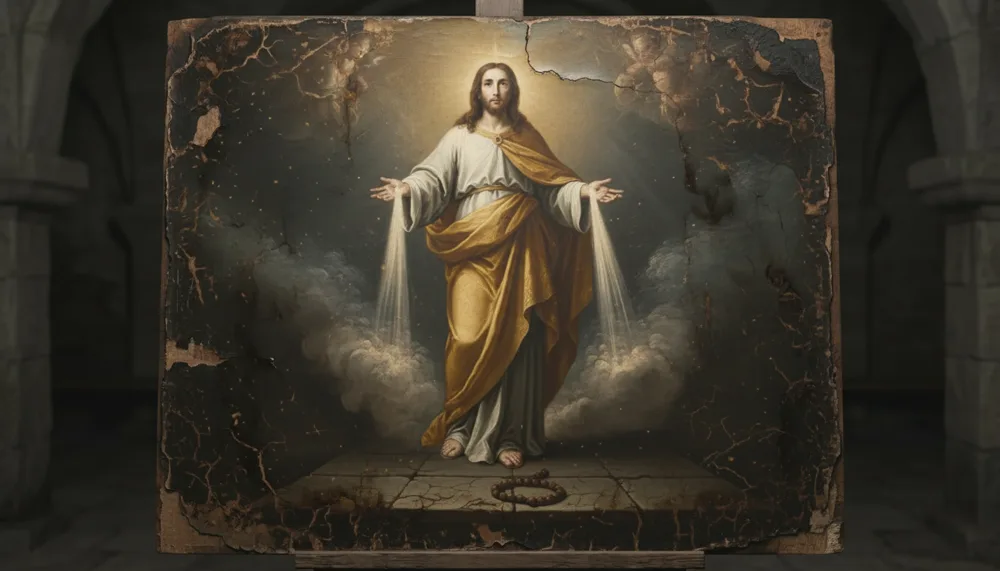
The Chaplet of the Five Wounds is a counted devotion of the Passion by which we honour the five sacred Wounds of our crucified Lord — the wound in each hand, the wound in each foot, and the wound of the lance in His side — pleading the Precious Blood that flowed from them for the living and the dead.
It is a form of the old devotion to the Five Wounds, carried in the modern age above all by the Passionists; the chaplet's prayers are devotional texts, not liturgical ones. Below we set out what the five Holy Wounds are, why the Church venerates them, and how the chaplet is prayed. If the form is new to you, our note on what a chaplet is explains the genre, and the chaplet takes its place among the wider body of Catholic devotions the Church has proved and indulgenced.
What the Five Wounds are
The five Wounds are the five openings torn in the Body of Christ in His crucifixion: the two hands and the two feet fastened to the wood, and the side opened after death by the soldier's lance. The Roman Catechism describes the nailing without softening: "His feet and His hands were nailed to the Cross... His whole Body, in fine, was beaten with rods" (Catechism of the Council of Trent, On the Fourth Article of the Creed). The wound of the side the Evangelist records apart: "one of the soldiers with a spear opened his side, and immediately there came out blood and water" (John xix, Douay-Rheims).
The Wounds are venerated because they remained. The Risen Christ kept them in His glorified Body and showed them to the doubting Thomas: "Put in thy finger hither, and see my hands; and bring hither thy hand, and put it into my side; and be not faithless, but believing" (John xx). The five Wounds are therefore not a memory of a past suffering but the standing marks of our redemption, borne by the Lord in heaven and pleaded for us before the Father.
Why we venerate the Wounds of Christ
A reader sometimes asks whether it is fitting to adore wounds — whether the honour does not stop at the flesh. St Thomas answers plainly. Because the Word is hypostatically united to the flesh He assumed, the Body of Christ and every part of it is adored with the same adoration of latria due to the Word Himself (Summa Theologiae III, q. 25, a. 2). To venerate the Wounds is to adore the Crucified. For the same reason St Thomas teaches that the Cross of Christ is to be venerated, both as it represents Him crucified and as it touched His sacred limbs and was bathed in His Blood (III, q. 25, a. 4).
What the Wounds are worth, the Catechism states in the language of price. The death of Christ "was a full and entire satisfaction" by which He paid "all the debt of our sins," and "this price which He paid for us not only equalleth our obligation, but is infinitely superior to it" (Catechism of the Council of Trent, On the Fourth Article). The Blood that ran from the five Wounds is therefore of infinite worth. When we tell this chaplet we plead that price — not to repay a debt that love has already overpaid, but to stand within it and ask that it be applied to ourselves and to the whole world.
The Wounds were prophesied. Zacharias foretold the Pierced One: "they shall look upon me, whom they have pierced" (Zacharias xii), and of the hands: "What are these wounds in the midst of thy hands? And he shall say: With these I was wounded in the house of them that loved me" (Zacharias xiii). The Psalmist sang it long before the nails: "they have dug my hands and feet, they have numbered all my bones" (Psalm xxi). You will find more of these verses among our Catholic Bible verses on the Passion.
A devotion older than the modern chaplets
The veneration of the five Wounds is among the most ancient currents of Catholic piety. The Fathers loved to read the open side of Christ as the cleft of the rock where the dove shelters, the wound through which the Church was born of Blood and water. The medieval Church gave the Wounds their own Mass and Office of the Five Wounds long before the chaplet took its bead form. This is the wound our older Passion devotions all circle — the Stations of the Cross, the Chaplet of the Holy Face, the Anima Christi with its cry within thy wounds hide me.
In the modern age the devotion was carried above all by the Passionists, the Congregation of the Passion founded by St Paul of the Cross in the eighteenth century, who wear the sign of the Passion on the habit and bind themselves to keep the memory of the Wounds alive. From their preaching the chaplet spread as a short, daily way of dwelling in the five Wounds and offering the Blood that flowed from them. It is the same impulse that gives us the Chaplet of the Precious Blood and the devotion to the Sacred Heart of Jesus — for the side-wound and the Heart are one wound, the open Heart from which Blood and water flowed.
A word of correction, since the point is often confused. The Chaplet of the Five Wounds is not the Divine Mercy chaplet, which arose from private revelations of the twentieth century and is a distinct devotion of much later date. The chaplet treated here belongs to the older tradition. Nor is it a relic of superstition: the beads are a sacramental, and their whole power is the prayer of the Church and the faith of the one who prays, not any virtue in the wood or the metal.
How to pray the Chaplet of the Five Wounds
The chaplet is built on the five Wounds, honoured one by one. The common traditional arrangement gives five Our Fathers — one for each Wound — followed by a single Hail Mary to honour the Mother who stood beneath the Cross. Some forms expand each Wound into five Our Fathers, so that twenty-five are said in all; the shorter form is the one most kept by the faithful and the one we set out here. Take it slowly: its strength is in the offering, not the counting.
Begin with the sign of the Cross and an act of intention.
O Jesus, divine Redeemer, I adore the five Wounds which Thou didst suffer for me upon the Cross, and I offer to the eternal Father the Precious Blood that flowed from them, in reparation for my sins and for the salvation of the living and the dead.
Then honour each of the five Wounds in turn — the right hand, the left hand, the right foot, the left foot, and the wounded side — saying for each one:
Our Father, who art in heaven... (recalling this Wound of our Lord)
I adore Thee, O wounded hand (or foot, or side) of my Saviour, and through this Wound I plead Thy Precious Blood for the living and for the dead.
When the five Wounds are told, say the Hail Mary in honour of the Sorrowful Mother:
Hail Mary, full of grace, the Lord is with thee; blessed art thou amongst women, and blessed is the fruit of thy womb, Jesus. Holy Mary, Mother of God, pray for us sinners, now and at the hour of our death. Amen.
Close with the ancient versicle the Church sings of the Passion:
V. We adore Thee, O Christ, and we bless Thee.
R. Because by Thy holy Cross Thou hast redeemed the world.
The whole is the work of a few minutes. The Pater is chosen so that we ask for our daily bread and our deliverance from evil while holding before the Father the very Blood that purchased both, exactly as the Chaplet of the Precious Blood does on its thirty-three Our Fathers.
What the Wounds ask of us
To pray the five Wounds is not a sentiment but a reckoning. The Catechism warns that those who fall back into sin "crucify again in their hearts, as much as in them lieth, the Son of God by their sins" (Catechism of the Council of Trent, On the Fourth Article). The Wounds we venerate are the Wounds our sins reopen; the chaplet that adores them is therefore also a summons to leave the sins that drove the nails. It is no use to kiss the wounded hand and keep the hand that wounds. The devotion bears its fruit when, having pleaded the Blood, we confess our sins and amend our lives, that the price poured from those five Wounds may not be pleaded over us in vain.
Pray it for the dying and for the souls in purgatory, offering the Blood of the five Wounds for their release, after the manner of the prayers for the dead and the Litany of the Poor Souls. Pray it in Lent and on the Fridays of the year, when the Church turns the whole Body to the Cross. And pray it for yourself, to dwell where the Fathers bid the soul take shelter — in the wounded side of Christ, the open Heart that is the surest refuge of a sinner.
It sits well among the wider body of Catholic prayers and beside the other Catholic litanies of the Passion that the faithful have always loved. Take the beads, recall the two hands and the two feet and the pierced side, and offer the Blood that flowed from them to the Father — that the price of our redemption, infinitely greater than our debt, may be applied to us and to all the world.
Frequently Asked Questions
What are the five wounds of Jesus Christ?
The five Wounds are the five openings torn in the Body of Christ in His crucifixion: the wound in each hand and the wound in each foot, fastened to the wood, and the wound of the lance in His side, opened after death (John xix, Douay-Rheims). The Roman Catechism records the nailing without softening — "His feet and His hands were nailed to the Cross." The Risen Christ kept these Wounds in His glorified Body and showed them to the doubting Thomas, so they are the standing marks of our redemption, not a mere memory of past suffering.
How do you pray the Chaplet of the Five Wounds?
In the common traditional form you say five Our Fathers — one for each Wound — honouring in turn the right hand, the left hand, the right foot, the left foot, and the pierced side, then a single Hail Mary for the Sorrowful Mother who stood beneath the Cross. At each Wound you adore it and plead the Precious Blood that flowed from it for the living and the dead. The whole is closed with the versicle "We adore Thee, O Christ, and we bless Thee, because by Thy holy Cross Thou hast redeemed the world."
Why does the Church venerate the Wounds of Christ?
Because the Word is hypostatically united to the flesh He assumed, the Body of Christ and every part of it is adored with the same adoration of latria due to the Word Himself (St Thomas, Summa Theologiae III, q. 25, a. 2). To venerate the Wounds is therefore to adore the Crucified, not to stop at the flesh. The Blood that ran from them is of infinite worth, for the death of Christ was "a full and entire satisfaction... infinitely superior" to our debt (Catechism of the Council of Trent).
Is the Chaplet of the Five Wounds the same as the Divine Mercy chaplet?
No. The Chaplet of the Five Wounds belongs to the ancient tradition of the devotion to the Holy Wounds, kept long before the modern chaplets and carried in the modern age above all by the Passionists. The Divine Mercy chaplet arose from private revelations of the twentieth century and is a distinct devotion of much later date.
Who promoted devotion to the Five Wounds?
The veneration of the five Wounds is among the most ancient currents of Catholic piety, and the medieval Church gave the Wounds their own Mass and Office of the Five Wounds. In the modern age the devotion was carried above all by the Passionists, the Congregation of the Passion founded by St Paul of the Cross, who wear the sign of the Passion on the habit and bind themselves to keep the memory of the Wounds alive.
What does the Chaplet of the Five Wounds ask of us?
It asks not a sentiment but a reckoning, for those who fall back into sin "crucify again in their hearts... the Son of God by their sins" (Catechism of the Council of Trent). The Wounds we venerate are the Wounds our sins reopen, so the chaplet is also a summons to confess our sins and amend our lives. It is no use to kiss the wounded hand and keep the hand that wounds.
The Iter Fidei app carries the Douay-Rheims Bible, the catechism, the prayers and devotions in Latin and your own language. Join early access here.
Sources. Catechism of the Council of Trent (1566), On the Fourth Article of the Creed (the Passion) — on the nailing of the hands and feet, on the satisfaction "infinitely superior" to our obligation, and on those who "crucify again" the Son of God by their sins; St Thomas Aquinas, Summa Theologiae III, q. 25, a. 2 (the adoration of latria due to the Body of Christ) and a. 4 (the veneration of the Cross of Christ); Sacred Scripture in the Douay-Rheims: John xix and xx (the side opened by the lance; the wounds shown to Thomas), Zacharias xii–xiii and Psalm xxi (the wounds prophesied); the traditional Mass and Office of the Five Wounds and the devotion fostered by the Passionists, the Congregation of the Passion of St Paul of the Cross.