
Devotions
The Holy Face of Jesus: The Devotion of Reparation
The devotion to the Holy Face of Jesus honours the wounded countenance of Our Lord in reparation for blasphemy and the profanation of Sundays — revealed at Tours to Sister Marie de Saint-Pierre in the 1840s and spread by the Venerable Leo Dupont, with the Golden Arrow prayer.
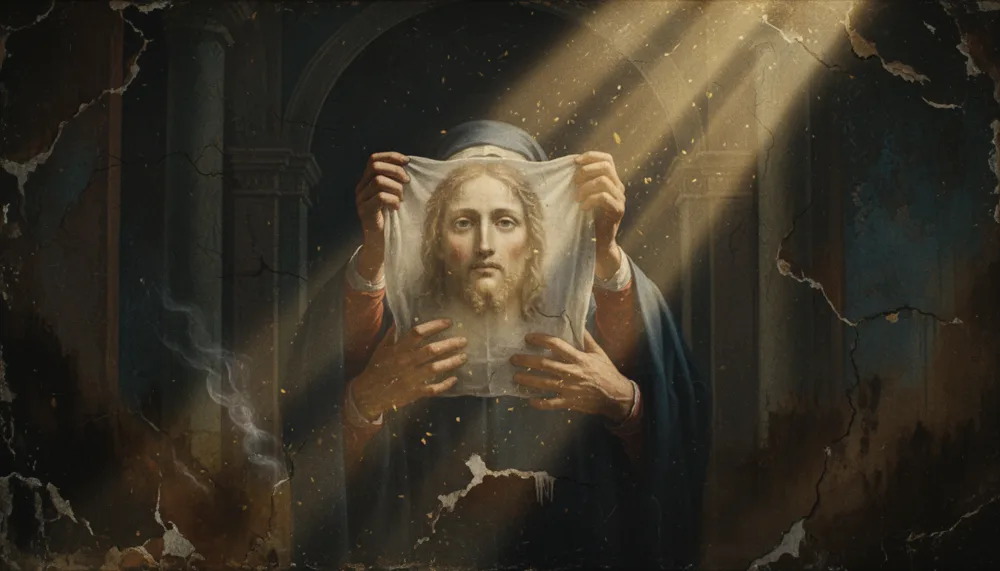
The devotion to the Holy Face of Jesus is the veneration of the sacred countenance of Our Lord as it was disfigured in His Passion, offered to the Father in reparation for the sins of blasphemy and the profanation of Sundays and holy days. It rose in its modern form at Tours in the 1840s, made known to the Carmelite Sister Marie de Saint-Pierre and carried to the world by the layman Leo Dupont; from it comes the short prayer of praise called the Golden Arrow. Below we explain what the devotion is, where it came from, the prayer at its centre, and its link to the Veil of Veronica and the Holy Shroud.
What the devotion to the Holy Face is
The Holy Face of Jesus is His human face — the true face He took when the Word was made flesh, a mystery we treat at length in the Incarnation. This devotion does not honour that face in its beauty but in its humiliation: spat upon, struck, crowned with thorns, swollen and bloodied in the night of His suffering. It is the Face of which the prophet sang centuries before, there is no beauty in him, nor comeliness... his look was as it were hidden and despised, whereupon we esteemed him not (Isaias 53:2-3, Douay-Rheims). To gaze on that Face is to see, in one image, what sin does to God made man.
The devotion, then, is not first a prayer of petition. It is a prayer of reparation. Reparation means making amends for offences against God — not because His glory can be lessened, for nothing created can touch it, but because justice and love demand that the wrong be owned and the honour restored. Where the Sacred Heart is venerated as the emblem of Christ's love, the Holy Face is venerated as the visible bearing of our sins, the answer of love to the malice that wounded Him. It is one of the great Catholic devotions precisely because it sets the soul before the cost of sin.
The two sins it repairs: blasphemy and the profanation of Sundays
The devotion fixes itself upon two precise offences, both against the first table of the Law — the Commandments that touch God Himself.
The first is blasphemy, forbidden by the Second Commandment. The Catechism of Saint Pius X teaches that this Commandment forbids us "to blaspheme against God, against the Most Blessed Virgin, and against the Saints," blasphemy being "a horrible sin which consists in words or acts of contempt or of malediction against God, the Blessed Virgin, the Saints, or against holy things." It is the direct dishonouring of the Name of God.
The second is the profanation of the Lord's Day, against the Third Commandment, which "commands us to honour God by the practices of worship on feast days" and "forbids us servile works and every other occupation which turns us away from divine worship" (Catechism of Saint Pius X, On the Commandments which regard God). The trampling of Sunday — its surrender to labour, commerce and amusement — strips God of the day He claims as His own.
These are the two wounds the Holy Face devotion sets itself against. They were spreading in the nineteenth century; they have not retreated in ours. The devotion answers them not with argument but with adoration: it repairs the dishonour of the Name by blessing that Name, and the loss of the Lord's Day by giving God worship.
Tours, 1840s: Sister Marie de Saint-Pierre and the Golden Arrow
The devotion in its modern form was made known to Sister Marie de Saint-Pierre (1816-1848), a Discalced Carmelite of the monastery of Tours. In the communications she reported — and which she submitted entirely to her superiors and to the judgment of the Church — she was given to understand that the sins of blasphemy and of Sunday profanation pierced the Heart of God as a poisoned arrow, and that He willed a work of reparation through the honouring of His Holy Face. The remedy was to be a counter-arrow: a short prayer of praise that would "wound" the Heart of Jesus with love as blasphemy wounds it with malice. This is the Golden Arrow prayer:
May the most holy, most sacred, most adorable, most incomprehensible and unutterable Name of God be for ever praised, blessed, loved, adored and glorified in Heaven, on earth, and under the earth, by all the creatures of God, and by the Sacred Heart of Our Lord Jesus Christ, in the Most Holy Sacrament of the Altar. Amen.
The prayer answers blasphemy point for point. Where the blasphemer curses the Name, it blesses the Name; where contempt is poured out, it pours out adoration. It is the whole devotion in a single sentence. Sister Marie de Saint-Pierre died young and almost unknown, and the work she had received would in all likelihood have died with her, but for a layman of Tours.
The Venerable Leo Dupont, the Holy Man of Tours
Leo Dupont (1797-1876) was a Catholic gentleman of independent means who settled at Tours. Drawn to the message of the Carmel, he kept a lamp burning before an image of the Holy Face in his own house and prayed there with whoever would come. Cures and conversions were reported in such number that his home became a place of pilgrimage, and he was called the Holy Man of Tours. He spent his fortune and his years propagating the devotion, and from his work grew the Archconfraternity of the Holy Face. He died with the reputation of sanctity, and the Church later declared him Venerable.
So the devotion passed from a hidden cell, through one obscure layman, into the universal Church — a reminder, like so many sacramentals and devotions, that the tradition is carried as much by faithful obscurity as by office. The same lesson runs through the lives of the saints whose witness anchors the Church, from Saint Peter and Saint Paul to the converted Mary Magdalene, who first looked upon the risen Face at the tomb.
How the devotion is practised: the chaplet and the image
The Holy Face devotion is lived in two chief ways. The first is the honouring of an image of the wounded Face — kept, as Leo Dupont kept it, with a lamp before it, made the object of an act of reparation. The second is the praying of the Chaplet of the Holy Face on its thirty-nine beads, which gathers the Golden Arrow and the offering of the Face into a fixed form. We give the chaplet in full, bead by bead, in our companion piece on the chaplet of the Holy Face; it is the natural way to make this devotion a regular practice. The same reparation may also be spread over nine days in a novena to the Holy Face.
At its heart stands one offering, repeated through both: Eternal Father, I offer Thee the adorable Face of Thy beloved Son, for the honour and glory of Thy Name, for the conversion of sinners, and for the salvation of the dying. Here the soul does not ask for itself; it presents the wounded Face to the Father as the price already paid, pleading the Passion against the sins of the age.
The Chaplet of the Holy Face beads: how the form is built
The Holy Face chaplet beads are not a rosary. The cord carries thirty-nine small beads grouped in six divisions, together with a medal of the Holy Face — thirty-three beads for the years of Our Lord's earthly life and six in honour of the wounded senses of His Face: the eyes, the ears, the nostrils, the mouth, the cheeks, and the whole countenance.
On the first beads the soul prays O God, come to my assistance; O Lord, make haste to help me, and on each division offers the senses of the Holy Face to the Eternal Father, repeating the Golden Arrow. There is no obligatory commercial form: a person may pray the whole chaplet on an ordinary set of beads, or even on the fingers, for the value is in the offering, not in the object. We set out every bead and every word in our companion piece on the chaplet of the Holy Face.
The Litany of the Holy Face of Jesus
Beside the chaplet stands the Litany of the Holy Face of Jesus, a litany of invocation and reparation drawn from the same devotion of Tours. Like every litany approved for private use, it is a series of short praises and petitions, each answered by the people. It is a fitting prayer to join to the chaplet, or to pray alone before an image of the Face. We give here the core of its invocations:
Lord, have mercy on us. Christ, have mercy on us. Lord, have mercy on us.
O God, the Father of Heaven, have mercy on us.
O God the Son, Redeemer of the world, have mercy on us.
O God the Holy Ghost, have mercy on us.
Holy Trinity, one God, have mercy on us.O adorable Face, which was adored with profound respect by Mary and Joseph when they saw Thee for the first time, have mercy on us.
O adorable Face, which in the night of the Nativity didst ravish with joy the angels and the shepherds, have mercy on us.
O adorable Face, which didst transport with happiness the holy old man Simeon and the prophetess Anna, have mercy on us.
O adorable Face, which on Thabor wast resplendent with glory before the apostles, have mercy on us.
O adorable Face, which wast covered with the sweat of blood in the Garden of Olives, have mercy on us.
O adorable Face, which wast struck by a vile servant, covered with spittle, and soiled by the hands of the wicked, have mercy on us.
O adorable Face, which on the Cross wast bathed in blood and bedewed with tears, have mercy on us.Be merciful unto us, Pardon us, O Lord.
Be merciful unto us, Hear us, O Lord.V. Show us Thy Face, O Lord, and we shall be saved. R. Arise, O Lord, and help us, and deliver us for Thy Name's sake.
The full litany continues the same pattern of invocation, closing with the prayer that God, who has signed His servants with the light of His Face, may grant them by the merits of that Holy Face the remission of all their sins. The litany of the Holy Face belongs, like the chaplet, to private devotion; it carries no liturgical rank, and we pray it in that humility. It takes its place among the other Catholic litanies of the tradition.
The Holy Face scapular
Some of the faithful wear a Holy Face scapular or carry a Holy Face medal as a sign and reminder of the devotion. Unlike the Brown Scapular of Mount Carmel, the Holy Face badge does not carry a great formal promise attached by a particular apparition; it is worn as a sacramental of remembrance — a small cloth or medal bearing the wounded Face, which calls the soul back through the day to the work of reparation.
A sacramental is a sign instituted by the Church that disposes us to grace; it works not by any power of its own, still less by magic, but by stirring devotion and by the prayers of the Church (Catechism of Saint Pius X, on the sacramentals). To wear the Holy Face, then, is to carry a reminder of a debt of love, not a charm. The image and the chaplet remain the heart of the devotion; the badge serves them.
The Veil of Veronica and the Holy Shroud
The devotion is bound to two relics of the Passion through which the Face of Christ has come down to us. The first is the Veil of Veronica. Tradition holds that as Our Lord carried His Cross to Calvary, a woman pressed forward through the crowd and wiped His face with a cloth, and that His features remained imprinted upon it. The Roman Catechism teaches that in His Passion our Lord "was seized, overwhelmed with mockeries and insults, tormented in divers manners, and at last fastened to a cross"; the Veronica is venerated as the cloth that received the imprint of that suffering Face. The episode is enshrined in the sixth Station of the Way of the Cross, the great public meditation on the Passion of Jesus Christ.
The second is the Holy Shroud of Turin, the linen bearing the front-and-back image of a scourged and crucified man, venerated for centuries as the burial cloth in which the body of Christ was wrapped — a clean linen cloth in which Joseph of Arimathea laid Him (Matthew 27:59-60). On it appears a face marked by the very wounds the devotion contemplates: the punctures of the thorns, the swelling of the blows. We examine what the science honestly shows, and what the Church does and does not require us to believe, in our study of the Shroud of Turin; and the question many ask of all these images — what did Jesus look like — we take up there as well.
We must be exact about these relics. The Church has never bound the faithful, by any definition, to hold the Veronica or the Shroud authentic; their veneration is permitted and commended, but our faith does not rest on a cloth. It rests on the Word made flesh and risen from the dead. The relics serve the devotion; they do not found it. Whether or not the linen of Turin wrapped that sacred body, the Face it depicts is the true Face the devotion adores.
Why the devotion matters
The Holy Face of Jesus is the human countenance of God, made ugly for our sake and offered back to the Father in love. To venerate it is to take the side of God against the dishonour heaped on His Name and the desecration of His day, and to plead His own Passion for the conversion of those who curse and the salvation of the dying. Keep an image of that Face where you pray; bless the Name that others blaspheme; sanctify the Lord's Day. O Lord, show us Thy Face, and we shall be saved.
Frequently Asked Questions
What is the devotion to the Holy Face of Jesus?
It is the veneration of the sacred countenance of Our Lord as it was disfigured in His Passion — spat upon, struck, crowned with thorns — offered to the Father in reparation for the sins of blasphemy and the profanation of Sundays and holy days. It is not first a prayer of petition but a prayer of reparation: making amends for offences against God. Its modern form rose at Tours in the 1840s, made known to the Carmelite Sister Marie de Saint-Pierre and spread by the layman Leo Dupont.
What is the Chaplet of the Holy Face of Jesus?
The Chaplet of the Holy Face is the proper devotional prayer of this veneration, prayed on thirty-nine beads — recalling the wounds of Christ — and gathering the Golden Arrow and the offering of the Face into a fixed form. Its central offering is: "Eternal Father, I offer Thee the adorable Face of Thy beloved Son, for the honour and glory of Thy Name, for the conversion of sinners, and for the salvation of the dying." We give the chaplet in full, bead by bead, in our companion piece on the chaplet of the Holy Face.
What is the Golden Arrow prayer?
The Golden Arrow is the short prayer of praise at the heart of the devotion, given to repair blasphemy point for point: "May the most holy, most sacred, most adorable, most incomprehensible and unutterable Name of God be for ever praised, blessed, loved, adored and glorified in Heaven, on earth, and under the earth, by all the creatures of God, and by the Sacred Heart of Our Lord Jesus Christ, in the Most Holy Sacrament of the Altar. Amen." Where the blasphemer curses the Name, it blesses the Name.
What is the Litany of the Holy Face of Jesus?
The Litany of the Holy Face is a prayer of invocation and reparation drawn from the devotion of Tours, made of short praises and petitions — O adorable Face... have mercy on us — each answered by the people, and closing with Show us Thy Face, O Lord, and we shall be saved. It belongs to private devotion and carries no liturgical rank; it is fittingly joined to the Chaplet of the Holy Face or prayed alone before an image. It stands among the other Catholic litanies of the tradition.
How many beads are on the Holy Face chaplet?
The Holy Face chaplet has thirty-nine beads, grouped in six divisions with a medal of the Holy Face: thirty-three for the years of Our Lord's earthly life and six in honour of the wounded senses of His Face — the eyes, ears, nostrils, mouth, cheeks, and the whole countenance. There is no obligatory commercial form; the value is in the offering, not in the object. We set out every bead in our companion piece on the chaplet of the Holy Face.
What is the Holy Face scapular?
The Holy Face scapular or medal is a small cloth or badge bearing the wounded Face of Christ, worn as a sacramental of remembrance — a reminder through the day of the work of reparation. Unlike the Brown Scapular of Mount Carmel, it carries no great promise attached by a particular apparition. A sacramental works not by any power of its own, still less by magic, but by stirring devotion and by the prayers of the Church. To wear the Holy Face is to carry a reminder of a debt of love, not a charm.
Is the Holy Face the same as the Shroud of Turin?
They are related but distinct. The devotion to the Holy Face venerates the suffering countenance of Christ; the Holy Shroud of Turin is a relic — the linen bearing the image of a scourged and crucified man, venerated as His burial cloth — on which appears a face marked by the very wounds the devotion contemplates. The Church has never bound the faithful by any definition to hold the Shroud or the Veil of Veronica authentic; their veneration is permitted and commended, but the devotion rests on the Word made flesh, not on a cloth. We examine the relic itself in the Shroud of Turin.
The Iter Fidei app carries the Douay-Rheims Bible, the catechism, and the prayers of the Church. Join early access here.
Sources. Douay-Rheims Bible (Isaias 53:2-3; Matthew 27:59-60). Catechism of Saint Pius X (1908), Part III, "The Commandments which regard God" — the Second Commandment (on blasphemy and the irreverent use of the Name of God) and the Third Commandment (on keeping holy the feast days and the forbidding of servile works). Catechism of the Council of Trent (1566), Part I, Article IV, On the Passion. Catechism of Saint Pius X (1908), On the Sacramentals. The Litany of the Holy Face of Jesus and the Chaplet of the Holy Face (thirty-nine beads), forms of private devotion of the Carmel of Tours. The Golden Arrow prayer and the devotion to the Holy Face as made known at the Carmel of Tours to Sister Marie de Saint-Pierre (1816-1848) and propagated by the Venerable Leo Dupont (1797-1876), the Holy Man of Tours, through the Archconfraternity of the Holy Face — reported as historical fact, not as doctrine.