
Devotions
The Chaplet of the Holy Ghost
What the traditional chaplet of the Holy Ghost is, how it is prayed, and the invocation of the Seven Gifts of the Holy Ghost — set within the Church's ancient devotion to the Spirit, the Veni Creator and Veni Sancte Spiritus.
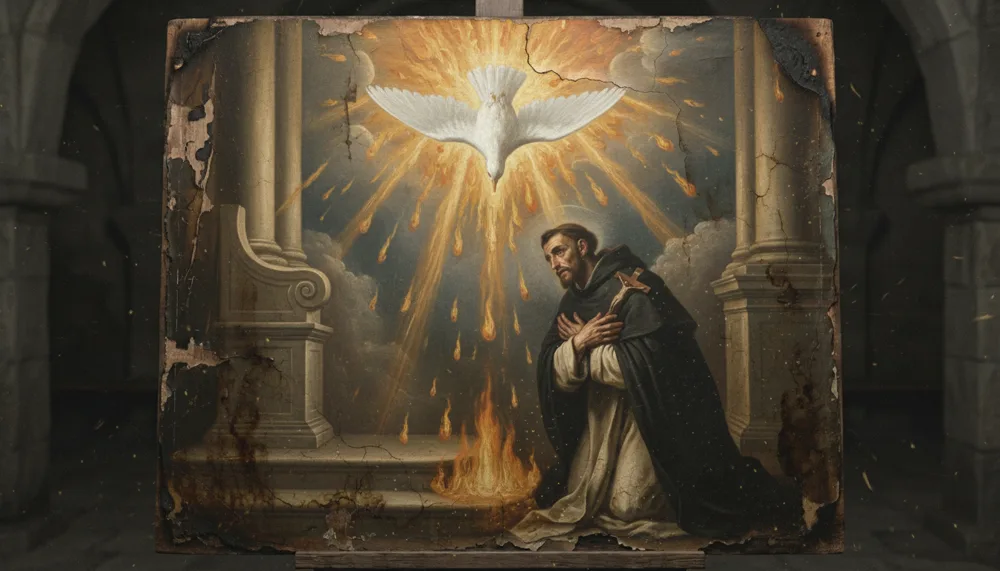
The chaplet of the Holy Ghost is a traditional vocal devotion that honours the Third Person of the Blessed Trinity by invoking, one by one, the Seven Gifts He pours into the soul — Wisdom, Understanding, Counsel, Fortitude, Knowledge, Piety, and the Fear of God. It is prayed on a set of beads, opening with the Veni Creator Spiritus, and asks the Holy Ghost to confirm in us those gifts received in Baptism and sealed in Confirmation. Below we set out what the chaplet of the Holy Spirit is, how it is prayed, and the older devotion to the Spirit from which it springs.
What the chaplet of the Holy Ghost is
A chaplet, in the older and proper sense, is a fixed string of distinct invocations counted on beads — not five decades borrowed from the Rosary, but its own pattern, ordered to a single object. For the wider genre and its rules, see what is a chaplet. The holy spirit chaplet takes for its object the Holy Ghost Himself and, above all, His seven Gifts: it moves through them in order, begging at each a fuller share. It names exactly what the soul most needs and asks the Giver for it by name.
The Gifts are not a private inspiration but settled doctrine. The Catechism of St Pius X teaches that "there are seven gifts of the Holy Ghost: the gift of Wisdom; of Understanding; of Counsel; of Fortitude; of Knowledge; of Piety; of the Fear of God," and that they "serve to confirm us in Faith, Hope, and Charity, and to make us prompt in the acts of virtue." We treat each Gift more fully in our article on the gifts of the Holy Ghost; the chaplet is the prayer that puts that doctrine on the lips.
The devotion to the Holy Ghost it grows from
The chaplet did not invent devotion to the Holy Ghost; it gathers it. Long before any beads were strung, the Church called upon the Spirit in two great hymns she has never set aside.
The first is the Veni Creator Spiritus, sung at Pentecost, at ordinations, at the dedication of churches, at the opening of councils — wherever the Church begs the Spirit to descend upon a work too great for men. It hails Him as "the sevenfold Gift," Tu septiformis munere, and asks Him to "kindle our senses from above, and make our hearts o'erflow with love." The second is the Veni Sancte Spiritus, the Sequence the Church sings at the Mass of Pentecost itself:
Come, Holy Ghost, send forth from heaven the ray of Thy light. Come, Father of the poor, come, giver of all gifts, come, light of hearts. Best Comforter, sweet guest of the soul, sweet refreshment... Give to Thy faithful, who trust in Thee, Thy seven sacred gifts. Grant the merit of virtue, grant the issue of salvation, grant everlasting joy. Amen. Alleluia.
Here, in the Church's own liturgy, is the very plea the chaplet repeats: Da tuis fidelibus... sacrum septenarium — "give to Thy faithful Thy seven sacred gifts." The chaplet of the Holy Ghost is nothing other than this Pentecostal cry, drawn out gift by gift and counted on beads, so that what the Church sings once a year the soul may pray on any day.
How the chaplet of the Holy Ghost is prayed
The chaplet is prayed on its own small set of beads — traditionally seven groups, one for each Gift, often a single bead with three beads at each, the seven groups standing for the seven Gifts. Forms vary; what is fixed is the order of the seven Gifts and the opening invocation of the Spirit. A sound and simple way to pray it is this:
Begin with the Sign of the Cross and the Veni Creator Spiritus:
Come, Holy Ghost, Creator blest, and in our hearts take up Thy rest; come with Thy grace and heavenly aid, to fill the hearts which Thou hast made. (continuing the hymn, or saying its first stanza alone).Then make an act of desire: O Holy Ghost, divine Spirit of light and love, I consecrate to Thee my understanding, my heart, and my will, my whole being, for time and for eternity.
For each of the seven Gifts in turn, on its bead or group of beads, name the Gift and ask for it, then say one Our Father, one Hail Mary, and Glory be:
- O Holy Ghost, grant me the Gift of Wisdom, that I may esteem rightly the things of God and love them above all.
- Grant me the Gift of Understanding, that I may know the mysteries of the Faith as far as is given to mortal man.
- Grant me the Gift of Counsel, that in every doubt I may choose what is for the glory of God and the salvation of souls.
- Grant me the Gift of Fortitude, that I may do Thy will and bear all things for Thee, overcoming every assault of the enemy.
- Grant me the Gift of Knowledge, that I may rightly value created things and order them to Thee, their last end.
- Grant me the Gift of Piety, that I may love and serve Thee, and be merciful to my neighbour for the love of God.
- Grant me the Gift of the Fear of God, that I may reverence Thy Majesty and dread, above all evils, to offend Thee by sin.
Conclude with an antiphon and prayer to the Holy Ghost:
Come, O Holy Ghost, fill the hearts of Thy faithful, and kindle in them the fire of Thy love.
V. Send forth Thy Spirit, and they shall be created.
R. And Thou shalt renew the face of the earth.
Let us pray. O God, who didst instruct the hearts of the faithful by the light of the Holy Ghost, grant us by the same Spirit to relish what is right, and ever to rejoice in His consolation. Through Christ our Lord. Amen.
The definitions folded into each petition are not improvised: they are the very words by which the Catechism of St Pius X explains the Gifts — Wisdom by which "we contemplate eternal things"; Counsel by which "we know what contributes most to the glory of God"; Fortitude that "inspires us with energy and courage to observe faithfully the holy law of God"; the Fear of God which "makes us respect God and fear to offend His divine Majesty." To pray the chaplet is therefore to pray the Catechism.
Why honour the Seven Gifts
The Gifts are not extras for the advanced. The Catechism of the Council of Trent, teaching the sacrament of Confirmation, recalls that in it the Holy Ghost comes to "increase grace and strengthen" the soul, arming the baptised for the spiritual battle. The seven Gifts are precisely that armament. They were given to us; the chaplet asks that they be stirred into flame. This is why the devotion sits naturally beside the Litany of the Holy Ghost, that other great traditional invocation of the Spirit by His titles and works — see our litany of the Holy Ghost. Where the litany hails Him, the chaplet asks Him for the seven things He most desires to give.
The classic time to pray it is the great novena that fills the days between the Ascension and Pentecost — the first novena the Church ever kept, when the Apostles "were persevering with one mind in prayer" awaiting the Spirit. On the structure and spirit of such nine-day prayer, see what is a novena. But the chaplet is a prayer for any day, and a fitting daily devotion for one who would live by the Spirit he received in Confirmation.
Where this devotion stands among the others
The chaplet of the Holy Ghost belongs to the Church's settled patrimony of Catholic devotions — beads and fixed invocations — alongside such forms as the prayer to St Michael and the chaplet of St Michael with its nine salutations of the angelic choirs. It asks nothing novel and rests on nothing private: it draws its words from the Pentecostal hymns of the liturgy and its doctrine from the catechisms. A soul that prays it does, day by day and Gift by Gift, what the whole Church does each Pentecost — calling down the Spirit who was promised, and begging Him to finish in us the work He began at the font.
Frequently Asked Questions
What is the chaplet of the Holy Ghost?
The chaplet of the Holy Ghost is a traditional vocal devotion that honours the Third Person of the Blessed Trinity by invoking, one by one, the Seven Gifts He pours into the soul — Wisdom, Understanding, Counsel, Fortitude, Knowledge, Piety, and the Fear of God. It is prayed on a set of beads, opening with the Veni Creator Spiritus, and asks the Holy Ghost to confirm in us the gifts received in Baptism and sealed in Confirmation.
How do you pray the chaplet of the Holy Ghost?
Begin with the Sign of the Cross and the Veni Creator Spiritus, then make an act of self-consecration to the Spirit. For each of the seven Gifts in turn, name the Gift and ask for it, then say one Our Father, one Hail Mary, and a Glory be. Conclude with the antiphon Come, O Holy Ghost, fill the hearts of Thy faithful, the versicle Send forth Thy Spirit, and the collect Deus qui corda fidelium.
What are the seven gifts of the Holy Ghost?
The Catechism of St Pius X names them: the gift of Wisdom, Understanding, Counsel, Fortitude, Knowledge, Piety, and the Fear of God. They "serve to confirm us in Faith, Hope, and Charity, and to make us prompt in the acts of virtue." We treat each in our article on the gifts of the Holy Ghost.
When should the chaplet of the Holy Ghost be prayed?
The classic time is the great novena between the Ascension and Pentecost — the first novena the Church ever kept, when the Apostles "were persevering with one mind in prayer" awaiting the Spirit (Acts 1:14). But it is a prayer for any day, and a fitting daily devotion for one who would live by the Spirit received in Confirmation.
What is the difference between the chaplet and the litany of the Holy Ghost?
Both honour the Holy Ghost, but in different ways. The chaplet moves through the seven Gifts in order, begging at each a fuller share, and is counted on beads. The litany of the Holy Ghost hails Him by His many titles and works, each invocation answered by have mercy on us. Where the litany praises Him, the chaplet asks Him for the seven things He most desires to give.
The Iter Fidei app carries the novenas, chaplets, litanies and prayers — the Veni Creator, the Veni Sancte Spiritus, the chaplet of the Holy Ghost — in Latin and your own language, with audio. Download it here.
Sources. Catechism of St Pius X (1908), Part V, Chapter 2, On the Gifts of the Holy Ghost (the seven Gifts named, and the definitions of Wisdom, Understanding, Counsel, Fortitude, Knowledge, Piety, and the Fear of God; their use "to confirm us in Faith, Hope, and Charity"); Catechism of the Council of Trent (Roman Catechism, 1566), On the Sacrament of Confirmation; the hymn Veni Creator Spiritus; the Pentecost Sequence Veni Sancte Spiritus (Da tuis fidelibus... sacrum septenarium); the antiphon and collect of the Holy Ghost, Emitte Spiritum tuum (Psalm 103) and Deus qui corda fidelium, of the Roman liturgy; Acts 1:14 (the Apostles persevering in prayer before Pentecost).