
Devotions
Holy Water: What It Is and How to Use It
Holy water is water blessed by the Church — a sacramental by which we ask God's protection and grace, and recall our baptism each time we sign ourselves.
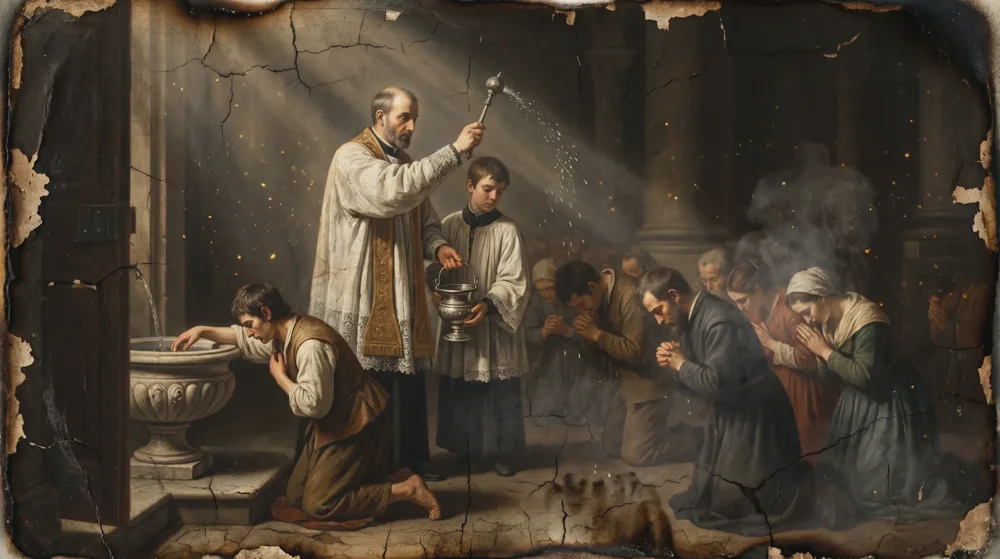
Holy water is water that the Church has blessed, set apart from common use to ask God for protection and grace. It is not a sacrament but a sacramental — a sacred sign instituted by the Church which, through her prayer, obtains chiefly spiritual effects. We use it to sign ourselves with the cross, to bless our homes and persons, and to call down God's help against the assaults of the enemy. Each drop recalls the water of our baptism, by which we were first cleansed and made children of God.
What is holy water?
To answer the head question plainly: holy water is ordinary water consecrated by a priest for sacred use. Its place in Catholic life belongs to the order of sacramentals. A sacramental, as the tradition defines it, is a "sacred sign instituted by the Church which produces, through the prayer of the Church, above all spiritual effects (holy water, medal, scapular, blessings)." Holy water itself is defined in the same vocabulary as "water consecrated by a priest, used for blessings and sprinklings."
This distinction matters. The seven sacraments were instituted by Christ Himself and confer grace by their own power, given the right dispositions. Sacramentals were instituted by the Church and work not by their own virtue but through her intercession. The Roman Catechism, treating of sacred signs, draws the line between signs that only represent or recall something and the sacraments of the New Law, which "possess in themselves the power to work the sacred effects which they express." Holy water belongs to the first kind raised by the Church's prayer: it disposes us, it asks, it recalls — it does not of itself remit sin as Baptism and Penance do.
What makes holy water holy?
What makes holy water holy is not the water and not the salt, but the blessing of the Church. The priest, acting in the name of the Church, exorcises and consecrates salt and water and joins them, calling down God's protection upon whatever they touch. The water is set apart — that is the root meaning of holy, separated for sacred use — and raised by the Church's prayer to be an instrument of grace. Take the same water before the blessing and it is common; the change is wrought by the rite, not by any quality added to the liquid. So the answer is exact: holy water is made holy by the prayer and intention of the Church, exercised through the priest she ordains for it.
Where does holy water come from?
The practice of blessing water for sacred use is very old in the Church. From the early centuries the faithful kept water blessed against sickness and the assaults of the enemy, and the placing of fonts at the doors of churches grew naturally from the rite of the Asperges and from the desire to recall baptism on entering God's house. The salt joined to the water echoes the prophet Eliseus, who cast salt into the spring and healed the waters (4 Kings 2), and the universal scriptural sign of salt as preservation. What we receive today — water and blessed salt, exorcised and consecrated — is the continuation of this ancient discipline, kept and ordered by the Church across the ages.
Holy water for the Catholic: a sacramental, not a charm
Because holy water is a sacramental, its effect is moral and impetratory, never magical. We do not treat it as a charm that works of itself regardless of the soul. Its fruit depends on the prayer of the Church and on the faith and devotion of the one who uses it. Used with faith, it draws down real help; used with superstition, it profits nothing. The Church blesses the water and asks God, through that blessing, to grant His protection wherever it is sprinkled.
The holy water blessing
The blessing of holy water is reserved to the priest. He blesses both salt and water, exorcises them, and joins them, asking God that this water serve for the driving away of the enemy and the safeguarding of those who use it. The Church has long kept this rite, and from it flows the use of holy water at the door of the church and in the home.
The most familiar public use is the Asperges — the sprinkling of holy water before the principal Sunday Mass, accompanied by the chant Asperges me from Psalm 50: "Thou shalt sprinkle me, O Lord, with hyssop, and I shall be cleansed." Before the holy Sacrifice begins, the faithful are sprinkled as a sign of the purifying of the soul that the Mass requires and works. This single rite teaches the whole meaning of holy water: water, blessing, and the plea to be made clean.
The uses of holy water
The uses of holy water are simple and within reach of every Christian. We name the chief ones.
Blessing oneself
On entering and leaving a church we dip the fingers in the holy water font and make the sign of the cross. The Catechism of Saint Pius X counsels the Christian to make this sign on rising, before and after meals, in time of temptation, and before sleep — and where holy water is at hand, it is fittingly joined to it. The gesture is small; what it expresses is not. We profess the Most Holy Trinity, we claim the Cross of Christ, and we ask to be guarded.
Blessing the home
Holy water is kept by Catholic families to bless the home and those within it. A small font near the door, a sprinkling of the rooms, a sign of the cross made on a child before bed — these are the ordinary devotions of the Christian household. The Church blesses the water precisely that it may serve "for blessings and sprinklings," and the home is among the first places it is used.
Protection against the enemy
Among the sacramentals, holy water has long been recommended as a defence in spiritual combat. Tanquerey, treating of the means against the assaults of the devil, names "the confident use of the sacraments and the sacramentals," and adds that "Saint Teresa particularly recommends holy water, perhaps because it is humiliating for the devil to find himself thus foiled by so simple a means." The strength does not lie in the water as a thing, but in the prayer of the Church and the faith of the one who uses it. We sprinkle ourselves and our dwellings to ask God's protection — and we ask it through Him who alone conquers the enemy.
The holy water font for the home
A holy water font is a small vessel — often called a stoup or benitier — fixed near a doorway to hold blessed water within reach. In churches it stands at the entrance; in the Catholic home it is fittingly placed by the front door or at the bedroom door, that the household may sign themselves on rising, on going out, and before sleep. A holy water font for home use need be nothing elaborate: a simple wall font of porcelain, metal, or stone, with a basin to hold the water and often a cross or sacred image above it.
The well-known Hummel holy water fonts, with their figures of children at prayer, are one familiar example of the domestic stoup, but the form matters far less than the use. Keep the font clean, refill it from the church font or from water a priest has blessed, and let it serve its one purpose: to put the sign of the cross and the memory of baptism at the threshold of daily life. When the water grows stale or the font is to be emptied, the water should be poured onto the bare earth or into a sacrarium, never into a common drain, out of reverence for what the Church has blessed.
The holy water bottle
A holy water bottle is simply a clean, well-stoppered container used to carry blessed water home from the church and to keep a supply for the home font, for the sick, and for the blessing of rooms. The faithful have always filled a small flask at the church door; a dedicated holy water bottle — often of glass or of a sturdy plastic marked with a cross — keeps the water clean and prevents it from being mistaken for ordinary water.
Choose a vessel that closes tightly, label it plainly, and reserve it for this use alone. When you fill it, take the water reverently and use it for sacred purposes only: refilling the home font, sprinkling the house, signing the sick. There is no required form for the bottle; what matters is that the blessed water be kept clean, distinct, and treated with the reverence due a sacramental.
Lourdes water and holy water bracelets
A common question concerns Lourdes water and the holy water bracelets sold at the shrine. Lourdes water is water from the spring at the grotto of Lourdes, where Our Lady appeared to Saint Bernadette in 1858 and bade her drink and wash at the spring. This water is not strictly the same as the blessed holy water of the rite; it is spring water associated with the apparition and the many cures reported there, and the faithful carry it home, drink a little, and apply it in sickness, asking God's help through Our Lady of Lourdes.
A holy water bracelet is a small devotional band, often bearing an image of Our Lady of Lourdes and sometimes a tiny vial of Lourdes water, worn as a reminder to pray. Like every devotional object, the bracelet has no power of its own; it is a sign and a spur to prayer. We honor such things rightly when we use them to lift the mind to God and to the intercession of His Mother, and wrongly when we treat them as charms that work by themselves. The cure of Lourdes, as the Church teaches, comes from God, sought through faith and the prayers of Our Lady — never from the water as a thing.
Where to get holy water
Holy water is freely given, never bought or sold. The simplest place to get it is your parish church: every Catholic church keeps a font at its doors, and you may fill a clean holy water bottle from it to carry home. If you want a larger quantity, or water for a new home font, bring ordinary water to your parish and ask the priest to bless it, for the blessing is reserved to him. Vessels, fonts, and bottles may be bought from a Catholic goods supplier — but the blessing that makes the water holy cannot be purchased; it is given through the prayer of the Church. Lourdes water may be requested from the shrine or from those who have visited it. In every case, what you receive is to be treated with reverence and kept for sacred use.
Holy water and baptism
Holy water cannot be understood apart from Catholic baptism. When we sign ourselves with it, we recall the water by which we were first washed. The Roman Catechism, speaking of the moment of our Lord's own baptism when the heavens opened and the Holy Ghost descended, says it was given "to warn us that at the very moment when we are washed by the holy water of Baptism, Grace is poured into our souls." Baptism is the sacrament "by which we are reborn to the grace of God and we become Christians"; by the washing of water in the word, original sin is blotted out and the soul is made a child of God.
The water of the font and the holy water at the church door are not the same thing — one is the matter of a sacrament that regenerates, the other a sacramental that recalls and asks. But the second is ordered to the first. Every time we touch holy water and sign ourselves, we renew the memory of our baptism, of the day we were claimed for Christ, and of the obligation to live as those who were once washed. The sacramental sends us back to the sacrament.
Conclusion
Holy water is a small thing the Church puts within reach of every Christian: blessed water by which we ask protection and grace, sign ourselves with the cross, sanctify our homes, and remember our baptism. It works not by its own power but by the prayer of the Church and the faith of the one who uses it. Taken so, it is a daily school of dependence on God.
Frequently Asked Questions
What is holy water?
Holy water is ordinary water that a priest has blessed and set apart for sacred use. It is not a sacrament but a sacramental — a sacred sign instituted by the Church which, through her prayer, obtains chiefly spiritual effects. We use it to sign ourselves with the cross, to bless our homes, and to ask God's protection, recalling each time the water of our baptism.
How do you make holy water?
A layman cannot make holy water; the blessing belongs to the priest, who exorcises and blesses both salt and water and joins them with the prayers of the Church. You may bring ordinary water to your parish and ask the priest to bless it. Once blessed, it may be added to a larger quantity of unblessed water, which thereby shares in the blessing.
How is holy water made?
The priest blesses and exorcises salt and water separately, then mixes the blessed salt into the water with the prayers of the rite, asking God that it serve for the driving away of the enemy and the safeguarding of those who use it. The salt is an ancient sign of preservation and incorruption. The water's virtue is the prayer of the Church, not the matter itself; there is nothing magical in the mixture.
What is holy water made of?
Holy water is plain water to which blessed salt is added, both exorcised and consecrated by the priest. The salt is an ancient figure of preservation and incorruption, joined to the water that it may serve, in the words of the rite, against the assaults of the enemy. Its power lies in the Church's blessing and the faith of the one who uses it, never in the elements themselves.
Can you drink holy water?
Holy water may be drunk with reverence; the faithful have long taken a little in sickness or temptation, asking God's help through this blessed thing. It is not, however, a medicine or charm that works of itself, and it must never be treated as ordinary drink or used superstitiously. What profits the soul is faith and devotion, not the act of drinking.
What happens if you drink holy water?
Nothing harmful happens to the body, for it is ordinary water; and nothing magical happens to the soul, for holy water is a sacramental, not a charm. Taken with faith and reverence, a small draught is a humble plea for God's protection and grace. Taken thoughtlessly or superstitiously, it profits nothing — the fruit depends on the prayer of the Church and the devotion of the one who drinks.
What makes holy water holy?
What makes holy water holy is the blessing of the Church, not the water or the salt themselves. Acting in the Church's name, the priest exorcises and consecrates salt and water and joins them, asking God's protection upon all they touch. The water is thereby set apart for sacred use and raised by the Church's prayer; the same water before the blessing is common. The change is wrought by the rite and intention of the Church, never by any quality in the liquid.
Where does holy water come from?
The blessing of water for sacred use is an ancient practice in the Church, kept from the early centuries against sickness and the assaults of the enemy. Fonts at the doors of churches grew from the rite of the Asperges and from the desire to recall baptism on entering God's house. The salt joined to the water echoes the prophet Eliseus, who cast salt into the spring to heal the waters. What we use today is the continuation of this discipline, ordered by the Church across the ages.
What is a holy water font?
A holy water font, or stoup, is a small vessel that holds blessed water within reach. In churches it stands at the entrance; in the home it is fittingly placed by the front or bedroom door, that the household may sign themselves on rising, on going out, and before sleep. A font for home need not be elaborate — porcelain, metal, or stone with a small basin will serve. Refill it from the church font or from water a priest has blessed, and when emptying it, pour the water onto bare earth, never into a common drain.
What is the difference between holy water and Lourdes water?
Holy water is water blessed by the rite of the Church and is a sacramental in the strict sense. Lourdes water is spring water from the grotto where Our Lady appeared to Saint Bernadette in 1858; it is associated with the apparition and the cures reported there, and the faithful drink a little or apply it in sickness, asking God's help through Our Lady of Lourdes. Devotional objects such as Lourdes-water bracelets are reminders to pray, not charms; the cure comes from God, sought through faith, never from the water as a thing.
Where can I get holy water?
Holy water is not bought or sold; it is freely given. Every Catholic church keeps a font at its doors, and the faithful may fill a clean bottle from it to carry home. If you wish a larger quantity blessed, simply ask a priest to bless water for you, for the rite is reserved to him.
What is holy water used for?
Holy water serves to bless persons, homes, and objects, and to ask God's protection against the assaults of the enemy. Publicly it is used in the Asperges, the sprinkling before the principal Sunday Mass, with the chant "Thou shalt sprinkle me, O Lord, with hyssop, and I shall be cleansed" (Psalm 50). In every case its end is the same: to purify, to guard, and to recall our washing in Christ.
The Iter Fidei app carries the prayers, devotions, and a guide to the spiritual life — free to taste, if you wish to keep them at hand. Get the app link by email here.
Sources. Catechism of the Council of Trent (Roman Catechism), On the Sacraments in General. Catechism of Saint Pius X, Part IV (The Sacraments in General; Baptism) and Part V, ch. 8 (The Pious Exercises Counselled for Each Day). A. Tanquerey, The Spiritual Life (Ascetical and Mystical Theology), n. 224 (the sacramentals and holy water in spiritual combat). Traditional liturgical glossary: Sacramental, Holy water, Asperges. Scripture: Psalm 50 (Asperges me); John 3, 5 (Crampon/Douay-Rheims).