
The Faith
The Eight Beatitudes Explained
What are the Beatitudes? The eight Beatitudes from the Sermon on the Mount (Matthew 5, Douay-Rheims), each listed with its Catholic meaning — the way of perfection that goes beyond the Commandments, grounded in the Catechism of St Pius X.
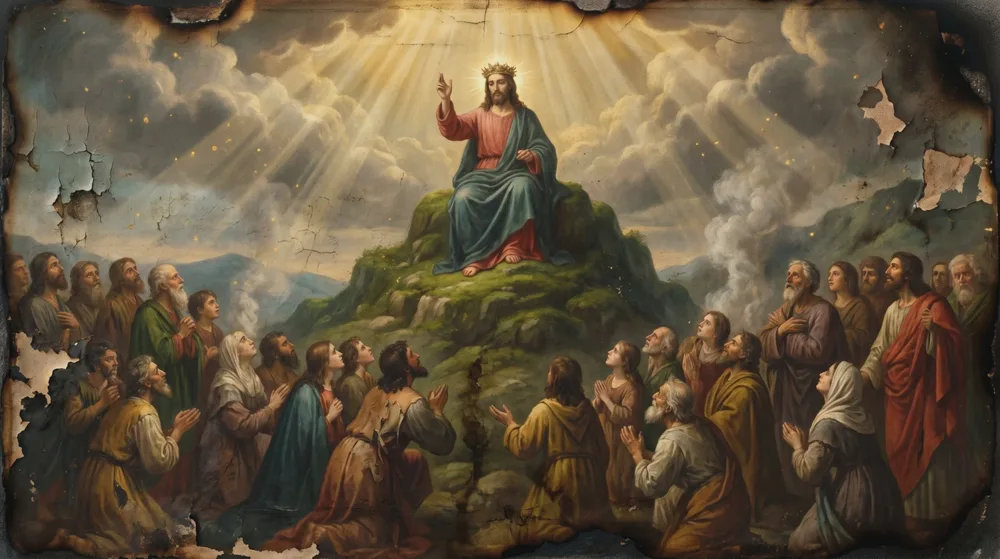
The Beatitudes are the eight blessings Our Lord pronounced at the opening of the Sermon on the Mount, recorded in Matthew 5. Each names a disposition of soul the world despises — poverty of spirit, meekness, mourning, hunger for justice, mercy, purity, peacemaking, willingness to suffer for justice — and attaches to it a reward that is, under various names, eternal glory. The Catechism of St Pius X teaches that there are eight Evangelical Beatitudes, and that Jesus Christ proposed them to us "in order to make us detest the maxims of the world and to invite us to love and practise the maxims of His Gospel" (Catechism of St Pius X, Part V, ch. 3).
What are the Beatitudes?
The word "beatitude" means blessedness or happiness. In Catholic teaching the Beatitudes are not a second set of laws set beside the Ten Commandments; they are the description of the truly happy man as God sees him. The world calls blessed "those who have riches and honours in abundance, those who live in delights and who have no occasion to suffer" (Catechism of St Pius X, Part V, ch. 3). Christ overturns that judgment. He declares blessed the poor, the meek, the mourning, the persecuted — and in doing so He hands us the portrait of the soul conformed to His own. The Beatitudes are therefore both a teaching about what happiness is and a road by which we reach it.
They belong to the Sermon on the Mount, the great discourse in which Our Lord, having confirmed the law of Moses, draws souls higher than the letter of precept into the spirit of charity. Whoever has already grasped the Ten Commandments finds in the Beatitudes the next step: not the floor of what is commanded, but the height of what is counselled.
Where are the Beatitudes found in the Bible?
The Beatitudes are found in the Bible in the Gospel of St Matthew, chapter 5, verses 3 to 10 — the opening lines of the Sermon on the Mount. A shorter parallel, with four blessings and four corresponding woes, appears in St Luke, chapter 6, verses 20 to 26, often called the Sermon on the Plain. When readers ask where to find the Beatitudes in the Bible, the answer for the full eightfold list is always Matthew 5:3–10. The Catholic Church takes her settled enumeration from this Matthean text, which is why the Catechism of St Pius X numbers eight.
If you are looking for the chapter and verse to memorise, here is the locator: poverty of spirit (v. 3), meekness (v. 4 in the Douay-Rheims, v. 5 in many modern versions), mourning (v. 5 / v. 4), hunger for justice (v. 6), mercy (v. 7), cleanness of heart (v. 8), peacemaking (v. 9), and persecution for justice (v. 10). The slight difference in verse numbering between the meek and those that mourn comes from the order in the Greek manuscripts; the Douay-Rheims, following the Vulgate, places the meek before those that mourn.
The Sermon on the Mount: the setting of the Beatitudes
The Beatitudes do not stand alone. They open the Sermon on the Mount, the first and longest of the five great discourses in St Matthew, running from chapter 5 through chapter 7. Our Lord, seeing the multitudes, "went up into a mountain, and when he was set down, his disciples came unto him. And opening his mouth, he taught them" (Matthew 5:1–2, Douay-Rheims). The eight blessings are the overture; what follows — the fulfilment of the Law, the teaching on prayer and the Our Father, the warning against serving two masters, the golden rule — unfolds the life the Beatitudes describe.
Reading the Beatitudes inside the Sermon on the Mount guards us from a common error: treating them as detached mottoes. They are the opening of a single sustained teaching on the interior life of the Kingdom. The poor in spirit of verse 3 are the same souls Our Lord later tells not to lay up treasures on earth (Matthew 6:19); the peacemakers of verse 9 are the same He sends to be reconciled with their brother before offering at the altar (Matthew 5:24).
The Eight Beatitudes (Matthew 5, Douay-Rheims)
Here are the eight Beatitudes as Our Lord pronounced them, in the Douay-Rheims wording carried in the Catechism of St Pius X:
- Blessed are the poor in spirit, for theirs is the kingdom of heaven.
- Blessed are the meek, for they shall possess the land.
- Blessed are they that mourn, for they shall be comforted.
- Blessed are they that hunger and thirst after justice, for they shall have their fill.
- Blessed are the merciful, for they shall obtain mercy.
- Blessed are the clean of heart, for they shall see God.
- Blessed are the peacemakers, for they shall be called the children of God.
- Blessed are they that suffer persecution for the love of justice, for theirs is the kingdom of heaven.
Beatitudes meaning: each one explained
We give the meaning of each Beatitude as the Catechism of St Pius X sets it out, since the head query of every reader is the same: what does each one actually ask of us.
Blessed are the poor in spirit
The poor in spirit are not simply those who have little. They are "those who have their heart detached from riches": making good use of them if they possess them, not seeking them with anxiety if they lack them, and bearing their loss with resignation if they are taken away (Catechism of St Pius X, Part V, ch. 3). The reward, the kingdom of heaven, is given first to the detached heart.
Blessed are the meek
The meek "treat their neighbour with gentleness, bear with patience his defects and the wrongs they receive from him, without quarrel, resentment, or vengeance" (Catechism of St Pius X, Part V, ch. 3). To them is promised possession of the land — the inheritance of the saints.
Blessed are they that mourn
This Beatitude blesses those who suffer tribulations with resignation, who grieve over the sins they have committed, over the evils and scandals seen in the world, and over their distance from heaven and the danger of losing it (Catechism of St Pius X, Part V, ch. 3). Their tears, sanctified, are the seed of comfort. This is why a humble and exact examination of conscience belongs to the spiritual life: holy sorrow is itself a blessing.
Blessed are they that hunger and thirst after justice
Those who hunger and thirst after justice "ardently desire to grow ever more and more in divine grace and in the exercise of good and virtuous works" (Catechism of St Pius X, Part V, ch. 3). It is the hunger of the soul that will not be content with the bare minimum but presses toward the heavenly virtues, and shall have its fill.
Blessed are the merciful
The merciful love their neighbour in God and for God, have compassion on his spiritual and corporal miseries, and strive to relieve him according to their strength and their state (Catechism of St Pius X, Part V, ch. 3). The measure is exact: they shall obtain the mercy they showed.
Blessed are the clean of heart
The clean of heart "have no affection for sin and keep themselves far from it, and who flee above all every kind of impurity" (Catechism of St Pius X, Part V, ch. 3). To this purity alone is promised the highest of all rewards: they shall see God.
Blessed are the peacemakers
The peacemakers preserve peace with their neighbour and with themselves, and strive to establish peace between those who are divided (Catechism of St Pius X, Part V, ch. 3). Because they do the work of the God of peace, they shall be called the children of God.
Blessed are they that suffer persecution for the love of justice
The last Beatitude blesses those who "bear with patience the mockeries, the blame, and the persecutions on account of the faith and the law of Jesus Christ" (Catechism of St Pius X, Part V, ch. 3). To them, as to the poor in spirit, is promised the kingdom of heaven itself — the two ends of the list meeting in the same crown.
The Beatitudes explained simply
If we strip the eight blessings to their plainest sense, each one praises a poverty the world flees and promises a fullness the world cannot give. Put simply: be empty of the love of money, and heaven is yours; be gentle, and the earth is yours; weep for sin, and you will be consoled; long for holiness, and you will be satisfied; forgive, and you will be forgiven; keep your heart pure, and you will see God; make peace, and you will be called God's child; suffer for doing right, and heaven is yours again. The whole list can be held in one sentence: God blesses the soul that lets go of what the world clutches.
This is the Beatitudes explained simply enough for a child to learn, yet it is the same teaching the saints spent their lives unfolding. Simplicity here is not shallowness. Our Lord put the highest doctrine of the spiritual life into eight short lines precisely so that the unlettered and the learned could carry it alike.
The Beatitudes in the King James and Douay-Rheims versions
Many readers know the Beatitudes from the King James Version (KJV), whose cadence — "Blessed are the poor in spirit: for theirs is the kingdom of heaven" — is nearly identical to the Douay-Rheims. The two English translations agree closely here because both render the same underlying text faithfully. The chief difference Catholics should note is the fourth Beatitude: the Douay-Rheims, following the Latin Vulgate, reads "they that hunger and thirst after justice," where the KJV reads "after righteousness." The Latin iustitia carries both senses, but the older Catholic rendering, "justice," better preserves the breadth of the word — the whole right ordering of the soul to God, not merely moral uprightness.
For our exposition we use the Douay-Rheims because it is the traditional English Catholic Bible, translated from the Vulgate that the Church received, and because the Catechism of St Pius X carries its wording. Readers who pray from the KJV will find the substance the same; only the choice of "justice" over "righteousness" marks the line a Catholic should weigh.
The Mount of the Beatitudes and the Church of the Beatitudes
The traditional site of the Sermon on the Mount is the Mount of the Beatitudes, a hill on the north-western shore of the Sea of Galilee, near Capharnaum and Tabgha, in the Holy Land. Pilgrims have venerated this slope since the early centuries as the place where Our Lord preached the eight blessings. A church stands there today commemorating the discourse — the Church of the Beatitudes — set among gardens overlooking the lake.
We mention the site for the pilgrim's sake, but a word of caution belongs here. The exact spot cannot be fixed with certainty from the Gospel, which names only "a mountain" (Matthew 5:1); the traditional location is a pious memory, not a defined article of faith. The blessings themselves do not depend on the geography. Whether or not one ever stands on that Galilean hill, the Beatitudes are preached anew at every Mass and lived in every soul that takes them to heart.
The way of perfection beyond the Commandments
The Commandments mark what is necessary for salvation; the Beatitudes mark the way of perfection. Spiritual theology keeps this distinction firmly. Tanquerey notes that the Church, "while urging chosen souls towards heights inaccessible to ordinary Christians, does not forget the difference between the commandments and the counsels, between the conditions essential to salvation and those required for perfection" (Tanquerey, The Spiritual Life, Introduction). The Commandments forbid theft, murder, impurity; the Beatitudes ask the heart itself to be poor, meek, clean. One can keep the law and still be far from the spirit Christ describes here.
Yet the two are not opposed. The same author observes that "in order to keep the commandments, some counsels must be observed" (Tanquerey, The Spiritual Life, Introduction). The man who never detaches his heart from riches will, sooner or later, break the precept that guards them. The Beatitudes are thus the safe road: they lead not only above the Commandments but back into them, securing what mere obedience leaves exposed. This higher road is walked by spiritual combat against self-love. Scupoli warns that our nature, "always occupied with itself," seeks its own comfort even in spiritual things (Scupoli, The Spiritual Combat, ch. 9); the Beatitudes name precisely the victories won over that self-love — the heart emptied of riches, of anger, of impurity, of the world's idea of happiness.
Do the Beatitudes reward us only in heaven?
No. The Catechism of St Pius X teaches that the various rewards promised in the Beatitudes all signify, under various names, eternal glory — but adds that they are also "the means of rendering our life as happy as is possible here below" (Catechism of St Pius X, Part V, ch. 3). Those who follow them already receive some reward in this life, "because they already enjoy an interior peace and contentment which are the principle, though still imperfect, of eternal felicity." Those who follow the maxims of the world, by contrast, are not happy, "because they do not have the true peace of the soul and they run the danger of being damned" (Catechism of St Pius X, Part V, ch. 3).
This is the whole reversal the Beatitudes announce. The world's blessedness is loud and outward and ends; the blessedness Christ pronounces is quiet, inward, and eternal — and it begins now, in the peace of a soul ordered to God.
Frequently Asked Questions
What are the Beatitudes?
The Beatitudes are the eight blessings Our Lord pronounced at the opening of the Sermon on the Mount, recorded in Matthew 5. Each names a disposition of soul the world despises — poverty of spirit, meekness, mourning, hunger for justice, mercy, purity, peacemaking, willingness to suffer for justice — and attaches to it a reward that is, under various names, eternal glory. They describe the truly happy man as God sees him.
What are the eight Beatitudes in the Bible?
In the Douay-Rheims wording carried in the Catechism of St Pius X they are: blessed are the poor in spirit; the meek; they that mourn; they that hunger and thirst after justice; the merciful; the clean of heart; the peacemakers; and they that suffer persecution for the love of justice (Matthew 5:3–10). Each carries its own promise, from the kingdom of heaven to the vision of God.
Where are the Beatitudes in the Bible?
The Beatitudes are found in the Gospel of St Matthew, chapter 5, verses 3 to 10, at the opening of the Sermon on the Mount. A shorter parallel with four blessings and four woes appears in St Luke, chapter 6, verses 20 to 26. For the full eightfold list the reference is always Matthew 5:3–10.
Are there eight or ten Beatitudes?
The Catechism of St Pius X teaches that there are eight Evangelical Beatitudes. There are no ten Beatitudes in the Catholic enumeration; the search for "ten" usually comes from confusing them with the Ten Commandments, or from counting schemes that split lines of Matthew 5. Some count differently by treating Our Lord's further words on persecution (Matthew 5:11) as a ninth blessing, but the Church's settled enumeration is eight, and we follow that traditional count.
Are the Beatitudes the same in the KJV and the Douay-Rheims?
Very nearly. Both English versions render the eight blessings of Matthew 5:3–10 faithfully and read almost identically. The chief difference is the fourth Beatitude: the Douay-Rheims has "hunger and thirst after justice," the KJV "after righteousness." Both translate the same word; the Catholic "justice" keeps the wider sense of the soul rightly ordered to God. We use the Douay-Rheims as the traditional English Catholic Bible.
Where is the Mount of the Beatitudes?
The traditional Mount of the Beatitudes is a hill on the north-western shore of the Sea of Galilee, near Capharnaum, in the Holy Land, where the Church of the Beatitudes now stands. It is the site pilgrims have long honoured as the place of the Sermon on the Mount. The exact spot cannot be fixed from the Gospel, which names only "a mountain," so the location is a pious tradition rather than a defined certainty.
What is the difference between the Beatitudes and the Ten Commandments?
The Commandments mark what is necessary for salvation; the Beatitudes mark the way of perfection. The Commandments forbid theft, murder, and impurity; the Beatitudes ask the heart itself to be poor, meek, and clean. They are not opposed — the man who never detaches his heart from riches will sooner or later break the precept that guards them — so the Beatitudes lead above the Commandments and back into them.
Do the Beatitudes reward us only in heaven?
No. The rewards promised all signify eternal glory, yet the Catechism of St Pius X adds that they are also "the means of rendering our life as happy as is possible here below." Those who follow them already enjoy an interior peace and contentment which is the principle, though still imperfect, of eternal felicity. The blessedness Christ pronounces begins now, in the peace of a soul ordered to God.
The Iter Fidei app carries the prayers, devotions, and a guide to the spiritual life — free to taste before you download. Get the app link by email here.
Sources. Catechism of St Pius X, Part V, ch. 3, "The Evangelical Beatitudes." The Holy Gospel according to St Matthew, ch. 5:1–10, and the parallel in St Luke, ch. 6:20–26 (Douay-Rheims). A. Tanquerey, The Spiritual Life, Introduction (on the distinction between precepts and counsels). L. Scupoli, The Spiritual Combat, ch. 9 (on self-love in the spiritual life).