
Scripture
Ask and It Shall Be Given: Matthew 7:7
"Ask, and it shall be given you" (Matthew vii. 7). We give the traditional Catholic reading of the prayer of petition — its boundless confidence and its real conditions — against the "name it and claim it" misreading.
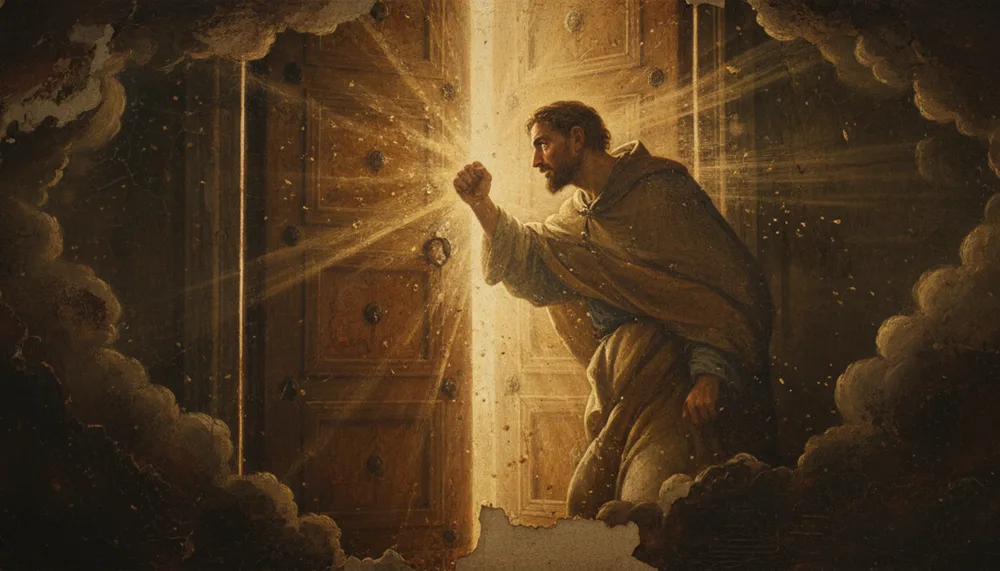
"Ask, and it shall be given you" is Our Lord's own promise on the prayer of petition, and in the Douay-Rheims — the traditional English Bible drawn from the Latin Vulgate — it reads: "Ask, and it shall be given you: seek, and you shall find: knock, and it shall be opened to you" (Matthew vii. 7). This is a promise of boundless confidence; it is not a blank cheque. The Church has always read it with both halves intact — Christ binds Himself to hear us, and we for our part must ask rightly: for what is for our salvation, with faith, with perseverance, and in submission to the will of God.
Ask, and it shall be given you: seek, and you shall find: knock, and it shall be opened to you. For every one that asketh, receiveth: and he that seeketh, findeth: and to him that knocketh, it shall be opened. — Matthew vii. 7–8 (Douay-Rheims)
What does "ask and it shall be given" mean in Matthew 7:7?
The verse rises in three steps, and each step says more than the last. To ask is the prayer of the child who knows he has nothing of his own. To seek is to add the labour of the soul that goes after God, not idly waiting but pursuing. To knock is the persistence of one who will not be turned away from a door that has not yet opened. The three verbs are not three different requests but one prayer growing in earnestness — and to each Our Lord attaches an unconditional verb of His own: it shall be given, you shall find, it shall be opened.
This is the foundation of what the Church calls the prayer of petition. The Catechism of the Council of Trent puts it bluntly: God owes nothing to anyone, and so "if we wish that He grant us that whereof we have need, we must of necessity solicit it from Him by Prayer. Prayer is as an instrument which He hath given us, that we may use it to obtain what we desire." The verse is therefore not a piece of encouragement to feel hopeful; it is a command and a promise together. We are commanded to ask, and we are promised that asking is never wasted.
"Ask and you shall receive" — the confidence Christ commands
The confidence of this promise is total, and we must not shrink it. Our Lord does not say some who ask receive; He says "every one that asketh, receiveth" (Matthew vii. 8). He repeats the same word elsewhere with no less force — "Ask, and you shall receive, that your joy may be full" (John xvi. 24) — and the Roman Catechism gathers up the whole teaching of Scripture on this: "Then shalt thou call, and the Lord shall hear thee: thou shalt cry, and the Lord shall say: Here I am" (Isaias lviii. 9); "before they cry, I will hear; while they are yet speaking, I will hearken" (Isaias lxv. 24).
There is no tepidity here, and we should have none. To doubt that God hears is itself a fault, for St James commands: "But let him ask in faith, nothing wavering" (James i. 6), and St Augustine says without flinching, "If Faith fail, there is no longer any Prayer."
The two great motives of this confidence, the Trent Catechism teaches, are God's omnipotence and His mercy — and above both stands our Mediator, "Jesus Christ the just; and he is the propitiation for our sins" (1 John ii. 1–2), who "maketh intercession for us" at the right hand of the Father. We are unworthy of ourselves to obtain anything; but through His infinite merits we may ask with entire confidence. This is the trust the whole of Scripture commands, the same trust that bids us trust in the Lord with all thy heart and be anxious for nothing.
"Seek and you shall find" — but seek the right thing
Here the conditions appear, and they are not a retreat from the promise but its very meaning. Our Lord promises that the seeker finds — but what is he to seek? The Roman Catechism answers plainly: the faithful "ought to ask of God only things that are just and honest," for "if they asked that which is not fitting, they would have to fear being repulsed with this answer: You know not what you ask" (cf. Matthew xx. 22). The one thing we may ask "in an absolute manner, without condition and without restriction," is the glory of God, and next "all that can attach us and unite us to this sovereign Good, such as Faith, the fear of the Lord and His love."
What, then, of health, money, success, the relief we so often beg for? The Catechism does not forbid these; it orders them. The goods of the body and of fortune "are but too often occasions and instruments of sin," and so we are to ask them only "inasmuch as they are necessary to us," and on the condition that "in our hands they shall turn to the Glory of God and to the salvation of our soul." This is why an unanswered prayer is not a broken promise.
As St Augustine says, "there are things which God refuseth in His goodness," for God either "grants us graces greater and more precious than those we solicit," or withholds what "had God granted it to us, it would have become fatal and hurtful to us." The seeker who seeks his salvation always finds. This is the counsel the whole of the Catholic Bible verses speak with one voice, and it shapes how we read every petition for relief — see What Does God Say About Fear? and What Does God Say About Depression?
"Knock and it shall be opened" — pray with perseverance
The third verb teaches the condition the impatient soul most often lacks. To knock is to keep on. The Roman Catechism is exact: "To obtain that which one asks, there is needed not only a fitting Prayer, but a persevering prayer," and it quotes St Jerome on this very verse — "It is given to whosoever asks. If, then, it is not given you, it is because you ask not. Ask, then, and you shall receive." Our Lord Himself binds us to it: "We ought always to pray, and not to faint" (Luke xviii. 1).
God could pour out every gift without our asking, as He feeds the beasts that cannot pray. But "this Father of a perfect Goodness wills to be prayed to by His children," that our prayer may rise "each day up to Him with a greater confidence." Perseverance is not God's reluctance to give; it is His way of making us fit to receive — the soul that knocks long is enlarged by the knocking. This is the hidden labour of the spiritual life, waged in mental prayer and the spiritual combat, and carried by hope when the door stays shut.
Against "name it and claim it": the conditions of true prayer
We must say this plainly, because the error is widespread. The verse is often pressed into a "name it and claim it" gospel — as if Christ had promised that whatever a man pictures and demands with enough conviction, God is bound to deliver: health on command, money on demand, every desire of the flesh underwritten by a verse. This is a counterfeit, and it cuts the words of Our Lord in half. It keeps "ask and it shall be given" and quietly drops every condition the Church has always read with it.
Scripture itself forecloses the error. St James names the very fault: "You ask, and receive not; because you ask amiss, that you may consume it on your concupiscences" (James iv. 3). The Roman Catechism teaches that the prayer of the man who "wishes to persevere" in sin "is not heard," and that even the believer's prayer is refused when it is "so lukewarm and so listless that we do not even think upon what we are saying." The "name it and claim it" reading keeps the soul at its own centre: prayer becomes a technique for bending Heaven to the appetites, and faith is reduced to the strength of one's own wanting. The Catholic reading does the opposite.
It hands the will over: we ask, and then we add what Our Lord added in the Garden — "not my will, but thine be done" (Luke xxii. 42). True prayer is not the creature commanding the Creator, but the child confiding in the Father, content that the Father knows better what to give — the same surrender of self that another much-misread verse commands when it bids us be still and know that I am God. Against pride that would make God a servant of our wishes, see What Does God Say About Pride?; against the appetites that pray amiss, What Does God Say About Lust? and What Does God Say About Gambling?.
How the Church teaches us to ask: the Our Father and the litanies
We are not left to invent the prayer of petition for ourselves. Our Lord gave us its perfect form. The Roman Catechism calls the Our Father "that divine formula" in which "all the qualities of perfect Prayer are found united" — and there the order is taught us: hallowed be thy name before give us this day our daily bread, the glory of God before our daily wants, thy will be done set over every petition. He who learns to pray the Our Father has already learned to ask aright, and so we treasure the whole school of vocal prayer among the Catholic prayers.
The Catholic litanies are this same petition made corporate and unwearying — the soul knocking with the whole Church behind it. We knock through Our Lady, Mother of mercy, the advocate of the faithful people, in the Litany of the Immaculate Heart of Mary and the Litany of Our Lady of Sorrows. We ask not only for ourselves but for others, for the Roman Catechism teaches us to make "Prayers and wishes" for all men — and so we knock even for the dead, who can no longer ask for themselves, in the Litany of the Poor Souls in Purgatory.
Conclusion
"Ask, and it shall be given you: seek, and you shall find: knock, and it shall be opened to you." The promise is as wide as the heart of God, and we should never make it smaller. But it is a promise to those who ask as children, not as masters — who seek their salvation before their comfort, who knock and do not faint, who pray thy will be done and mean it. So read, the verse is no slogan for getting what we want; it is the charter of Christian confidence. We have a Father who hears. We have only to ask Him rightly.
Frequently Asked Questions
Does "ask and it shall be given" mean God will give me whatever I ask?
The promise is boundless in its confidence — every one that asketh, receiveth (Matthew vii. 8) — but it is not a blank cheque. The Roman Catechism teaches that we may ask absolutely only for the glory of God and the goods that unite us to Him, such as faith and His love; bodily and worldly goods we ask only inasmuch as they serve our salvation. God always grants what the seeker truly needs, even when He refuses what would harm him.
Why does God not answer some of my prayers?
Because a prayer may be asked amiss, or for something that would hurt the soul. St James says, You ask, and receive not; because you ask amiss, that you may consume it on your concupiscences (James iv. 3). St Augustine teaches that God in His goodness sometimes refuses, granting instead graces greater than those we sought, or withholding what would have become fatal to us. The seeker who seeks his salvation always finds.
What does it mean to ask, seek, and knock?
The three verbs are one prayer growing in earnestness. To ask is the prayer of the child who has nothing of his own; to seek is to pursue God with the labour of the soul; to knock is to persevere and not be turned away. Our Lord attaches an unconditional promise to each: it shall be given, you shall find, it shall be opened.
Why must we pray with perseverance?
Because God wills to be prayed to as His children, and perseverance enlarges the soul to receive. The Roman Catechism, citing St Jerome, teaches that "to obtain that which one asks, there is needed not only a fitting Prayer, but a persevering prayer," and Our Lord Himself says We ought always to pray, and not to faint (Luke xviii. 1). Perseverance is not God's reluctance to give; it is His way of making us fit to receive.
How does the "name it and claim it" gospel misread this verse?
It keeps "ask and it shall be given" and drops every condition the Church reads with it, treating prayer as a technique to bend Heaven to our appetites. The Catholic reading does the opposite: it hands the will over, adding what Our Lord added in the Garden — not my will, but thine be done (Luke xxii. 42). True prayer is the child confiding in the Father, not the creature commanding the Creator.
The Iter Fidei app carries the Douay-Rheims Bible, the prayers and litanies, in Latin and your own language. Get the app link by email here.
Sources. The Holy Bible, Douay-Rheims version: Matthew vii. 7–8; Matthew xx. 22; John xvi. 24; Isaias lviii. 9; Isaias lxv. 24; James i. 6; James iv. 3; 1 John ii. 1–2; Luke xviii. 1; Luke xxii. 42. Catechism of the Council of Trent (Roman Catechism, 1566), Fourth Part, on Prayer — Chapter Thirty-Eighth (on prayer in general: its necessity, fruits, the parts and degrees of prayer, what must be asked, and the dispositions of faith, confidence, and perseverance), citing St Jerome, St Augustine, St James, and St Ignatius of Antioch.