
Apologetics
The True Cross: The Relic of Our Lord's Passion
Was the True Cross found? St Helena recovered it at Jerusalem in the fourth century, and the Church keeps its memory in the Finding (3 May) and the Exaltation (14 September). What the relics of the True Cross are, and the answer to the charge that the fragments would build a ship.
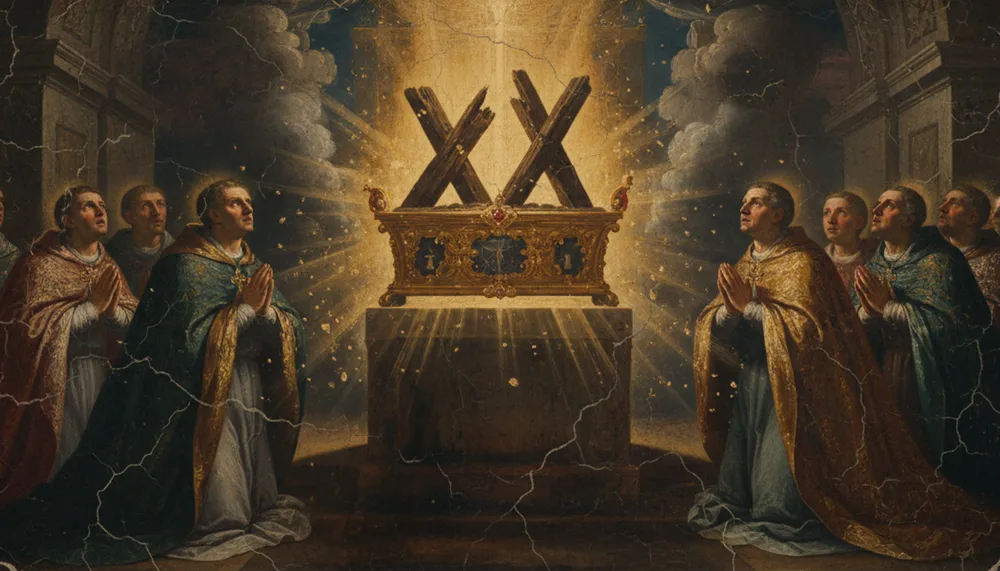
The True Cross is the wood on which our Lord Jesus Christ was crucified, and yes, the ancient tradition holds that it was found: St Helena, mother of the Emperor Constantine, recovered it at Jerusalem in the early fourth century, and from her discovery come the relics of the True Cross venerated across the Christian world. These relics, like all the relics of the Passion, prove nothing of themselves; the faith rests on Christ and on the Apostles who died rather than deny what they had seen. What the wood does is set before our eyes the price of our redemption: the Cross on which, in the words of the Church, hung the salvation of the world.
Was the True Cross found? St Helena and the True Cross of Jesus
The constant tradition of the Church, handed down by the early historians and Fathers, is that the Cross was discovered through the labour of St Helena. About the year 326, an aged woman and a Christian, she journeyed to the Holy Land. With the help of St Macarius, bishop of Jerusalem, the site of the Crucifixion was located, and there the wood of three crosses was unearthed. The cross of Christ was distinguished from the two crosses of the thieves, and the place was crowned in time by the great basilica of the Holy Sepulchre.
St Helena is so bound up with this discovery that she is named in some places after it — St Helena of the True Cross of Jesus — for her name and the wood she recovered are remembered together. The older accounts tell that the true cross was known from the two others by a miracle of healing: a sick or dead person was touched with each of the three in turn, and at the touch of the third was made whole. We pass that on as the tradition gives it, neither vouching for the detail nor needing it, for the Church has never made the manner of the finding an article of faith.
We report this as what it is: a tradition of high antiquity, attested within a few generations of the event, not a defined article of faith. The Church has never bound us under pain of heresy to hold that any given splinter is authentic. The relic is offered to our piety, not imposed on our intellect. What is of faith is the thing the wood points to — that the Son of God truly suffered and died upon a cross. As the Douay-Rheims records, the soldiers crucified him (St John xix. 18). The historical wood serves that truth; it does not establish it. The price was paid on Calvary whether or not a single fragment survived, and we set out the whole of it in our article on the Passion.
The Finding and the Exaltation: the two feasts of the Cross
The traditional Roman calendar keeps the memory of the Cross with two distinct feasts, and the distinction is worth knowing.
The Finding of the Holy Cross falls on 3 May. It commemorates St Helena's discovery — the recovery of the wood itself. The Exaltation of the Holy Cross falls on 14 September. It commemorates a second event: the recovery of the relic after it had been carried off. In 614 the Persians under Chosroes sacked Jerusalem and bore the Cross away into captivity; in 629 the Emperor Heraclius defeated them and returned it in triumph to the holy city. The Exaltation celebrates that restoration, when the wood was lifted up again before the faithful.
Both feasts breathe the same spirit, which the Church puts on our lips in the ancient hymn Vexilla Regis: the royal banners go forth, the standard of the Cross shines out. The Cross, the instrument of a slave's death, is for us the throne of the King. This is why the Church does not shrink from it but lifts it high, the same paradox St Paul preached when he resolved to glory in nothing save in the cross of our Lord Jesus Christ (Galatians vi. 14).
Relics of the True Cross: "enough to build a ship"?
The most familiar objection is the cynical one: that there are so many pieces of the True Cross scattered through the churches of Christendom that, gathered together, they would build a ship — or, in the form Calvin gave the gibe, freight a whole vessel. The charge is old, and it sounds devastating until it is actually measured.
It was measured. In 1870 the French scholar Charles Rohault de Fleury published his Mémoire sur les instruments de la Passion, in which he set himself to catalogue and measure every known relic of the True Cross he could trace. He first estimated the volume of a whole Roman cross of the kind used at the Crucifixion at roughly 10,900 cubic inches. He then totalled the surviving fragments he could document. They came to about 240 cubic inches — a small fraction of one cross. Even allowing generously for fragments lost, destroyed in the wars and the Reformation, or held privately and never catalogued, the documented relics fall far short of a single cross, let alone a ship.
So the famous taunt is, on the evidence, simply false. The pieces of the True Cross known to exist could not build a ship; they could not even reconstruct one cross. We state this soberly, not triumphantly: the survey does not prove that any fragment is the authentic wood, and we do not claim that it does. It disproves the specific objection, and that is all it is asked to do. A relic of the Passion, like the Shroud of Turin or the Sudarium of Oviedo, is a buttress to faith, never its foundation.
The other relics of the Passion
The True Cross does not stand alone. The Church has long venerated the other instruments of the Passion — the Arma Christi, the arms of Christ — each tied to a moment of the Gospel narrative. We name them here briefly; each deserves its own veneration, and each, like the Cross, is a relic offered to piety and not a proof imposed on reason.
The Crown of Thorns
Before the Crucifixion the soldiers platting a crown of thorns, put it upon his head (St Matthew xxvii. 29), mocking the kingship they did not understand. A circlet of rushes long honoured as the Crown of Thorns — its thorns long since dispersed as separate relics — was kept at Constantinople, passed to St Louis of France in the thirteenth century, and enshrined at Paris. It is the diadem of the King whose crown was pain.
The Holy Nails
The hands and feet of our Lord were pierced, as the prophecy foretold and the Gospel fulfilled: the risen Christ showed the wounds to the Apostles, an episode we treat in the resurrection appearances of Jesus. Several churches venerate relics honoured as the Holy Nails. Their exact number and authenticity cannot be established with certainty, and we say so plainly; the wounds they recall are not in doubt.
The Holy Lance
St John alone records it: after the death of Christ one of the soldiers with a spear opened his side, and immediately there came out blood and water (St John xix. 34). The soldier of tradition is named Longinus, though the Gospel does not name him; the name belongs to later piety, not to Scripture. The relic honoured as the Holy Lance has a tangled history and more than one claimant. What is certain is the pierced side, the source the Fathers saw as the wellspring of the sacraments.
The Titulus
Pilate wrote the charge and set it on the Cross — and the writing was: JESUS OF NAZARETH, THE KING OF THE JEWS (St John xix. 19), inscribed in Hebrew, Greek and Latin. A wooden tablet venerated at Rome as the Titulus, the title-board of the Cross, bears letters in those three tongues, written in part reversed. Its authenticity, like that of the other relics, is a matter of pious tradition and not of definition. It preserves the irony Pilate did not intend: the sentence over the condemned man was the truest title ever written.
Churches named for the True Cross: the Shrine of the True Cross
The Cross has given its name to churches across the Catholic world, from the Roman basilica of Santa Croce in Gerusalemme — "Holy Cross in Jerusalem," raised by St Helena to house the soil and the relics she brought back — to many a parish that bears the title of the Holy or True Cross. In the United States, one of the better-known is the Shrine of the True Cross Catholic Church at Dickinson, Texas, a parish of the Latin rite that takes its dedication from the wood of the Passion.
A church called a "true cross church" or a "shrine of the true cross" is named for the relic and the mystery, in the same way other parishes are dedicated to the Holy Name, the Sacred Heart, or a saint. The dedication does not by itself mean the building holds a fragment of the wood, though many such churches do keep a relic for the veneration of the faithful, especially for the feasts of 3 May and 14 September. If you wish to know whether a particular parish holds a relic of the True Cross, the parish itself is the place to ask; the title tells you what the church honours, not what it possesses.
Can you buy a relic of the True Cross? Relics "for sale"
People searching for a true cross relic for sale should know the Church's clear law before anything else: it is forbidden to sell sacred relics. The traffic in relics for money is the sin of simony, condemned from the days of the Apostles, when St Peter rebuked Simon the magician for thinking that the gift of God may be purchased with money (Acts viii. 20). The Church has legislated against the sale of relics for centuries precisely because the holy is not merchandise.
What this means in practice is plain. A genuine, certified relic of the True Cross — sealed in its reliquary with an authenticating document from competent Church authority — cannot lawfully be bought or sold; it is given, entrusted, or bequeathed. Where "relics" are offered for sale, either the object is not a recognised relic, or the transaction is illicit, or both. The faithful who desire to venerate the True Cross need not, and should not, try to purchase the wood. They may venerate the relics already enshrined in churches, pray before a crucifix, and unite themselves to the Cross at the Mass, where the one sacrifice of Calvary is made present. Devotion to the Cross is offered freely to all, and costs nothing but the heart.
What the relics ask of us
The relics of the Passion converge on a single fact, and the fact is the heart of the faith: God became man and died for us. The wood, the thorns, the nails, the lance, the title-board — all of them say that the Incarnation ended at a real execution, witnessed, recorded, and conquered three days later in the Resurrection. The Cross is not the end of the story; we trace what happened after Jesus rose from the dead elsewhere, and we have answered the bare claim that the body of Jesus has been found. But the Cross is where the love that did all this was made visible.
The Church does not leave the Cross in the past. At every offering of the Mass, and supremely in the traditional Latin Mass, the one sacrifice of Calvary is made present on the altar, and the same Body that hung on the wood is given under the appearances of bread — the truth we keep at Corpus Christi and confess as the Real Presence. The Apostles who carried this faith to the ends of the earth, St Peter, St Paul and the rest, glory in nothing but this Cross. A relic of the True Cross, when it is genuine, is a fragment of that throne. We venerate the wood for the sake of Him who reigned from it.
Frequently Asked Questions
What is the True Cross?
The True Cross is the wood on which our Lord Jesus Christ was crucified, the very instrument of our redemption. From St Helena's discovery at Jerusalem come the relics of the True Cross venerated throughout the Christian world. The relic is offered to our piety, but the faith rests on the truth it points to — that the Son of God truly suffered and died upon a cross, as the Douay-Rheims records when the soldiers crucified him (St John xix. 18).
Where is the True Cross now?
No single cross survives intact; what remains are fragments dispersed across Christendom after St Helena's discovery. The largest portions were long kept at Jerusalem and at Rome — Constantine sent part to his mother's foundation, and a notable relic is enshrined at the Roman basilica of Santa Croce in Gerusalemme. Smaller fragments are venerated in countless churches throughout the Catholic world.
What happened to the True Cross?
After St Helena unearthed it about the year 326, the chief portion was enshrined at Jerusalem, while fragments were distributed to Rome and elsewhere. In 614 the Persians under Chosroes sacked the holy city and bore the Cross away; in 629 the Emperor Heraclius defeated them and returned it in triumph, an event the Church keeps as the Exaltation of the Holy Cross on 14 September. Over the centuries the wood was divided into the many small relics that survive today.
Is the True Cross real?
The wood of the Cross was certainly real, for the Crucifixion is a fact of history and of faith. Whether any given fragment is authentic is a matter of pious tradition, not a defined article of faith; the Church offers the relic to our devotion and never imposes it on our intellect. The famous taunt that the fragments would build a ship is, on the evidence, false — they fall far short even of a single cross.
How many relics of the True Cross are there?
The relics are too numerous to count exactly, scattered among many churches, yet they are far smaller in total than the legend suggests. In 1870 Charles Rohault de Fleury catalogued every fragment he could trace and found they amounted to roughly 240 cubic inches — only a fraction of a single cross, not the shipload of the old taunt. Each is offered to our piety, never imposed on our reason.
How did St Helena find the True Cross?
The ancient tradition holds that about the year 326 St Helena, mother of the Emperor Constantine, journeyed to the Holy Land and, with the help of St Macarius, bishop of Jerusalem, located the site of the Crucifixion. There the wood of three crosses was unearthed, and the cross of Christ was distinguished from the two crosses of the thieves. We report this as a tradition of high antiquity, attested within a few generations of the event, not as a defined article of faith.
Where is the Shrine of the True Cross?
The Shrine of the True Cross Catholic Church is a Latin-rite parish at Dickinson, Texas, in the United States, dedicated to the wood of our Lord's Passion. More broadly, the most famous church named for the relic is the Roman basilica of Santa Croce in Gerusalemme — Holy Cross in Jerusalem — built by St Helena to house the relics and the soil she brought from the Holy Land. A church that bears the title "true cross" or "holy cross" is named for the mystery; whether a given parish keeps an actual fragment of the wood is best asked of the parish itself.
Can you buy a relic of the True Cross?
No. The Church forbids the sale of sacred relics, and trafficking in them for money is the sin of simony, condemned since St Peter rebuked Simon the magician (Acts viii. 20). A genuine certified relic of the True Cross is given or entrusted, never sold; where relics are offered "for sale," the object is either not a recognised relic or the transaction is illicit. The faithful venerate the relics already enshrined in churches and unite themselves to the Cross at the Mass, freely and at no price.
Is the True Cross of Jesus a single cross?
The wood of the Cross was a single instrument on which our Lord was crucified, but it was not kept whole. After St Helena's discovery the chief portion was enshrined at Jerusalem and fragments were sent to Rome and elsewhere, and over the centuries the wood was divided into the many small relics — pieces and fragments of the True Cross — that survive in churches today. No intact cross remains; what we venerate are these dispersed fragments of the one wood.
The Iter Fidei app carries the Douay-Rheims Bible, the catechism, and the prayers of the Church. Get the app link by email here.
Sources. Holy Bible, Douay-Rheims version (St Matthew xxvii. 29; St John xix. 18-19, 34; Acts viii. 20; Galatians vi. 14); Catechism of the Council of Trent (1566), on the Passion and Death of our Lord; the hymn Vexilla Regis, Roman Breviary, Passiontide and the feasts of the Holy Cross; the traditional Roman Missal and Calendar, Finding of the Holy Cross (3 May) and Exaltation of the Holy Cross (14 September); Charles Rohault de Fleury, Mémoire sur les instruments de la Passion de N.-S. J.-C. (Paris, 1870), survey and measurement of the relics of the True Cross.