Apologetics
The Four Marks of the Church: One, Holy, Catholic, and Apostolic
The four marks of the Church are One, Holy, Catholic, and Apostolic. These are the signs by which the true Church Christ founded is recognised — and only the Catholic Church bears all four.
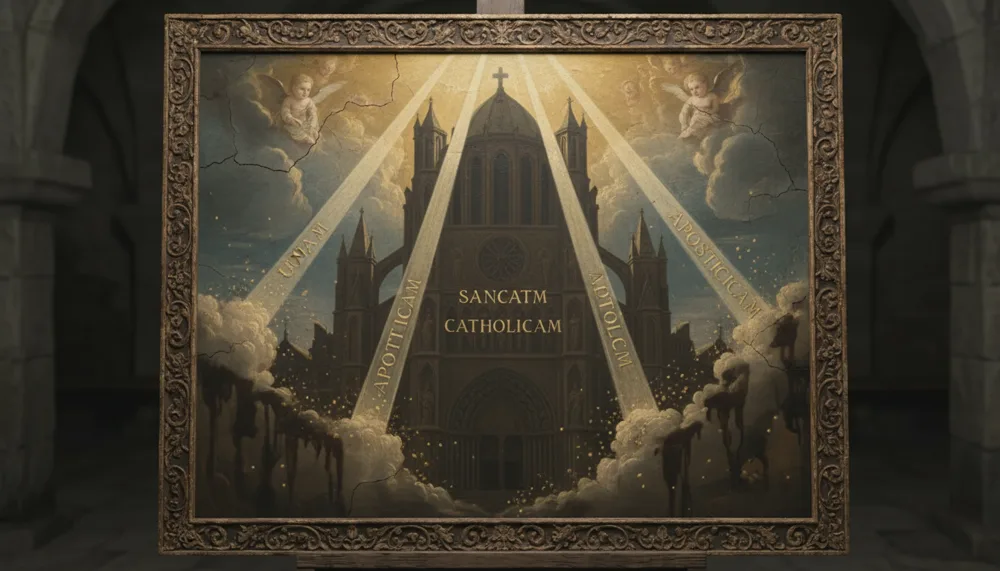
The four marks of the Church are One, Holy, Catholic, and Apostolic — the four signs by which the true Church founded by Jesus Christ is recognised, professed every Sunday in the Creed when we say we believe in "one, holy, catholic and apostolic Church." A mark is a visible sign that distinguishes the true from the false. These four are the test for which is the true Church, and only one body in the world bears all four together: the Catholic Church. We say this plainly and without hostility to anyone.
Why marks at all: how to find the true Church
Christ founded one Church, not many. To know which it is, He gave it features that can be seen and tested, as a coin bears the stamp that proves it genuine. The four marks are exactly that test. Many communities possess one or another of them in some degree; the question of how to find the true Church is settled by asking where all four are found at once, unbroken, from the beginning. We have written separately on who founded the Church of Christ and on what the Catholic Church is; here we set out the four signs themselves.
One: one faith, one government under the Pope
The first mark is Unity. The Church is one in faith, one in worship, and one in government. Christ prayed for this on the night before He died:
And not for them only do I pray, but for them also who through their word shall believe in me. That they all may be one, as thou, Father, in me, and I in thee; that they also may be one in us: that the world may believe that thou hast sent me. (John xvii. 20-21)
Saint Paul names the same unity to the Ephesians:
One body and one Spirit: as you are called in one hope of your calling. One Lord, one faith, one baptism. (Ephesians iv. 4-5)
The Roman Catechism teaches that this unity has both an invisible Head, Christ, and "one only visible Head who is the lawful successor of Saint Peter on the see of Rome." Christ established that visible headship Himself: "Thou art Peter; and upon this rock I will build my church" (Matthew xvi. 18). The office of the Pope exists precisely to hold the one Church in one faith and one communion; we treat this in Thou Art Peter. Where doctrine fractures into competing confessions, the mark of Unity is absent.
Holy: in her founder, her doctrine, her sacraments, and her saints
The second mark is Holiness. The Church is holy not because every member is sinless, but in four respects: in her Founder, in her doctrine, in her means of grace, and in the saints she produces. The Roman Catechism states that the Church is holy "because she is united to a holy Head whose Body she is; to Our Lord Jesus Christ, Source of all Holiness," and again "because she alone possesses the worship of the legitimate Sacrifice and the salutary use of the Sacraments."
She is the body of the One who took flesh for us — the truth we set out in the Incarnation — and she is "the church of the living God, the pillar and ground of the truth" (1 Timothy iii. 15). A doctrine that sanctifies, sacraments that confer grace, and a continuous line of canonised saints in every century are the visible proof of this mark. What the Church holds on the soul's destiny we cover in the four last things and in what happens after death.
Catholic: universal, for all nations and all ages
The third mark is Catholicity, which means universality. The Church is for all nations, all classes, and all ages of the world. The risen Christ commanded exactly this reach:
Going therefore, teach ye all nations: baptizing them in the name of the Father and of the Son and of the Holy Ghost. (Matthew xxviii. 19)
The Roman Catechism explains that the Church "is not, like the States of the earth, or the diverse heresies, bounded by the frontiers of a kingdom or to a race of men," but "encloses all within the bowels of her charity," extending "from the east unto the west." This mark is twofold: extension in space, gathering every people, and extension in time, holding "all the Faithful who have existed from Adam unto this day."
A community bound to one nation, one language, or one century is not catholic in this full sense. The word itself is why we speak of the Church as the Catholic Church and not a regional sect; we untangle the common confusion in Roman Catholic vs Catholic. The oldest writing known to give the Church this name is the letter of St Ignatius of Antioch to the Smyrnaeans, about the year 107: "wherever Jesus Christ is, there is the Catholic Church."
Apostolic: unbroken succession from the Apostles
The fourth mark is Apostolicity. The true Church traces back, without a break, to the Apostles whom Christ chose — in her doctrine and in the unbroken line of her bishops. Saint Paul tells the Ephesians they are:
Built upon the foundation of the apostles and prophets, Jesus Christ himself being the chief corner stone. (Ephesians ii. 19-20)
The Roman Catechism teaches that the Church's doctrine "is not a thing new and beginning... it is the truth transmitted of old by the Apostles," and that the Fathers of the Council of Nicaea added the word Apostolic to the Creed so that all would know which was the true Church. The Holy Ghost given to the Apostles "remained always in the Church" through "the lawful successors of the Apostles." A body whose foundation begins in the sixteenth century, or any century after the Apostles, cannot claim this mark, however earnest its members. This is the heart of the difference we examine in Catholic vs Protestant.
Only one Church bears all four
A community may hold something of one mark: a strong claim to holiness of life, or a wide geographic spread, or a zeal for Scripture. But the four marks are a single test taken together. Only the Catholic Church is at once one in faith and government under the successor of Peter, holy in her Founder and her sacraments and her saints, catholic across all nations and ages, and apostolic in unbroken succession from the Twelve. This is not pride; it is the plain reading of the marks Christ gave.
Some have sincerely tried to recover the "primitive Church" by setting aside later development — the nineteenth-century American Restoration Movement of Barton W. Stone and the brothers Thomas and Alexander Campbell is one such effort, which gave rise to the Churches of Christ and the Disciples of Christ. We name it without scorn. But a movement that begins in the 1800s and seeks to reconstruct apostolicity cannot supply the very mark it lacks: an unbroken line. The Apostolic Church is not rebuilt; it is the one that was never interrupted. The Church Christ founded is His own gift, and He who founded her is risen, as we hold in the Resurrection and against the modern claim we answer in Has the Body of Jesus Been Found.
To search for God in earnest is to be led, in the end, to the Church that bears His four marks. If that is your search, begin with how to find God, and see what Catholics actually hold in what do Catholics believe. The marks are not a slogan but an invitation: one fold, one shepherd (John x. 16).
Frequently Asked Questions
What are the four marks of the Catholic Church?
The four marks of the Catholic Church are One, Holy, Catholic, and Apostolic — the four signs professed every Sunday in the Creed and taught in the Roman Catechism (1566). They are the visible test by which the true Church founded by Jesus Christ is recognised: one in faith and government under the successor of Peter, holy in her Founder and sacraments, catholic for all nations and ages, and apostolic in unbroken succession from the Apostles. Only the Catholic Church bears all four together.
What are the four marks of the Roman Catholic Church?
They are the same four — One, Holy, Catholic, and Apostolic. "Roman Catholic" and "Catholic" name the one Church Christ founded; the word Roman points to her unity under the see of Peter at Rome. The four marks are not four separate Churches but a single test taken together, which only one body in the world satisfies.
What are the four pillars of the Catholic Church?
The "four marks" (One, Holy, Catholic, Apostolic) are sometimes confused with the "four pillars," but they are different things. The four pillars usually refer to the structure of the catechism: the Creed (what we believe), the Sacraments (how we worship), the Commandments (how we live), and Prayer. The four marks are the signs that identify the true Church; the four pillars are how her teaching is organised.
What does it mean that the Church is One?
Unity means the Church is one in faith, one in worship, and one in government — "one Lord, one faith, one baptism" (Ephesians iv. 5). Christ prayed "that they all may be one" (John xvii. 21) and built His Church on Peter: "Thou art Peter; and upon this rock I will build my church" (Matthew xvi. 18). Where doctrine fractures into competing confessions, the mark of Unity is absent.
Why is the Church called Holy if her members sin?
The Church is holy not because every member is sinless, but in her Founder, her doctrine, her sacraments, and her saints. The Roman Catechism teaches she is holy "because she is united to a holy Head whose Body she is; to Our Lord Jesus Christ, Source of all Holiness," and because she alone possesses the legitimate Sacrifice and the salutary use of the Sacraments. The continuous line of canonised saints in every century is the visible proof of this mark.
What does Catholic mean as a mark of the Church?
Catholic means universal. The Church is for all nations, all classes, and all ages, fulfilling Christ's command to "teach ye all nations" (Matthew xxviii. 19). This universality is twofold: extension in space, gathering every people from east to west, and extension in time, holding the faithful of every century. A community bound to one nation or one era is not catholic in this full sense.
What does Apostolic mean?
Apostolicity means the Church traces back, without a break, to the Apostles whom Christ chose — in her doctrine and in the unbroken line of her bishops. Saint Paul says the faithful are "built upon the foundation of the apostles" (Ephesians ii. 20). A body whose foundation begins in any century after the Apostles cannot claim this mark; the Apostolic Church is not rebuilt, it is the one that was never interrupted.
How do the four marks help you find the true Church?
Christ founded one Church and gave it features that can be seen and tested, as a coin bears the stamp that proves it genuine. Many communities possess one mark or another in some degree, but the four marks are a single test taken together. To find the true Church, ask where all four — Unity, Holiness, Catholicity, and Apostolicity — are found at once, unbroken, from the beginning.
The Iter Fidei app carries the Douay-Rheims Bible, the catechism, and the prayers of the Church. Join early access here.
Sources. Holy Scripture, Douay-Rheims version: John xvii. 20-21; John x. 16; Matthew xvi. 18; Matthew xxviii. 19; Ephesians ii. 19-20; Ephesians iv. 4-5; 1 Timothy iii. 15. The Catechism of the Council of Trent (Roman Catechism, 1566), Part I, Article IX, "On the Church," §§ IV-VII (Unity, Holiness, Catholicity, Apostolicity). Catechism of Saint Pius X (1908), on the ninth article of the Creed. Council of Nicaea (325), the Nicene Creed: "one, holy, catholic and apostolic Church." On the Restoration Movement: Barton W. Stone and Thomas and Alexander Campbell, early nineteenth-century United States, origin of the Churches of Christ and the Disciples of Christ.