
Novenas
The Epiphany Holy Magi Novena
The Novena to the Holy Magi, prayed the nine days before the Epiphany (December 28 to January 5), with the full 'I salute Thee, O divine Heart' prayer, all nine daily invocations to the three Kings, and the Prayer to the Infant Jesus.
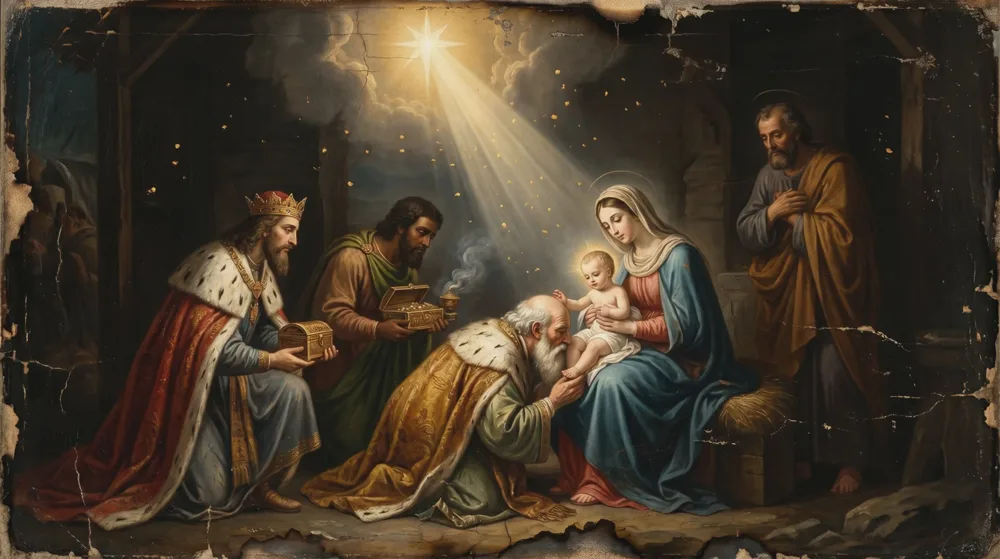
The Epiphany Holy Magi novena is a nine-day prayer to the three Wise Men — Caspar, Melchior, and Balthasar — said in the days before the Feast of the Epiphany on January 6, when the Church keeps the manifestation of the newborn Christ to the Gentiles in the persons of the Magi.
It is prayed to obtain an increase of faith, the grace to seek Christ as they sought Him, and whatever particular favour the soul brings — asking the first of the Gentiles ever called to the crib to lead us, as the star led them, to the feet of the Infant King. Below we give the complete novena: the salutation to the Sacred Heart, all nine daily invocations to the Holy Magi, and the Prayer to the Infant Jesus, with the history of the devotion and how to pray it.
When to pray the Epiphany novena
The Novena to the Magi is commonly begun on December 28, the Feast of the Holy Innocents — those infants of Bethlehem whom Herod slew in his rage against the newborn King the Magi had sought — and it ends on January 5, the Vigil of the Epiphany, so that its ninth day gives way to the feast itself on January 6.
This is the oldest and most fitting reckoning, binding the nine days to the Christmas Octave and letting the star of the Magi rise, as it were, over the whole season. Some who come to the devotion later keep the nine days from December 29 to January 6, ending on the feast; either way the object is the same — to walk the road of the Wise Men through Advent's last light into the great manifestation. If the nine-day form is new to you, see our guide to what is a novena.
The full Epiphany Holy Magi novena
The devotion is the same on each of the nine days, except for the daily invocation to the Magi, which changes to follow their journey step by step — expectation, departure, hardship, the lost star, its return, the adoration, the gifts, the road home, and perseverance to death. Each day, make the Sign of the Cross, say the salutation to the Sacred Heart with your intention, then the invocation appointed for that day, and close with the Prayer to the Infant Jesus and the Our Father, Hail Mary, and Glory Be. These prayers are a devotional composition found in prayer-books, with no liturgical text and no approval of their own that we can cite; the Church's official prayer is the collect of the Epiphany, given at the end of this page's account of the feast.
The daily salutation to the Sacred Heart
Said every day of the novena:
In the Name of the Father, and of the Son, and of the Holy Ghost. Amen.
I salute Thee, O divine Heart, with the three Magi who offered their homage to Thee. Regard me, I beseech Thee, with the same love and kindness with which Thou didst receive them, that I may offer with my heart, gold, frankincense and myrrh; that is to say, my intellect, my memory and my will, in complete subjection to Thee, in faith, hope, charity, in thought, word and deed. Accept my offering, accept my heart, and grant that I may live and die thanking Thee for the invaluable favour of being called to the true faith. Hence I beg of Thee, by the joy which filled Thy heart when Thou didst see the first of the Gentiles at Thy feet, to hear my prayer and grant the request I make in this novena. (Here name your request.) Amen.
The nine daily invocations to the Holy Magi
Say the one appointed for the day, followed by the Glory be to the Father.
Day 1 — December 28
O holy Magi! You were living in continual expectation of the rising of the Star of Jacob, which would announce the birth of the true Sun of justice; obtain for us an increase of faith and charity, and the grace to live in continual hope of beholding one day the light of heavenly glory and eternal joy.
Glory be to the Father, and to the Son, and to the Holy Ghost; as it was in the beginning, is now, and ever shall be, world without end. Amen.
Day 2 — December 29
O holy Magi! who at the first appearance of the wondrous star left your native country to go and seek the newborn King of the Jews; obtain for us the grace of corresponding with alacrity to every divine inspiration.
Glory be to the Father...
Day 3 — December 30
O holy Magi! who regarded neither the severity of the season, nor the inconveniences of the journey, that you might find the newborn Messias; obtain for us the grace not to allow ourselves to be discouraged by any of the difficulties which may meet us on the way of salvation.
Glory be to the Father...
Day 4 — December 31
O holy Magi! who, when deserted by the star in the city of Jerusalem, sought humbly and without human respect, from the rulers of the Church, the place where you might discover the object of your journey; obtain for us the grace to have recourse, in faith and humility, in all our doubts and perplexities, to the counsel of our superiors, who hold the place of God on earth.
Glory be to the Father...
Day 5 — January 1
O holy Magi! who were gladdened by the reappearance of the star which led you to Bethlehem; obtain for us from God the grace that, remaining always faithful to Him in afflictions, we may be consoled in time by His grace, and in eternity by His glory.
Glory be to the Father...
Day 6 — January 2
O holy Magi! who, entering full of faith into the stable of Bethlehem, prostrated yourselves upon the earth to adore the newborn King of the Jews, though He was surrounded only by signs of poverty and weakness; obtain from the Lord for us a lively faith in the real presence of Jesus in the Blessed Sacrament, the true spirit of poverty, and a Christ-like charity for the poor and suffering.
Glory be to the Father...
Day 7 — January 3
O holy Magi! who offered to Jesus Christ gold, incense, and myrrh, thereby recognizing Him to be at once King, God, and Man; obtain from the Lord for us the grace never to present ourselves before Him with empty hands, but that we may continually offer to Him the gold of charity, the incense of prayer, and the myrrh of penance and mortification.
Glory be to the Father...
Day 8 — January 4
O holy Magi! who, when warned by an angel not to return to Herod, travelled back to your country by another road; obtain for us from the Lord the grace that, after having found Him in true repentance, we may avoid all danger of losing Him again.
Glory be to the Father...
Day 9 — January 5
O holy Magi! who were first among the Gentiles called to the knowledge of Jesus Christ, and who persevered in the faith till your deaths; obtain for us of the Lord the grace of living always in conformity to our baptismal vows, ever leading to a life of faith, that like you we may attain to the beatific vision of that God Who now is the object of our faith.
Glory be to the Father, and to the Son, and to the Holy Ghost; as it was in the beginning, is now, and ever shall be, world without end. Amen.
The Prayer to the Infant Jesus
Said every day at the close:
Infant Jesus, meek and mild, look upon me as Thy little child. Look with pity upon me; suffer me to come to Thee.
Heart of Jesus, I adore Thee. Heart of Mary, I implore Thee. Heart of Joseph, pure and just, in these three hearts I put my trust.
Help us, Joseph, in our earthly strife, ever to lead a pure and blameless life. O holy Magi, pray for us. Amen.
Our Father. Hail Mary. Glory be. In the Name of the Father, and of the Son, and of the Holy Ghost. Amen.
Praying the novena for a particular intention
The salutation to the Sacred Heart leaves room to name your request, and the Magi's own petition — that we "never present ourselves before Him with empty hands" — makes this a fitting novena for any grave need brought in faith. Name your intention plainly at the words provided, and keep it through all nine days. The offering the novena teaches is itself the model of every good petition: we bring the King our intellect, memory, and will before we bring Him our wants, and we ask first for the increase of faith, leaving the rest to His wisdom. For a season of trust when the road is dark, many join it to the Litany of Trust or the Novena to the Divine Infant, whose King is the same Child the Magi adored.
The short Epiphany prayer to the Magi
Those who cannot keep the full form each day may pray the shorter devotion: the daily salutation I salute Thee, O divine Heart with the intention named, followed by the invocation for the day. Even a single Heart of Jesus, I adore Thee; Heart of Mary, I implore Thee; Heart of Joseph, pure and just, in these three hearts I put my trust is a true Epiphany prayer, and a fitting aspiration through the whole of Christmastide.
Who were the three Magi? The story of the Epiphany
Epiphany is a Greek word meaning manifestation or showing-forth, and the feast of January 6 is one of the most ancient in the Church — older in the East than Christmas itself. It celebrates the day the Gentile world was first led to Christ, when, as St Matthew records, "there came wise men from the East to Jerusalem, saying, Where is he that is born king of the Jews? for we have seen his star in the East, and are come to adore him" (Matthew 2:1-2). The Magi were learned men, watchers of the heavens, whom God drew by a star out of the pagan East to the manger of Bethlehem — the firstfruits of all the nations who would come to believe.
Scripture does not give their number, but the constant tradition of the Church has held them to be three, drawn from the three gifts they offered, and has handed down their names as Caspar, Melchior, and Balthasar. From early centuries they were honoured as kings, in fulfilment of the prophecy that "the kings of Tharsis and the islands shall offer presents; the kings of the Arabians and of Saba shall bring gifts" (Psalm 71:10), and so they are called the Three Kings. The tradition that one of them was of dark countenance expressed the Church's sense that in the Magi all the races of men — every people under heaven — came at last to adore their Maker.
Their gifts, the Fathers teach, were a threefold confession of who the Child was: gold for a King, frankincense for God, and myrrh — the spice of burial — for the Man who would die for the world. The novena turns these outward gifts inward, asking that we offer Christ the gold of charity, the incense of prayer, and the myrrh of penance and mortification, and that we surrender to Him our own intellect, memory, and will. Having adored the King and been warned in a dream, the Magi "went back another way into their own country" (Matthew 2:12) — a road home that the Church reads as the way of the soul that, having found Christ, will not return to its former life.
The relics of the Holy Magi have been venerated since ancient times, and from the twelfth century have rested in the great shrine of the Three Kings in the Cathedral of Cologne, one of the most famous places of pilgrimage in Christendom; the same city keeps the church of St Ursula and her companions, its virgin martyrs.
The Church keeps their feast on the Epiphany, and in the old calendar the season that follows — the Sundays after the Epiphany — continues to unfold the manifestations of Our Lord: to the Magi at Bethlehem, at His Baptism in the Jordan, and in the first of His miracles at the wedding of Cana. The Magi are honoured as patrons of travellers and pilgrims — a patronage they share with St Christopher and the patron saints of travellers — for they made the longest journey of all: out of darkness into the true Light.
The Church's own prayer for the feast is the collect of the Mass of the Epiphany, a feast of the first class in the Roman Missal of 1962:
Collect of the Epiphany, 6 January
Deus, qui hodiérna die Unigénitum tuum géntibus stella duce revelásti: concéde propítius; ut, qui jam te ex fide cognóvimus, usque ad contemplándam spéciem tuæ celsitúdinis perducámur. Per eúndem Dóminum nostrum Jesum Christum Fílium tuum, qui tecum vivit et regnat in unitáte Spíritus Sancti, Deus, per ómnia sǽcula sæculórum. Amen.
O God, You Who by the guidance of a star this day revealed Your only-begotten Son to the Gentiles; mercifully grant that we who know You now by faith, may come to behold You in glory. Through the same Jesus Christ, thy Son, Our Lord, Who liveth and reigneth with thee in the unity of the Holy Ghost, God, world without end. Amen.
How to pray the Holy Magi novena well
Begin on December 28 and pray one day's portion each day through January 5, or keep the nine days that end on the feast itself; fix a time, light a candle before the crib if you can, and pray before the image of the Christ Child among the shepherds and kings. Name your intention in the salutation and hold to it. Make the offering the novena teaches — intellect, memory, and will — before you make your request, and ask first for the increase of faith the Magi were given.
Above all, ask in the spirit of the Wise Men, who followed a light they did not fully understand and adored a King hidden in poverty: in faith, in perseverance, and in submission to God's will, content to receive the grace He knows to be best. To keep the whole Christmas season in the same spirit, the Epiphany novena joins naturally to the Novena to St Andrew that opens Advent and to the Holy Family novena of the days between.
Frequently Asked Questions
When do you start the Epiphany novena?
The Novena to the Magi commonly begins on December 28, the Feast of the Holy Innocents, and ends on January 5, the Vigil of the Epiphany, so that the feast of January 6 crowns the nine days. If you come to it late, you may instead pray the nine days from December 29 to January 6, ending on the Epiphany itself. Either reckoning is sound; what matters is nine consecutive days leading to or ending on the feast.
Who were the three kings in the Epiphany novena?
They are the Magi — the Wise Men from the East whom St Matthew records coming to adore the newborn Christ. Scripture does not number them, but tradition has held them to be three, from their three gifts, and has named them Caspar, Melchior, and Balthasar. Honoured from antiquity as kings, in fulfilment of the psalm that the kings of the earth would bring Him gifts, they are the first of the Gentiles ever called to the knowledge of Christ.
What is the difference between the Magi novena and the Three Kings novena?
They are the same devotion under different names. "Magi," "Three Kings," and "Three Wise Men" all name the same men who came from the East to Bethlehem, and the Epiphany novena to them is one prayer whether you call it the Novena to the Magi, the Three Kings novena, or the Novena to the Three Wise Men.
What do gold, frankincense, and myrrh mean in the novena?
The Fathers of the Church read the three gifts as a confession of who the Child is: gold honours Him as King, frankincense as God, and myrrh — the spice used in burial — as the Man who would die and rise. The novena turns them into a rule of the spiritual life, asking that we offer Christ the gold of charity, the incense of prayer, and the myrrh of penance, and surrender to Him our intellect, memory, and will.
Are the three Magi saints?
Yes; they are venerated in the Church as the Holy Magi, or the Holy Three Kings, and their relics have rested since the Middle Ages in the shrine of the Three Kings at Cologne Cathedral. The novena invokes them by name — "O holy Magi, pray for us" — as intercessors, and honours them especially as patrons of travellers and pilgrims.
Can I pray the Epiphany novena for a special intention?
Yes. The salutation to the Sacred Heart leaves a place to name your request, and the whole devotion is fittingly prayed for any grave need brought in faith. Name your intention there and keep it through all nine days — but ask first, as the novena directs, for the increase of faith and the grace to seek Christ, and leave the outcome to God's wisdom.
Is the Epiphany one of the oldest feasts of the Church?
Yes. The Epiphany, kept on January 6, is among the most ancient feasts of the Church — older in the Eastern churches than the feast of Christmas — and it celebrates the manifestation of Christ to the Gentiles in the Magi. In the traditional calendar the Sundays following continue to unfold His manifestations at the Baptism in the Jordan and the wedding of Cana.
The Iter Fidei app carries the Epiphany novena, and the litanies, chaplets, and prayers of the whole Christmas season, in Latin and your own language, with day-by-day reminders and audio. Join early access here.
Sources. Holy Scripture (Matthew 2:1-12; Psalm 71:10); the devotional Novena to the Magi in anticipation of the Epiphany, with its nine daily invocations, the salutation I salute Thee, O divine Heart, and the Prayer to the Infant Jesus, as carried in prayer-books; Roman Missal (1962), Epiphany (Collect); the Glory be to the Father; the feast of the Epiphany (6 January) and the ancient tradition of the three Holy Kings, Caspar, Melchior, and Balthasar, whose relics are venerated at Cologne.