
Novenas
Novena to the Divine Infant Jesus (Divino Niño)
The complete Novena of Confidence to the Divine Infant Jesus — the Divino Niño novena — in English and Spanish, with the daily prayer, the promise of the Holy Child, and how to pray it for a favor.
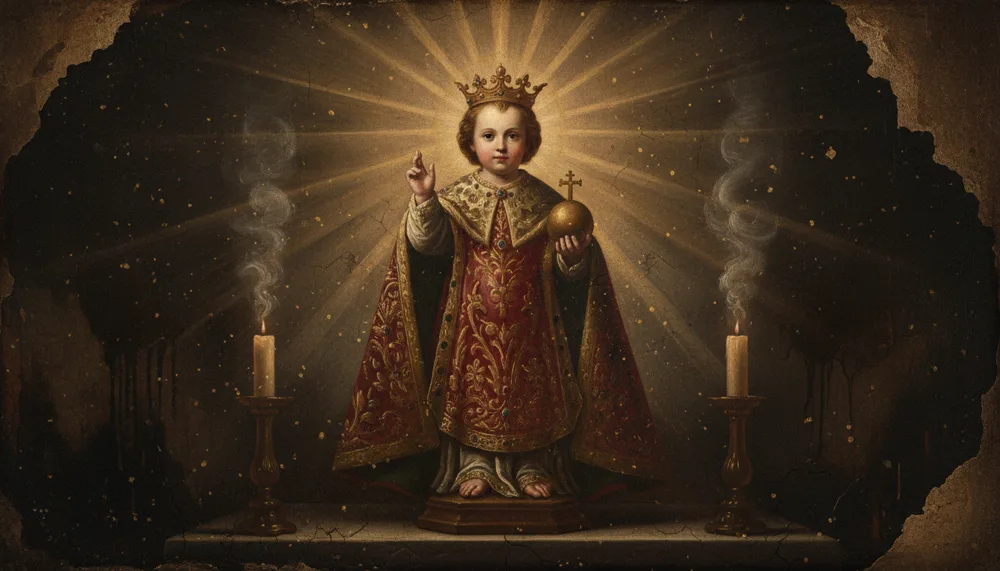
The novena to the Divine Infant Jesus — known to millions of Spanish-speaking Catholics as the Novena de la Confianza al Divino Niño (the Novena of Confidence to the Divine Child) — is a nine-day prayer to Our Lord under His most tender title, the Christ Child with arms flung open in blessing beneath the words Yo reinaré, "I will reign."
It is prayed to obtain a favour by trusting entirely in the Child who promised, in the old Carmelite devotion to His Holy Childhood, that whatever we ask Him "by the merits of My childhood" shall not be refused. Most keep it in the nine days before the great Colombian feast of the Divino Niño on 20 July, or begin it any day a soul is in need. Below is the full novena in English and in the original Spanish, the promise on which it rests, the Christmas form, and the story of the devotion.
A note on this devotion. The image of the Divino Niño — the standing Child with open arms — took its present form in Colombia in the 1930s, so this particular devotion is not ancient in its outward shape. What it carries, however, is old as the Gospel: the Church's tender love for the Holy Childhood of Jesus, the same devotion that gave us the Infant of Prague novena and the age-old veneration of the Divine Infant King. We give it here in full because it is widely sought, entirely orthodox, and rooted in that ancient treasury; those attached to the older statues may simply pray the same trust before the Infant of Prague.
The promise of the Divine Infant
The whole novena leans on a single word of confidence. Devotion to the Holy Childhood treasures an invitation attributed to the Child in a private revelation, which we cannot trace to a verified source:
Ask of Me whatever you wish, by the merits of My childhood, and nothing shall be denied you, if it is fitting for you to obtain it.
(Pídeme lo que quieras por los méritos de mi infancia, y nada te será negado, si te conviene conseguirlo.)
That last clause — if it is fitting — is the soul of the prayer. The Divino Niño novena is not a spell that forces God's hand; it is a child's confidence that a Child who is God will give what is truly good. If you are new to these nine-day devotions, see our short guide to what is a novena.
The Novena of Confidence to the Divine Infant — the full prayer
This is the heart of the page: the Novena de la Confianza, a devotional composition of the twentieth century with no liturgical text, said once on each of the nine days, always naming your intention. The whole prayer is the same every day — its power is in the repetition of trust, not in variety. Begin with the Sign of the Cross and an act of contrition, then pray:
Loving Child of my life,
consolation of Christians,
the grace that I need
I place in your blessed hands.
(Our Father…)
You who know my sorrows,
for I entrust them all to you,
give peace to the troubled
and relief to this heart of mine.
(Hail Mary…)
And though I do not deserve your love,
I will not turn to you in vain,
for you are the Son of God
and the help of Christians.
(Glory Be…)
Then the concluding petition — a Memorare to the Holy Child, in which you name what you ask:
Remember, O Divine Infant Jesus, that it was never known that anyone who implored your help was left without aid. Filled therefore with confidence, humble and repentant, full of love and hope, I ask you for this favour: (here name your request).
Close by saying seven times:
Divine Infant Jesus, bless us. Amen.
Many finish with three Hail Marys in honour of the Holy Childhood — the old devotion of the Three Hail Marys — and a Glory Be.
Novena al Divino Niño — la oración diaria (Spanish original)
Because so many pray this in the language it was born in, here is the same daily prayer in Spanish, word for word:
Niño amable de mi vida,
consuelo de los cristianos,
la gracia que necesito
pongo en tus benditas manos.(Padre Nuestro…)
Tú que sabes mis pesares,
pues todos te los confío,
da la paz a los turbados
y alivio al corazón mío.(Ave María…)
Y aunque tu amor no merezco,
no recurriré a ti en vano,
pues eres Hijo de Dios
y auxilio de los cristianos.(Gloria…)
Acuérdate, oh Divino Niño Jesús, que jamás se oyó decir que alguno te haya implorado sin tu auxilio recibir; por eso, con fe y confianza, humilde y arrepentido, lleno de amor y esperanza, este favor yo te pido: (aquí se pide la gracia).
Y se dice siete veces: Divino Niño Jesús, bendícenos. Amén.
The Divino Niño novena in English, for a specific favour
Whether you search for the divino niño novena in english or novena al divino niño para pedir un favor — to ask for a particular favour — the prayer above serves both. Name your intention plainly at the Memorare ("I ask you for this favour…"): a healing, work, a reconciliation, a conversion, a safe delivery, a home. The Child to whom the Holy Family entrusted everything is the natural refuge of families in need; those praying for a child of their own, or for the peace of their household, often add this novena to their prayer for the family. Ask boldly, then add in your heart the clause the Child Himself attached: if it is fitting for me to obtain it.
The nine days, day by day
A common question is what to pray on día 1, día 2, and so on, through día 9. In the Novena of Confidence the answer is simple and easily missed: the prayer is the same on all nine days. You do not need a different meditation for each day — you need nine days of the same steady, trusting petition. Keep the intention fixed, pray at the same hour, and let the ninth day find you still asking with the confidence of the first.
If it is a day-by-day novena with distinct daily meditations you are looking for, that is the Christmas form of the devotion, below.
The Christmas novena to the Divine Infant (Novena de Navidad)
The novena de navidad al Divino Niño Jesús is the beloved Colombian Christmas novena — the Novena de Aguinaldos — prayed in the home from 16 to 24 December, one day for each of the nine days before Our Lord's birth. Unlike the Novena of Confidence, this form does give a distinct reading, reflection, and petition for every day, all crowned by the sung Gozos with their refrain, "Ven, ven, ven" — "Come, come, come." Families gather before the crib, the youngest child often reading, and carry the Divine Infant through Advent to the manger. It is the same Christ Child, honoured now in the season of His birth; those who keep it may also love the Epiphany, when the Magi came to adore the same Infant.
The chaplet (coronilla) of the Divine Infant
Alongside the novena, Colombian devotion keeps a short coronilla al Divino Niño — a chaplet said on ordinary rosary beads, honouring the Child with repeated invocations of trust and the sevenfold "Divine Infant Jesus, bless us." It is not a substitute for the novena but a daily companion to it, a way to keep the confidence of the nine days alive through the year.
Divino Niño, Infant of Prague, or Divine Mercy?
Three devotions are often confused because they crowd the same searches. They are distinct:
- The Divino Niño is the standing Colombian Child with open arms and Yo reinaré — in fact carved from a modified Infant of Prague statue, which is why the two resemble one another.
- The Infant of Prague is the older, crowned and royally robed Child of the Discalced Carmelites in Prague, prayed especially in the "nine-hour" urgent novena — see the Infant of Prague novena.
- The Divine Mercy novena is a separate devotion entirely, given through St Faustina, prayed from Good Friday to Divine Mercy Sunday; its "nine days" belong to the Divine Mercy novena, not to the Divino Niño.
All three adore the one Christ; choose the image your heart is drawn to and pray the trust.
How to pray this novena
Pray the daily prayer above once a day for nine consecutive days, at a fixed hour, naming a single intention throughout. Begin the Sign of the Cross with a brief act of sorrow for sin, and where you can, join the novena to Mass and Holy Communion, or at least to a decade of the Rosary. To keep the feast, count back nine days from 20 July and begin so that the ninth day falls on the feast; but any urgent need is reason enough to begin today. Above all, pray as a child prays a father: ask for exactly what you need, and then rest — if it is fitting — in the wisdom of the Child who is God.
The story of the Divino Niño
Devotion to the Divine Infant of "20 de Julio" was born of a poor Salesian priest and a promise. Father Juan del Rizzo (Giovanni del Rizzo, born at Azzano Decimo in northern Italy in 1882, died in Bogotá in 1957) was a Salesian who carried a lifelong love for the Holy Childhood of Jesus. Ordained in 1900, he crossed to the Americas as a young missionary and came to Colombia — first Barranquilla, then Bogotá — where he laboured among the poor. Tradition holds that his heart was moved to spread the devotion by the tender image of the Christ Child he had long carried.
Given charge of a bare lot in a Bogotá neighbourhood called 20 de Julio, Fr Rizzo took an Infant of Prague statue, had the cross removed from its back, opened out the arms in a gesture of welcome and blessing, and had inscribed at its base the Child's own royal word: Yo reinaré — "I will reign." He preached tirelessly that the Christ Child grants favours to those who trust Him and who help the poor. A parish-sanctuary rose on the spot, founded in 1937 and completed in 1942, and has been served by the Salesians ever since.
From that humble lot the devotion spread across Colombia and, with the great emigration, across the Americas and the world, until the Divino Niño became one of the most beloved of all Latin American devotions. Pilgrims fill the sanctuary week by week; the 20th of July is kept there with Masses through the day, and the shrine keeps its patronal feast on the first Sunday of September. What draws them is what drew Fr Rizzo: not a new revelation, but the oldest confidence there is — that God became a little Child, and a little Child refuses no one who asks Him in trust.
Frequently Asked Questions
What is the Divino Niño?
The Divino Niño — the "Divine Child" — is an image and devotion to Our Lord Jesus Christ under His childhood, showing Him standing with arms open in blessing, dressed in a rose tunic, with the words Yo reinaré ("I will reign") at His feet. The devotion began in the 1930s in the 20 de Julio neighbourhood of Bogotá, Colombia, through the Salesian Father Juan del Rizzo, and has become one of the most widespread Catholic devotions of the Spanish-speaking world.
What is the Novena of Confidence to the Divine Infant?
The Novena de la Confianza is the classic nine-day prayer to the Divino Niño. The same short prayer — "Loving Child of my life… the grace that I need I place in your blessed hands" — is said once a day for nine days, with an Our Father, Hail Mary, Glory Be, and a closing Memorare to the Child in which the person names the favour asked, ending "Divine Infant Jesus, bless us," said seven times.
When is the feast of the Divino Niño?
Popular devotion keeps the Divino Niño especially on 20 July — the name-day of the Bogotá neighbourhood and sanctuary where the devotion began, marked there with Masses throughout the day. The sanctuary itself observes its patronal feast on the first Sunday of September. The nine days leading up to 20 July are a favoured time to pray the novena.
Can I pray the Divino Niño novena in English?
Yes. The daily prayer translates faithfully into English (given in full above) and may be prayed in either language, or both. The devotion belongs to the whole Church, not to one tongue; what matters is the confidence with which it is prayed.
How do I pray the novena for a specific favour?
Pray the daily prayer once a day for nine days, and at the closing Memorare name your one request plainly: "I ask you for this favour…" Keep the same intention through all nine days. Ask boldly, but add in your heart the Child's own condition — if it is fitting for me to obtain it — leaving the outcome to God's wisdom.
Is the Divino Niño the same as the Infant of Prague?
They are closely related but distinct. Fr Rizzo actually formed the Divino Niño image by modifying an Infant of Prague statue, which is why they resemble one another. The Infant of Prague is the older, crowned and royally robed Child venerated by the Carmelites in Prague; the Divino Niño is the standing Colombian Child with open arms. Both honour the same Holy Childhood of Jesus.
What does "Yo reinaré" mean?
Yo reinaré is Spanish for "I will reign" — the word inscribed at the base of the Divino Niño image. It expresses the Child Jesus's royal claim over hearts, homes, and nations, and echoes the promise of the Holy Childhood that He will reign in the souls who trust Him.
Pray this novena with day-by-day reminders and audio, in Spanish and your own language, with the Iter Fidei app. Join early access here.
Sources. The devotional Novena de la Confianza al Divino Niño Jesús (daily prayer Niño amable de mi vida and concluding Acuérdate, oh Divino Niño Jesús), as carried in Colombian Salesian prayer-books; the promise of the Holy Childhood, Pídeme lo que quieras por los méritos de mi infancia; the Novena de Aguinaldos (Colombian Christmas novena, 16–24 December) with its Gozos; the history of the devotion of the Divino Niño de 20 de Julio and its founder, Fr Juan del Rizzo, S.D.B. (Bogotá, sanctuary founded 1937, completed 1942); Holy Scripture on the childhood of Our Lord (Luke 2; Matthew 2).