
Novenas
Novena to St Mary Magdalene
The complete 9 day novena to St Mary Magdalene — the daily prayer, nine days of Gospel meditations, and the Litany — prayed to the penitent who loved much and first saw the risen Christ, before her feast on 22 July.
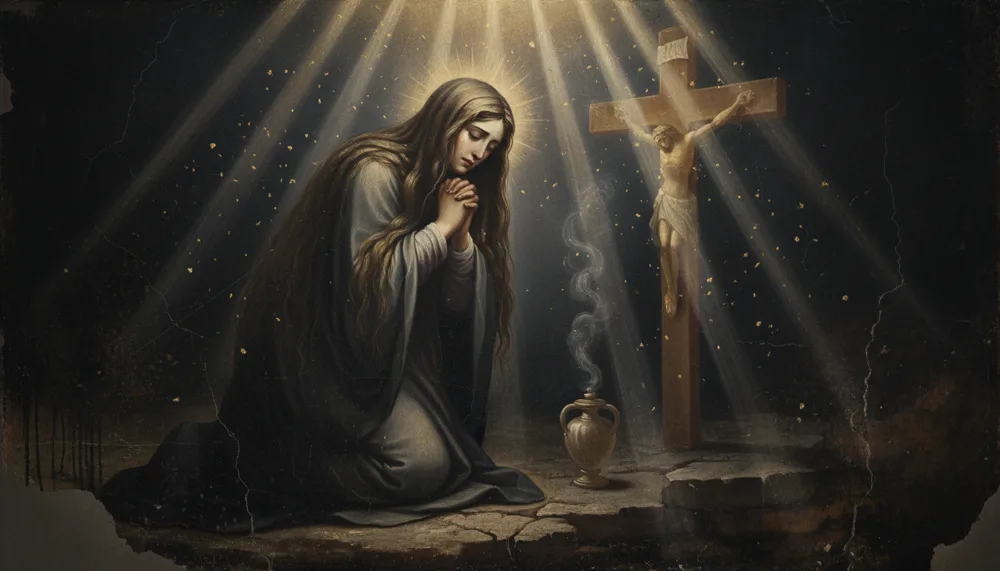
The novena to St Mary Magdalene is nine days of prayer to the woman who "loved much" (Luke 7:47) — the penitent who washed the feet of Jesus with her tears, stood by His cross when the apostles had fled, and was the first to see Him risen from the dead. We pray it to ask her intercession for conversion and sorrow for sin, for the return of a wandering soul, for perseverance in grief, and for the grace to love Our Lord as she loved Him. It is prayed above all in the nine days leading to her feast on 22 July, beginning on 13 July. Below is the complete devotion: the daily prayer, nine days of Gospel meditations, and the Litany.
If you are new to this kind of prayer and want to know what a novena is and why it lasts nine days, see our short guide to what is a novena.
The daily prayer to St Mary Magdalene
This short prayer is the heart of the novena; it is a modern devotional composition, with no liturgical text and no approval of its own, and the Church's prayer for her feast is the collect of 22 July (a feast of the third class in 1962). It is said once on each of the nine days, together with the day's meditation and intention:
Saint Mary Magdalene, woman of many sins, who by conversion became the beloved of Jesus, thank you for your witness that Jesus forgives through the miracle of love.
You, who already possess eternal happiness in His glorious presence, please intercede for me, so that some day I may share in the same everlasting joy. Amen.
After it, name your intention, and close each day with one Our Father, one Hail Mary, and one Glory Be. Many add the Litany given further down, or a decade of the Rosary.
The 9 day novena to St Mary Magdalene
Below the same daily prayer is joined each day to a distinct meditation drawn from the Gospel account of her life, moving with her from her sin, through her love and her vigil at the cross, to the garden of the Resurrection. Pray the day's meditation, then the daily prayer above, then name your intention and say the Our Father, Hail Mary, and Glory Be.
Day 1 — The penitent sinner
"And behold, a woman that was in the city, a sinner... began to wash his feet with tears, and wiped them with the hair of her head" (Luke 7:37-38). Mary came uninvited into the Pharisee's house and knelt weeping at the feet of Christ, and He forgave her because she loved much. We pray today for true sorrow for our own sins, and the courage to bring them to Our Lord as she did.
Day 2 — Delivered from seven devils
"Mary who is called Magdalen, out of whom seven devils were gone forth" (Luke 8:2). From the deepest bondage Christ set her wholly free, and she followed Him and served Him of her substance. We pray for all held captive by sin, vice, or despair — for ourselves and for those we love who are bound — that Christ may deliver them as He delivered her.
Day 3 — The better part
"Mary hath chosen the best part, which shall not be taken away from her" (Luke 10:42). At Bethany she sat at the feet of the Lord and listened to His word while Martha served, and He praised her. We pray for a heart that seeks Christ before all else — for a life of prayer, and for the grace to choose the one thing necessary.
Day 4 — Love poured out
"Mary therefore took a pound of ointment of right spikenard, of great price, and anointed the feet of Jesus... and the house was filled with the odour of the ointment" (John 12:3). Judas called it waste; Our Lord called it a good work done for His burial. We pray for a generous, extravagant love of God that does not count the cost, and against the meanness of soul that measures everything.
Day 5 — Faithful at the cross
"Now there stood by the cross of Jesus... Mary Magdalen" (John 19:25). When the apostles had fled, she remained at Calvary and would not leave Him in His agony. We pray for perseverance in our trials — that we may not abandon Our Lord when following Him grows hard, but stand by Him faithfully.
Day 6 — Watching at the tomb
"And Mary Magdalen was there, and the other Mary, sitting over against the sepulchre" (Matthew 27:61). She kept watch as the great stone was rolled across the door, and rested only for the Sabbath before returning. We pray for all who mourn and keep vigil in sorrow — for the dying, the bereaved, and the grieving — that they may wait in hope.
Day 7 — Seeking Him in the dark
"Mary stood at the sepulchre without, weeping... They have taken away my Lord, and I know not where they have laid him" (John 20:11-13). She came while it was yet dark, found the tomb empty, and would not be consoled until she found Him. We pray for all who seek God in confusion and doubt, and for the grace never to stop seeking Him.
Day 8 — "Mary!"
"Jesus saith to her: Mary. She turning, saith to him: Rabboni, which is to say, Master" (John 20:16). He spoke her name, and at once she knew Him — the risen Lord, made known first of all to the penitent who loved Him. We pray to recognise Christ in our own lives, and for the joy of His presence to answer our sorrow.
Day 9 — Apostle to the apostles
"Go to my brethren, and say to them: I ascend to my Father... Mary Magdalen cometh, and telleth the disciples: I have seen the Lord" (John 20:17-18). She was the first to preach the Resurrection, sent by Christ Himself to the apostles. We pray today for the grace to bear witness to Him wherever we are — and we place before her, with confidence, our particular intention. (Name your request.)
The Litany of St Mary Magdalene
Many join this litany to the novena, especially on the feast. It is a private composition, not one of the litanies approved for public use. The response to each invocation is "pray for us."
Lord, have mercy. Christ, have mercy. Lord, have mercy.
Holy Mary, Mother of God, pray for us.Saint Mary Magdalene, pray for us.
Sister of Martha and Lazarus, pray for us.
Who anointed the feet of Jesus, pray for us.
Who washed His feet with thy tears, pray for us.
Who wiped them with the hair of thy head, pray for us.
Who received the pardon of thy sins, pray for us.
From whom seven devils were cast out, pray for us.
Restored from darkness to light, pray for us.
Mirror of penance, pray for us.
Wounded with the love of Christ, pray for us.
Most dear to the Heart of Jesus, pray for us.
Who didst choose the better part, pray for us.
Last at the cross of Jesus, first at His tomb, pray for us.
First to see Christ risen, pray for us.
Constant woman, pray for us.
Apostle to the apostles, pray for us.
Sweet advocate of sinners, pray for us.Lamb of God, who takest away the sins of the world, spare us, O Lord.
Lamb of God, who takest away the sins of the world, graciously hear us, O Lord.
Lamb of God, who takest away the sins of the world, have mercy on us.Let us pray. May the merits and prayers of blessed Mary Magdalene, we beseech Thee, O Lord, commend us; that by their pleading we may obtain what by our own deserts we cannot. Through Christ our Lord. Amen.
For the great litanies of the Church, see the Litany of the Saints.
A novena for conversion and for sinners
Because St Mary Magdalene was herself a great sinner made a great saint, her novena is the natural recourse of anyone praying for a conversion — one's own return to God, or the return of a soul who has wandered. She knows the road back from sin, having walked it herself, and no penitent is a stranger to her. Prayed for a loved one who has left the Faith or fallen into grave sin, this novena is well joined to the Novena to St Monica, who wept and prayed her son Augustine into the Church, and to the mercy of the Divine Mercy Novena, for Our Lord refuses no contrite heart. Name the soul plainly, and beg her who loved much to obtain for them the grace of true sorrow.
A novena for a particular intention
The novena is also prayed for one urgent need — a healing, a reconciliation, a decision, a desperate case. Keep the same daily prayer and meditations, and hold your single intention before her throughout the nine days, naming it especially on the ninth day as above. As a saint restored from the depths, she is a strong advocate for causes that seem beyond repair; for the classic patroness of such desperate and impossible cases, see also the Novena to St Rita.
Is there a St Mary Magdalene novena PDF?
The complete text you would find in a printed booklet or PDF is exactly what is given above: the short daily prayer, the nine days of Gospel meditations, the Our Father, Hail Mary, and Glory Be, and the Litany. You can copy this page and keep it beside you for the nine days, or pray it from the Iter Fidei app, which carries the devotion day by day with reminders and audio so nothing need be printed.
Better than a PDF: the Iter Fidei app sets the right text before you each day and reminds you to pray it, even without a connection. Join early access here.
How to pray this novena
A novena is nine consecutive days of prayer for one intention. To finish on the eve of her feast, begin on 13 July and pray through 21 July, so the ninth day falls the day before the feast on 22 July — though the novena may be prayed at any time of year for any grave need. Pray at a fixed hour each day, name your intention clearly, and, where you can, join the novena to Holy Mass or Communion. Above all, pray in submission to God's will: a novena does not compel Heaven, but commends our need with confidence to a saint who has His ear. The grace asked is not always the grace given — but the soul that prays with St Mary Magdalene's love never prays in vain.
Who is St Mary Magdalene?
In the tradition of the Western Church, following St Gregory the Great, three women named in the Gospels are honoured as one: the unnamed sinner who anointed Christ's feet in the house of the Pharisee (Luke 7), Mary Magdalene, out of whom seven devils were cast (Luke 8:2), and Mary of Bethany, the sister of Martha and Lazarus (John 11-12). The Roman liturgy long identified these three, and so the Church keeps a single feast.
She took her name most likely from Magdala, a town on the Sea of Galilee. A notorious sinner, she was converted by the mercy of Christ, delivered from the seven devils, and became one of the women who followed Him and ministered to Him of their means. She sat at His feet at Bethany and chose "the better part"; she anointed Him for His burial; and in His Passion she did not flee.
She stood by His cross, watched His body laid in the tomb, and came back while it was still dark on the first day of the week bearing spices to anoint Him. It was to her — the penitent, weeping in the garden — that the risen Christ first appeared and spoke her name, and it was she whom He sent to announce the Resurrection to the apostles. For this the Fathers call her Apostola Apostolorum, the "Apostle to the apostles."
According to the Provençal legend, which no early document confirms, she, with Lazarus and St Martha, later evangelized Provence, and spent the last thirty years of her life as a hermit in penance in the cave of La Sainte-Baume in the mountains above Marseilles, before dying and being buried at St-Maximin. She is honoured as the patroness of penitents, converts, contemplatives, and of those who, like her, are mocked for their devotion. Her feast is kept on 22 July. Because she was last at the cross and first at the empty tomb, her name belongs especially to the great days of the Passion and Resurrection — see Holy Week and Holy Saturday.
Frequently Asked Questions
When is St Mary Magdalene's feast day?
The feast of St Mary Magdalene is kept on 22 July. To pray the novena so that it ends on the eve of the feast, begin on 13 July; the ninth and final day then falls on 21 July.
What is St Mary Magdalene the patron saint of?
She is the patroness of penitents and converted sinners, of contemplatives, and of those ridiculed for their piety. Because of the ointment she poured on Christ, she is also the patroness of perfumers and, by old custom, of hairdressers — for she wiped His feet with her hair. Above all she is the advocate of anyone praying for the forgiveness of sins and the return of a soul to God.
How many days is the novena to St Mary Magdalene?
Nine days — the word novena comes from the Latin for "nine." The novena is prayed on nine consecutive days, one intention held throughout. This page gives the full nine-day form, with a distinct Gospel meditation for each day.
Why is St Mary Magdalene called the "Apostle to the apostles"?
Because the risen Christ appeared to her first, before all the apostles, and sent her to carry the news of the Resurrection to them: "Go to my brethren... Mary Magdalen cometh, and telleth the disciples: I have seen the Lord" (John 20:17-18). She was thus the first to announce the Gospel of the Resurrection, and the Fathers of the Church honoured her with the title Apostola Apostolorum.
What can I pray this novena for?
For conversion and sorrow for sin; for the return of a loved one who has left the Faith; for perseverance in grief and trial; for a deeper, more generous love of Our Lord; and for any particular intention you wish to place under her patronage. As a saint raised from the depths of sin to the heights of grace, she is a strong intercessor for causes that seem hopeless.
Is the novena to St Mary Magdalene the same as the novena to St Mary Magdalene de' Pazzi?
No — these are two different saints. St Mary Magdalene is the friend of Christ and witness of the Resurrection, whose feast is 22 July, and whom this novena honours. St Mary Magdalene de' Pazzi (1566-1607) is a Carmelite mystic of Florence, whose feast falls on 29 May in the calendar of 1962 (25 May since 1969). If you are searching for the Carmelite, this page is for the Gospel Magdalene; the two are often confused because they share a name.
Do I have to pray it before her feast?
No. Ending the novena on the eve of the feast of 22 July is the most fitting time, but a novena may be prayed at any time of year, for any pressing need. What matters is nine days of faithful, unhurried prayer for one intention.
The Iter Fidei app carries this novena to St Mary Magdalene — the daily prayer, the nine meditations, and the Litany — in Latin and your own language, with day-by-day reminders and audio. Join early access here.
Sources. Holy Scripture: Luke 7:36-50; 8:2; 10:38-42; John 11-12; 19:25; 20:1-18; Matthew 27:61. Butler's Lives of the Saints (St Mary Magdalen, 22 July); the identification of the three women following St Gregory the Great, as received in the Roman liturgy; the daily novena prayer Saint Mary Magdalene, woman of many sins; the Litany of St Mary Magdalene; the French tradition of Provence and La Sainte-Baume.