
Novenas
Novena to St Rita of Cascia
The traditional nine-day novena to St Rita of Cascia — the Saint of the Impossible — with the full prayer, the novena for impossible cases, for marriage, her life, and the story of the rose. Prayed May 13-21 for her feast on May 22.
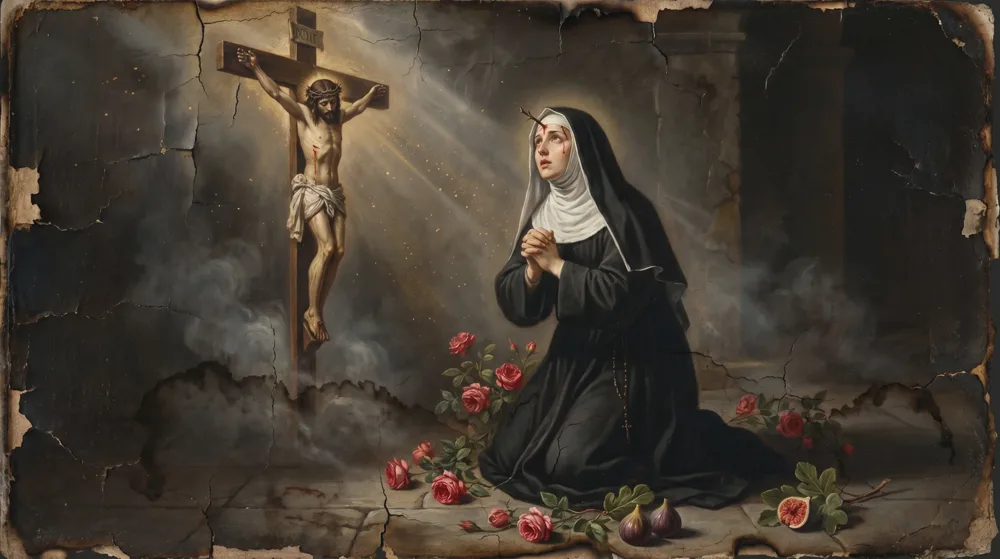
The novena to St Rita of Cascia is the nine-day prayer said to the saint the Church calls the Advocate of the Impossible — the wife, mother, widow, and Augustinian nun who bore a thorn-wound of Christ's Passion in her forehead for fifteen years, and who is invoked above all others for causes the world has given up as hopeless. It is prayed for desperate and impossible cases, difficult marriages, wayward children, the sick, and the barren, because St Rita knew every one of those sorrows in her own life. Below: the full traditional novena prayer, the nine days in order, the prayer for impossible cases, her life and the miraculous rose, and how to pray the devotion for her feast on 22 May.
Why St Rita is the "Saint of the Impossible"
No saint earned her title more plainly by living it. Every human means in her life was at some point spent, and God answered each time. So the faithful bring her the cases where nothing is left but Providence, and she is called, in the old novena, "the Advocate of the Hopeless and even of the Impossible." This is not magic and no novena binds God; for the meaning and shape of the nine-day prayer, see our guide to what is a novena.
The novena prayer to St Rita
This is the classic traditional prayer at the heart of the devotion. It is said once on each of the nine days, with your intention named at the place marked:
O Holy Patroness of those in need, St Rita, whose pleadings before thy Divine Lord are almost irresistible, who for thy lavishness in granting favours hast been called the Advocate of the Hopeless and even of the Impossible; St Rita, so humble, so pure, so mortified, so patient, and of such compassionate love for thy crucified Jesus that thou couldst obtain from Him whatsoever thou didst ask — on account of which all confidently have recourse to thee, expecting, if not always relief, at least comfort: be propitious to our petition, showing thy power with God on behalf of thy suppliant. Be lavish to us as thou hast been in so many wonderful cases, for the greater glory of God, for the spreading of thine own devotion, and for the consolation of those who trust in thee.
We promise, if our petition be granted, to glorify thee by making known thy favour, to bless and sing thy praises for ever. Relying then upon thy merits and power before the Sacred Heart of Jesus, we pray thee grant that (here name your request).
St Rita, Advocate of the Impossible, pray for us.
St Rita, Advocate of the Hopeless, pray for us.
Close each day with the three prayers that traditionally seal a novena — the Our Father, Hail Mary, and Glory Be — offered for your intention. Because her power was always drawn from the Passion of Christ, many join to the novena a short act toward the Sacred Heart of Jesus, before whom the prayer says St Rita pleads.
The full nine-day novena to St Rita
The oldest form of the devotion walks, across the nine days, through the stages of St Rita's own life — so that we ask each grace through the very trial in which she first learned it. Say the novena prayer above each day, and take the day's meditation and petition as its intention.
Day 1 — For frustrated hopes and impossible situations
St Rita, from childhood you longed to give yourself wholly to God, and that first hope was denied you; yet God had a greater design in the very disappointment. Teach me to trust when my own plans are broken, and obtain the grace to lay before God the impossible situation I now carry. (Name it.) Advocate of the Impossible, pray for me.
Day 2 — For a difficult or violent marriage
St Rita, given in marriage to a harsh and violent man, you bore eighteen years of ill-treatment with such patience that at last you won his heart and his conversion. Obtain for all who suffer in a hard or abusive marriage your patience and hope, and win for them the peace you won for your own home. (Name the marriage or household you pray for.) Patroness of difficult marriages, pray for us.
Day 3 — For difficult children and the conversion of loved ones
St Rita, when your sons resolved to avenge their murdered father, you feared for their souls more than their lives, and prayed God rather to take them than let them sin — and they died reconciled to Him. Watch over the children and loved ones I fear for, and bring back to God those who have wandered from Him. (Name them.) Mother of sorrows and of mercy, pray for us.
Day 4 — For the healing of family discord and hatred
St Rita, you laboured and prayed until the feud that had killed your husband was laid to rest and the warring families reconciled. Where there is hatred, division, and old wounds in my family, obtain the peace of Christ and soften every hardened heart. (Name the discord you pray over.) Peacemaker of Cascia, pray for us.
Day 5 — For conformity to the will of God
St Rita, in every loss you united your will to God's, saying with Christ, "not my will, but Thine, be done." Obtain for me the grace to want what God wants, and to receive whatever answer He sends as the better gift. (Renew your intention.) Model of resignation, pray for us.
Day 6 — For perseverance in prayer
St Rita, thrice refused at the convent, you did not cease to knock, and tradition tells that your heavenly patrons carried you within its walls when men would not open. Give me your perseverance, that I may keep praying when the answer is slow and the door seems shut. (Renew your petition.) Advocate of the Hopeless, pray for us.
Day 7 — For the sick, the suffering, and the rejected
St Rita, for fifteen years you bore in your forehead a wound from the thorn of Christ's crown — a suffering so offensive that you lived apart, sustained by the Blessed Sacrament almost alone. Comfort all who suffer sickness, pain, and the loneliness of being shunned, and obtain for the sick I name the healing or strength they need. (Name them.) Partaker of the Passion, pray for us.
Day 8 — For a compassionate and forgiving heart
St Rita, you forgave your husband's murderers and prayed for those who wronged you. Take from my heart every bitterness and grudge, and make me as lavish in mercy toward others as you were in obtaining favours for those who trust in you. (Ask the grace of forgiveness.) Mirror of patience, pray for us.
Day 9 — For my own impossible cause
St Rita, Saint of the Impossible, on this last day I place in your hands the one great cause I have carried through these nine days, the thing beyond all human reach. Show your power with God, as you have in so many wonderful cases, and obtain for me — if it be for the glory of God and the good of my soul — the favour I most desire. (Name your impossible cause.) St Rita, Advocate of the Impossible, pray for us.
The St Rita novena for impossible cases
The most-sought form of the devotion is simply the novena above prayed for a hopeless cause — but there is a second traditional prayer that many add when the case is truly impossible:
O holy protectress of those who art in greatest need, thou who shinest as a star of hope in the midst of darkness, blessed St Rita, bright mirror of God's grace, in patience and fortitude thou art a model of all the states in life. I unite my will with the will of God through the merits of my Saviour Jesus Christ, and in particular through His patient wearing of the crown of thorns, which with tender devotion thou didst daily contemplate. Through the merits of the holy Virgin Mary and thine own graces and virtues, I ask thee to obtain my earnest petition, provided it be for the greater glory of God and my own sanctification.
Guide and purify my intention, O holy protectress and advocate, so that I may obtain the pardon of all my sins and the grace to persevere daily, as thou didst, in walking with courage, generosity, and fidelity down the path of life. (Name your request.) St Rita, Advocate of the Impossible, pray for us. Amen.
St Rita shares this patronage of hopeless causes with the Apostle St Jude; the two are often invoked together, and you may wish to add the prayer to St Jude or pray his novena to St Jude alongside hers.
The St Rita novena for marriage
Because Rita endured eighteen years of a violent marriage and won her husband's conversion by patience, she is the special patroness of difficult marriages, wives who suffer abuse, and those seeking peace in the home — and the St Rita novena for marriage is among the most-prayed. Use the nine days above, dwelling on Day 2, and name the marriage you pray for. Those asking St Rita for a husband, or for a child in barrenness, pray the same novena; she is invoked by the childless as a patroness of mothers and of causes nature seems to have closed. For a mother's cause you may also entrust it to Our Lady, in the novena to Our Lady of Perpetual Help.
The rose of St Rita, and her signs and wonders
The emblem of St Rita is the rose, and it comes from the last winter of her life. Bedridden and near death in January, she asked a visiting cousin to bring her a rose from the garden of her old home at Roccaporena. It was deep winter — yet in the frozen garden a single rose was found in full bloom, and, on a second errand, two ripe figs on a bare tree. The Church has read the sign ever since as a token that with God nothing is impossible. For this reason roses are blessed in her honour on her feast day, and the faithful keep a blessed rose or petal as a sacramental — a sign of her patronage, never a charm. Her body is still venerated incorrupt at the basilica in Cascia, and the miracles long attributed to her are the ground of her old reputation as the saint who obtains the impossible.
How to pray the novena to St Rita
A novena is nine days of prayer for one intention. To keep St Rita's novena for her feast, begin on 13 May so that the ninth day falls on the eve of her feast, 22 May — the traditional schedule, though the novena may be prayed at any time of year for a pressing need. Pray at a fixed hour each day; say the novena prayer once, add the day's meditation and the Our Father, Hail Mary, and Glory Be; and name your one intention plainly. Where you can, join it to Mass and Holy Communion, or at least to a decade of the Rosary. Above all, ask in submission — if it be for the glory of God and the good of my soul. Like the sure novena to St Joseph, another patron of impossible causes, the devotion never fails to obtain what is truly best, even when it does not grant the thing we named.
Who is St Rita of Cascia?
St Rita was born about 1381 at Roccaporena, near Cascia in the Umbrian mountains of Italy, the long-awaited child of elderly parents. From girlhood she desired to enter religion, but at her parents' wish she was given in marriage, about the age of eighteen, to Paolo Mancini, a man of harsh and violent temper. For eighteen years she bore his ill-usage with a patience that at last worked his conversion; they had two sons.
Then her husband was murdered in one of the blood-feuds of the region. Her sons resolved to avenge him, and Rita, dreading that they would die in the mortal sin of murder, prayed that God would rather take them than let them stain their souls; within the year both fell ill and died, reconciled to God. Widowed and childless, Rita sought to enter the Augustinian convent of St Mary Magdalen at Cascia, and was refused three times — a widow among virgins, bound up with a feud the nuns feared to import. Tradition holds she was at length brought within the enclosure miraculously, by the aid of her patrons St John the Baptist, St Augustine, and St Nicholas of Tolentino, and, the feud reconciled through her, she was received.
For some forty years she lived the Augustinian Rule in great austerity, obedience, and charity. About 1442, hearing a sermon on the crown of thorns, she begged Our Lord to let her share one pang of His Passion; and a thorn, as from the crucifix, wounded her forehead, leaving a deep sore that never healed and that she carried for the last fifteen years of her life. So grievous was it that she lived much apart, and in her final, largely bedridden years she was sustained, the old accounts tell, chiefly by the Holy Eucharist. She died at Cascia on 22 May 1457; her body was found incorrupt, remains so, and rests in the basilica raised over her tomb.
Rita was beatified by Pope Urban VIII in 1627 and canonized by Pope Leo XIII on 24 May 1900, who set her feast on 22 May. The Church honours her as patroness of impossible and desperate causes, of unhappy and abusive marriages, of widows, of mothers, of the sick, and of the barren — every state she herself passed through, which is why the novena is prayed with such confidence.
Frequently Asked Questions
What is St Rita the patron saint of?
St Rita of Cascia is the patron saint of impossible and desperate causes — she is called the Saint, or Advocate, of the Impossible. Because of her own life she is also patroness of difficult and abusive marriages, of wives and mothers, of widows, of the sick, and of those seeking children. She shares the patronage of hopeless cases with the Apostle St Jude.
When is the St Rita novena, and when does it start?
The novena is traditionally prayed in the nine days leading up to her feast: begin on 13 May so that the ninth day falls on the eve of the feast on 22 May. It may, however, be prayed at any time of year when a pressing need arises — nine consecutive days, once each day, for one intention.
How many days is the St Rita novena?
Nine days. Novena comes from the Latin novem, "nine," and recalls the nine days the Apostles and Our Lady prayed together between the Ascension and Pentecost. It is said once a day for nine days in a row, with a single intention named throughout.
How do I pray the novena to St Rita?
Choose a fixed hour and pray each day for nine days: say the novena prayer "O Holy Patroness of those in need," add the day's meditation and the Our Father, Hail Mary, and Glory Be, and name your intention plainly. Join it to Mass or the Rosary where you can, and ask always in submission to God's will.
What is the story of the rose of St Rita?
In her last winter, dying and bedridden, St Rita asked a visitor to fetch a rose from her old garden at Roccaporena. Though it was January, a single rose was found blooming in the frost, and afterward two ripe figs on a bare tree. The rose became her emblem and a sign that with God nothing is impossible.
Does the St Rita novena really work, and what can I pray for?
The novena does not compel God, and no saint can force an answer — to pray as though words worked automatically would be superstition, which the Church condemns. What the devotion rests on is St Rita's real intercession, tested in the impossible cases of her own life. Bring her anything: a hopeless cause, a broken marriage, a sick loved one, a wayward child, a longing for a family. She obtains either the favour named or the greater good God sends.
Is there a printable PDF of the 9-day novena to St Rita?
The complete text is on this page — the daily prayer, all nine days with their meditations, the prayer for impossible cases, and the closing prayers — so you can copy it, print it, or pray it straight from your phone. The Iter Fidei app also carries the whole devotion with day-by-day reminders and audio, so no printed sheet is needed.
Pray the novena to St Rita in the Iter Fidei app — the full nine days with day-by-day reminders and audio, in Latin and your own language, so you never lose your place. Download it here.
Sources. The traditional novena prayer "O Holy Patroness of those in need, St Rita" and the prayer for impossible cases "O holy protectress of those who art in greatest need," as carried in the standard Catholic prayer-books; the life of St Rita after Butler's Lives of the Saints and the traditional accounts (her marriage to Paolo Mancini, the death of her sons, her entrance among the Augustinians of Cascia, the thorn-wound of 1442, the rose of Roccaporena, her death on 22 May 1457, and her incorrupt body); her beatification by Urban VIII (1627) and canonization by Pope Leo XIII (24 May 1900); Holy Scripture, the prayer of Christ in the Garden, "not my will, but Thine, be done" (St Luke 22:42).