
Novenas
The Annunciation Novena
The traditional novena for the Annunciation — the nine days before 25 March and the famous nine-month novena for impossible requests — with the full prayers and how to pray them.
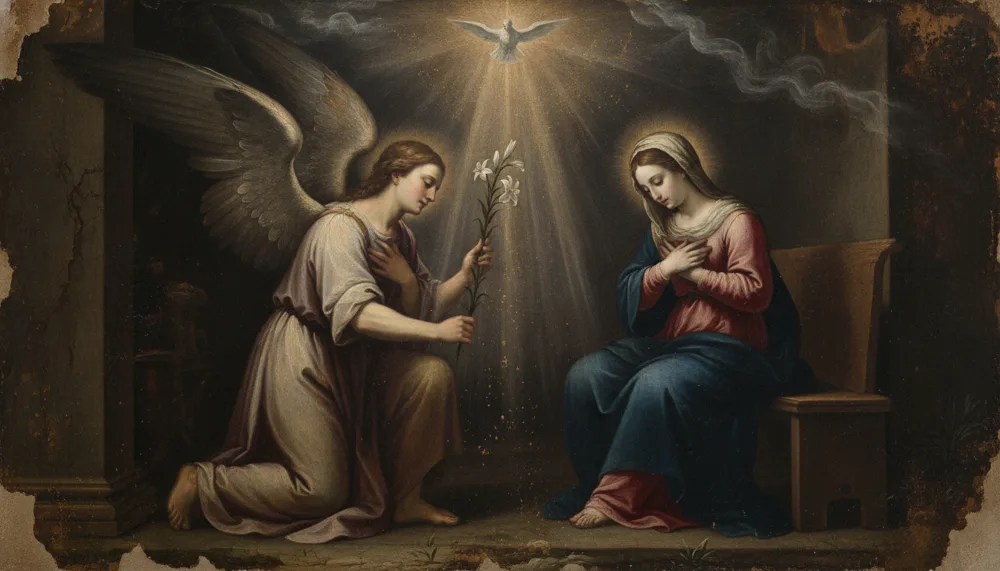
The Annunciation novena is prayed to the Blessed Virgin Mary under the mystery of the Annunciation — the day the Angel Gabriel came to Nazareth and Mary answered "Be it done unto me according to thy word," and the Word was made flesh in her womb. There are two forms, and the tail of searches asks for both: the ordinary nine-day novena said in the days leading up to the feast of the Annunciation on 25 March, and the famous nine-month novena for impossible requests, prayed daily from 25 March to Christmas in honour of the nine months Our Lord lay hidden beneath Mary's heart. Below we give the full authentic text of each, the variants the faithful ask for, how to pray them, and the meaning of the feast itself.
Why the Annunciation, and why "nothing is impossible"
The whole confidence of this devotion rests on a single verse. When the angel told Mary that her aged kinswoman Elizabeth had conceived a son, he added the reason: "For with God nothing shall be impossible" (Luke 1:37). The Annunciation is the hour when the impossible became fact — a Virgin conceived, God took flesh, heaven bent down to earth. That is why, of all the Marian devotions, this one is bound up with hopeless and impossible causes: it commemorates the very moment God proved that with Him nothing is impossible at all. If you are new to these nine-day prayers, see our short guide to what is a novena; and for the angel who carried the message, St Gabriel the Archangel.
The nine-day Annunciation novena
This is the ordinary form, prayed once a day for nine days, from 16 to 24 March, so that it closes on the eve of the feast. It is short, and easily kept. Begin with the Sign of the Cross, name your intention, and say:
In the name of the Father, and of the Son, and of the Holy Ghost. Amen.
O most holy Virgin Mary, to whom God sent the Angel Gabriel to announce that thou shouldst be the Mother of His only-begotten Son, pray for us who have recourse to thee.
Holy, lovely Mary, we give our all to thee: what is past and present, and the future too.
Blessed be the holy and Immaculate Conception of the most blessed Virgin Mary, Mother of God.
(Here name the grace you ask.)
Then say the Angelus, the Church's own daily memorial of this mystery:
V. The Angel of the Lord declared unto Mary.
R. And she conceived of the Holy Ghost. (Hail Mary…)V. Behold the handmaid of the Lord.
R. Be it done unto me according to thy word. (Hail Mary…)V. And the Word was made flesh.
R. And dwelt among us. (Hail Mary…)V. Pray for us, O holy Mother of God.
R. That we may be made worthy of the promises of Christ.
And close with the ancient collect of the feast:
Pour forth, we beseech Thee, O Lord, Thy grace into our hearts; that we, to whom the Incarnation of Christ Thy Son was made known by the message of an Angel, may by His Passion and Cross be brought to the glory of His Resurrection. Through the same Christ our Lord. Amen.
Because the prayer itself is the same each day, many lengthen the nine days by adding three Hail Marys, or a decade of the Rosary, or the Litany of the Blessed Virgin Mary, naming their intention throughout.
The nine-month Annunciation novena for impossible requests
This is the great novena the tail of searches most often means by "annunciation novena 9 months" and "impossible requests annunciation novena." It is not nine days but nine months — prayed every single day from the Feast of the Annunciation (25 March) to Christmas Day (25 December), honouring the nine months Our Lord dwelt in the womb of His Mother, from the moment of His conception to His birth in Bethlehem. Because it commemorates the mystery in which nothing proved impossible to God, it is prayed above all for three requests the world calls impossible. Each day, the same short office is said, and the three intentions are named within it.
Hail, holy Queen, Mother of Mercy, our life, our sweetness, and our hope! To thee do we cry, poor banished children of Eve; to thee do we send up our sighs, mourning and weeping in this valley of tears. Turn then, most gracious Advocate, thine eyes of mercy toward us; and after this our exile, show unto us the blessed fruit of thy womb, Jesus. O clement, O loving, O sweet Virgin Mary.
V. Pray for us, O holy Mother of God.
R. That we may be made worthy of the promises of Christ.
Then the petition, said three times — once for each of your three requests:
Virgin of the Incarnation, a thousand times we greet thee; a thousand times we praise thee for thy joy when God was incarnate in thee. Because thou art so powerful a Virgin and Mother of God, grant what we ask of thee for the love of God. (Name the first request.)
Virgin of the Incarnation, a thousand times we greet thee; a thousand times we praise thee for thy joy when God was incarnate in thee. Because thou art so powerful a Virgin and Mother of God, grant what we ask of thee for the love of God. (Name the second request.)
Virgin of the Incarnation, a thousand times we greet thee; a thousand times we praise thee for thy joy when God was incarnate in thee. Because thou art so powerful a Virgin and Mother of God, grant what we ask of thee for the love of God. (Name the third request.)
Close with the Memorare:
Remember, O most gracious Virgin Mary, that never was it known that anyone who fled to thy protection, implored thy help, or sought thy intercession, was left unaided. Inspired by this confidence, I fly unto thee, O Virgin of virgins, my Mother; to thee do I come, before thee I stand, sinful and sorrowful. O Mother of the Word Incarnate, despise not my petitions, but in thy mercy hear and answer me. Amen.
Then a Hail Mary, and the closing blessing:
Blessed and praised be the most holy Sacrament of the Altar, in heaven, on earth, and everywhere.
A word of honest counsel belongs here, since the name "impossible requests" can be misread. No novena binds God, and no length of prayer compels Him; to pray as though the words were a mechanism would be superstition, which the Church condemns. What the nine months teach is the opposite of impatience — a long, daily, trusting perseverance, in the school of the Virgin who waited nine months upon the Lord. Ask your three things plainly, and add to each if it be God's will. For the fuller treatment of this form, see our guide to the nine-month Annunciation novena; and when the cause seems truly hopeless, the patron of hopeless cases.
The Annunciation novena for women trying to conceive
Because the Annunciation is the feast of a conception — the conceiving of Christ in Mary's womb — it is a natural and fitting devotion for married couples longing for a child. The nine-month form especially, tracing Our Lord's own nine months in the womb, has long been prayed by mothers hoping to conceive and by those carrying a child, that the pregnancy be safe and the birth happy. Bring the intention plainly to Our Lady of the Annunciation, who knew what it was to bear a child by the power of God, and see also our novena for fertility and to conceive a child. As always, the prayer asks; God gives what is best, in His time.
How to pray the Annunciation novena
For the nine-day form, begin on 16 March so that the ninth day falls on 24 March, the eve of the feast. Say the prayer once each day at a fixed hour, name one intention and keep it through all nine days, and if you can, join the novena to Mass or Holy Communion on the feast of the Annunciation itself.
For the nine-month form, begin on 25 March, the feast of the Annunciation, and pray the office above every day without fail until Christmas Day, 25 December — naming your three requests each day. The perseverance is the heart of it: nine months of unhurried, daily asking, in imitation of the Virgin who bore the Word in silence and patience until His birth.
Either way, pray in submission. The Annunciation novena is not a lever on Providence; it is the trust of a child who lays the impossible in the hands of the Mother of God and waits, as she waited, upon the Lord.
The Annunciation: the feast and the mystery
The Feast of the Annunciation of the Blessed Virgin Mary is kept on 25 March, one of the oldest festivals of the Church — known to the East and West by the seventh century, and to the English of old as Lady Day. Its date is not chosen by chance. It falls exactly nine months before Christmas, 25 December, for it marks the moment Christ was conceived; and the old writers loved to note that the same 25 March was held by tradition to be the day of the world's creation, of the Fall, and of the death of Our Lord upon the Cross — the day of ruin made the day of redemption.
The Gospel gives us the scene. "The angel Gabriel was sent from God into a city of Galilee, called Nazareth, to a virgin espoused to a man whose name was Joseph… and the virgin's name was Mary. And the angel being come in, said unto her: Hail, full of grace, the Lord is with thee: blessed art thou among women" (Luke 1:26-28). He announced that she should conceive and bear a Son, and call His name Jesus, and that of His kingdom there should be no end. Mary asked how this should be, since she knew not man; and the angel answered that the Holy Ghost should come upon her, and the power of the Most High overshadow her, and that "with God nothing shall be impossible." Then came the word on which the salvation of the world hung — the fiat, the free consent of a creature to the will of her Maker: "Behold the handmaid of the Lord; be it done unto me according to thy word" (Luke 1:38). At that word the Son of God took flesh.
This is why the feast is also called the Feast of the Incarnation. In honouring the Annunciation we honour the beginning of our redemption, the humility of God who would not come among us without asking the consent of a lowly girl, and the obedience of the Virgin whose yes undid the no of Eve. Every Angelus, prayed three times a day at the toll of the bell, is a small keeping of this feast; and this novena is its longer form. See too the mystery of Mary's own beginning in the Immaculate Conception.
Frequently Asked Questions
What is the Annunciation novena?
It is a novena prayed to the Blessed Virgin Mary under the mystery of the Annunciation — the coming of the Angel Gabriel to Nazareth and Mary's consent to become the Mother of God. There are two forms: an ordinary nine-day novena said from 16 to 24 March before the feast, and a nine-month novena for impossible requests prayed daily from 25 March to Christmas. Both honour the Incarnation of Christ in the womb of the Virgin.
When do you pray the Annunciation novena?
The nine-day form begins on 16 March and ends on 24 March, the eve of the Feast of the Annunciation (25 March). The nine-month form begins on the feast itself, 25 March, and is prayed every day until Christmas, 25 December — nine months, one for each month Our Lord lay in His Mother's womb.
What is the 9-month Annunciation novena for impossible requests?
It is the devotion prayed daily for the full nine months from the Annunciation (25 March) to the Nativity (25 December), in honour of the nine months of Our Lord's hidden life in the womb. It is called the novena "for impossible requests" because the Annunciation is the mystery in which the angel declared "with God nothing shall be impossible" (Luke 1:37). Three intentions are traditionally named and carried through all nine months. It does not compel God; it schools the soul in patient, persevering trust.
Why is the feast of the Annunciation on 25 March?
Because 25 March is exactly nine months before Christmas, 25 December — the day of Christ's birth — and the Annunciation marks the day of His conception. Tradition also honoured 25 March as the date of the creation of the world, of Adam's fall, and of the Crucifixion, so that the day of the first ruin became the day the Redeemer took flesh.
Can you pray the Annunciation novena for a baby or to conceive?
Yes. Because the feast celebrates the conceiving of Christ in the womb of the Virgin, it is a fitting devotion for married couples hoping for a child and for expectant mothers, that the pregnancy be safe and the birth happy. The nine-month form is especially loved for this, tracing Our Lord's own nine months before His birth. Bring the intention to Our Lady of the Annunciation and leave the gift, and its timing, to God.
Is there a PDF of the Annunciation novena?
The complete text of both forms is given in full above — the nine-day prayer with the Angelus and the feast's collect, and the nine-month office with the Hail Holy Queen, the "Virgin of the Incarnation" petition, and the Memorare — so it may be copied and kept beside you. The Iter Fidei app also carries the whole devotion, with the daily prayers and audio, so it can be prayed from a phone through all nine days or all nine months without a printed sheet.
Does the Annunciation novena "never fail"?
No sound devotion binds God or guarantees the exact favour named — to pray as though it did would be superstition, which the Church condemns. What this novena obtains without fail is the grace of trust: it lays the impossible in the hands of the Mother of God and waits upon the Lord who made her fruitful, content to receive either the thing asked or the better thing He chooses to give. Pray it in the Virgin's own spirit: Be it done unto me according to thy word.
The Iter Fidei app carries the Annunciation novena in both its forms — the nine days and the nine months — with the Angelus, the Hail Holy Queen, and the daily prayers in Latin and your own language, with audio and day-by-day reminders. Download it here.
Sources. Holy Scripture, the Gospel of St Luke 1:26-38 (the Annunciation; "with God nothing shall be impossible"); the Angelus and the collect of the Feast of the Annunciation (Roman Missal and Breviary, 25 March); the traditional prayers of the nine-day Annunciation novena and the nine-month novena for impossible requests, as carried in traditional Catholic prayer-books; the antiphon Salve Regina (Hail, Holy Queen) and the Memorare.